Page 162 of 324
Downloaded from www.Manualslib.com manuals search engine When You Are Ready to Leave After
Parking on a Hill
1. Apply your regular brakes and hold the pedal down
while you:
Start your engine;
Shift into a gear; and
Release the parking brake.
2. Let up on the brake pedal.
3. Drive slowly until the trailer is clear of the chocks.
4. Stop and have someone pick up and store the chocks.
Maintenance When Trailer Towing
Your vehicle will need service more often when you’re
pulling a trailer. See the Maintenance Schedule for more
on this. Things that are especially important in trailer
operation are automatic transaxle fluid (don’t overfill),
engine
oil, belts, cooling system, and brake adjustment.
Each
of these is covered in this manual, and the Index
will help you find them quickly. If you’re trailering, it’s
a good idea to review these sections before you start
your trip.
Check periodically
to see that all hitch nuts and bolts are
tight.
Page 165 of 324
Downloaded from www.Manualslib.com manuals search engine To Jump Start Your Chevrolet
1. Check the other vehicle. It must have a 12-volt
battery with a negative ground system.
~
NOTICE:
If the other system isn’t a 12-volt system with a
negative ground, both vehicles can be damaged.
2. Get the vehicles close enough so the jumper cables
can reach, but be sure the vehicles aren’t touching
each other.
If they are, it could cause a ground
connection you don’t want. You wouldn’t be able to
start your Chevrolet, and the bad grounding could
damage the electrical systems.
You could be injured
if the vehicles roll. Set the
parking brake firmly on each vehicle. Put an
automatic transaxle in
PARK (P) or a manual
transaxle in NEUTRAL
(N).
3. Turn off the ignition on both vehicles. Turn off all
lamps that aren’t needed, and radios. This will avoid
sparks and help save both batteries. And it could
save your radio!
NOTICE:
If you leave your radio on, it could be badly
damaged. The repairs wouldn’t be covered by
your warranty.
4. Open the hoods and locate the batteries.
5. Find the positive (+) and negative (-) terminals on
each battery. Your Chevrolet has a remote positive
(+) jump starting terminal. The terminal is on the
same side
of the engine compartment as your battery.
You should always use the remote positive
(+)
terminal instead of the positive (+) terminal on your
battery. To uncover the remote positive
(+) terminal,
lift the red plastic cap.
5-3
Page 166 of 324
Downloaded from www.Manualslib.com manuals search engine 6. Check that the jumper cables don’t have loose or
missing insulation.
If they do, you could get a shock.
The vehicles could be damaged, too.
Before
you connect the cables, here are some basic
things you should know. Positive
(+) will go to
positive
(+) and negative (-) will go to negative (-)
or a metal engine part. Don’t connect (+) to (-), or
you’ll get a short that would damage the battery and
maybe other parts, too.
5-4
Page 177 of 324
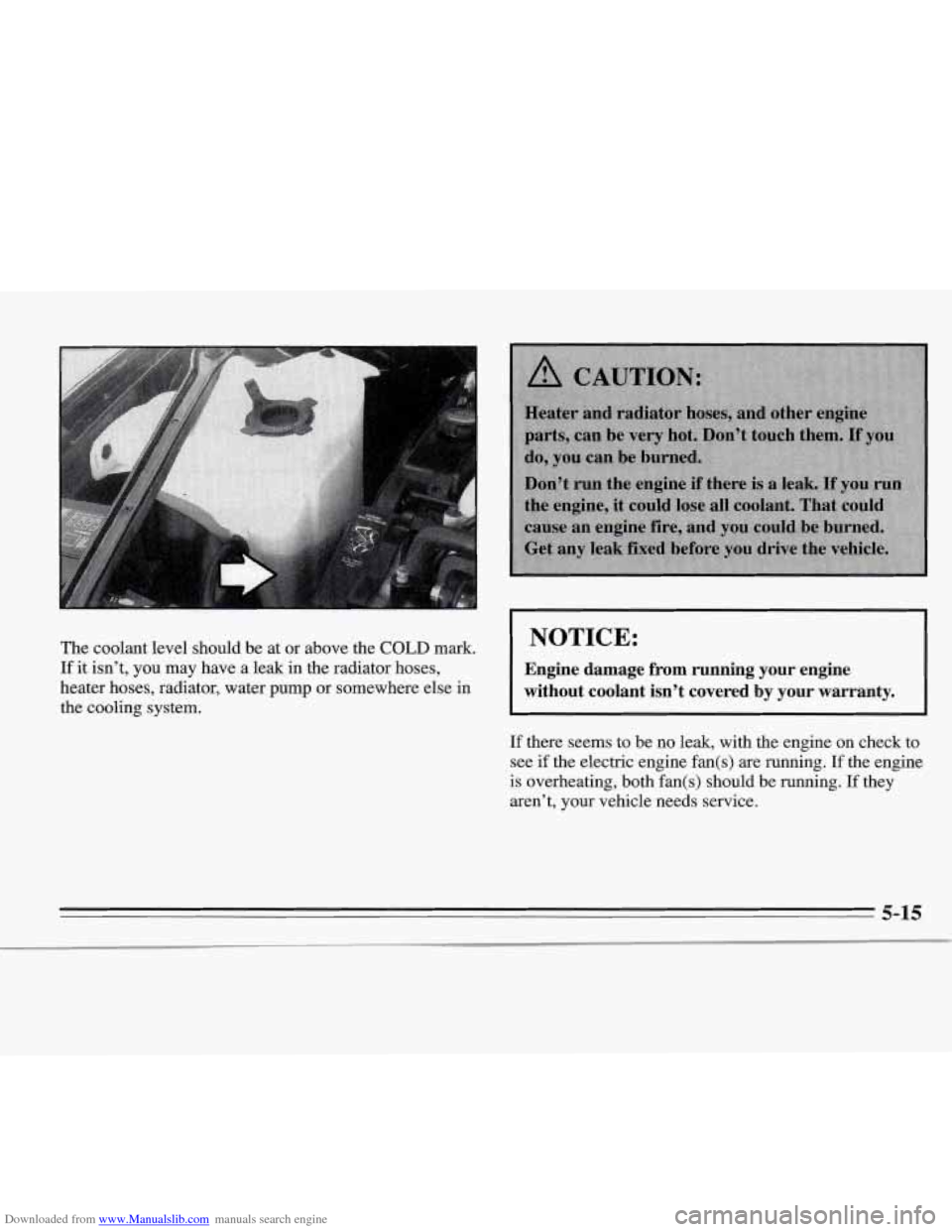
Downloaded from www.Manualslib.com manuals search engine The coolant level should be at or above the COLD mark.
If it isn’t, you may have a leak in the radiator hoses,
heater hoses, radiator, water pump or somewhere else in
the cooling system.
I NOTICE
Engine damage from running your engine
without coolant isn’t covered by your warranty.
If there seems to be no leak, with the engine on check to
see if the electric engine fan(s) are running. If the engb
is overheating, both fan(s) should be running.
If they
aren’t, your vehicle needs service.
5-15
Page 183 of 324
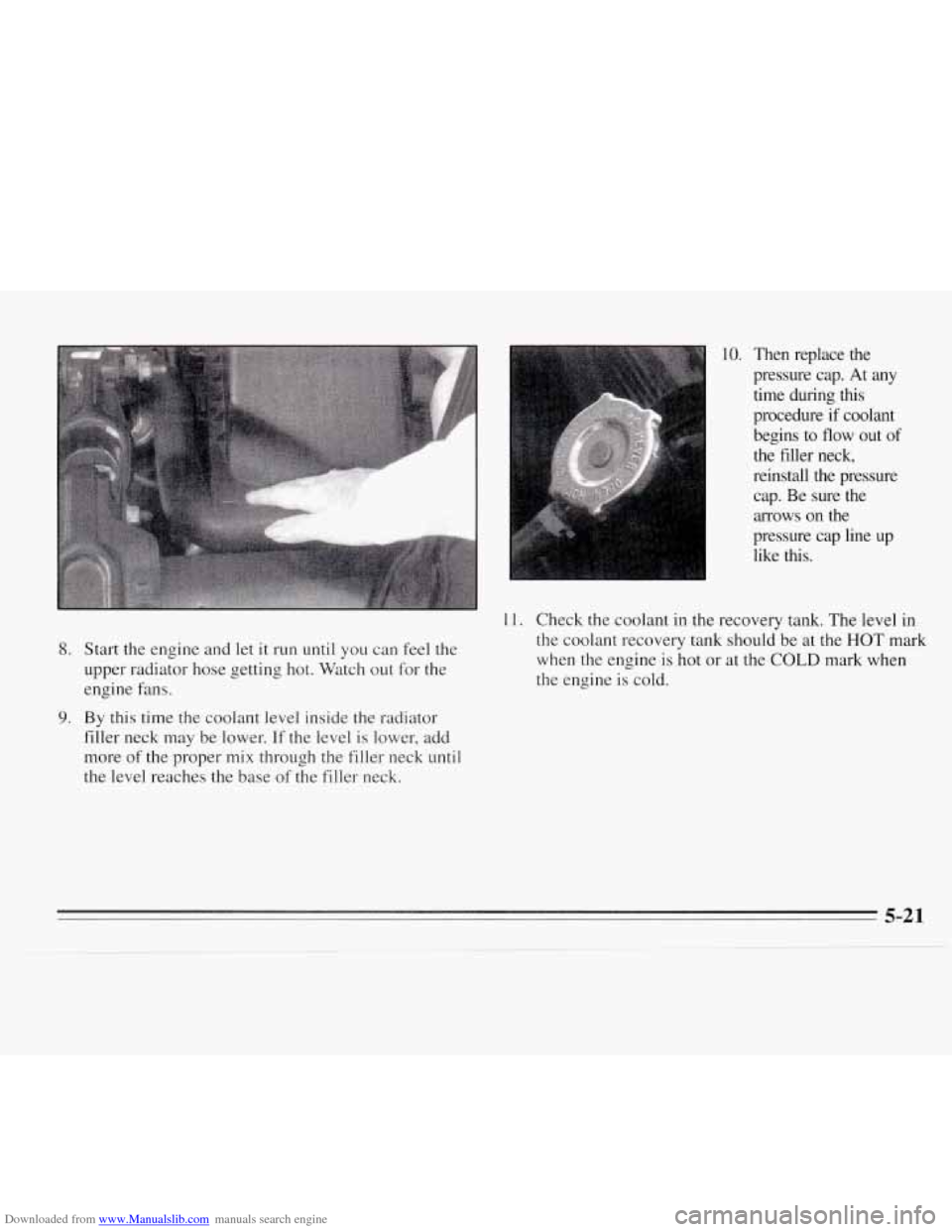
Downloaded from www.Manualslib.com manuals search engine 10. Then replace the
pressure cap. At any
time during this
procedure if coolant
begins
to flow out of
the filler neck,
reinstall the pressure cap. Be sure the
arrows on the
pressure cap line up
like
this.
8. Start the engine and let it run until you can feel the
upper radiator hose getting hot. Watch out for the
engine fans.
9. By this time the coolant level inside the radiator
filler neck may be lower.
If the level is lower, add
more
of the proper mix through the filler neck until
the level reaches the base of the filler neck. 11.
Check the coolant in the recovery tank. The level in
the coolant recovery tank should be at
the HOT mark
when the engine is hot or at the
COLD mark when
the engine is cold.
5-21
Page 193 of 324
Downloaded from www.Manualslib.com manuals search engine Compact Spare Tire
Although the compact spare was fully inflated when
your vehicle was new, it can lose air after a time. Check
the inflation pressure regularly. It should be
60 psi
(420 Wa). After installing the compact spare on your
vehicle, you should stop as soon as possible and make
sure your spare tire is correctly inflated. The compact
spare is made to perform well at posted speed limits for
distances up to
3,000 miles (5 000 km), so you can
finish your trip and have your full-size tire repaired or
replaced where you want. Of course, it’s best to replace
your spare with a full-size tire as soon as you can. Your
spare will last longer and be
in good shape in case you
need it again.
NOTICE:
Don’t take your compact spare through an
automatic car wash with guide rails. The
compact spare can get caught on the rails. That
can damage the tire and wheel, and maybe other
parts
of your vehicle.
Don’t use your compact spare on some other vehicle.
And don’t mix your compact spare or wheel with other
wheels or tires. They won’t fit. Keep your spare and its
wheel together.
NOTICE:
Tire chains won’t fit your compact spare. Using
them will damage your vehicle and destroy the
chains too. Don’t use tire chains on your compact
spare.
3-3 1
Page 195 of 324
Downloaded from www.Manualslib.com manuals search engine 0 Section 6 Service and Appearance Care
Here you will find information about the care of your
Chevrolet. This section begins with service and fuel
information, and then
it shows how to check important
fluid and lubricant levels. There is also technical
information about your vehicle, and
a part devoted to
its appearance care.
Service
Your Chevrolet dealer knows your vehicle best and
wants you
to be happy with it. We hope you’ll go to
your dealer
for all your service needs. You’ll get
genuine
GM parts and GM-trained and supported
service people. We
hope you’ll
want to keep your CM vehicle all CM.
Genuine GM parts have one olthese nm-ks:
6-1
Page 198 of 324

Downloaded from www.Manualslib.com manuals search engine Gasolines for Cleaner Air
Your use of gasoline with deposit control additives will
help prevent deposits from forming in your engine and
fuel system. That helps keep your engine in tune and
your emission control system working properly. It’s
good for your vehicle, and you’ll be doing your part for
cleaner air.
Many gasolines are now blended with oxygenates.
General Motors recommends that you use gasolines with
these blending materials, such
as MTBE and ethanol. By
doing
so, you can help clean the air, especially in those
parts of the country that have high carbon monoxide
levels.
In addition, some gasoline suppliers are now producing
reformulated gasolines. These gasolines are specially
designed to reduce vehicle emissions. General Motors
recommends that you use reformulated gasoline. By
doing
so, you can help clean the air, especially in those
parts
of the country that have high ozone levels.
You should ask your service station operators if their
gasolines contain deposit control additives and
oxygenates, and if they have been reformulated to
reduce vehicle emissions.
Fuels in Foreign Countries
If you plan on driving in another country outside the
U.S. or Canada, unleaded fuel may be hard to find. Do
not use leaded gasoline. If you use even one tankful,
your emission controls won’t work well or at all. With
continuous use, spark plugs can get fouled, the exhaust
system can corrode, and your engine oil can deteriorate
quickly. Your vehicle’s oxygen sensor will be damaged.
All
of that means costly repairs that wouldn’t be covered
by your warranty.
To check on fuel availability, ask an auto club, or
contact a major oil company that does business in the
country where you’ll be driving.
You can also write us at the following address for
advice. Just tell
us where you’re going and give your
Vehicle Identification Number (VIN).
General Motors Overseas Distribution Corporation
North American Export Sales
(NAES)
1908 Colonel Sam Drive
Oshawa, Ontario
LIH 8P7
6-4