1995 CHEVROLET MONTE CARLO check engine
[x] Cancel search: check enginePage 100 of 324

Downloaded from www.Manualslib.com manuals search engine Safety Belt Reminder Light
8
When the key is turned to
RUN or START, a chime
will come on for about eight
seconds
to remind people to
fasten their safety belts,
unless the driver’s safety
belt is already buckled.
The safety belt light will also come on and stay on
until
the driver’s belt is buckled.
Air Bag Readiness Light
There is an air bag readiness light on the instrument
panel, which shows AIR
BAG or the air bag symbol.
The system checks the air bag’s electrical system for
malfunctions.
The light tells you if there is an electrical
problem. The system check includes the air bag sensors
and modules, the wiring and the diagnostic module. For
more information on the air bag system, see “Air Bag”
in the Index.
You will see this light flash
for
a few seconds when you
turn your ignition to RUN
or START. Then the light
should go out. This means
the system is ready.
1
If the air bag readiness light doesn’t come on when you
start your vehicle, or
stays on, or comes on when you
are driving, your air bag system may not work properly.
Have your vehicle serviced right away.
2-44
Page 103 of 324
Downloaded from www.Manualslib.com manuals search engine Anti-Lock Brake System Active Light
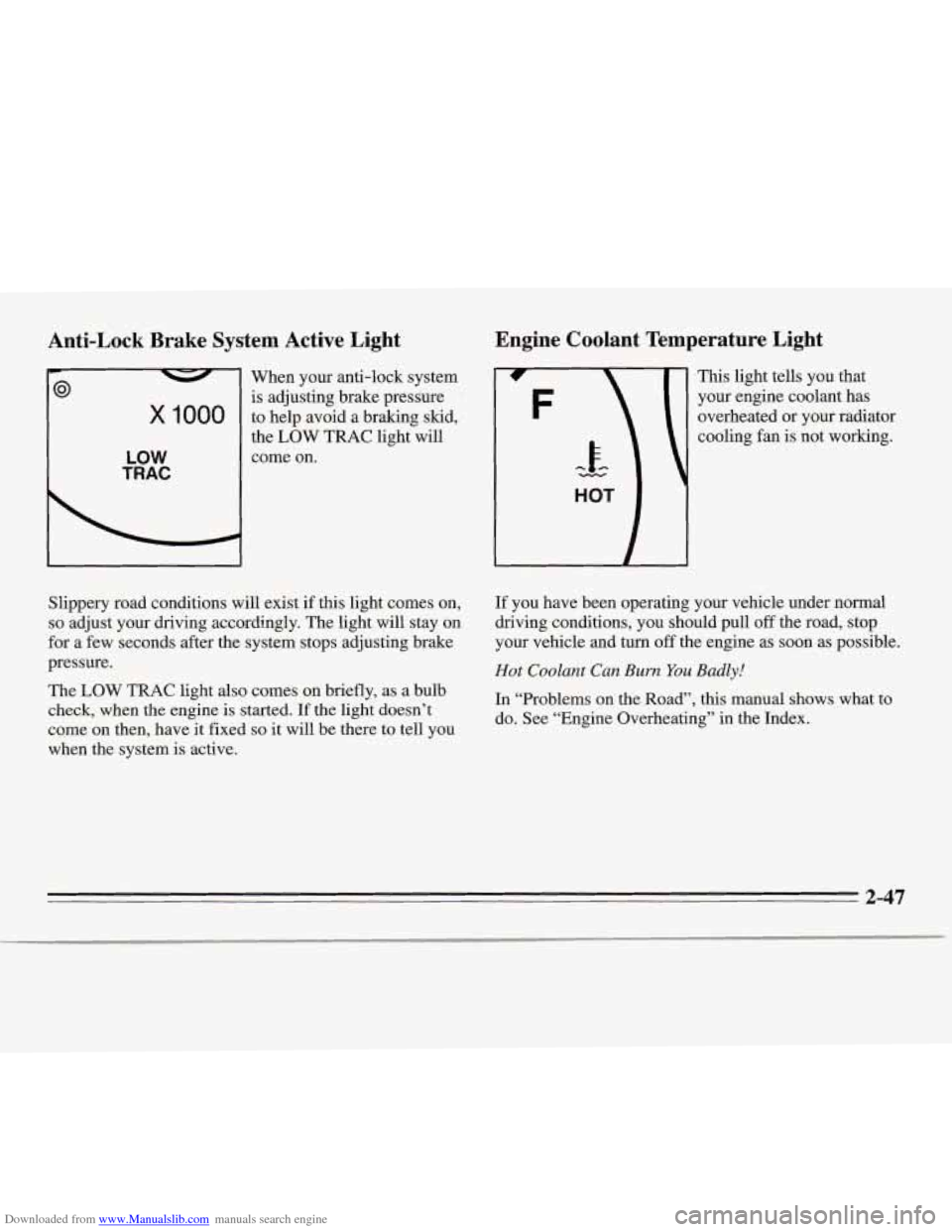
x 1000
LOW
TRAC
When your anti-lock system
is adjusting brake pressure
to help avoid a braking skid,
the
LOW TRAC light will
come on.
Engine Coolant Temperature Light
This light tells you that
your engine coolant has
overheated
or your radiator
cooling
fan is not working.
Slippery road conditions will exist if this light comes on,
so adjust your driving accordingly. The light will stay on
for a few seconds after the system stops adjusting brake
pressure.
The
LOW TRAC light also comes on briefly, as a bulb
check, when the engine is started.
If the light doesn’t
come on then, have
it fixed so it will be there to tell you
when the system is active. If you
have been operating your vehicle under normal
driving conditions, you should pull
off the road, stop
your vehicle and
turn off the engine as soon as possible.
Hot Coolant Can Burn You Badly!
In “Problems on the Road”, this manual shows what to
do. See “Engine Overheating” in the Index.
2-47
Page 105 of 324
Downloaded from www.Manualslib.com manuals search engine Malfunction Indicator Lamp (Service Engine Soon Light)
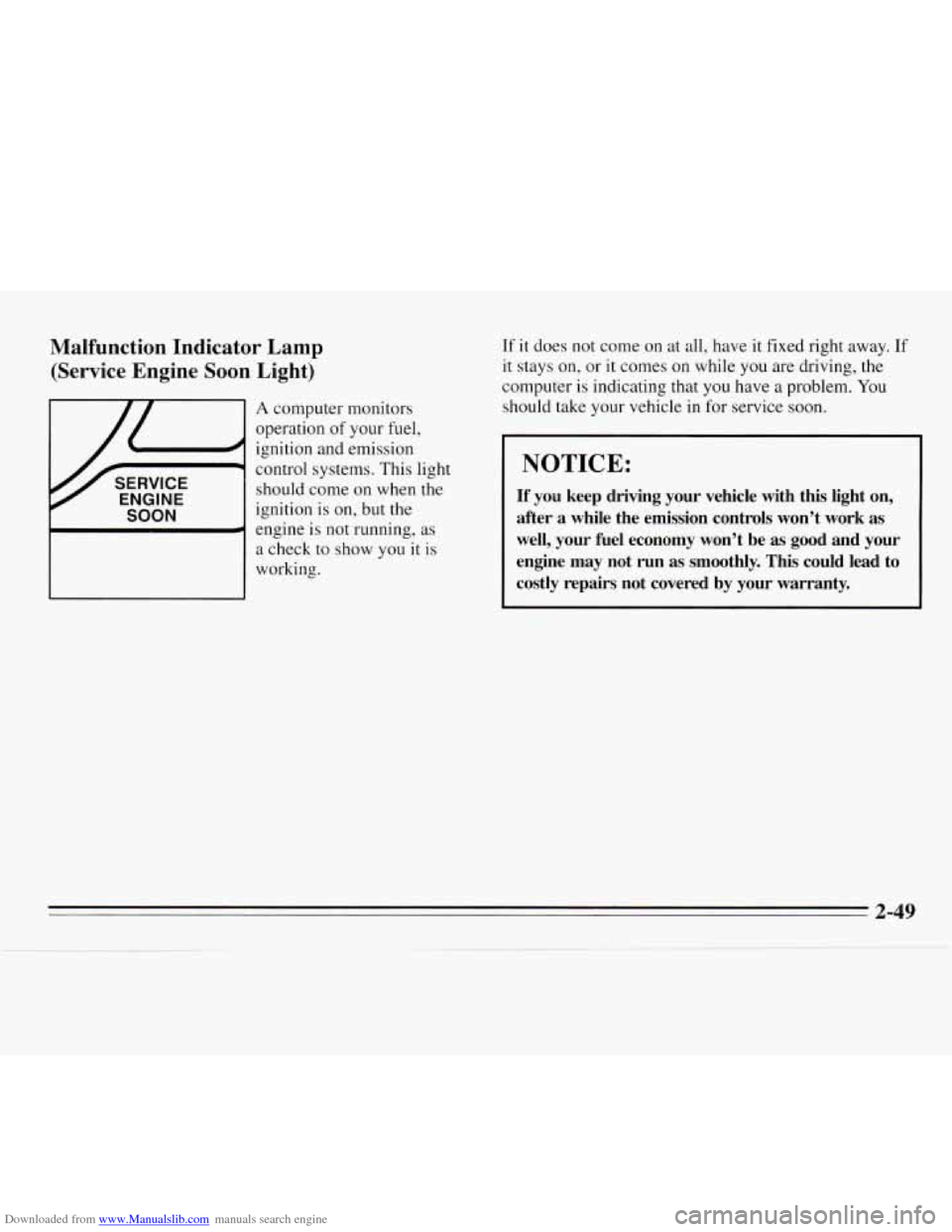
A computer monitors
operation
of your fuel,
ignition and emission
control systems. This light should come
on when the
ignition
is on, but the
engine is not running, as
a check to show you it
is
working. If it
does not come on at all, have
it fixed right away. If
it stays on, or it comes on while you are driving, the
computer
is indicating that you have a problem. You
should take your vehicle in for service soon.
NOTICE:
If you keep driving your vehicle with this light on,
after a while the emission controls won’t work as
well, your fuel economy won’t be as good and your engine may not run as smoothly.
This could lead to
costly repairs not covered by your warranty.
2-49
Page 107 of 324

Downloaded from www.Manualslib.com manuals search engine Security Light
Low Oil Level Light
Your engine is equipped
with an oil level monitoring
system. When the ignition
key is turned on, the LOW
OIL light will briefly flash.
If the light does not flash,
have
it fixed so it will be
ready to warn you if there’s
a problem.
If the light stays on, stop the vehicle on a level surface and
turm the engine off. Check the oil level using the engine oil
dipstick. (See “Engine Oil” in the Index.) If the light does
not flash, have the low oil level sensor system repaired
so
it will be ready to warn you if there’s a problem.
The oil level monitoring system only checks oil
level
during the brief period between key on and engine
crank. It does not monitor engine oil level when the
engine is running. Additionally, an oil level check is
only performed if the engine has been turned off for a
considerable period of time, allowing the oil normally
in
circulation to drain back into the oil pan. This light
will come on
when you turn the key to
START and stay on until the
vehicle starts. It will also
come on and stay on if your
key is too dirty or wet for
the PASS-Key@II system to
read the resistor pellet.
If the resistor pellet is damaged or missing, the light will
flash.
If you’re driving and the light comes on and remains on,
your PASS-Key% system is
not working properly.
Your vehicle is not protected by PASS-Key@II, and you
should see your dealer.
2-51
Page 125 of 324
Downloaded from www.Manualslib.com manuals search engine Understanding Radio Reception
FM Stereo
FM Stereo will give you the best sound, but FM signals
will reach only about
10 to 40 miles (16 to 65 km). Tall
buildings or hills can interfere with
FM signals, causing
the sound
to come and go.
AM
The range for most AM stations is greater than for FM,
especially at night. The longer range, however, can
cause stations to interfere with each other.
AM can also
pick up noise from things like storms and power lines.
To lower this noise, try reducing the treble level.
Tips About Your Audio System
Hearing damage from loud noise is almost undetectable
until it is too late. Your hearing can adapt to higher
volumes of sound. Sound that seems normal can be
loud and harmful to your hearing. Take precautions by
adjusting the volume control on your radio
to a safe
sound level before your hearing adapts to it. To
help avoid hearing loss or damage:
Adjust the volume control to the lowest setting.
Increase volume slowly until you hear Comfortably
and clearly.
NOTICE:
Before you add any sound equipment to your
vehicle
-- like a tape player, CB radio, mobile
telephone or two-way radio
-- be sure you,
can add what you want.
If you can, it’s very
important to do
it properly. Added sound
equipment may interfere with the operation
of your vehicle’s engine, Delco@ radio or other
systems, and even damage them. And, your
vehicle’s systems may interfere with the
operation of sound equipment that has been
added improperly.
So, before adding sound equipment, check with
your dealer and be sure to check Federal rules
covering mobile radio and telephone units.
3-15
Page 127 of 324
Downloaded from www.Manualslib.com manuals search engine Care of Your Compact Discs
Handle discs carefully. Store them in their original cases
or other protective cases and away from direct sunlight
and dust. If the surface
of a disc is soiled, dampen a
clean, soft cloth in a mild, neutral detergent solution and
clean
it, wiping from the center to the edge.
Be sure never to touch the signal surface
when handling
discs. Pick up discs by grasping the outer edges or
the
edge of the hole and the outer edge.
Fixed Mast Antenna
The fixed mast antenna can withstand most car washes
without being damaged. If the mast should ever become
slightly bent, you can straighten
it out by hand. If the
mast is badly bent, as it might be by vandals, you should
replace
it.
Check every once in a while to be sure the mast is still
tightened
to the fender.
Steering Wheel Touch Controls
(Option)
You can control certain audio system functions using the
buttons on your steering wheel.
VOLUME: Press the up or down arrows to increase or
decrease volume.
PLAY: Press to play the CD or cassette instead of the
radio.
MUTE: Press to silence the system. Press again to turn
on the sound.
SEEK: Press the up or down arrows to tune to the next
or previous radio station. If a tape
or compact disc is
playing, the player will advance or rewind.
PRESET Press to play a station you have programmed
on the radio preset buttons.
AM/FM: Press to choose AM, FMl or FM2. If a tape
or compact disc is playing,
it will stop and the radio will
play.
3-17
Page 139 of 324
Downloaded from www.Manualslib.com manuals search engine Passing
The driver of a vehicle about to pass another on a
two-lane highway waits for just the right moment,
accelerates, moves around the vehicle ahead,
then goes
back into the right lane again. A simple maneuver?
Not necessarily! Passing another vehicle on a two-lane
highway is a potentially dangerous move, since the
passing vehicle occupies the same lane
as oncoming
traffic for several seconds. A miscalculation, an error in
judgment, or a brief surrender to frustration or anger can
suddenly put the passing driver face to face with the
worst of all traffic accidents
-- the head-on collision.
So here are some tips for passing:
0 “Drive ahead.” Look down the road, to the sides, and
to crossroads for situations that might affect your
passing patterns.
If you have any doubt whatsoever
about making a successful pass, wait for a better time.
0 Watch for traffic signs, pavement markings, and lines.
If
you can see a sign up ahead that might indicate a
turn or an intersection, delay your pass. A broken
center
line usually indicates it’s all right to pass
(providing the road ahead is clear). Never cross a solid
line on your side of the lane or a double solid line,
even if the road seems empty
of approaching traffic.
0 Do not get too close to the vehicle you want to pass
while you’re awaiting an opportunity. For one thing,
following too closely reduces your area
of vision,
especially if you’re following a larger vehicle. Also,
you won’t have adequate space if the vehicle ahead
suddenly slows or stops. Keep back a reasonable
distance.
0 When it looks like a chance to pass is coming up,
start to accelerate but stay
in the right lane and
don’t get too close. Time your move
so you will be
increasing speed
as the time comes to move into the
other lane. If the way
is clear to pass, you will have a
“running start” that more than makes up for the
distance you would lose by dropping back. And if
something happens to cause you to cancel your pass,
you need only slow down and drop back again and
wait for another opportunity.
If other cars are lined up to pass a slow vehicle, wait
your turn.
But take care that someone isn’t trying to
pass
you as you pull out to pass the slow vehicle.
Remember to glance over your shoulder and check
the blind spot.
4-11
Page 140 of 324
Downloaded from www.Manualslib.com manuals search engine Check your mirrors, glance over your shoulder, and
start your left lane change signal before moving out
of the right lane to pass. When you are far enough
ahead of the passed vehicle
to see its front in your
inside mirror, activate your right lane change signal
and move back into the right lane. (Remember that
your right outside mirror is convex. The vehicle you
just passed may seem to be farther away from you
than it really
is.)
Try not to pass more than one vehicle at a time on
two-lane roads. Reconsider before passing the next
vehicle.
Don’t overtake a slowly moving vehicle too rapidly.
Even though the brake lights are not flashing, it may
be slowing down or starting to turn.
0 If you’re being passed, make it easy for the
following driver
to get ahead of you. Perhaps you
can ease a little to the right.
Loss of Control
Let’s review what driving experts say about what
happens when the three control systems (brakes, steering and acceleration) don’t have enough friction where the
tires meet the road to do what the driver has asked.
In any emergency, don’t give up. Keep trying to steer
and constantly seek an escape route
or area of less
danger.
Skidding
In a skid, a driver can lose control of the vehicle.
Defensive drivers avoid most skids by taking reasonable
care suited to existing conditions, and by not
“overdriving” those conditions. But
skids are always
possible.
The three types of skids correspond to your Chevrolet’s
three control systems. In the braking skid your wheels
aren’t rolling. In the steering or cornering skid, too
much speed or steering in a curve causes tires
to slip and
lose cornering force. And
in the acceleration skid too
much throttle causes the driving wheels to spin.
4-12