Page 196 of 386
Downloaded from www.Manualslib.com manuals search engine To Jump Start Your Corvette:
1. Check the other vehicle. It must have a 12-volt
battery with a negative ground system.
NOTICE:
If the other system isn’t a 12-volt system with a
negative ground, both vehicles can be damaged.
2. Get the vehicles close enough so the jumper cables
can reach, but be sure the vehicles aren’t touching
each other.
If they are, it could cause a ground
connection
you don’t want. You wouldn’t be able to
start your Corvette, and the bad grounding could
damage the electrical systems.
3. Turn off the ignition on both vehicles. Turn off all
lights that aren’t needed, and radios. This will avoid
sparks and help save both batteries. And
it could
save your radio!
NOTICE:
If you leave your radio on, it could be badly
damaged. The repairs wouldn’t be covered by
your warranty.
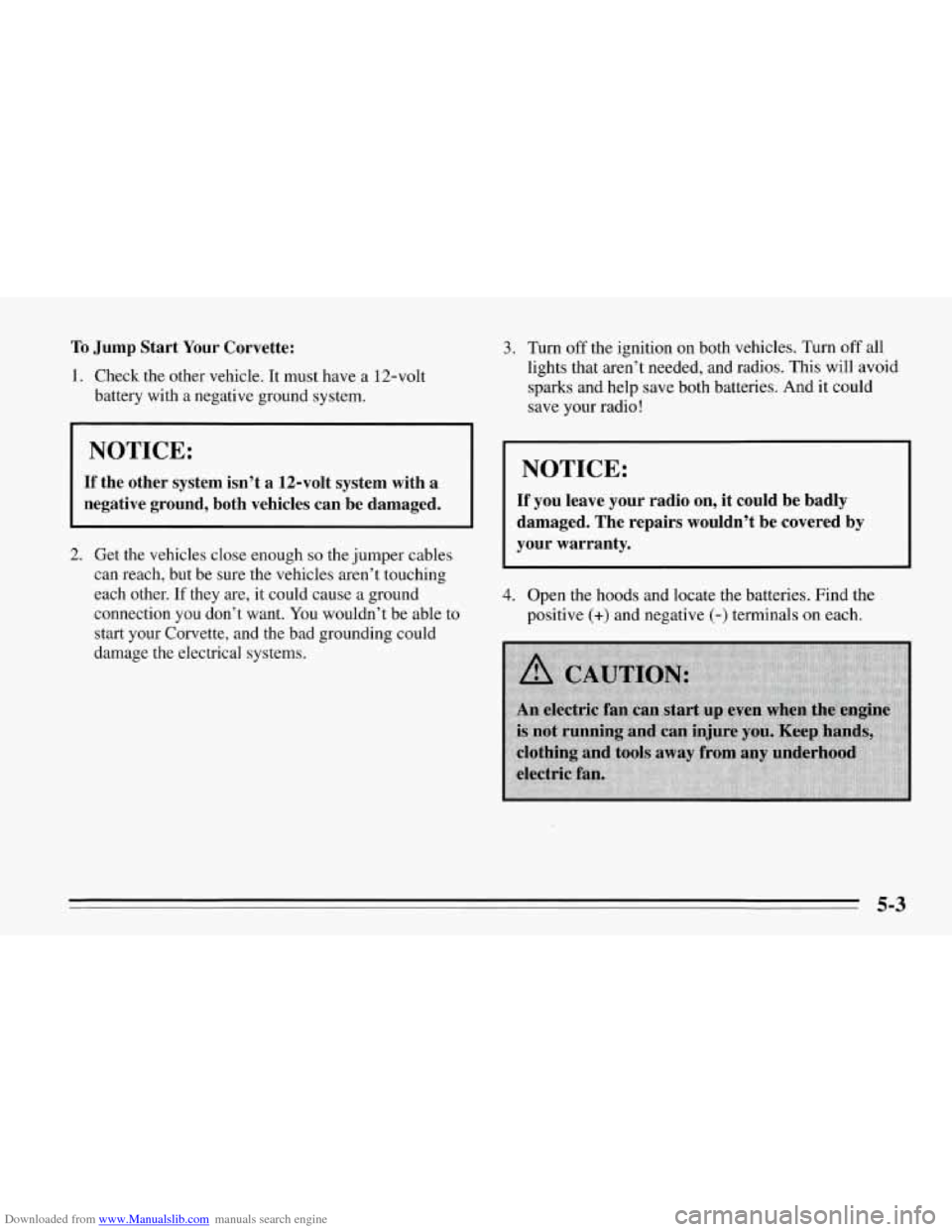
4. Open the hoods and locate the batteries. Find the
positive
(+) and negative (-) terminals on each.
5-3
Page 197 of 386
Downloaded from www.Manualslib.com manuals search engine 5. Check that the jumper cables don't have loose or
missing insulation.
If they do, you could get a shock.
The vehicles could be damaged, too.
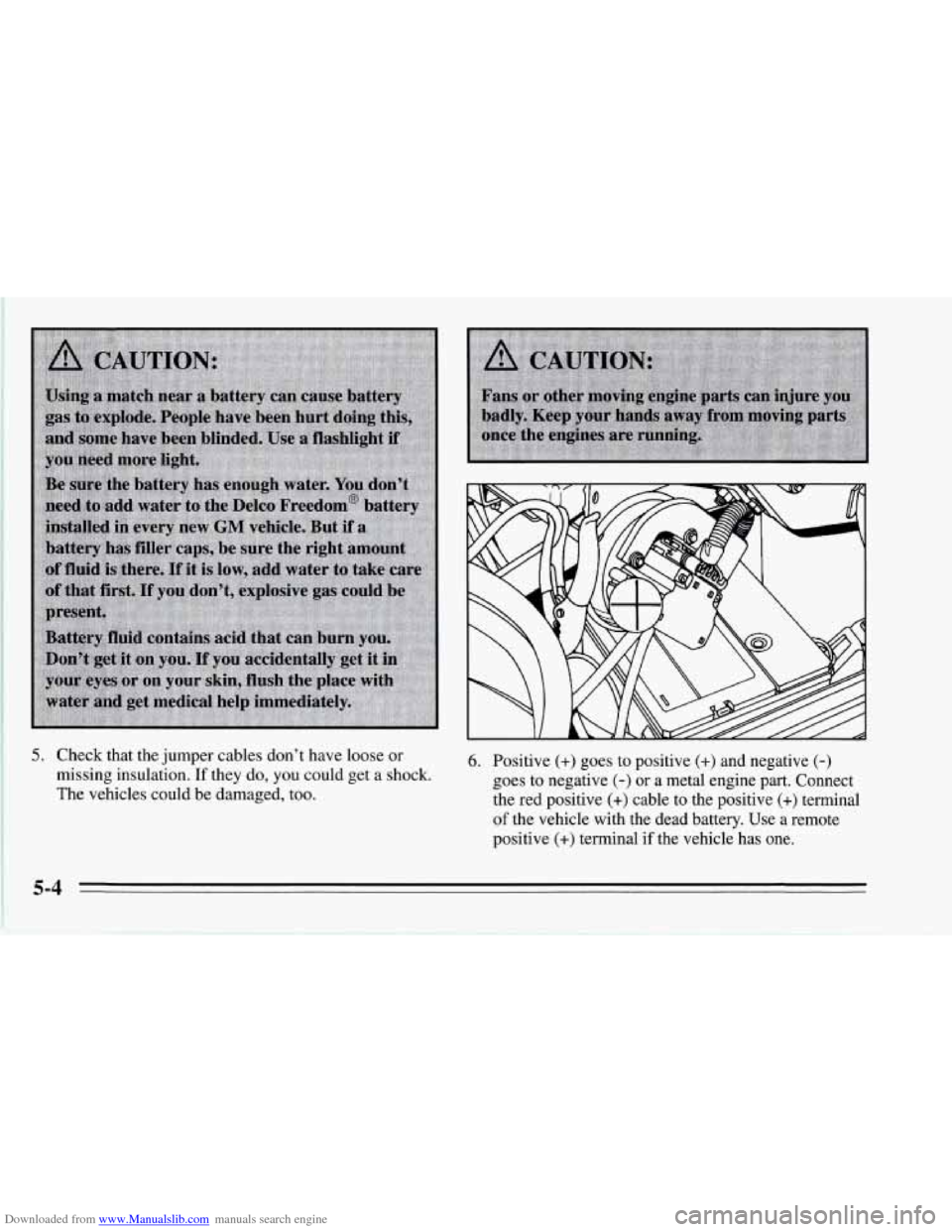
6. Positive (+) goes to positive (+) and negative (-)
goes to negative (-) or a metal engine part. Connect
the red positive
(+) cable to the positive (+) terminal
of the vehicle with the dead battery. Use a remote
positive
(+) terminal if the vehicle has one.
5-4
Page 210 of 386
Downloaded from www.Manualslib.com manuals search engine The coolant level should be at or above COLD. If it
isn’t, you may have a leak in the radiator hoses, heater
hoses, radiator, water pump or somewhere else in the
cooling system.
NOTICE:
Engine damage from running your engine
without coolant isn’t covered by your warranty.
If there seems to be no leak, with the engine on check to
see if the electric engine fan(s) are running.
If the engine
is overheating, both fan(s) should be running. If they
aren’t, your vehicle needs service.
How to Add Coolant to the Coolant
Recovery Tank
If you haven’t found a problem yet, but the ,coo,lant level
isn’t at or above the COLD mark, add
a 50MI mixture
of clean water (preferably distilled) and a proper
antifreeze at the coolant recovery tank. (%e “Engine
Coolant” in the Index for more information about the
proper coolant mix.)
5-17
Page 233 of 386
Downloaded from www.Manualslib.com manuals search engine Compact Spare Tire (If So Equipped)
Although the compact spare was fully inflated when your
vehicle was new,
it can lose air after a time. Check the
inflation pressure regularly. It should be
60 psi (420 Wa).
After installing the compact spare on your vehicle, you
should stop as soon as possible and make sure your spare
tire is correctly inflated. The compact spare is made to
perform well at posted speed limits for distances up to
3,000 miles (5 000 km), so you can finish your trip and
have your full-size tire repaired or replaced where you
want.
Of course, it’s best to replace your spare with a
full-size tire as soon as you can. Your spare will last
longer and be in good shape in case you need it again.
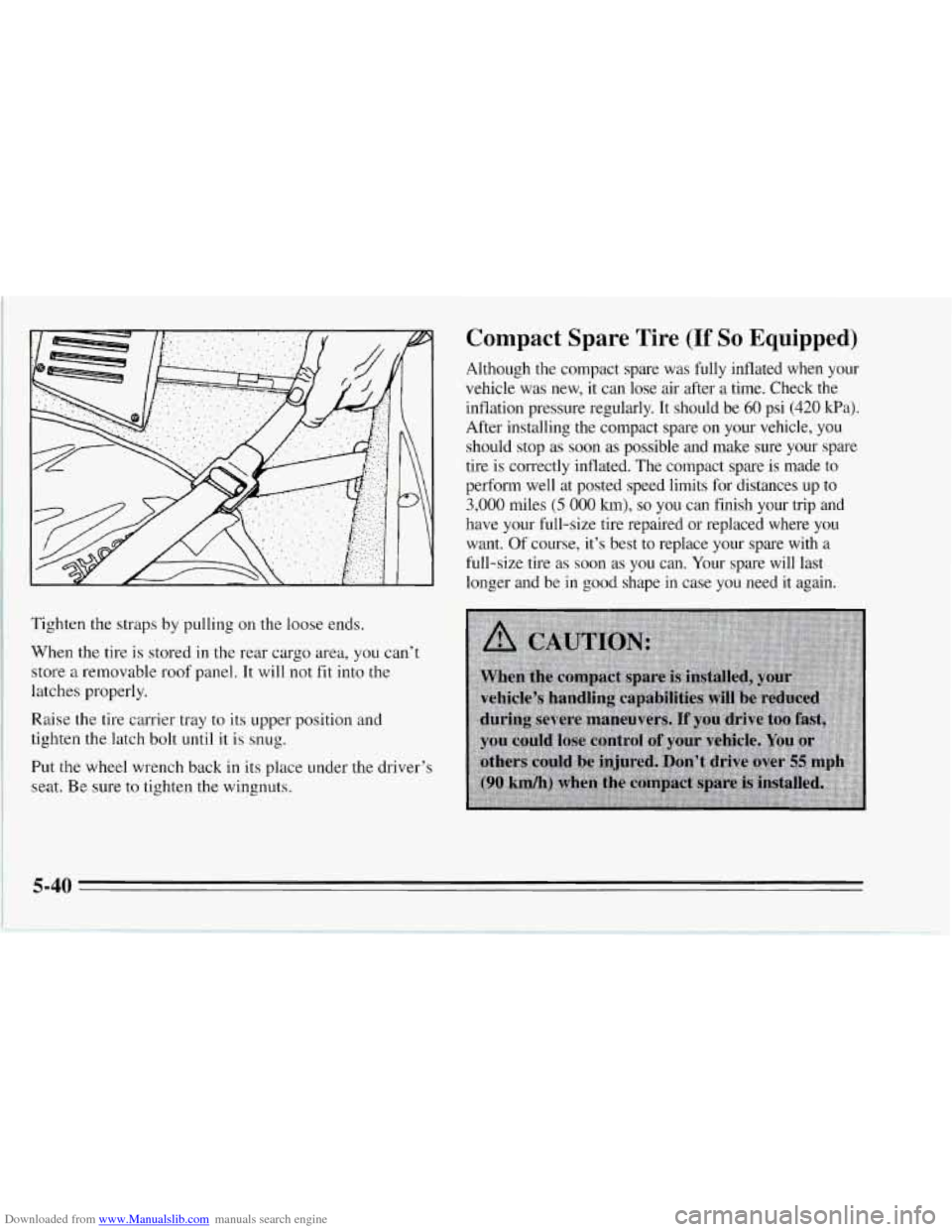
Tighten the straps by pulling on the loose ends.
When the tire is stored in the rear cargo area, you can’t
store
a removable roof panel. It will not fit into the
latches properly.
Raise the tire carrier tray to its upper position and
tighten the latch bolt until
it is snug.
Put the wheel wrench back in its place under the driver’s seat.
Be sure to tighten the wingnuts.
5-40
Page 236 of 386
Downloaded from www.Manualslib.com manuals search engine e Section 6 Service and Appearance Care
Here you will find information about the care of your
Corvette. This section begins with service and fuel
information, and then it shows how to check important
fluid and lubricant levels. There is also technical
information about your vehicle, and a part devoted to its
appearance care.
Service
Your Chevrolet dealer knows your vehicle best and
wants
you to be happy with it. We hope you’ll go to
your dealer for all your service needs. You’ll get
genuine
GM parts and GM-trained and supported
service people.
I
I
We hope you’ll want to keep your GM vehicle all GM.
Genuine GM parts have one of these marks:
Doing Your Own Service Work
If you want to do some of your own service work, you’ll
want to get the proper Corvette Service
Manual. It tells
you much more about how to service your Corvette than
this manual can.
To order the proper service manual, see
“Service Publications’’ in the Index.
6-1
Page 240 of 386

Downloaded from www.Manualslib.com manuals search engine What about gasoline with blending materials that
contain oxygen (oxygenates), such as
MTBE or alcohol?
MTBE is “methyl tertiary-butyl ether.” Fuel that is no
more than
15% MTBE is fine for your vehicle.
Ethanol is ethyl or grain alcohol. Properly-blended fuel
that is no more than
10% ethanol is fine for your
vehicle.
Methanol is methyl or wood alcohol.
NOTICE:
Fuel that is more than 5% methanol is bad for
your vehicle. Don’t use it. It can corrode metal
parts
in your fuel system and also damage plastic
and rubber parts. That damage wouldn’t be
covered under your warranty. And even at
5% or
less, there must be “cosolvents” and corrosion
preventers in this fuel to help avoid these
problems.
Fuels in Foreign Countries
If you plan on driving in another country outside the
U.S. or Canada, unleaded fuel may be hard to find. Do
not use leaded gasoline. If you use even one tankful,
your emission controls won’t work well or at all. With
continuous use, spark plugs can get fouled, the exhaust
system can corrode, and your engine oil can deteriorate
quickly. Your vehicle’s oxygen sensor will be damaged.
All of that means costly repairs that wouldn’t be covered
by your warranty.
To check on fuel availability, ask an auto club, or
contact a major oil company that does business in the
country where you’ll be driving.
You can also write us at the following address for
advice. Just tell
us where you’re going and give your
Vehicle Identification Number (VIN).
General Motors Overseas Distribution Corporation
North American Export Sales
(NAES)
1908 Colonel Sam Drive
Oshawa, Ontario
L1H 8P7
6-5
Page 243 of 386
Downloaded from www.Manualslib.com manuals search engine Checking Things Under the Hood
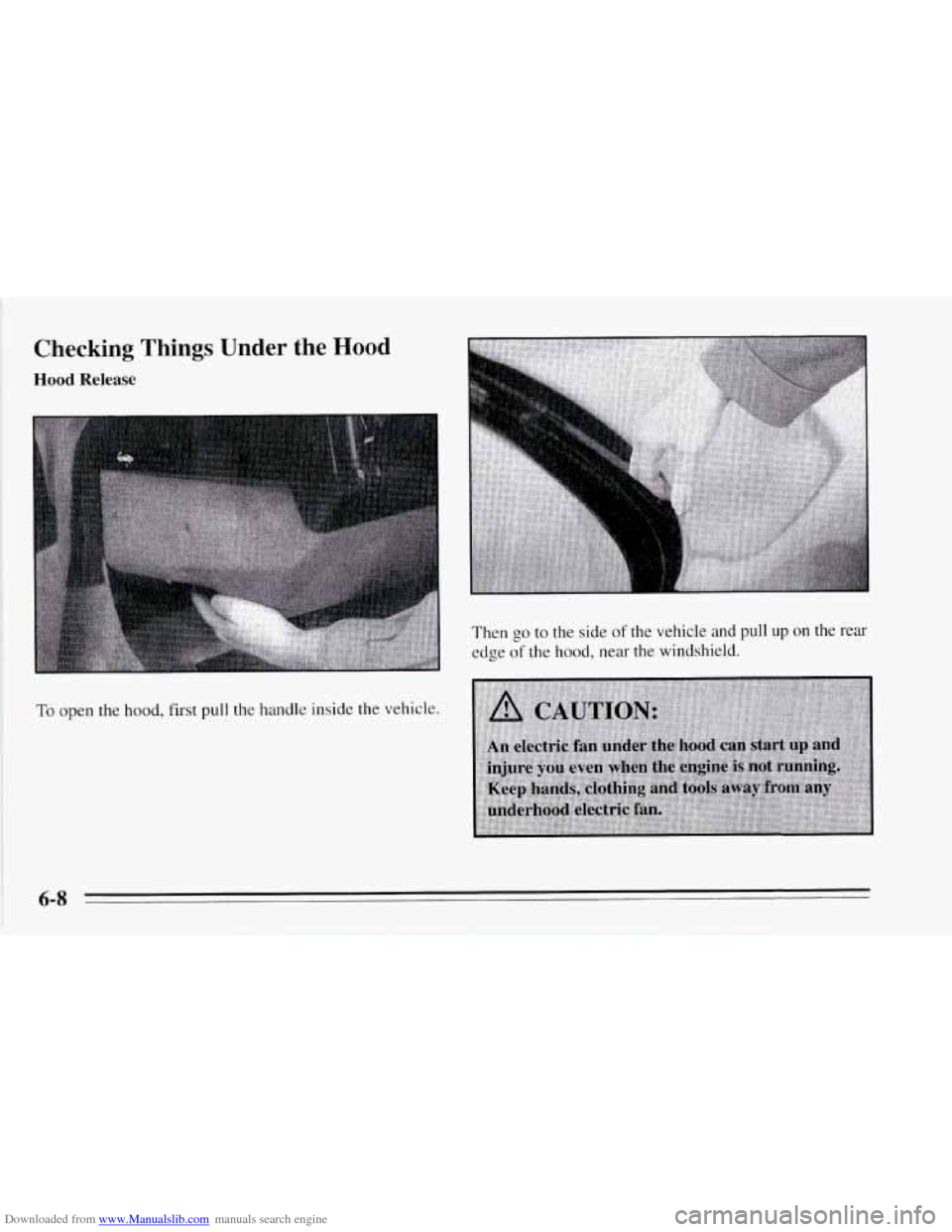
Hood Release
To open the hood, first pull the handle inside the vehicle. Then
go to the side of the
vehicle and pull up on the rear
edge
of the hood, near the windshield.
6-8
Page 247 of 386
Downloaded from www.Manualslib.com manuals search engine Engine Oil
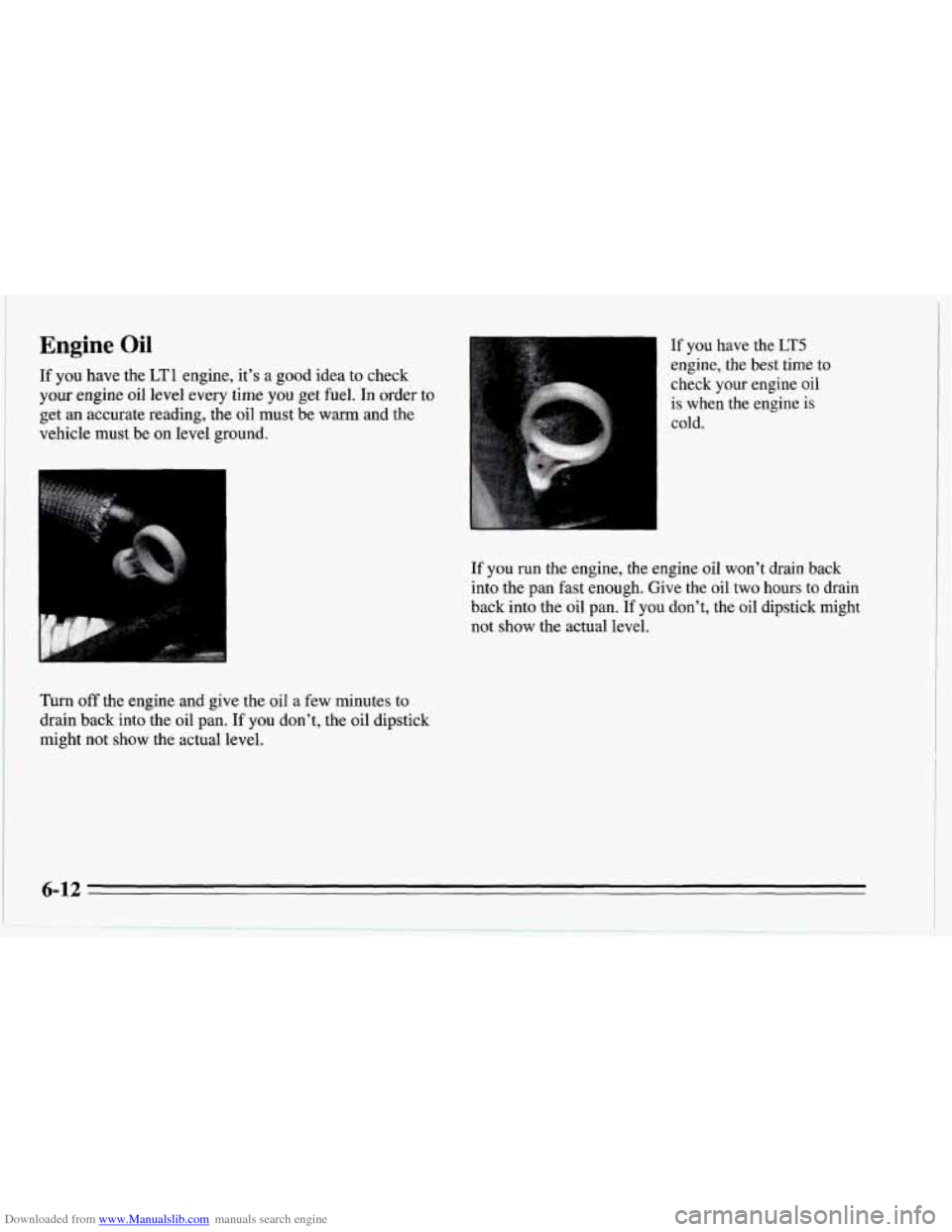
If you have the LT1 engine, it’s a good idea to check
your engine oil level every time you get fuel. In order to
get
an accurate reading, the oil must be warm and the
vehicle must be on level ground.
Turn
off the engine and give the oil a few minutes to
drain back into the oil pan.
If you don’t, the oil dipstick
might not show the actual level. If
you have the LT5
~ engine,
the best time to ~ check your engine oil
is when the engine is cold.
If
you run the engine, the engine oil won’t drain back
into the pan fast enough. Give the oil two hours to drain
back into the oil pan.
If you don’t, the oil dipstick might
not show the actual level.
6-12