Page 62 of 386

Downloaded from www.Manualslib.com manuals search engine NOTICE:
Holding your key in START for longer than
15 seconds at a time will cause your battery to be
drained much sooner. And the excessive heat can
damage your starter motor.
2. If it doesn’t start within 3 seconds, push the
accelerator pedal about one-third of the way down,
while you hold the ignition key in START. When the
engine starts, let go
of the key and let up on the
accelerator pedal. Wait about
15 seconds between
each try to help avoid draining your battery.
When starting your engine in very cold weather (below
0°F or -18”C), do this:
1. With your foot off the accelerator pedal, turn the
ignition key to START and hold it there. After two
seconds, push the accelerator pedal down just a little.
When the engine starts, let go
of the key. Use the
accelerator pedal to maintain engine speed,
if you
have to, until your engine has run for a while.
2. If your engine still won’t start (or starts but then
stops), it could be flooded with too much gasoline.
Try pushing your accelerator pedal all the way to the
floor and holding it there as you hold the key
in
START for about three seconds. If the vehicle starts
briefly but then stops again, do the same thing, but
this time keep the pedal down for five or six seconds.
This clears the extra gasoline from the engine.
NOTICE:
Your engine is designed to work with the
electronics in your vehicle.
If you add electrical
parts or accessories, you could change the
way
the fuel injection system operates. Before adding
electrical equipment, check with your dealer.
If
you don’t, your engine might not perform
properly.
If you ever have to have your vehicle towed, see
the part of this manual that tells how to do
it
without damaging your vehicle. See “Towing
Your Vehicle” in the Index.
2-19
Page 63 of 386

Downloaded from www.Manualslib.com manuals search engine To start your 5.7 Liter LTl engine:
1. Without pushing the accelerator pedal, turn the
ignition key to START. When the engine starts, let
go of the key. The idle speed will go down as your
engine gets warm.
I 1
I NOTICE:
Holding your key in START for longer than
15 seconds at a time will cause your battery to be
drained much sooner. And the excessive heat can
damage your starter motor.
2.
If it doesn’t start within 10 seconds, push the
accelerator pedal all the way to the floor, while you
hold the ignition key in START. When the engine
starts, let go of the key and let up on the accelerator
pedal. Wait about
15 seconds between each try to
help avoid draining your battery.
When starting your engine
in very cold weather (below
0°F or -18”C), do this:
1. With your foot off the accelerator pedal, turn the
ignition key to START and hold it there. When the
engine starts, let go of the key. Use the accelerator pedal
to maintain engine speed, if you have to, until
your engine has run for a while.
stops), it could be flooded with too much gasoline.
Try pushing your accelerator pedal all the
way to the
floor and holding it there as you hold the key in
START for about three seconds. If the vehicle starts
briefly but then stops again, do the same thing, but
this time keep the pedal down for five or six seconds.
This clears the extra gasoline from the engine.
2. If your engine still won’t start (or starts but then
I NOTICE:
Your engine is designed to work with the
electronics in your vehicle.
If you add electrical
parts
or accessories, you could change the way
the fuel injection system operates. Before adding
electrical equipment, check with your dealer.
If
you don’t, your engine might not perform
properly.
If you ever have to have your vehicle towed, see
the part of this manual that tells how to
do it
without damaging your vehicle. See “Towing
Your Vehicle” in the Index.
2-20
Page 106 of 386
Downloaded from www.Manualslib.com manuals search engine 4. Remove the four screws that attach the console door.
5. Remove the console door.
6. Remove the trim plate by pulling up and back.
7. Disconnect the plug by pulling forward on the plastic
locking tab and pull the plug into the console.
The plug has three separate wires:
0 The orange wire connects to the battery.
The pink wire connects to the ignition. Power is only
0 The black wire connects to the ground.
available in
RUN.
NOTICE:
When using the accessory plug:
0
0
0
0
Don’t splice wires directly into the
accessory plug wire.
If done incorrectly,
splicing might cause damage to your
electrical system.
The maximum load
of any electrical
equipment should not exceed
10 amps.
Be sure to turn
off any electrical equipment
when not in use. Leaving electrical
equipment on for extended periods can
drain your battery.
Do not use this plug if the electrical
equipment requires frequent connecting
and disconnecting. This may cause
excessive wear on the accessory plug and
damage your electrical system.
After you’ve installed the electrical equipment, put the
trim panel and console lid back in place and install the
screws
.
2-63
Page 113 of 386
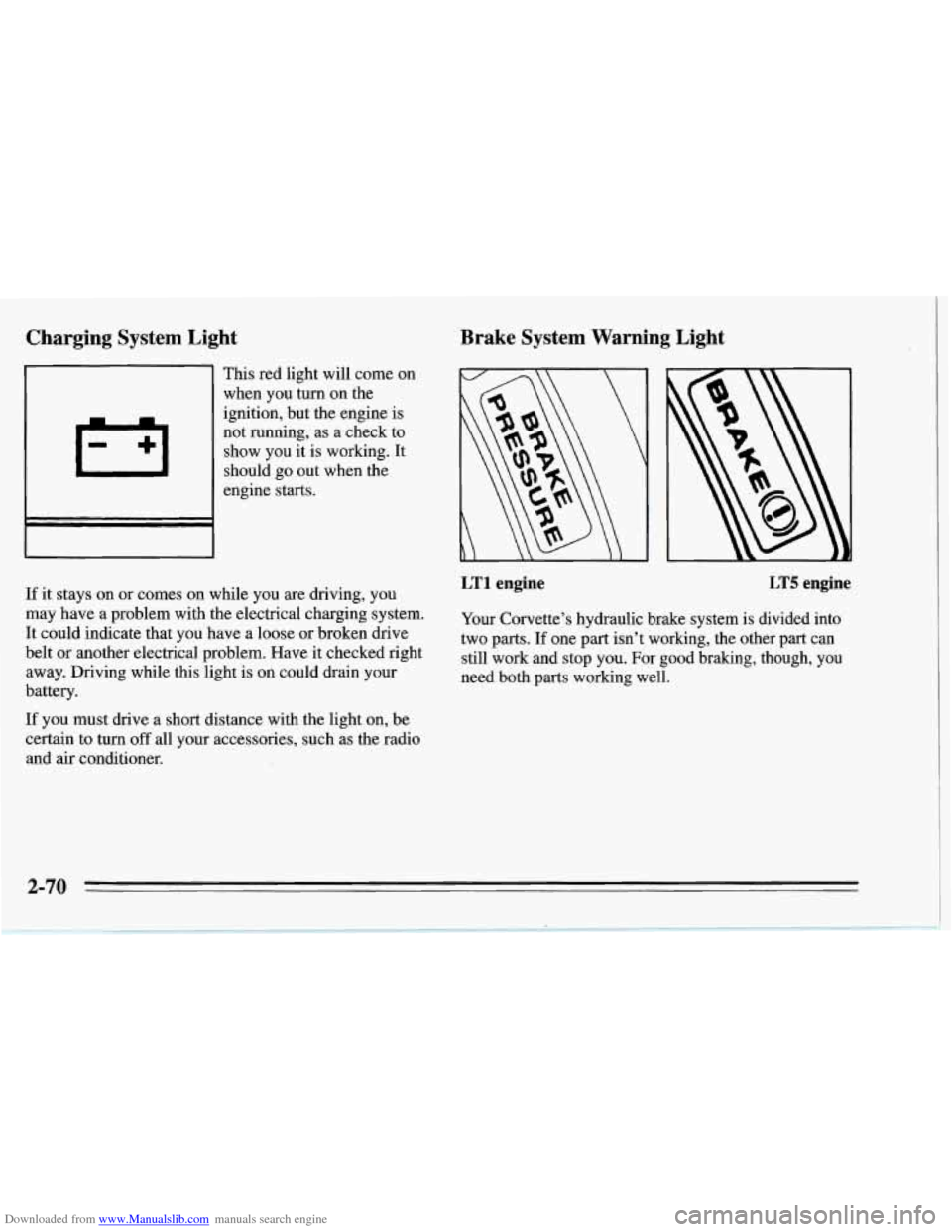
Downloaded from www.Manualslib.com manuals search engine Charging System Light
.
This red light will come on
when you turn on the
ignition, but the engine is
not running, as a check to
show you it is working. It
should go out when the
engine starts.
If it stays on or comes on while you
are driving, you
may have a problem with the electrical charging system.
It could indicate that you have a loose
or broken drive
belt
or another electrical problem. Have it checked right
away. Driving while this light is on could drain your
battery.
If you must drive a short distance with the light on, be
certain to turn
off all your accessories, such as the radio
and
air conditioner.
Brake System Warning Light
LT1 engine LT5 engine
Your Corvette’s hydraulic brake system is divided into
two parts. If one part isn’t working, the other part can
still work and stop you. For good braking, though, you
need both parts working well.
2-70
Page 122 of 386
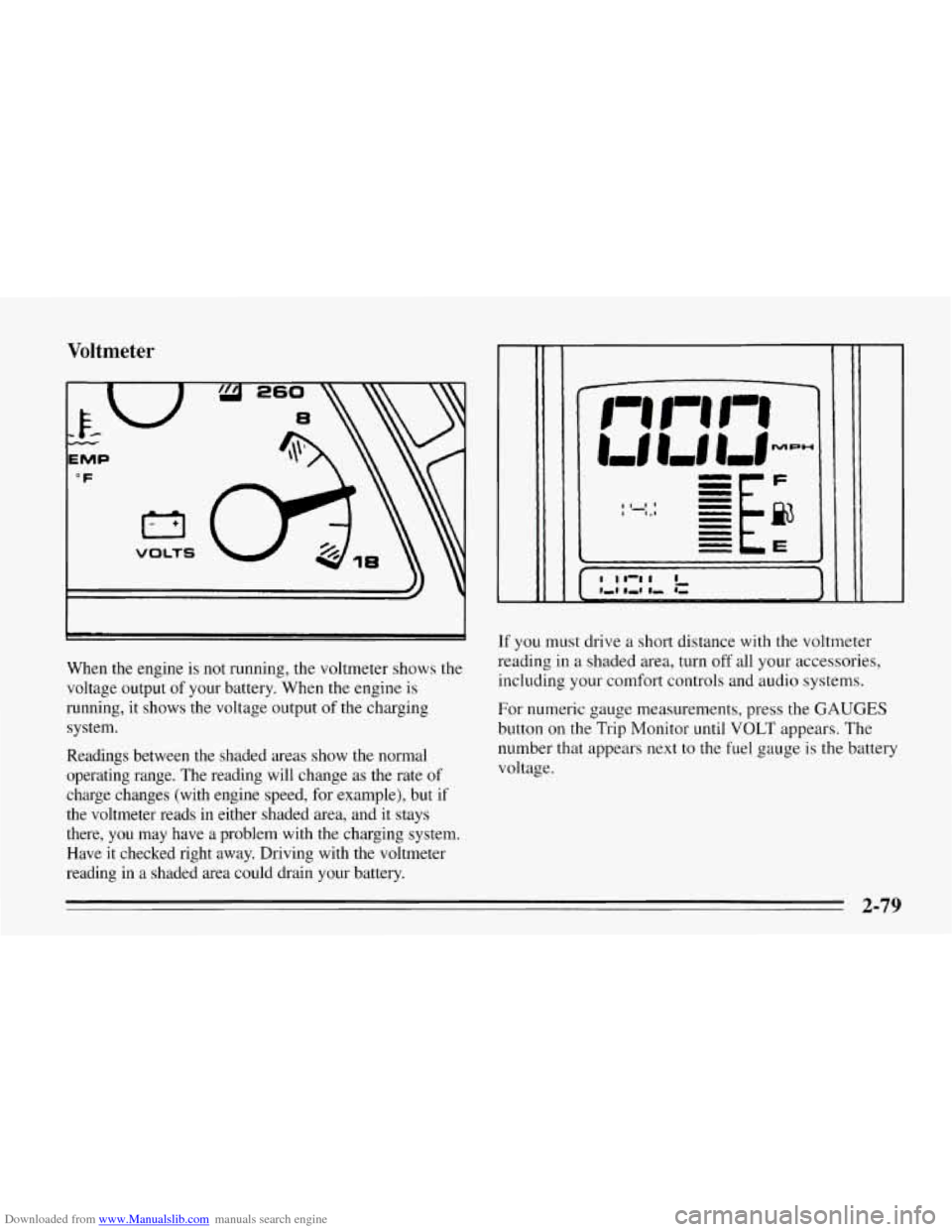
Downloaded from www.Manualslib.com manuals search engine Voltmeter
I
When the engine is not running, the voltmeter shows the
voltage output of your battery. When the engine is
running, it shows the voltage output
of the charging
system.
Readings between the shaded areas show the normal
operating range. The reading will change as the rate
of
charge changes (with engine speed, for example), but if
the voltmeter reads in either shaded area, and it stays
there, you may have a problem with the charging system,
Have it checked right away. Driving with the voltmeter
reading in a shaded area could drain your battery.
7
If you must drive a short distance with the voltmeter
reading in a shaded area, turn
off all your accessories,
including your comfort controls and audio systems.
For numeric gauge measurements, press the
GAUGES
button on the Trip Monitor until VOLT appears. The
number that appears next to the fuel gauge is the battery
voltage.
2-79
Page 128 of 386
Downloaded from www.Manualslib.com manuals search engine It’s normal for the transmission fluid temperature to
vary, depending on the type of driving you do and
weather conditions. If you drive on long grades on a hot
day, the transmission fluid temperature will be higher
than normal driving on a cold day. If you drive your
Corvette at high speeds with a lot of stop-and-go or fast
accelerations, your transmission fluid temperature may
also be higher.
If the transmission fluid exceeds
280°F (138 “C), the
CHECK GAUGES light will come on and HI
AUTO
will be displayed next to the transmission fluid
temperature when you toggle through the GAUGES
button. You should move the shift lever to DRIVE (D)
and continue driving at a slower, constant speed.
Monitor the transmission fluid temperature and allow
it
to cool to 180°F (82°C) to 200°F (93°C). Then, you
should check the transmission fluid level for a low fill or
overfill condition and bring your Corvette in for service
as soon as possible (see “Automatic Transmission Fluid”
in the Index). Also, check the engine coolant
temperature. If it’s too hot, see “Cooling System” in the
Index.
Check Gauges Light
This red light will come on
briefly when you are
starting the engine. If the
light comes on and stays on
while
you are driving, check
your gauges to see if they
are
in the warning areas.
This light can come
on for:
0 high engine oil temperature or low oil pressure
high coolant temperature
high or low battery voltage
0 low fuel level
0 high automatic transmission oil temperature
2-85
Page 135 of 386
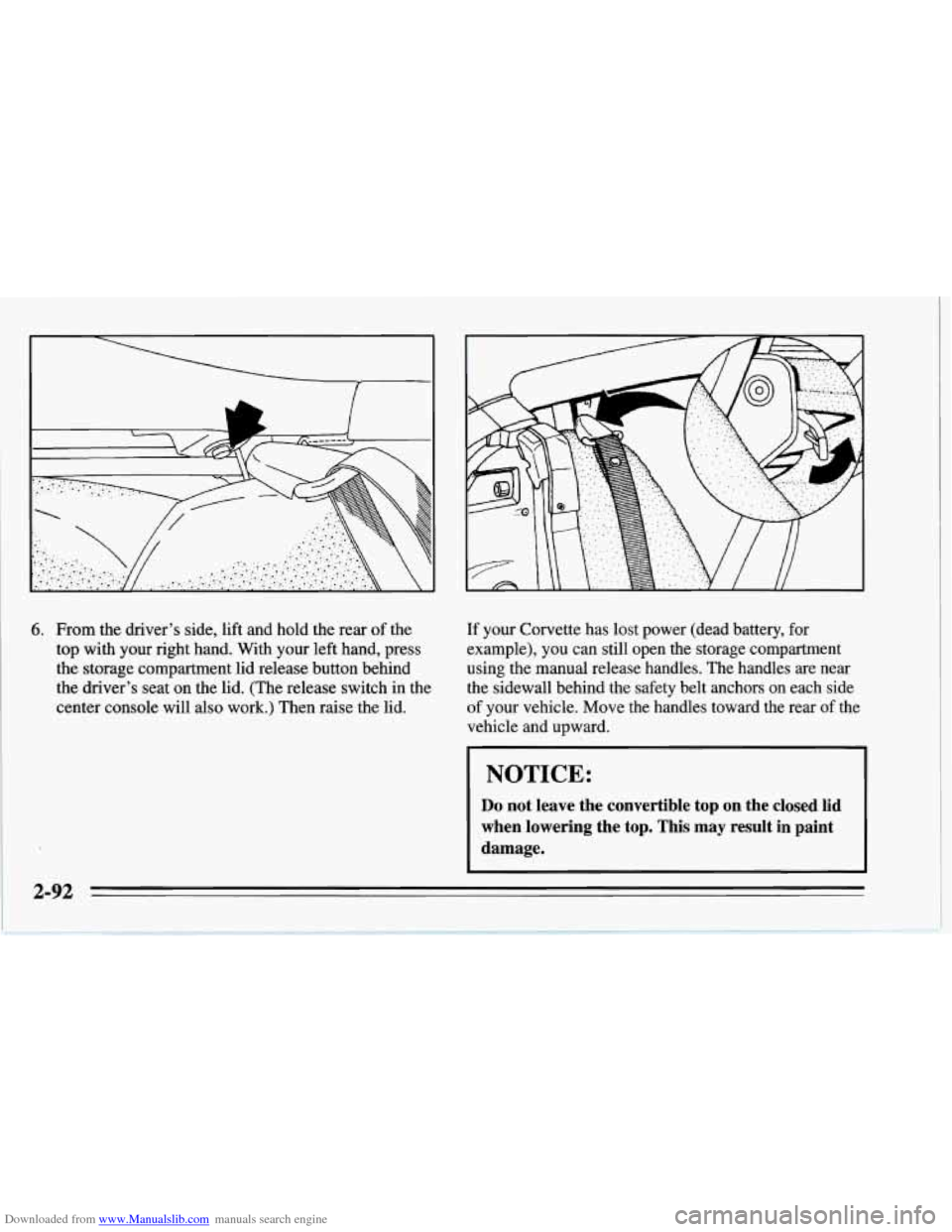
Downloaded from www.Manualslib.com manuals search engine 6. From the driver’s side, lift and hold the rear of the
top with your right hand. With your left hand, press
the storage compartment lid release button behind
the driver’s seat on the lid. (The release switch in the
center console will also work.) Then raise the lid. If
your Corvette has lost power (dead battery, for
example),
you can still open the storage compartment
using the manual release handles. The handles are near
the sidewall behind the safety belt anchors
on each side
of your vehicle. Move the handles toward the rear of the
vehicle and upward.
NOTICE:
Do not leave the convertible top on the closed lid
when lowering the top. This may result in paint
damage.
2-92
Page 190 of 386
Downloaded from www.Manualslib.com manuals search engine Run your engine only as long as you must. This saves
fuel. When you run the engine, make it go a little faster
than just idle. That is, push the accelerator slightly. This
uses less fuel for the heat that you get and it keeps the
~ battery charged. You will need a well-charged battery to
restart the vehicle, and possibly for signaling later on
with your headlights. Let the heater run for awhile.
Then, shut the engine off and close the window almost
all the way to preserve the heat. Start the engine again
and repeat this only when you feel really uncomfortable
from the cold. But do it as little as possible. Preserve the
fuel as long as you can. To help keep warm, you can get
out of the vehicle and do some fairly vigorous exercises
every half hour or
so until help comes.
4-27