Page 195 of 386
Downloaded from www.Manualslib.com manuals search engine Your hazard warning flashers work no matter what
position your key
is in, and even if the key isn’t in.
To turn off the flashers, pull out on the collar.
When the hazard warning flashers are on, your turn
signals won’t work.
Other Warning Devices
If you carry reflective triangles, you can set one up at
the sid’e
of the road about 300 feet (100 m) behind your
vehicle.
Jump Starting
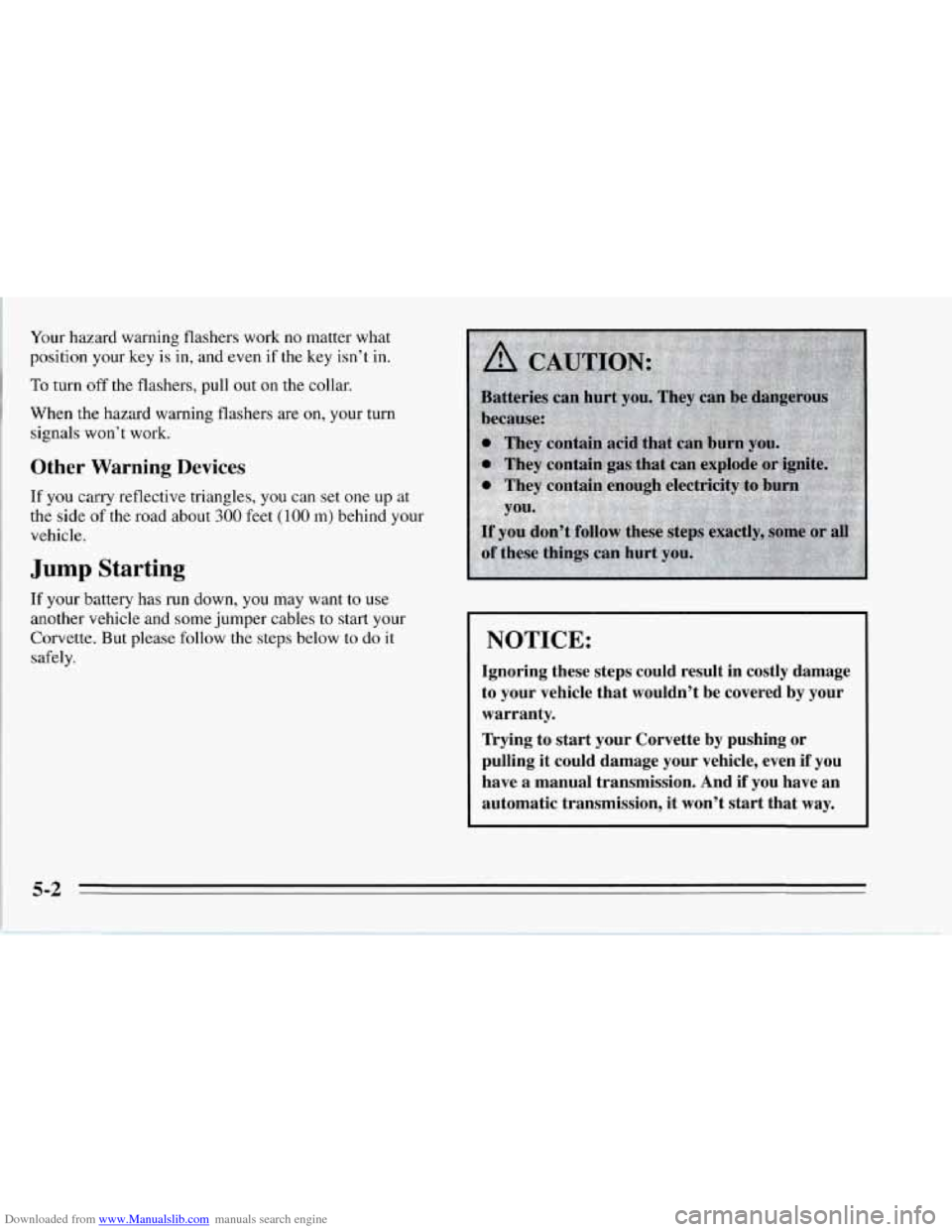
If your battery has run down, you may want to use
another vehicle and some jumper cables to start your
Corvette. But please follow the steps below to
do it
safely.
I
NOTICE:
Ignoring these steps could result in costly damage
to your vehicle that wouldn’t be covered by your
warranty.
Trying to start your Corvette by pushing or
pulling it could damage your vehicle, even if you
have
a manual transmission. And if you have an
automatic transmission, it won’t start that way.
5-2
Page 196 of 386
Downloaded from www.Manualslib.com manuals search engine To Jump Start Your Corvette:
1. Check the other vehicle. It must have a 12-volt
battery with a negative ground system.
NOTICE:
If the other system isn’t a 12-volt system with a
negative ground, both vehicles can be damaged.
2. Get the vehicles close enough so the jumper cables
can reach, but be sure the vehicles aren’t touching
each other.
If they are, it could cause a ground
connection
you don’t want. You wouldn’t be able to
start your Corvette, and the bad grounding could
damage the electrical systems.
3. Turn off the ignition on both vehicles. Turn off all
lights that aren’t needed, and radios. This will avoid
sparks and help save both batteries. And
it could
save your radio!
NOTICE:
If you leave your radio on, it could be badly
damaged. The repairs wouldn’t be covered by
your warranty.
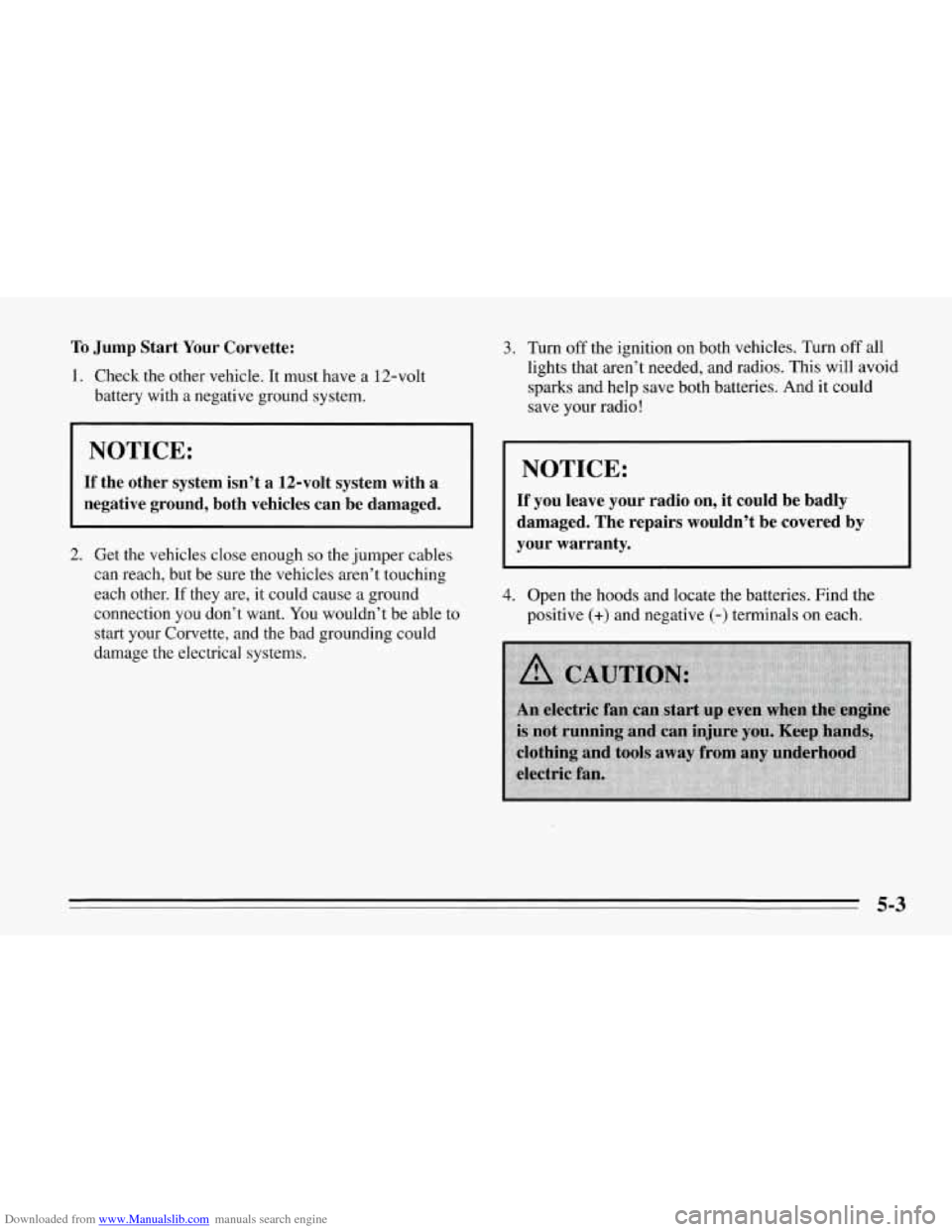
4. Open the hoods and locate the batteries. Find the
positive
(+) and negative (-) terminals on each.
5-3
Page 197 of 386
Downloaded from www.Manualslib.com manuals search engine 5. Check that the jumper cables don't have loose or
missing insulation.
If they do, you could get a shock.
The vehicles could be damaged, too.
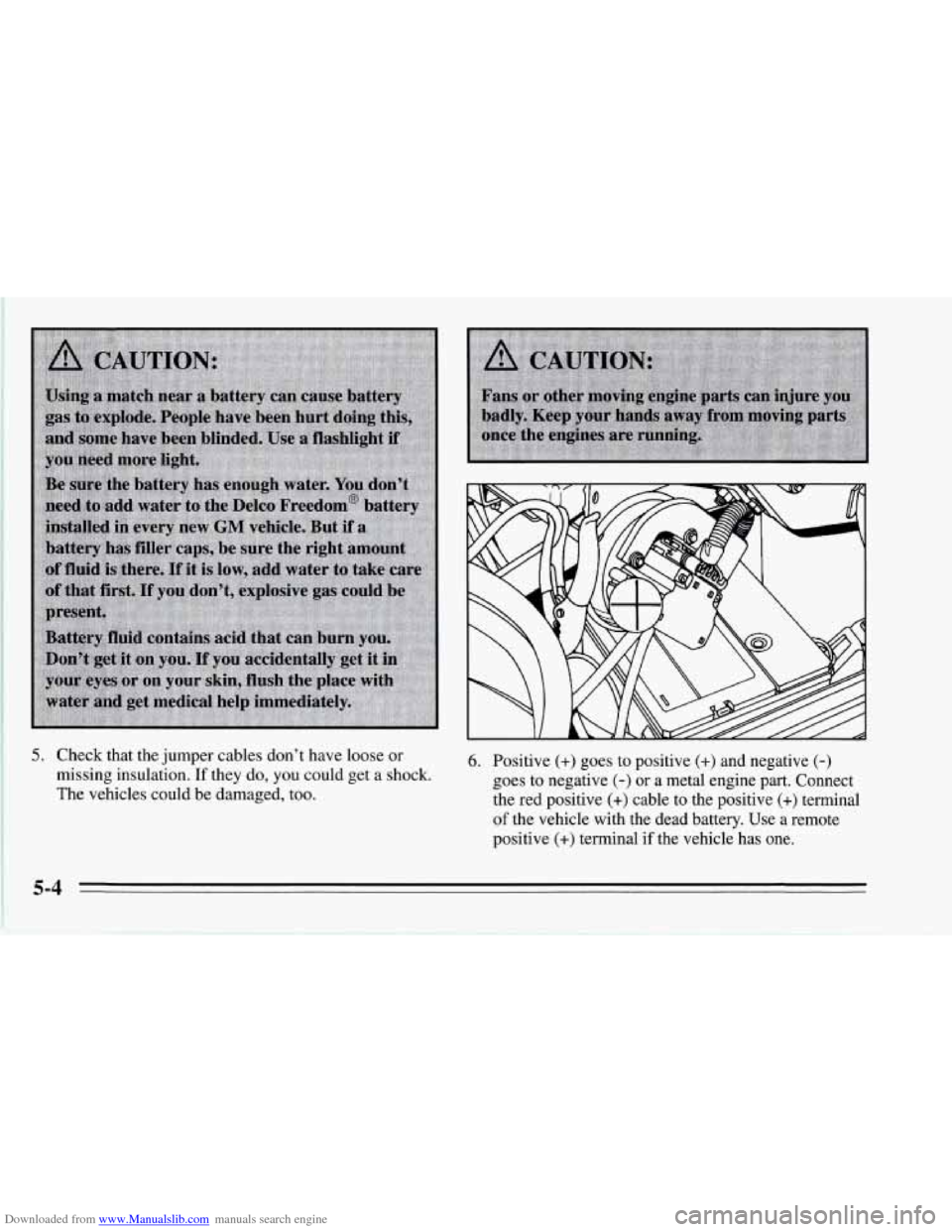
6. Positive (+) goes to positive (+) and negative (-)
goes to negative (-) or a metal engine part. Connect
the red positive
(+) cable to the positive (+) terminal
of the vehicle with the dead battery. Use a remote
positive
(+) terminal if the vehicle has one.
5-4
Page 198 of 386
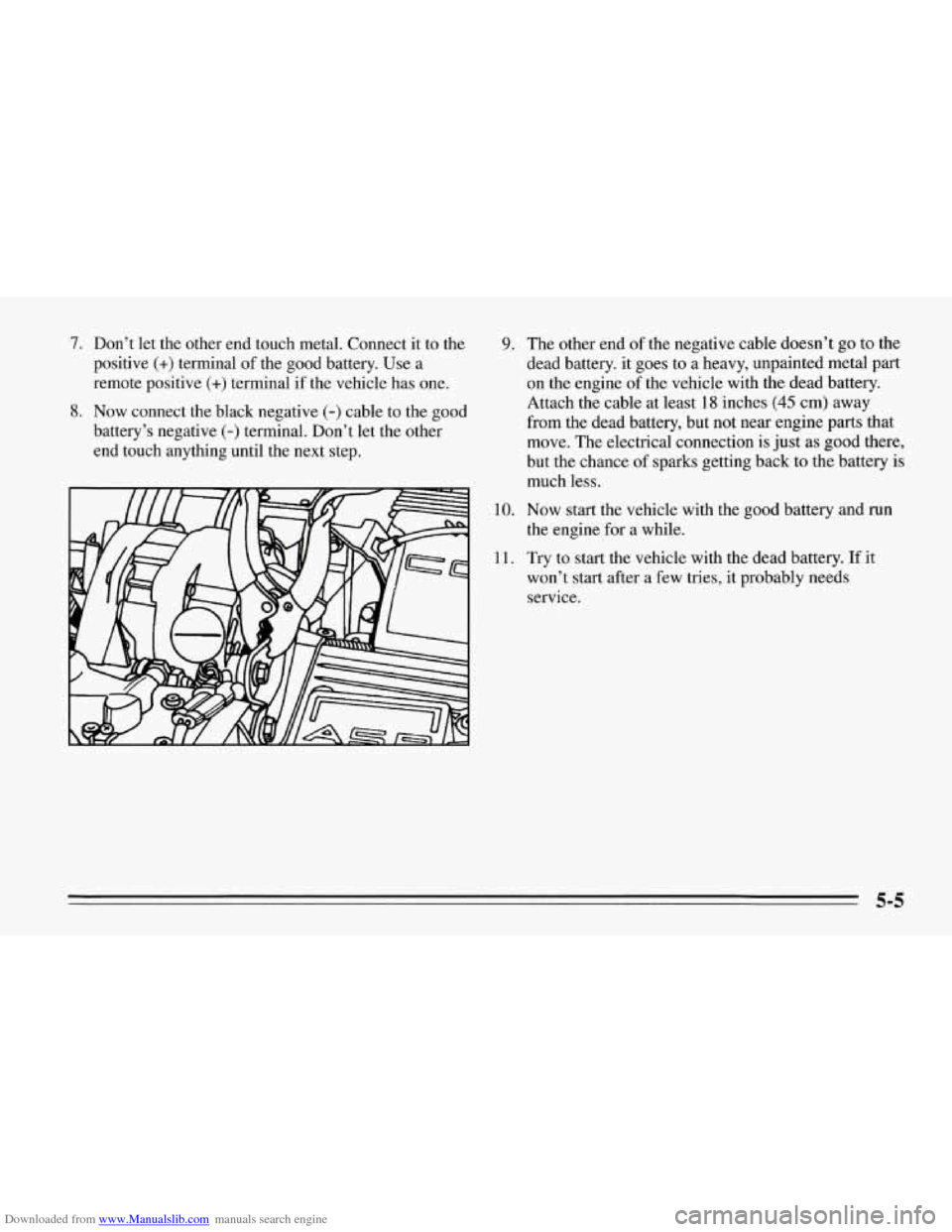
Downloaded from www.Manualslib.com manuals search engine 7. Don’t let the other end touch metal. Connect it to the
positive
(+) terminal of the good battery. Use a
remote positive
(+) terminal if the vehicle has one.
8. Now connect the black negative (-) cable to the good
battery’s negative
(-) terminal. Don’t let the other
end touch anything until the next step.
9. The other end of the negative cable doesn’t go to the
dead battery. it goes to a heavy, unpainted metal part
on the engine of the vehicle with the dead battery.
Attach the cable at least
1.8 inches (45 cm) away
from the dead battery, but not near engine parts that
move. The electrical connection is just as good there,
but the chance of sparks getting back to the battery is
10.
11.
much less.
Now start the vehicle with the good battery and run the engine for a while.
Try to start the vehicle with the dead battery. If it
won’t start after a few tries, it probably needs service.
Page 199 of 386
Downloaded from www.Manualslib.com manuals search engine I- +
I B'
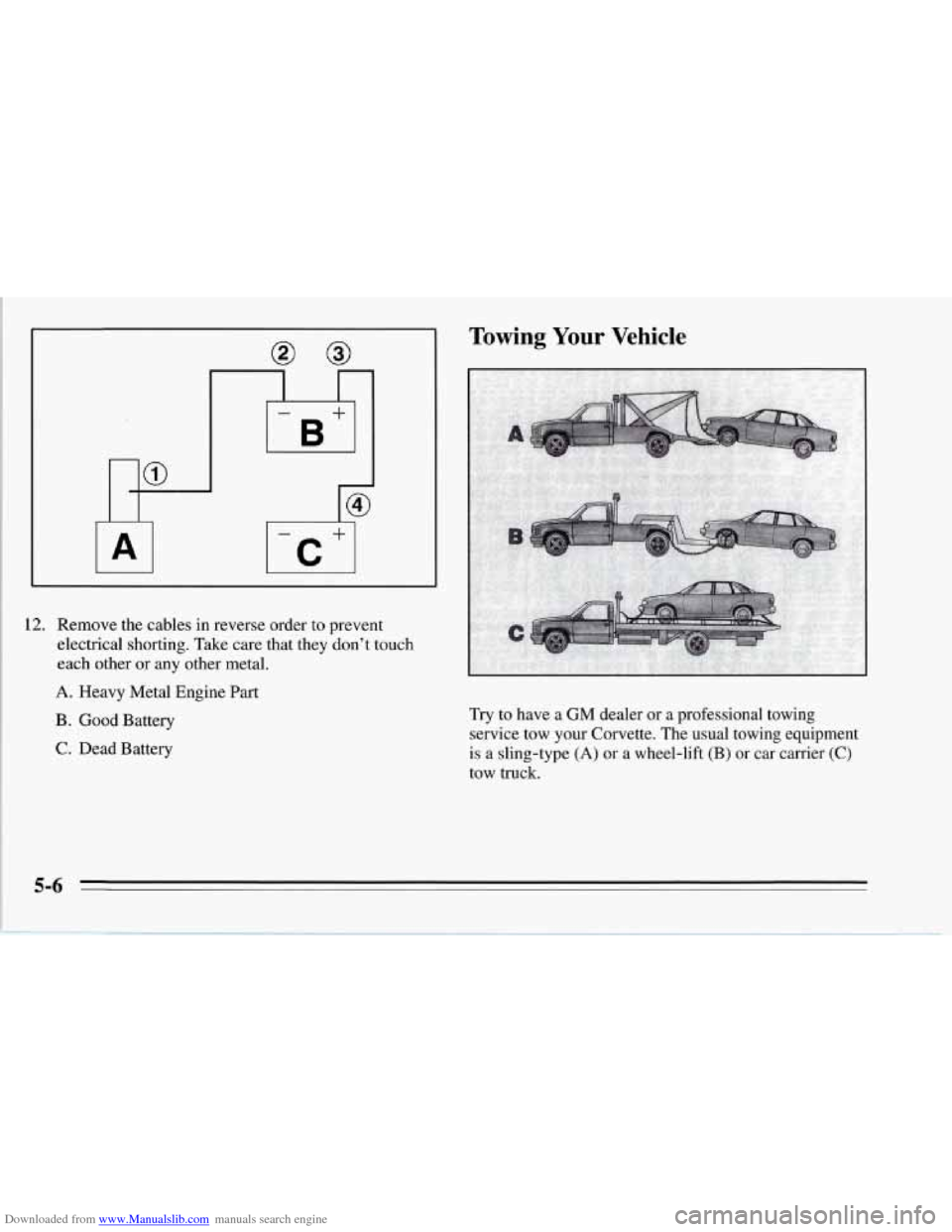
12. Remove the cables in reverse order to prevent
electrical shorting. Take care that they don't touch
each other or any other metal.
A. Heavy Metal Engine Part
B . Good Battery
C. Dead Battery
rowing Your Vehicle
Try to have a GM dealer or a professional towing
service tow your Corvette. The usual towing equipment
is a sling-type
(A) or a wheel-lift (B) or car carrier (C)
tow truck.
Page 244 of 386
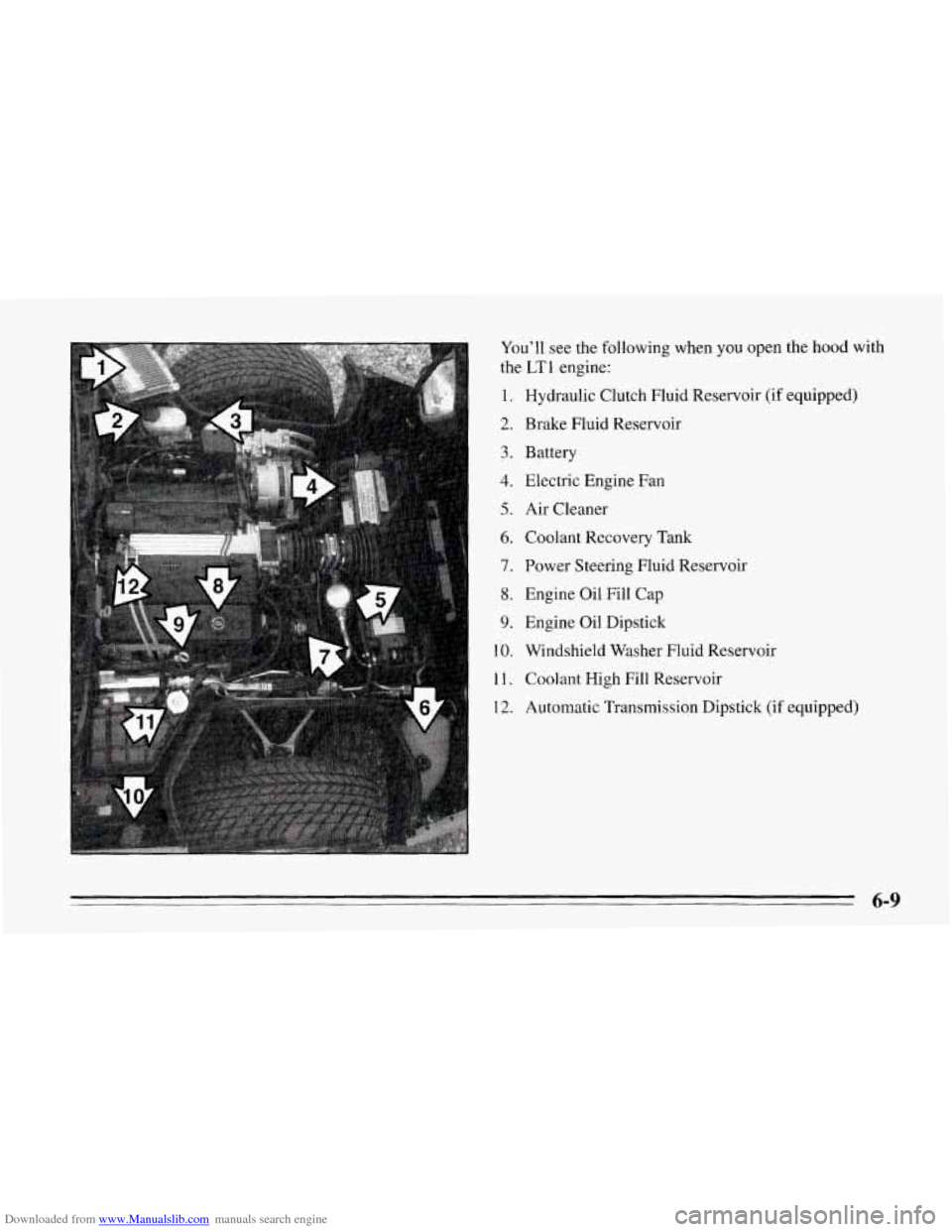
Downloaded from www.Manualslib.com manuals search engine You’ll see the following when you open the hood with
the
LTl engine:
1.
2.
3.
4.
5.
6.
7.
8.
9.
10.
11.
12.
Hydraulic Clutch Fluid Reservoir (if equipped)
Brake Fluid Reservoir
Battery
Electric Engine Fan
Air Cleaner
Coolant Recovery Tank Power Steering Fluid Reservoir
Engine Oil Fill Cap
Engine Oil Dipstick Windshield Washer Fluid Reservoir
Coolant High
Fill Reservoir
Automatic Transmission Dipstick (if equipped)
6-9
Page 245 of 386
Downloaded from www.Manualslib.com manuals search engine Before closing the hood, be sure all the filler caps are
on.
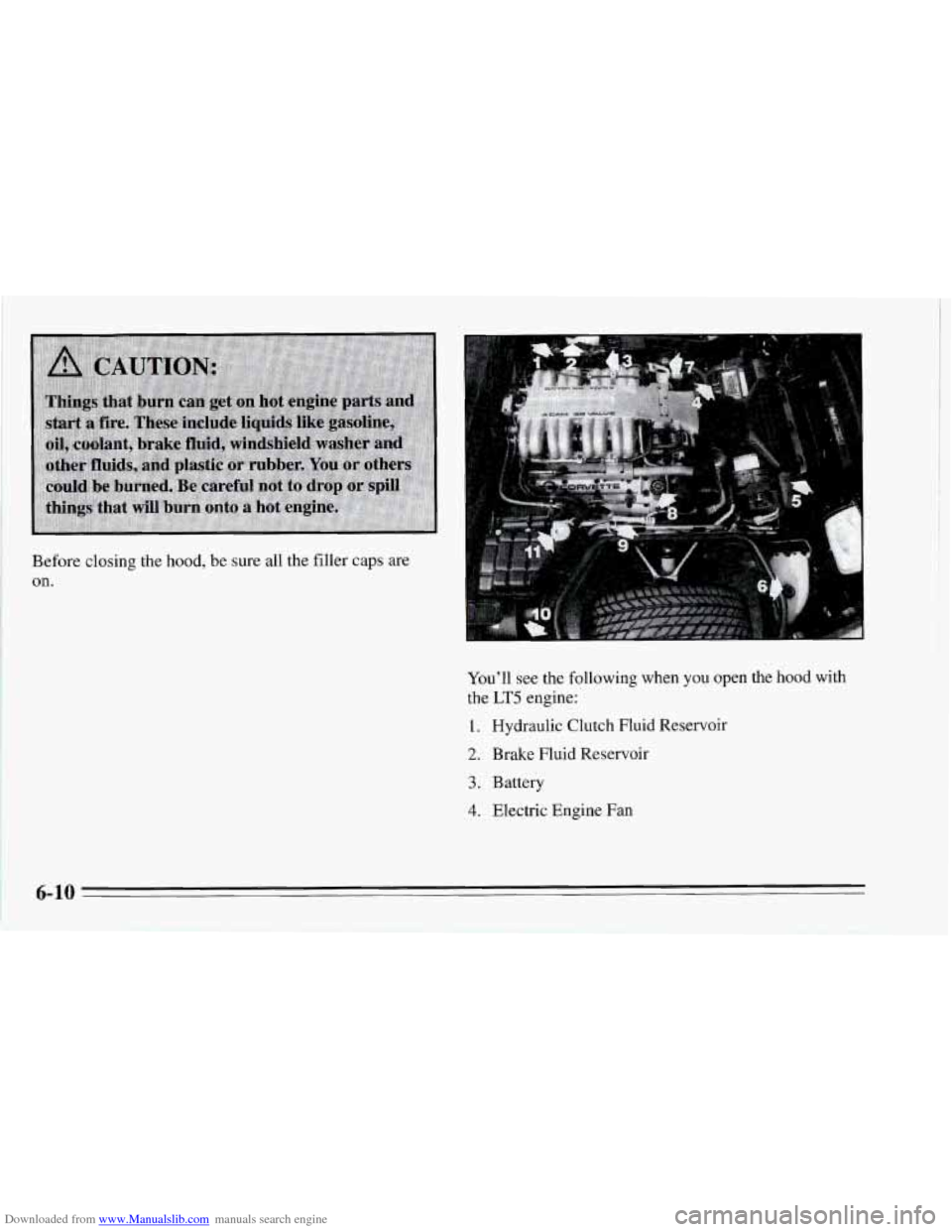
You’ll see the following when you open the hood with
the
LT5 engine:
1. Hydraulic Clutch Fluid Reservoir
2. Brake Fluid Reservoir
3. Battery
4. Electric Engine Fan
6-10
Page 260 of 386
Downloaded from www.Manualslib.com manuals search engine How To Check and Add Fluid
(LT1 Engine Only)
You must loosen and remove the two screws before the
PCM unit will lift out.
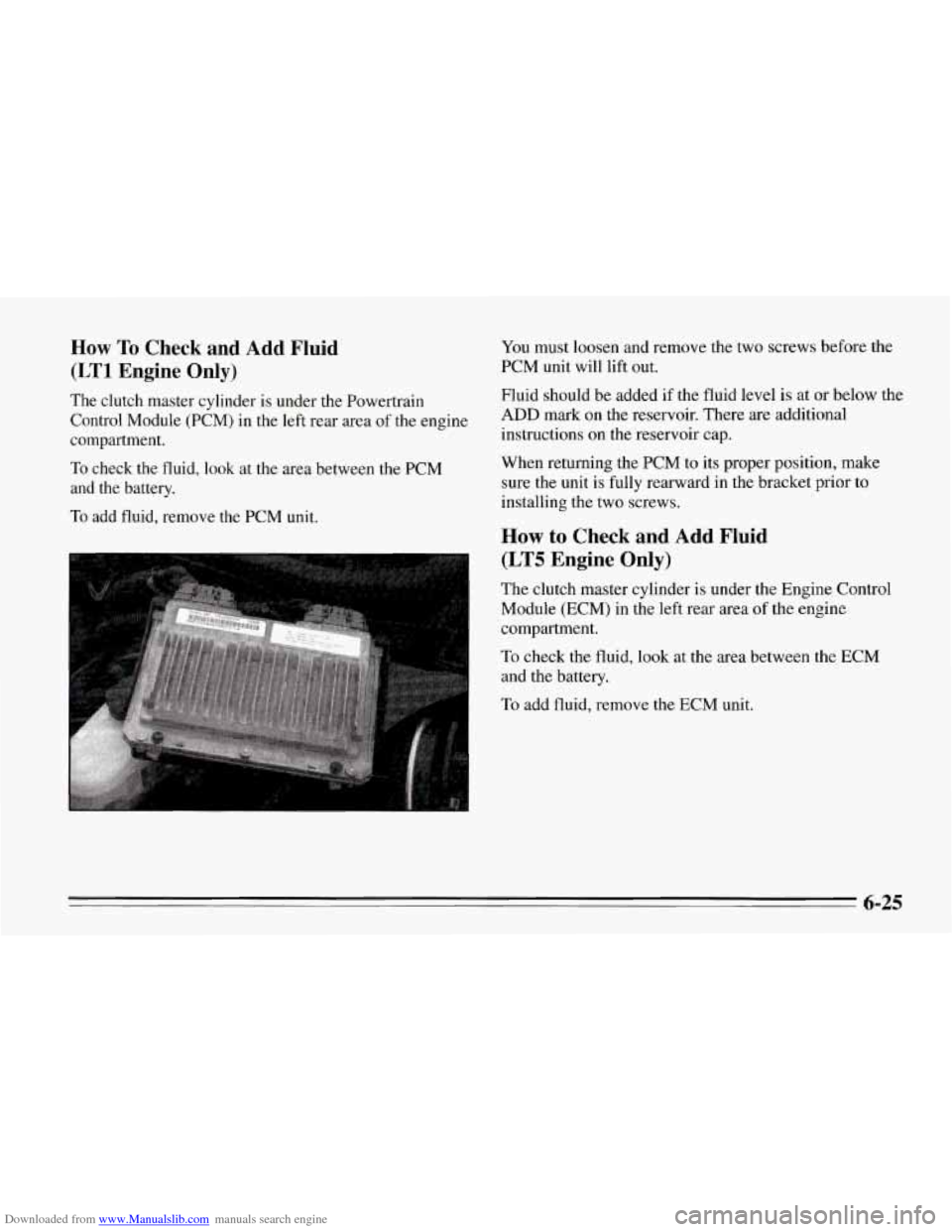
The clutch master cylinder is under the Powertrain Fluid should be added if the fluid
level is at or below the
Control Module (PCM) in the left rear area of the engine
ADD mark on the reservoir. There are additional
instructions on the reservoir cap.
compartment.
To check the fluid, look at the area between the PCM
and the battery.
To add fluid, remove the PCM unit. When returning
the PCM to its proper position, make
sure the unit is fully rearward
in the bracket prior to
installing the two screws.
How to Check and Add Fluid
(LT5 Engine Only)
The clutch master cylinder is under the Engine Control
Module (ECM) in the left rear area of the engine
compartment.
To check the fluid, look at the area
and the battery.
To add fluid, remove the ECM unit between
the ECM
6-25