1995 CHEVROLET CAVALIER engine oil
[x] Cancel search: engine oilPage 218 of 340
Downloaded from www.Manualslib.com manuals search engine Engine Oil Additives Engine Coolant Heater
Don’t add anything to your
oil. Your Chevrolet dealer is
ready
to advise if you think something should be added.
When to Change Engine Oil
See if any one of these is true for you:
0 Most trips are less than 5 to 10 miles (8 to 16 km).
This is particularly important when outside
temperatures are below freezing.
driving in stop and go traffic).
0 Most trips are through dusty areas.
0 Most trips include extensive idling (such as frequent
0 You frequently tow a trailer or use a carrier on top of
your vehicle.
If any
one of these is true for your vehicle, then you
need to change your oil and filter every
3,000 miles
(5 000 km) or 3 months -- whichever comes first.
If none of them is true, change the oil and filter every
7,500 miles (12 500 km) or 12 months -- whichever
comes first. An
engine coolant heater can be a big help
if you have
to park outside
in very cold weather, 0°F (- 18 “C) or
colder.
If your vehicle has this option, see “Engine
Coolant Heater” in the Index.
What to Do with Used Oil
Did you know that used engine oil contains certain
elements that may be unhealthy for your skin and could
even cause cancer? Don’t let used oil stay
on your skin
for very long. Clean your skin and nails with soap and
water, or a good hand cleaner. Wash or properly throw
away clothing or rags containing used engine oil. (See
the manufacturer’s warnings about the use and disposal
of oil products.)
Used oil can be a real threat to the environment.
If you
change your own oil, be sure
to drain all free-flowing oil
from the filter before disposal. Don’t ever dispose of oil
by putting it in the trash, pouring it
on the ground, into
sewers, or into streams or bodies of water. Instead,
recycle
it by taking it to a place that collects used oil. If
you have a problem properly disposing
of your used oil,
ask your dealer, a service station or a local recycling
center for help.
6-14
Page 220 of 340
Downloaded from www.Manualslib.com manuals search engine I NOTICE:
If the air cleaner is off, a backfire can cause a
damaging engine fire. And, dirt can easily get
into your engine, which
will damage it. Always
have the air cleaner in place when you’re driving.
Automatic Transaxle Fluid
(Except
2.3L Code D Engine)
When to Check and Change
A good time to check your automatic transaxle fluid
level is when the engine oil is changed. Refer to
the
Maintenance Schedule to determine when to change
your fluid. See “Scheduled Maintenance Services” in the
Index.
How to Check
Because this operation can be a little difficult, you may
choose
to have this done at your Chevrolet dealer
Service Department.
If
you do it yourself, be sure to follow all the
instructions here, or
you could get a false reading on the
dipstick.
6-16
Page 223 of 340
Downloaded from www.Manualslib.com manuals search engine Automatic Transaxle Fluid
(2.3L Code D Engine Only)
If you have the optional 2.3L Code D engine (see
“Engine Identification” in the Index) and an automatic
transaxle, it is not necessary to check the transaxle fluid
level.
A transaxle fluid leak is the only reason for fluid
loss. If a leak occurs, take the vehicle to your Chevrolet
dealer Service Department and have
it repaired as soon
as possible. You may also have your fluid level checked
by your dealer or service center when
you have your oil
changed.
Manual Transaxle Fluid
When to Check
A good time to have it checked is when the engine oil is
changed. However, the fluid in your manual transaxle
doesn’t require changing.
How to Check
Because this operation can be a little difficult, you may
choose
to have this done at your Chevrolet dealer
Service Department.
If you do it yourself, be sure to follow all the
instructions here, or
you could get a false reading on the
dipstick.
NOTICE:
Too much or too little fluid can damage your
transaxle.
Too much can mean that some of the
fluid could come out and fall on hot engine parts
or exhaust system parts, starting a fire. Be sure to
get an accurate reading if you check your
transaxle fluid.
Check the fluid level only when your engine is off, the
vehicle is parked on a level place and
the transaxle is
cool enough for
you to rest your fingers on the transaxle
case.
6-19
Page 225 of 340
Downloaded from www.Manualslib.com manuals search engine When to Check and What to Use
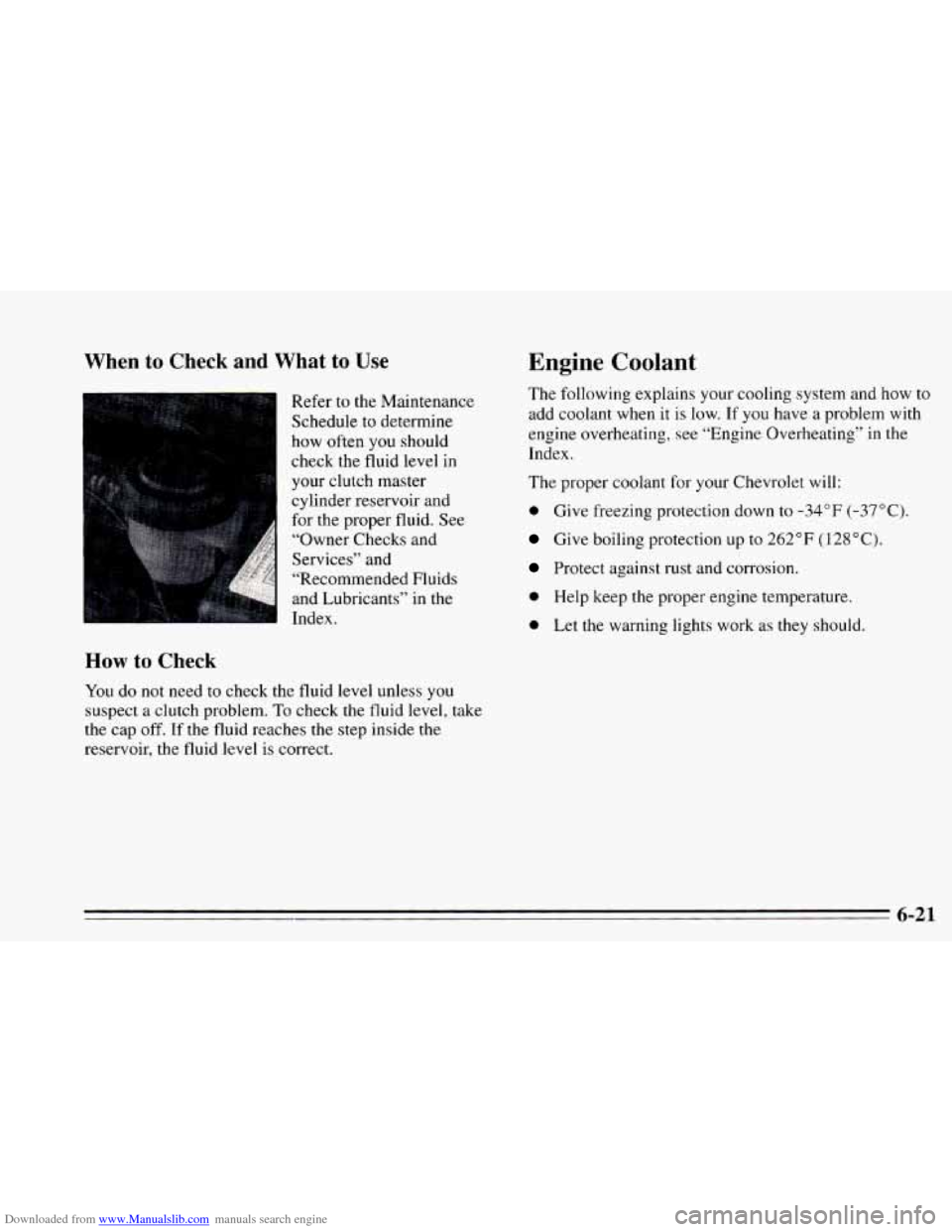
Refer to the Maintenance
Schedule to determine
how often you should
check the fluid level in
your clutch master
cylinder reservoir and
for the proper fluid. See
“Owner Checks and
Services” and
“Recommended Fluids
and Lubricants” in the
Index.
How to Check
You do not need to check the fluid level unless you
suspect a clutch problem. To check the fluid level, take
the cap
off. If the fluid reaches the step inside the
reservoir, the fluid level
is correct.
Engine Coolant
The following explains your cooling system and how to
add coolant when it is low.
If you have a problem with
engine overheating, see “Engine Overheating” in the
Index.
The proper
coolant for your Chevrolet will:
0 Give freezing protection down to -34°F (-37°C).
Give boiling protection up to 262°F (128°C).
Protect against rust and corrosion.
0 Help keep the proper engine temperature.
0 Let the warning lights work as they should.
6-21
Page 231 of 340
Downloaded from www.Manualslib.com manuals search engine What to Add
When you do need brake fluid, use only DOT-3
brake fluid
-- such as Delco Supreme 11 @ (GM Part
No. 1052535). Use new brake fluid from a sealed
container only, and always clean the brake fluid
reservoir cap before removing it.
NOTICE:
0
0
Don’t let someone put in the wrong kind of
fluid. For example, just
a few drops of
mineral-based oil, such as engine oil, in
your brake system can damage brake
system parts
so badly that they’ll have to be
replaced.
Brake fluid can damage paint,
so be careful
not to spill brake fluid
on your vehicle. If
you do, wash it off immediately. See
“Appearance Care” in the Index.
Brake Wear
Your Chevrolet has front disc brakes and rear drum
brakes.
Disc brake pads have built-in wear indicators that make a
high-pitched warning sound when the brake pads are
worn and new pads are needed. The sound may come and
go or be heard all the time your vehicle is moving (except
when
you are pushing on the brake pedal firmly).
NOTICE:
Continuing to drive with worn-out brake pads
could result in costly brake repair.
6-27
Page 247 of 340
Downloaded from www.Manualslib.com manuals search engine Using Foam-Type Cleaner on Fabric
0
0
0
0
0
0
0
0
0
0
Vacuum and brush the area to remove any loose dirt.
Always clean a whole trim panel or section. Mask
surrounding trim along stitch or welt lines.
Mix Multi-Purpose Powdered Cleaner following the
directions
on the container label.
Use suds
only and apply with a clean sponge.
Don’t saturate the material.
Don’t rub
it roughly.
As soon as you’ve cleaned the section, use a sponge
to remove the suds.
Rinse
the section with a clean, wet sponge.
Wipe
off what’s left with a slightly damp paper towel
or cloth.
Then dry it immediately with a blow dryer or a heat
lamp.
NOTICE:
Be careful. A blow dryer may scorch the fabric.
~~~~ ~~ ~~
0 Wipe with a clean cloth.
Using Solvent-Type Cleaner on Fabric
First, see if you have to use solvent-type cleaner at all.
Some spots and stains will clean
off better with just
water and mild soap.
If you need to use a solvent:
0 Gently scrape excess soil from the trim material with
a clean, dull knife or scraper. Use very little cleaner,
light pressure and clean cloths (preferably
cheesecloth). Cleaning should start at
the outside of
the stain, “feathering” toward
the center. Keep
changing to
a clean section of the cloth.
0 When you clean a stain from fabric, immediately dry
the area with
a blow dryer to help prevent a cleaning
ring. (See the previous
NOTICE.)
Fabric Protection
Your Chevrolet has upholstery that has been treated with
Scotchgard
TM Fabric Protector, a 3M product.
Scotchgard” protects fabrics by repelling oil and water,
which are the carriers
of most stains. Even with this
protection,
you still need to clean your upholstery often
to keep
it looking new.
Further information on cleaning is available by calling
1-800-433-3296
(in Minnesota, 1-800-642-6 167).
6-43
Page 248 of 340
Downloaded from www.Manualslib.com manuals search engine Special Cleaning Problems
Greasy or Oily Stains
Stains caused by grease, oil, butter, margarine, shoe
polish, coffee
with cream, chewing gum, cosmetic
creams, vegetable oils, wax crayon, tar and asphalt can
be removed
as follows:
Carefully scrape off excess stain.
Follow the solvent-type instructions described
earlier.
Shoe polish, wax crayon, tar and asphalt will stain if
left on a vehicle seat fabric. They should be removed
as soon as possible. Be careful, because the cleaner
will dissolve them and may cause them to spread.
Non-Greasy Stains
Stains caused by catsup, coffee (black), egg, fruit, fruit
juice,
milk, soft drinks, wine, vomit, urine and blood can
be removed
as follows:
0 Carefully scrape off excess stain, then sponge the
soiled area with
cool water.
If a stain remains, follow the foam-type instructions
described earlier.
If an odor lingers after cleaning vomit or urine, treat
the area with a waterhaking soda solution:
1 teaspoon (5 ml) of baking soda to 1 cup (250 ml)
of lukewarm water.
0 If needed, clean lightly with solvent-type cleaner.
Combination Stains
Stains caused by candy, ice cream, mayonnaise, chili
sauce and unknown stains can be removed as follows:
Carefully scrape off excess stain, then clean with
cool water and allow to dry.
If a stain remains, clean it with solvent-type cleaner.
Cleaning Vinyl
Use warm water and a clean cloth.
Rub with a clean, damp cloth to remove dirt. You
may have
to do it more than once.
0 Things like tar, asphalt and shoe polish will stain if
you don’t get them off quickly. Use a clean cloth and
a
GAM VinyVLeather Cleaner or equivalent product.
6-44
Page 251 of 340
Downloaded from www.Manualslib.com manuals search engine Foreign materials such as calcium chloride and other
salts, ice melting agents, road
oil and tar, tree sap. bird
droppings, chemicals from industrial chimneys, etc. can
damage your vehicle's finish
if they remain on painted
surfaces.
Wash the vehicle as soon as possible. If
necessary, use non-abrasive cleaners that are marked
safe for painted surfices
to remove foreign matter.
Exterior painted surfaces are subject to aging, weather
and chemical fallout that can take their
toll over a period
of years. You can help to keep the paint finish looking
new by keeping your Chevrolet garaged or covered
whenever possible.
Cleaning Your Convertible Top
Your convertible top should be cleaned often. If you use
an automatic car
wash, use one with water jets and
hanging cloths.
When you hand wash the top,
do it in partial shade. Use
a mild soap, lukewarm water and
a soft sponge. A
chamois or cloth may leave lint on the top, and a brush
can chate the tllreads
in the top fabric. Don't use
detergents, harsh cleaners, solvents or bleaching agents. When you
clean the top, put one hand under it
to
support it. Wet the entire vehicle and wilsh the top
evenly to avoid spots or rings. Let the soap remain
on
the fabric for a few minutes. When the top is really dirty,
use a mild foam-type cleaner. Thoroughly rinse the
entire vehicle,
then let the top dry in direct sunlight.
To protect the convertible top:
0 After you wash the vehicle, make sure the top is
completely
dry before you lower it.
0 Don't get any cleaner on the vehicle's painted finish:
it could leave streaks.
0 It' you decide to go through an automatic car wash,
ask the manager
if the equipment could damage your
top. Before entering
a car wash, set the climate
control
to VENT and the fan control to the highest
speed. This
will help to prevent water under high
pressure
from entering around the convertible top.
6-47