1995 CHEVROLET ASTRO CARGO VAN height
[x] Cancel search: heightPage 29 of 342
Downloaded from www.Manualslib.com manuals search engine Shoulder Belt Height Adjuster
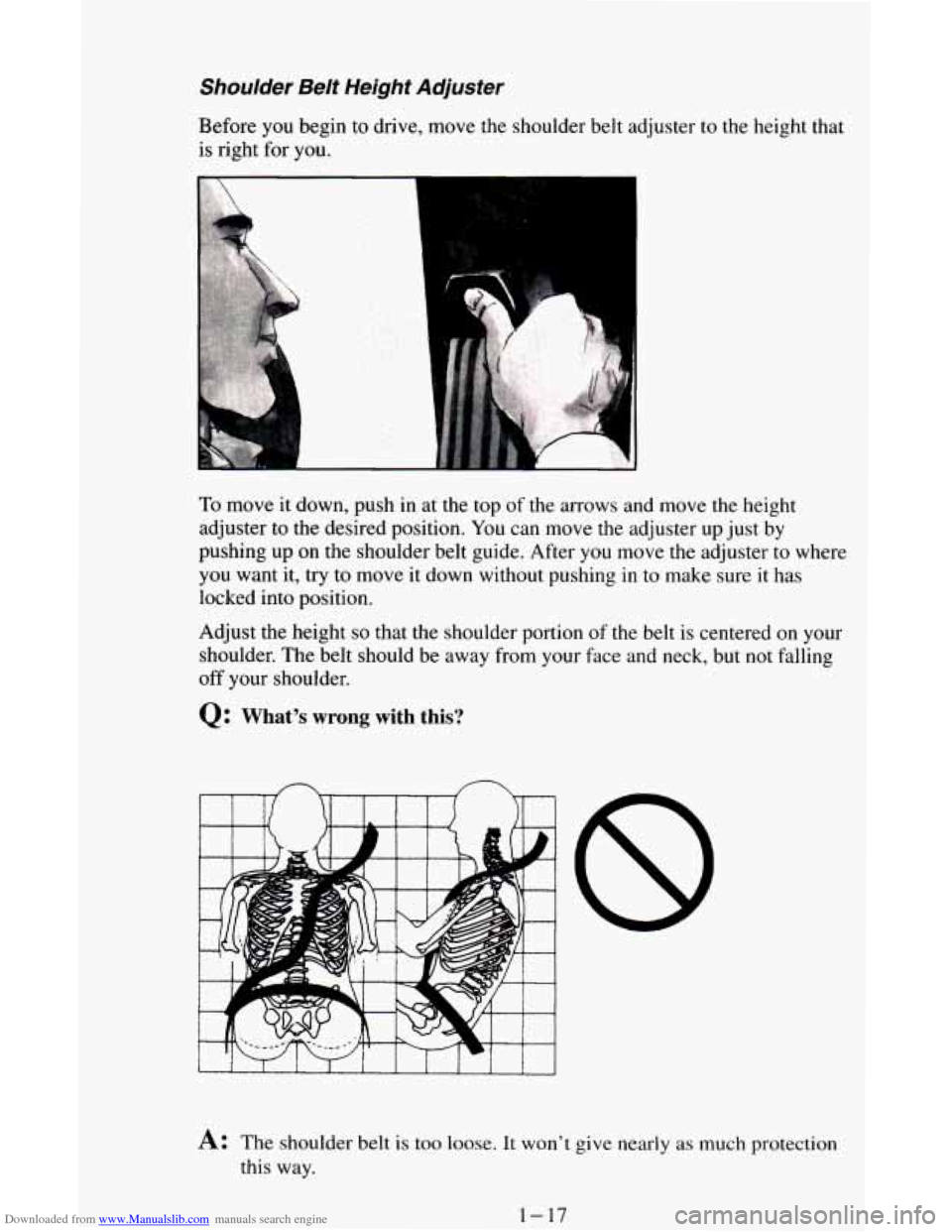
Before you begin to drive, move the shoulder belt adjuster to the height that
is right for you.
To move it down, push in at the top of the arrows and move the height
adjuster to the desired position. You can move the adjuster up just by
pushing up
on the shoulder belt guide. After you move the adjuster to where
you want it, try to move it down without pushing in to make sure it has
locked into position.
Adjust the height
so that the shoulder portion of the belt is centered on your
shoulder. The belt should be away from your face and neck, but
not falling
off your shoulder.
Q: What’s wrong with this?
I I I I
8
A: The shoulder belt is too loose. It won’t give nearly as much protection
this way.
1-17
Page 37 of 342
Downloaded from www.Manualslib.com manuals search engine Servicing Your Facial Air Bag-Equipped Vehicle
The facial air bag affects how your vehicle should be serviced. There are
parts of the air bag system in several places around your vehicle. You don’t
want the system to inflate while someone is working
on your vehicle. Your
GM dealer and
the 1995 GM Service Manual have information about
servicing your vehicle and the air bag system.
To purchase a service manual,
see “Service Publications”
in the Index. The air bag system does not need
regular maintenance.
Adding Equipment to Your Facial Air Bag-Equipped
Vehicle
0: If I add a push bumper or a bicycle rack to the front of my vehicle,
will it keep the air bag
from working properly?
A: As long as the push bumper or bicycle rack is attached to your vehicle
so that the vehicle’s basic structure isn’t changed, it’s not likely to keep
the air bags from working properly in a crash.
Q: Is there anything I might add to the front of the vehicle that could
keep the air bag from working properly?
A: Yes. If you add things that change your vehicle’s frame, bumper
system, front end sheet metal or height, they may keep the air bag
system from working properly. Also, the air bag system may not work
properly if
you relocate any of the air bag sensors. If you have any
question about this,
you should contact Customer Assistance before
you modify your vehicle. (The phone numbers and addresses for
Customer Assistance are
in Step Two of the Customer Satisfaction
Procedure in this manual. See “Customer Satisfaction Procedure” in
the Index
.)
1-25
Page 239 of 342
Downloaded from www.Manualslib.com manuals search engine Brake Wear
Your vehicle has front disc brakes and rear drum brakes.
Disc brake pads have built-in wear indicators that make
a high-pitched
warning sound when the brake pads are worn and new pads are needed. The
sound may come and go or be heard all the time your vehicle is moving
(except when you are pushing
on the brake pedal firmly).
NOTICE:
Continuing to drive with worn-out brake pads could result in
costly brake repair.
Some driving conditions or climates may cause a brake squeal when the
brakes are first applied or lightly applied. This does not mean something is
wrong with your brakes.
Your rear drum brakes don’t have wear indicators, but
if you ever hear a
rear brake rubbing noise, have the rear brake linings inspected. Also,
the
rear brake drums should be removed and inspected each time the tires are
removed for rotation or changing. When you have the front brakes replaced,
have
the rear brakes inspected, too.
Brake linings should always be replaced
as complete axle sets.
Brake Pedal Travel
See your dealer if the brake pedal does not return to normal height, or if
there is a rapid increase in pedal travel. This could be a sign of brake
trouble.
Brake Adjustment
Every time you make a brake stop, your disc brakes adjust for wear.
If your brake pedal goes down Farther than normal, your rear drum brakes
may need adjustment. Adjust them by backing
up and firmly applying the
brakes a few times.
6-3 1
Page 255 of 342
Downloaded from www.Manualslib.com manuals search engine If you need to replace any of your wheels, wheel bolts, or wheel nuts,
replace them
only with new GM original equipment parts. This way, you
will
be sure to have the right wheel, wheel bolts, and wheel nuts for your
GM model.
A CAUTION:
Using the wrong replacement wheels, wheel bolts, or wheel nuts
on your vehicle can be dangerous. It could affect the braking
and handling
of your vehicle, make your tires lose air and make
you lose control. You could have a collision in which you or
others could be injured. Always use the correct wheel, wheel
bolts, and wheel nuts for replacement.
I NOTICE:
The wrong wheel can also cause problems with bearing life,
brake cooling, speedometer/odometer calibration, headlamp
aim, bumper height, vehicle ground clearance, and tire or tire
chain clearance to the body and chassis.
Used Replacement Wheels
A CAUTION:
Putting a used wheel on your vehicle is dangerous. You can’t
know how
it’s been used or how many miles it’s been driven. It
could fail suddenly and cause an accident. If you have to replace
a wheel use a new GM original equipment wheel.
6-47
Page 339 of 342
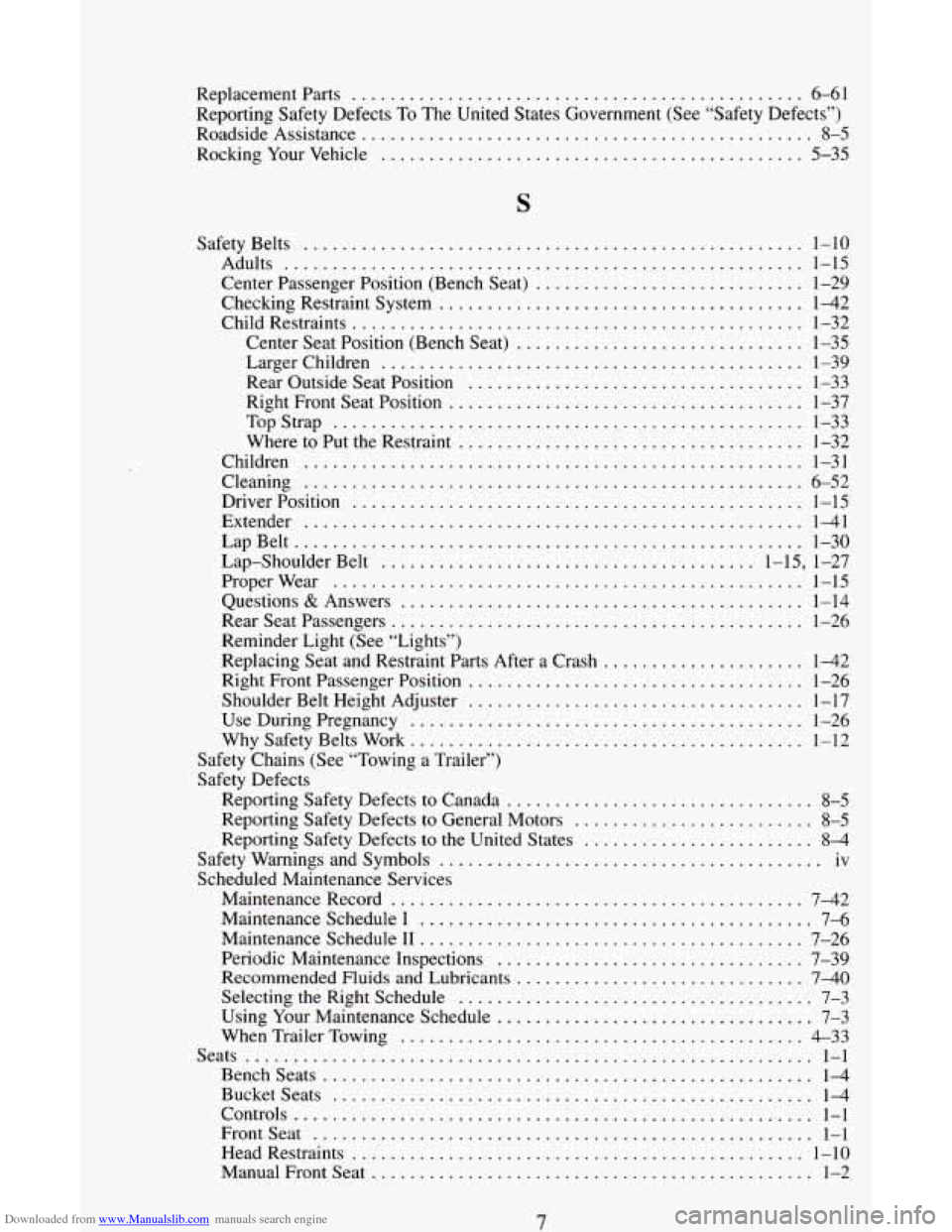
Downloaded from www.Manualslib.com manuals search engine Replacement Parts ............................................... 6-6 1
Reporting Safety Defects To The United States Government (See “Safety Defects”)
Roadside Assistance
............................................... 8-5
Rocking Your Vehicle ............................................ 5-35
SafetyBelts
....................................................
Adults ......................................................
Center Passenger Position (Bench Seat) ............................
Checking Restraint System ......................................
Child Restraints ...............................................
Center Seat Position (Bench Seat) ..............................
Larger Children ............................................
Rear Outside Seat Position ...................................
Right Front Seat Position .....................................
TopStrap .................................................
Where to Put the Restraint ....................................
Children ....................................................
Cleaning ....................................................
DriverPosition ...............................................
Extender ....................................................
Lar, Belt .....................................................
1-10
1-15
1-29
1-42
1-32
1-35
1-39
1-33 1-37 1-33
1-32
1-31
6-52
1-15
1-41 1-30
Lap-Shoulder Belt
....................................... 1.15. 1-27
Properwear
................................................. 1-15
Questions
& Answers .......................................... 1-14
RearSeatPassengers
........................................... 1-26
Reminder Light (See “Lights”)
Replacing Seat and Restraint Parts After a Crash
..................... 1-42
Right Front Passenger Position
................................... 1-26
Shoulder Belt Height Adjuster
................................... 1-17
Use During Pregnancy
......................................... 1-26
Why Safety Belts Work
......................................... 1-12
Safety Chains (See “Towing a Trailer”)
Safety Defects Reporting Safety Defects to Canada
................................ 8-5
Reporting Safety Defects to General Motors ......................... 8-5
Reporting Safety Defects to the United States ........................ 8-4
Safety Warnings and Symbols ........................................ iv
Scheduled Maintenance Services
Maintenance Record
........................................... 742
MaintenanceScheduleI
......................................... 7-6
MaintenanceScheduleII
........................................ 7-26
Periodic Maintenance Inspections
................................ 7-39
Recommended Fluids and Lubricants
.............................. 7-40
Selecting the Right Schedule ..................................... 7-3
Using Your Maintenance Schedule ................................. 7-3
When Trailer Towing
.......................................... 4-33
Seats ........................................................... 1-1
Benchseats
................................................... 1-4
Bucketseats .................................................. 1-4
Controls ...................................................... 1-1
Frontseat .................................................... 1-1
Head Restraints
............................................... 1-10
ManualFrontSeat .............................................. 1-2
7