1995 CHEVROLET ASTRO CARGO VAN service interval
[x] Cancel search: service intervalPage 251 of 342
Downloaded from www.Manualslib.com manuals search engine Tire lnspection and Rotation
Tires should be inspected every 6,000 to 8,000 miles ( 10 000 to 13 000 km)
for any signs of unusual wear. If unusual wear
is present, rotate your tires as
soon
as possible and check wheel alignment. Also check for damaged tires
or wheels. See “When It’s Time for New Tires” and “Wheel Replacement”
later
in this section for more information.
The purpose
of regular rotation is to achieve more uniform wear for all tires
on the vehicle. The first rotation is the most important. See “Scheduled
Maintenance Services”
in the Index for scheduled rotation intervals.
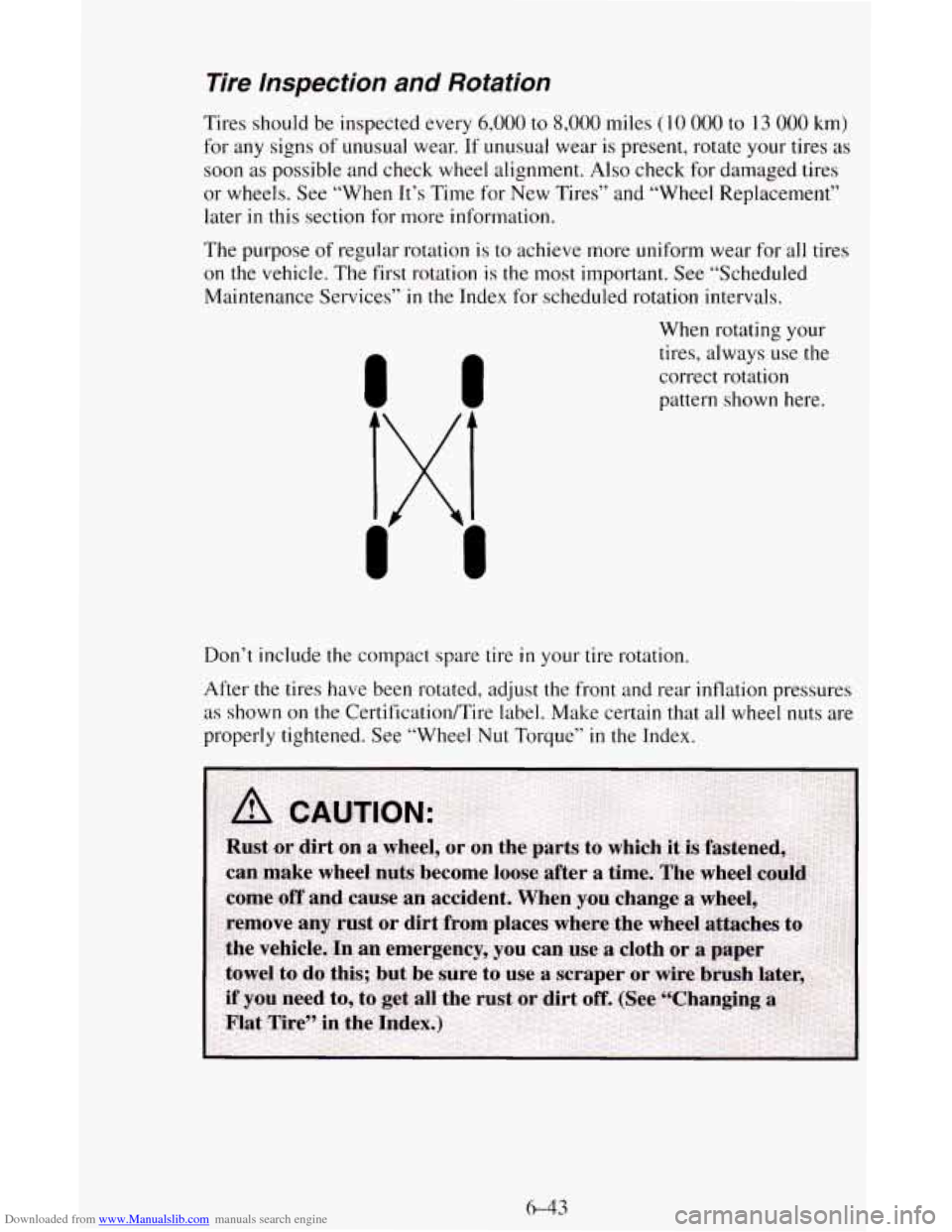
When rotating your tires, always use
the
correct rotation
pattern shown here.
Don’t include the compact spare tire
in your tire rotation.
After the tires have been rotated, adjust the front and rear inflation pressures
as shown on
the Certification/Tire label. Make certain that all wheel nuts are
properly tightened. See “Wheel
Nut Torque” in the Index.
6-43
Page 280 of 342
Downloaded from www.Manualslib.com manuals search engine I Schedule I Definition I
Follow Maintenance Schedule I if any one of these is true for your vehicle:
Most trips are less than 5 to 10 miles (8 to 16 km). This is particularly
important when outside temperatures are below freezing.
Most trips include extensive idling (such as frequent driving in stop and
Most trips are through dusty areas.
go traffic).
You frequently tow a trailer or use a carrier on top of your vehicle.
Schedule
I should also be followed if the vehicle is used for delivery
service, police, taxi,
or other commercial application.
I Schedule I Intervals I
Every 3,000 Miles (5 000 km) or 3 Months
Engine Oil and Filter Change
Chassis Lubrication
Drive Axle Service
At 6,000 Miles (10 OOO km) - Then Every 12,000 Miles (25 OOO km)
Tire Rotation
Every 15,000 Miles (25 000 km)
Air Cleaner Filter Inspection, if driving in dusty conditions
Front Wheel Bearing Repack
(or at each brake relining, whichever occurs
first)
(2WD Only)
Every 30,000 Miles (50 000 km)
Air Cleaner Filter Replacement
Spark Plug Replacement
Fuel Filter Replacement
Cooling System Service (or every
24 months, whichever occurs first)
Every 50,000 Miles (83 000 km)
Automatic Transmission Service (severe conditions only)
7-4
Page 281 of 342
Downloaded from www.Manualslib.com manuals search engine Every 60,000 Miles (100 000 km)
Engine Accessory Drive Belt Inspection
Spark Plug Wire Inspection
Engine Timing Check
Fuel Tank. CaD and Lines Inspection
Schedule 11 Definition I
Follow Schedule I1 only if none of the conditions from Schedule I is true.
Sohedule I1 Intervals
Every
7,500 Miles (12 500 km)
Engine Oil and Filter Change (or every 12 months, whichever occurs first)
Chassis Lubrication (or every 12 months, whichever occurs first)
Drive Axle Service
At 7,500 Miles (12 500 km) - Then Every 15,000 Miles (25 000 km)
Tire Rotation
Every 30,000 Miles (50 000 km)
Cooling System Service (or every 24 months, whichever occurs first)
Spark Plug Replacement
Fuel Filter Replacement
Air Cleaner Filter Replacement
Front Wheel Bearing Repack (or at each brake relining, whichever occurs
first
(2WD Only)
Every 50,000 Miles (83 000 km)
Automatic Transmission Service (severe conditions)
Every 60,000 Miles (100 000 km)
Spark Plug Wire Inspection
Engine Accessory Drive Belt Inspection
Fuel Tank, Cap and Lines Inspection
7-5
Page 282 of 342
Downloaded from www.Manualslib.com manuals search engine I Maintenance Schedule I
The services shown in this schedule up to 100,000 miles ( 166 000 km)
should be performed after 100,000 miles (166
000 km) at the same intervals.
Footnotes
f The California Air Resources Board has determined that the failure to
perform this maintenance item will not nullify the emission warranty or
limit recall liability prior to the completion of vehicle useful life. We,
however, urge that all recommended maintenance services be performed at
the indicated intervals and the maintenance be recorded.
** Drive axle service:
Locking Differential - Drain fluid and refill at first engine oil change.
At subsequent oil changes, check fluid level and add fluid as needed. If
driving in dusty areas or towing a trailer, drain fluid and refill every
15,000 miles (25 000 km).
Standard Differential - Check fluid level and add fluid as needed at
every oil change. If driving in dusty areas or towing a trailer, drain
fluid and refill every 15,000 miles
(25 000 km).
More frequent lubrication may be required for heavy-duty use.
3,000 Miles (5 000 km)
0 Change engine oil and filter (or every 3 months, whichever occurs
first).
An Emission Control Service.
Lubricate the front suspension, ball joints and king pin bushings,
steering linkage and transfer case shift linkage, parking brake cable
guides, and brake pedal springs at every oil change (or every
6 months,
whichever occurs first).
0 Check readfront axle fluid level and add fluid as needed. Check
constant velocity joints and axle seals
for leaking. **
I DATE I ACTUALMILEAGE I T~RVICED BY
7-6
Page 302 of 342
Downloaded from www.Manualslib.com manuals search engine Maintenance Schedule II
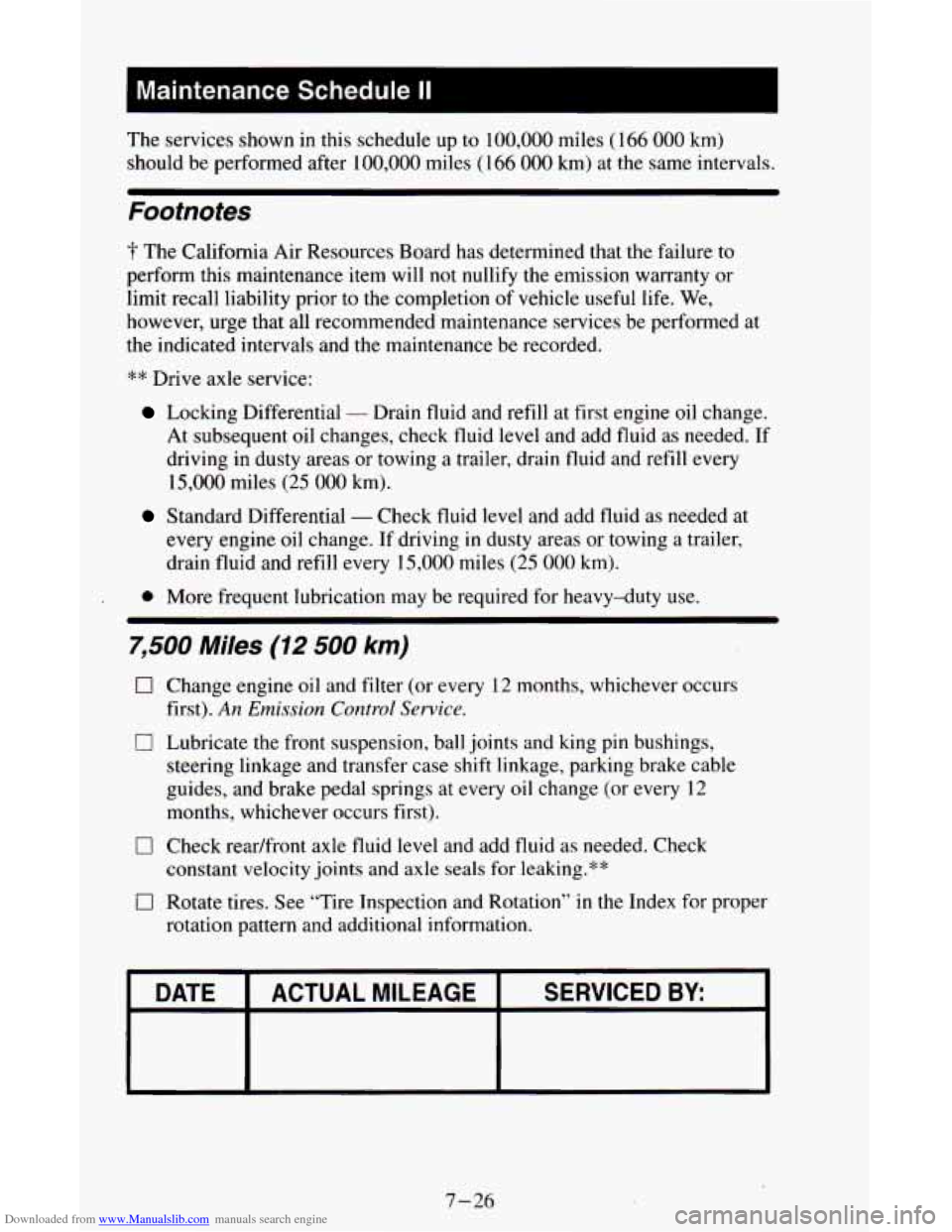
The services shown in this schedule up to 100,000 miles (166 000 km)
should be performed after
100,000 miles (1 66 000 km) at the same intervals.
Footnotes
3- The California Air Resources Board has determined that the failure to
perform this maintenance item will not nullify the emission warranty or
limit recall liability prior to the completion of vehicle useful life. We,
however, urge that all recommended maintenance services be performed at
the indicated intervals and the maintenance be recorded.
** Drive axle service:
Locking Differential - Drain fluid and refill at first engine oil change.
At subsequent oil changes, check fluid level and add fluid as needed. If
driving in dusty areas or towing a trailer, drain fluid and refill every
15,000 miles (25 000 km).
Standard Differential - Check fluid level and add fluid as needed at
every engine oil change. If driving
in dusty areas or towing a trailer,
drain fluid and refill every
15,000 miles (25 000 km).
0 More frequent lubrication may be required for heavy-duty use.
7,500 Miles (12 500 km)
0 Change engine oil and filter (or every 12 months, whichever occurs
0 Lubricate the front suspension, ball joints and king pin bushings,
steering linkage and transfer case shift linkage, parking brake cable
guides, and brake pedal springs at every oil change (or every 12
months, whichever occurs first).
0 Check readfront axle fluid level and add fluid as needed. Check
first).
An Emission Control Service.
constant
velocity joints and axle seals for leaking.**
0 Rotate tires. See “Tire Inspection and Rotation” in the Index for proper
rotation pattern and additional information.
DATE SERVICED BY: ACTUAL MILEAGE
7-26
Page 311 of 342
Downloaded from www.Manualslib.com manuals search engine I Maintenance Schedule II I
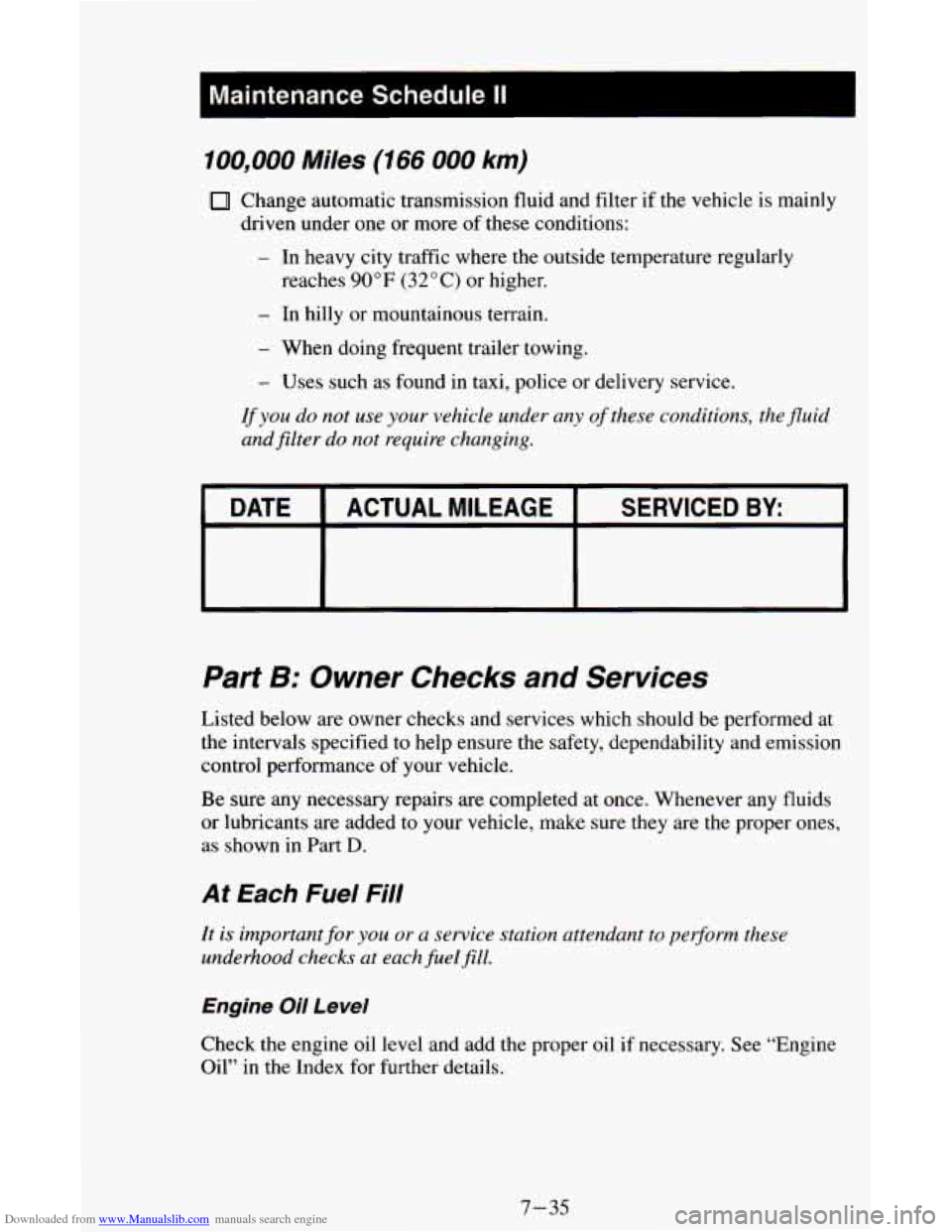
100,000 Miles (166 000 km)
Change automatic transmission fluid and filter if the vehicle is mainly
- In heavy city traffic where the outside temperature regularly
reaches
90°F (32°C) or higher.
- In hilly or mountainous terrain.
- When doing frequent trailer towing.
- Uses such as found in taxi, police or delivery service.
driven
under one
or more of these conditions:
If you do not use your vehicle under any of these conditions, the fluid
and filter do not require changing.
DATE
SERVICED BY: ACTUAL MILEAGE
Part 9: vwner Checks and Services
Listed below are owner checks and services which should be performed at
the intervals specified to help ensure the safety, dependability and emission
control performance
of your vehicle.
Be sure any necessary repairs are completed at once. Whenever any fluids
or lubricants are added to your vehicle, make sure they are the proper ones,
as shown
in Part D.
At Each Fuel Fill
It is important for you or a service station attendant to pegorm these
underhood checks at each fuel
fill.
Engine Oil Level
Check the engine oil level and add the proper oil if necessary. See “Engine
Oil” in the Index for further details.
7-35
Page 315 of 342
Downloaded from www.Manualslib.com manuals search engine Part C: Periodic Maintenance Inspections
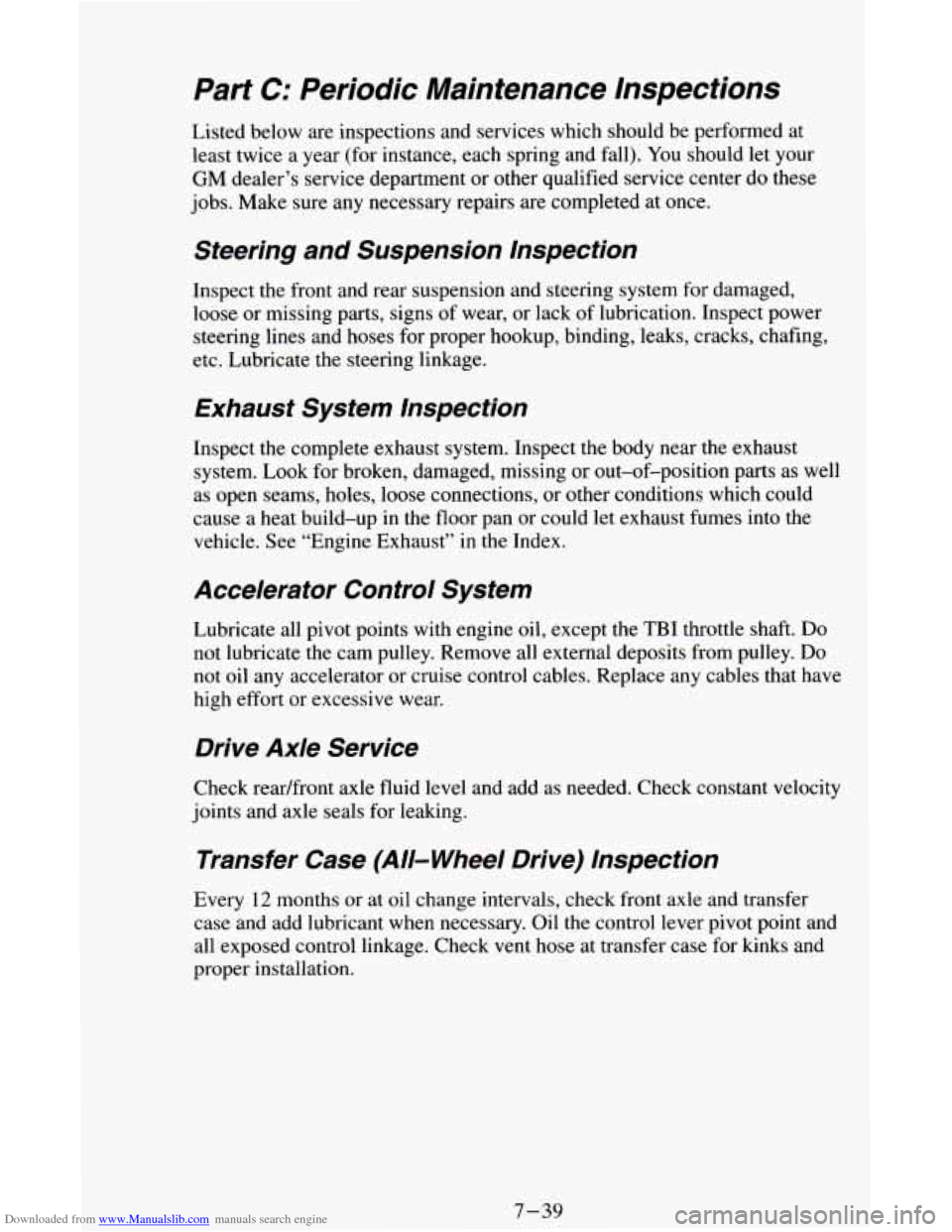
Listed below are inspections and services which should be performed at
least twice a year (for instance, each spring and fall). You should let your
GM dealer’s service department or other qualified service center \
do these
jobs. Make sure any necessary repairs are completed
at once.
Steering and Suspension Inspection
Inspect the front and rear suspension and steering system for damaged,
loose or missing parts, signs of wear, or lack of lubrication. Inspect power
steering lines and hoses for proper hookup, binding, leaks, cracks, chafing,
etc. Lubricate the steering linkage.
Exhaust System Inspection
Inspect the complete exhaust system. Inspect the body near the exhaust
system.
Look for broken, damaged, missing or out-of-position parts as well
as open seams, holes, loose connections, or other conditions which could
cause a heat build-up in the floor pan
or could let exhaust fumes into the
vehicle. See “Engine Exhaust”
in the Index.
Accelerator Control System
Lubricate all pivot points with engine oil, except the TBI throttle shaft. Do
not lubricate the cam pulley. Remove all external deposits from pulley. Do
not oil any accelerator or cruise control cables. Replace any cables that have
high effort or excessive wear.
Drive Axle Service
Check readfront axle fluid level and add as needed. Check constant velocity
joints and axle seals for leaking.
Transfer Case (AI/- Wheel Drive) Inspection
Every 12 months or at oil change intervals, check front axle and transfer
case and add lubricant when necessary.
Oil the control lever pivot point and
all exposed control linkage. Check vent hose at transfer case for kinks and
proper installation.
7-39
Page 318 of 342
Downloaded from www.Manualslib.com manuals search engine Part E: Maintenance Record
After the scheduled services are performed, record the date, odometer
reading and who performed the service
in the boxes provided after the
maintenance interval. Any additional information from “Owner Checks and
Services” or “Periodic Maintenance” can be added
on the following record
pages. Also,
you should retain all maintenance receipts. Your owner
information portfolio is a convenient place
to store them.
7-42