Page 68 of 342
Downloaded from www.Manualslib.com manuals search engine Ignition Switch
2
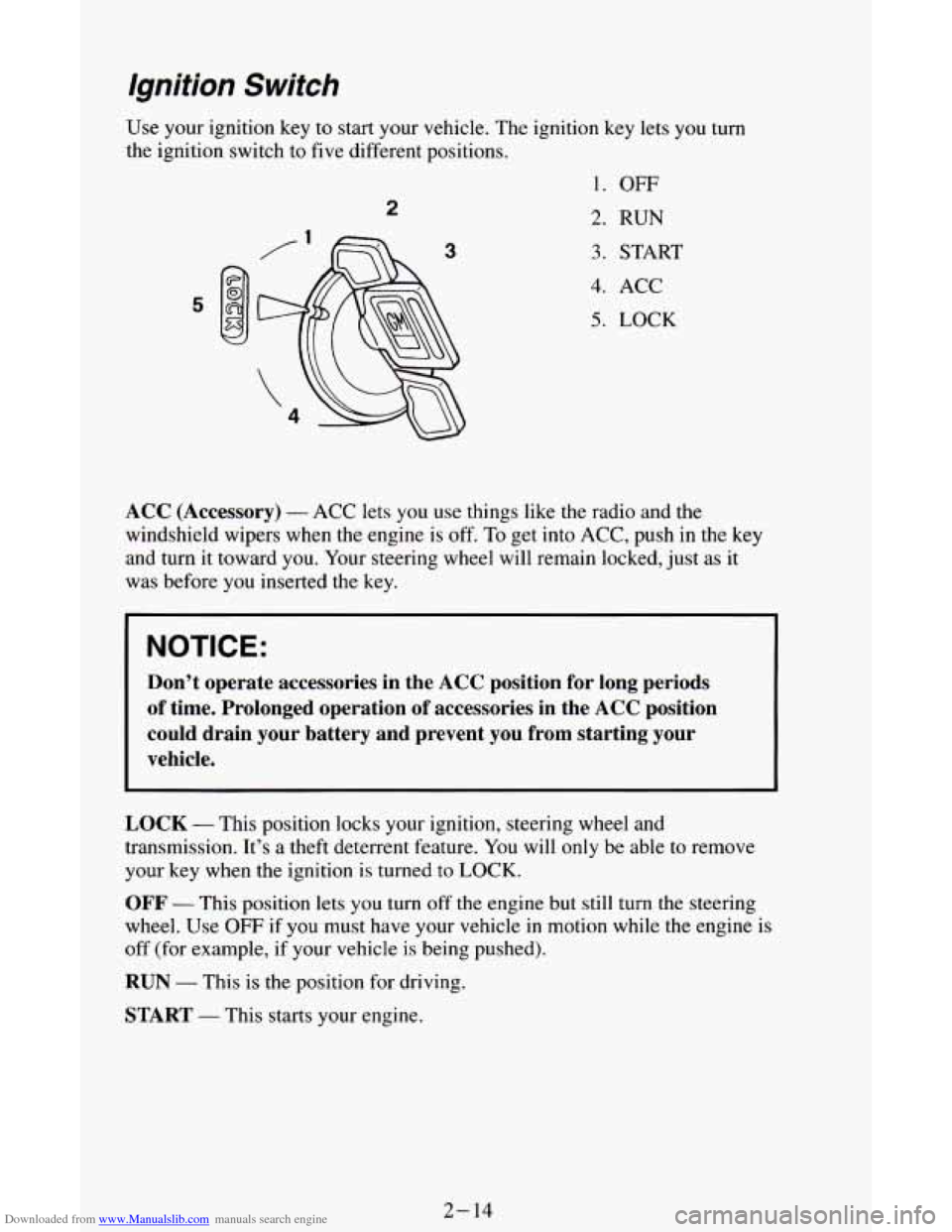
Use your ignition key to start your vehicle. The ignition key lets you turn
the ignition switch to five different positions.
1. OFF
2. RUN
3. START
4. ACC
5. LOCK 5
ACC (Accessory) - ACC lets you use things like the radio and the
windshield wipers when the engine is
off. To get into ACC, push in the key
and turn it toward you. Your steering wheel will remain locked, just
as it
was before you inserted
the key.
NOTICE:
Don’t operate accessories in the ACC position for long perio\
ds
of time. Prolonged operation of accessories in the ACC position
could drain your battery and prevent you from starting your
vehicle.
LOCK
- This position locks your ignition, steering wheel and
transmission. It’s
a theft deterrent feature. You will only be able to remove
your key when the ignition is turned
to LOCK.
OFF - This position lets you turn off the engine but still turn the steering
wheel. Use
OFF if you must have your vehicle in motion while the engine is
off (for example, if your vehicle is being pushed).
RUN - This is the position for driving.
START - This starts your engine.
2- 14
Page 69 of 342
Downloaded from www.Manualslib.com manuals search engine NOTICE:
If your key seems stuck in LOCK and you can’t turn it, be sure
it is
all the way in. If it is, then turn the steering wheel left and
right while you turn the key hard. But turn the key only with
your hand. Using
a tool to force it could break the key or the
ignition switch.
If none of this works, then your vehicle needs
service.
Starting Your Engine
Move your shift lever to PARK (P) or NEUTRAL (N). Your engine won’t
start
in any other position - that’s a safety feature. To restart when you’re
already moving, use
NEUTRAL (N) only.
NOTICE:
Don’t try to shift to PARK (P) if your vehicle is moving. If you
do, you could damage the transmission. Shift to PARK
(P) only
when your vehicle is stopped.
1. Without pushing the accelerator pedal, turn your ignition key to
START. When the engine starts, let go of the key. The idle speed will
go down
as your engine gets warm.
NOTICE:
Holding your key in START for longer than 15 seconds at a time
will cause your battery
to be drained much sooner. And the
excessive heat can damage your starter motor.
2. If it doesn’t start right away, hold your key in START. If it doesn’t start
in ten seconds, push the accelerator pedal about one-quarter of the way
down
for five more seconds, or until it starts.
2-15
Page 102 of 342
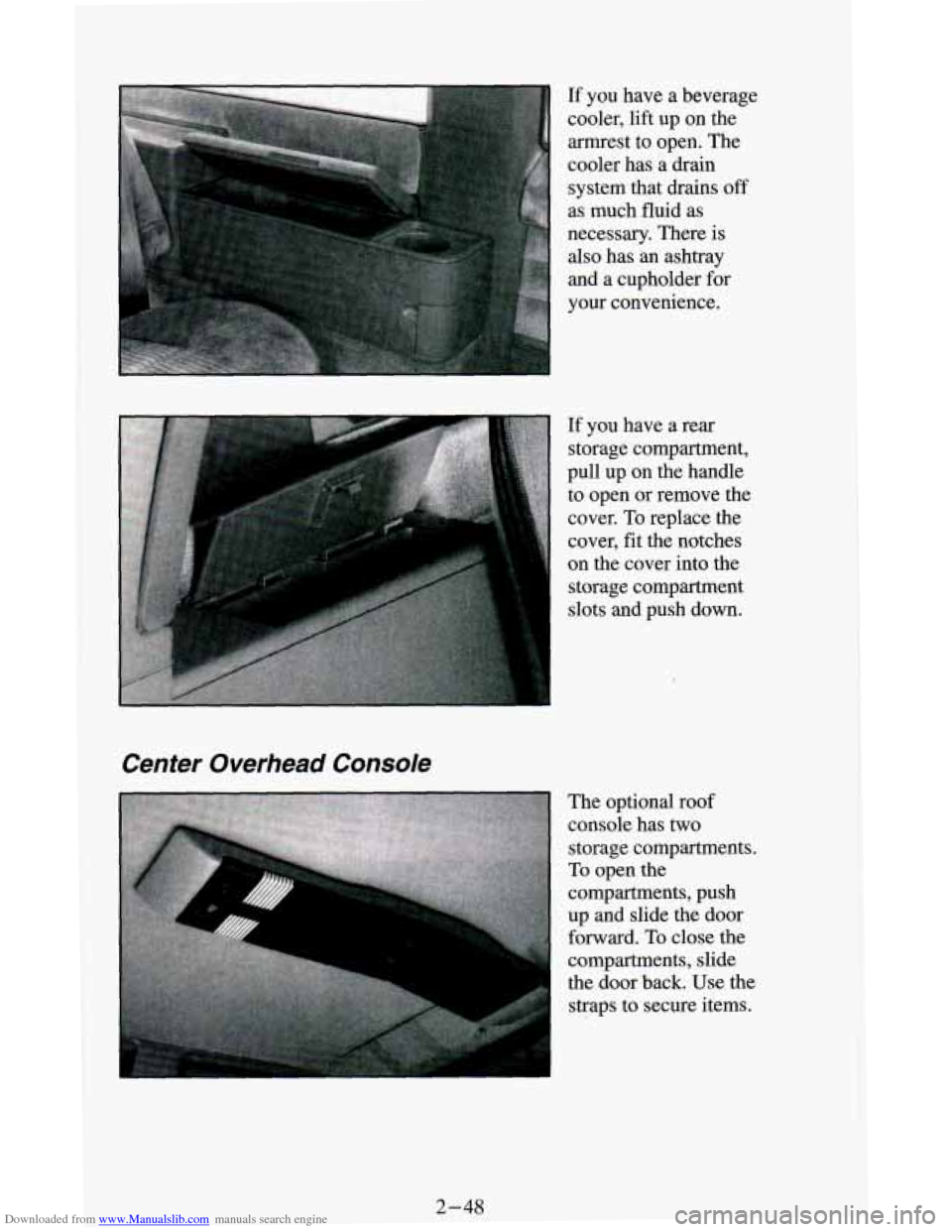
Downloaded from www.Manualslib.com manuals search engine If you have a beverage
cooler, lift up on the
armrest to open. The
cooler has a drain
system that drains
off
as much fluid as
necessary. There is
also has an ashtray
and a cupholder for
your convenience.
Center Overhead Console
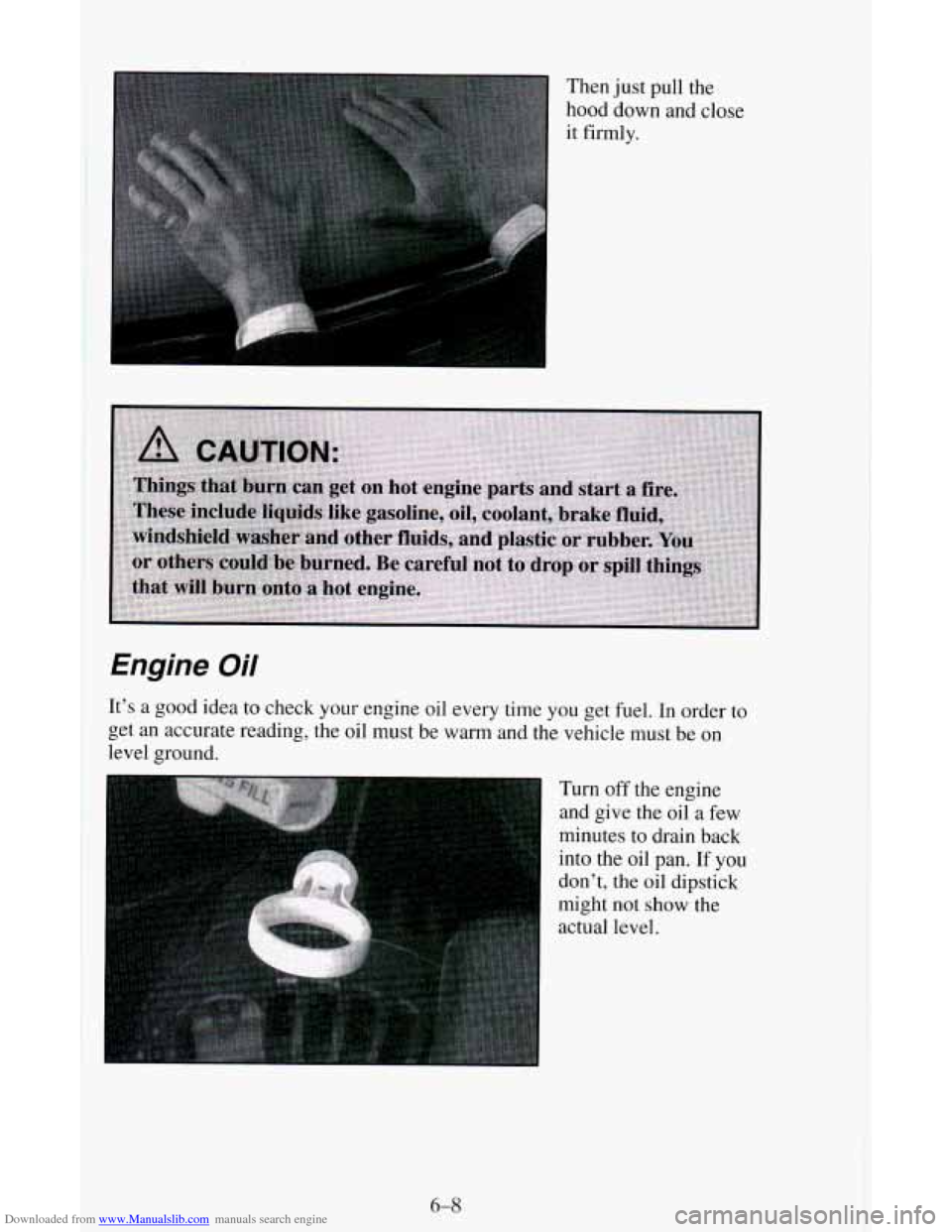
If you have a rear
storage compartment,
pull up on the handle
to open or remove the
cover.
To replace the
cover, fit the notches
on the cover into the
storage compartment
I slots and push down.
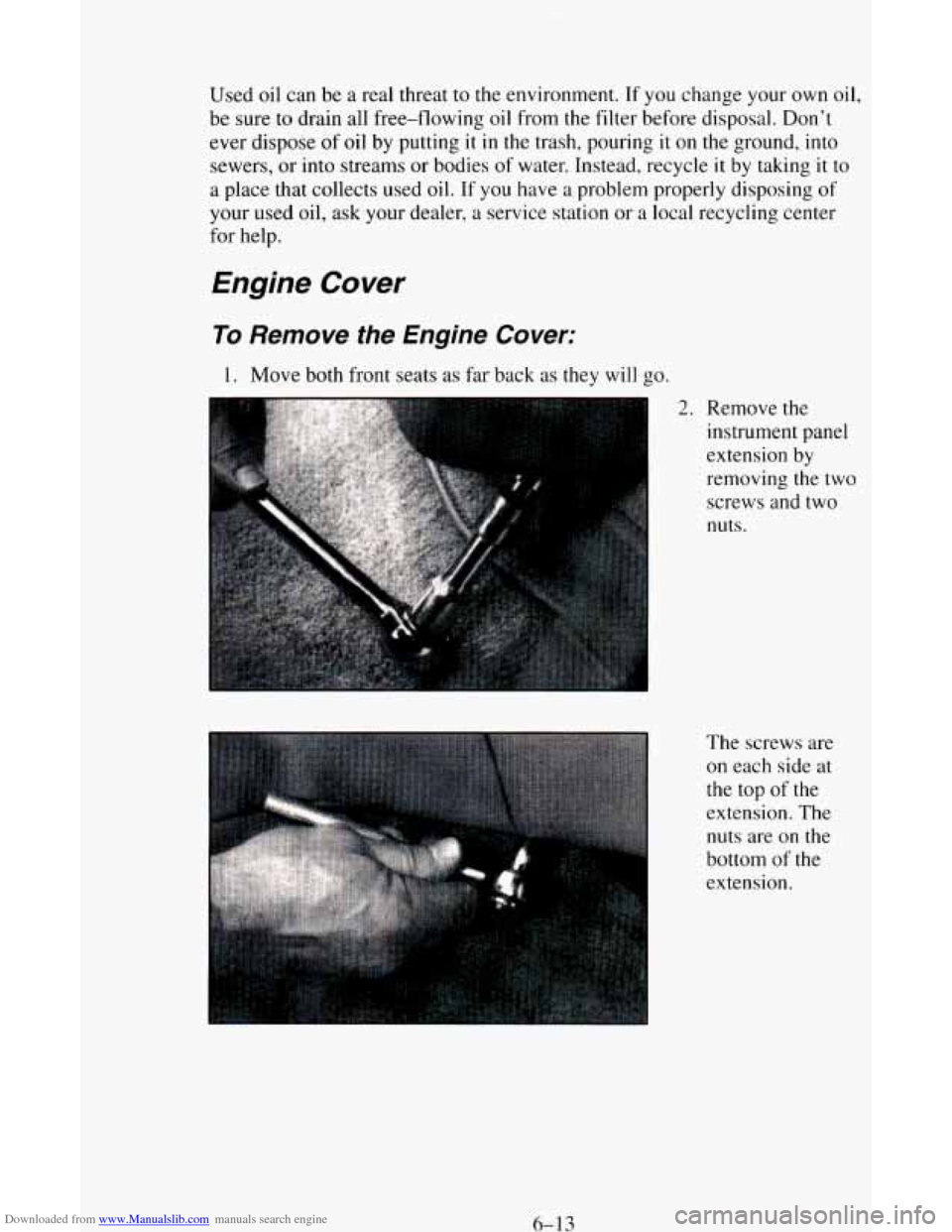
The optional roof
console has two
storage compartments.
To open the
compartments, push
up and slide the door
forward.
To close the
compartments, slide
the door back. Use the
straps to secure items.
2-48
Page 110 of 342
Downloaded from www.Manualslib.com manuals search engine Charging System Light
Standard Cluster
m
Digital Cluster
1
I
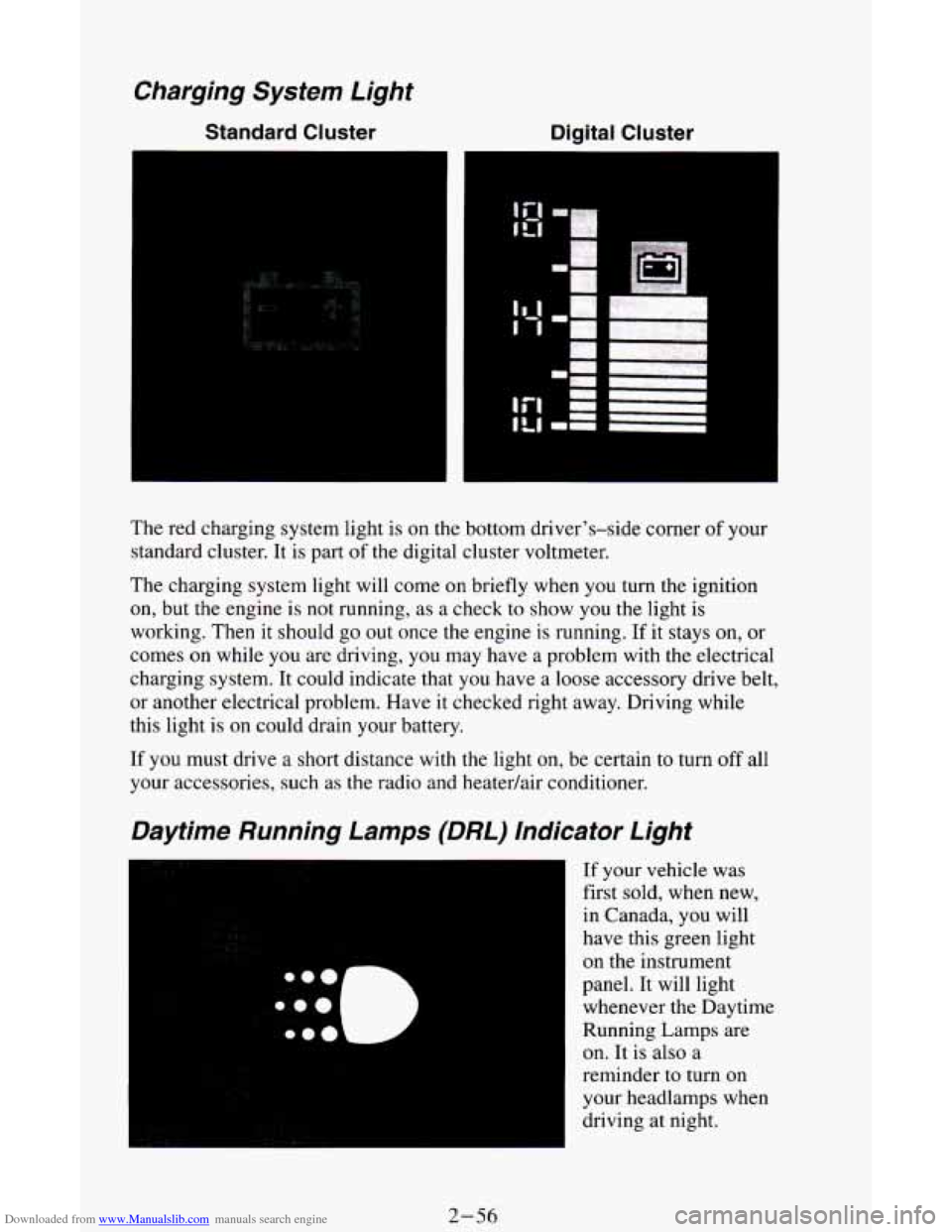
The red charging system light is on the bottom driver's-side corner of your
standard cluster. It is part
of the digital cluster voltmeter.
The charging system light will come on briefly when you
turn the ignition
on, but the engine is not running, as a check
to show you the light is
working.
Then it should go out once the engine is running. If it stays on, or
comes
on while you are driving, you may have a problem with the electrical
charging system. It could indicate that you have a loose accessory drive belt,
or another electrical problem. Have it checked right away. Driving while
this light is
on could drain your battery.
If you must drive
a short distance with the light on, be certain to turn off all
your accessories, such as the radio and heatedair conditioner.
Daytime Running Lamps (DRL) Indicator Light
If your vehicle was
first sold, when new,
in Canada, you will
have this green light
on the instrument
panel. It will light
whenever the Daytime
Running Lamps are
on.
It is also a
reminder to turn on
your headlamps when
driving at night.
2-56
Page 216 of 342
Downloaded from www.Manualslib.com manuals search engine Then just pull the
hood down and close
it firmly.
Engine Oil
It’s a good idea to check your engine oil every time you get fuel. In order to
get an accurate reading, the oil must be warm and the vehicle must be on
level ground.
- Turn off the engine
and give the oil a few
minutes to drain back
into the oil pan. If you
don’t, the oil dipstick
might not show the
actual level.
6-8
Page 221 of 342
Downloaded from www.Manualslib.com manuals search engine Used oil can be a real threat to the environment. If you change your own oil,
be sure to drain all free-flowing
oil from the filter before disposal. Don’t
ever dispose
of oil by putting it in the trash, pouring it on the ground, into
sewers, or into streams or bodies
of water. Instead, recycle it by taking it to
a place that collects used oil. If you have a problem properly disposing of
your used oil, ask your dealer, a service station
or a local recycling center
for help.
Engine Cover
To Remove the Engine Cover:
1. Move both front seats as far back as they will go.
I 2. Remove the
instrument panel
extension by
removing the two
screws and two
nuts.
The screws are
on each side at
the top of the
extension. The
nuts are on the
bottom
of the
extension.
6-1 3
Page 282 of 342
Downloaded from www.Manualslib.com manuals search engine I Maintenance Schedule I
The services shown in this schedule up to 100,000 miles ( 166 000 km)
should be performed after 100,000 miles (166
000 km) at the same intervals.
Footnotes
f The California Air Resources Board has determined that the failure to
perform this maintenance item will not nullify the emission warranty or
limit recall liability prior to the completion of vehicle useful life. We,
however, urge that all recommended maintenance services be performed at
the indicated intervals and the maintenance be recorded.
** Drive axle service:
Locking Differential - Drain fluid and refill at first engine oil change.
At subsequent oil changes, check fluid level and add fluid as needed. If
driving in dusty areas or towing a trailer, drain fluid and refill every
15,000 miles (25 000 km).
Standard Differential - Check fluid level and add fluid as needed at
every oil change. If driving in dusty areas or towing a trailer, drain
fluid and refill every 15,000 miles
(25 000 km).
More frequent lubrication may be required for heavy-duty use.
3,000 Miles (5 000 km)
0 Change engine oil and filter (or every 3 months, whichever occurs
first).
An Emission Control Service.
Lubricate the front suspension, ball joints and king pin bushings,
steering linkage and transfer case shift linkage, parking brake cable
guides, and brake pedal springs at every oil change (or every
6 months,
whichever occurs first).
0 Check readfront axle fluid level and add fluid as needed. Check
constant velocity joints and axle seals
for leaking. **
I DATE I ACTUALMILEAGE I T~RVICED BY
7-6
Page 287 of 342
Downloaded from www.Manualslib.com manuals search engine Maintenance Schedule I
30,000 Miles (50 000 km)
0
0
0
0
0
0
Change engine oil and filter (or every 3 months, whichever occurs
first).
An Emission Control Service.
Lubricate the front suspension, ball joints and king pin bushings,
steering linkage and transfer case shift linkage, parking brake cable
guides, and brake pedal springs at every
oil change (or every 6 months,
whichever occurs first).
Check redfront axle fluid
level and add fluid as needed. Check
constant velocity joints and
axle seals for leaking.**
Drain, flush and refill cooling system
(or every 24 months, whichever
occurs first). See “Engine Coolant’’
in the Index for what to use.
Inspect hoses. Clean radiator, condenser, pressure cap and neck.
Pressure test
the cooling system and pressure cap. An Emission
Control Service.
For 2-Wheel Drive vehicles only: Clean and repack the front wheel
bearings (or at each brake relining, whichever occurs first).
Replace spark plugs.
An Emission Control Service.
Replace fuel filter. An Emission Control Service.
Replace air cleaner filter. Replace filter more often under dusty
conditions. An Emission Control Service.
Rotate tires. See “Tire Inspection and Rotation” in the Index for proper
rotation pattern and additional information.
I DATE I ACTUALMILEAGE I SERVICED BY: I
7-1 1