Page 170 of 342
Downloaded from www.Manualslib.com manuals search engine Driving On Grades
Reduce speed and shift to a lower gear before you start down a long or steep
downgrade. If
you don’t shift down, you might have to use your brakes so
much that they would get hot and no longer work well.
On a long uphill grade, shift down and reduce your speed to around
45 mph
(70 km/h) to reduce the possibility of engine and transmission overheating.
When towing at high altitude
on steep uphill grades, consider the following:
Engine coolant will boil at
a lower temperature than at normal altitudes. If
you turn your engine off immediately after towing at high altitude on steep
uphill grades, your vehicle may show signs similar to engine overheating.
To avoid this, let the engine run while parked (preferably on level ground)
with the automatic transmission
in PARK (P) for a few minutes before
turning the engine off. If you do get the overheat warning, see “Engine
Overheating”
in the Index.
Parking on Hills
You really should not park your vehicle, with a trailer attached, on a hill. If
something goes wrong, your rig could start to move. People can be injured,
and both your vehicle and the trailer can be damaged.
But if
you ever have to park your rig on a hill, here’s how to do it:
1. Apply your regular brakes, but don’t shift into PARK (P) yet. Turn your
wheels into the curb when facing downhill and away from the curb
when facing uphill.
2. Have someone place chocks under the trailer wheels.
3. When the wheel chocks are in place, release the regular brakes until the
chocks absorb the load.
4. Reapply the regular brakes, Then apply your parking brake, and shift to
5. Release the regular brakes.
PARK (P).
When You Are Ready to Leave After Parking on a Hill
1. Apply your regular brakes and hold the pedal down while you:
Start your engine;
Shift into a gear; and
0 Release the parking brake.
2. Let up on the brake pedal.
3. Drive slowly until the trailer is clear of the chocks.
4. Stop and have someone pick up and store the chocks.
4-32
Page 171 of 342
Downloaded from www.Manualslib.com manuals search engine Maintenance When Trailer Towing
Your vehicle will need service more often when you’re pulling a trailer. See
the Maintenance Schedule for more
on this. Things that are especially
important in trailer operation are automatic transmission fluid (don’t
overfill), engine oil, axle lubricant, belt, cooling system, and brake
adjustment. Each of these is covered in this manual, and the Index will help
you find them quickly. If you’re trailering, it’s a good idea to review these
sections before you start your trip.
Check periodically to see that all hitch nuts and bolts are tight.
Trailer Lighting Systems Wiring
See “Trailer Wiring Harness” in the Index.
4-33
Page 179 of 342
Downloaded from www.Manualslib.com manuals search engine Towing Your Vehicle
Try to have a GM dealer or a professional towing service tow your vehicle.
They can provide the right equipment and know how to tow
it without
damage.
If your vehicle has been changed
or modified since it was factory-new by
adding aftermarket items like fog lamps, aero skirting, or special tires and
wheels, these things can be damaged during towing.
Before
you do anything, turn on the hazard warning flashers.
When
you call, tell the towing service:
0 Whether your vehicle has rear-wheel drive or the all-wheel-drive
option. If your vehicle has fog lamps, it cannot be towed from the front
with sling-type equipment.
The make, model, and year of your vehicle.
0 Whether you can still move the shift lever.
0 If there was an accident, what was damaged.
When your vehicle
is being towed, have the ignition key off. The steering
wheel should be clamped in a straight-ahead position, with
a clamping
device designed for towing service.
Do not use the vehicle’s steering
column lock for this.
The transmission should be in NEUTRAL (N) and the
parking brake released.
5-7
Page 180 of 342
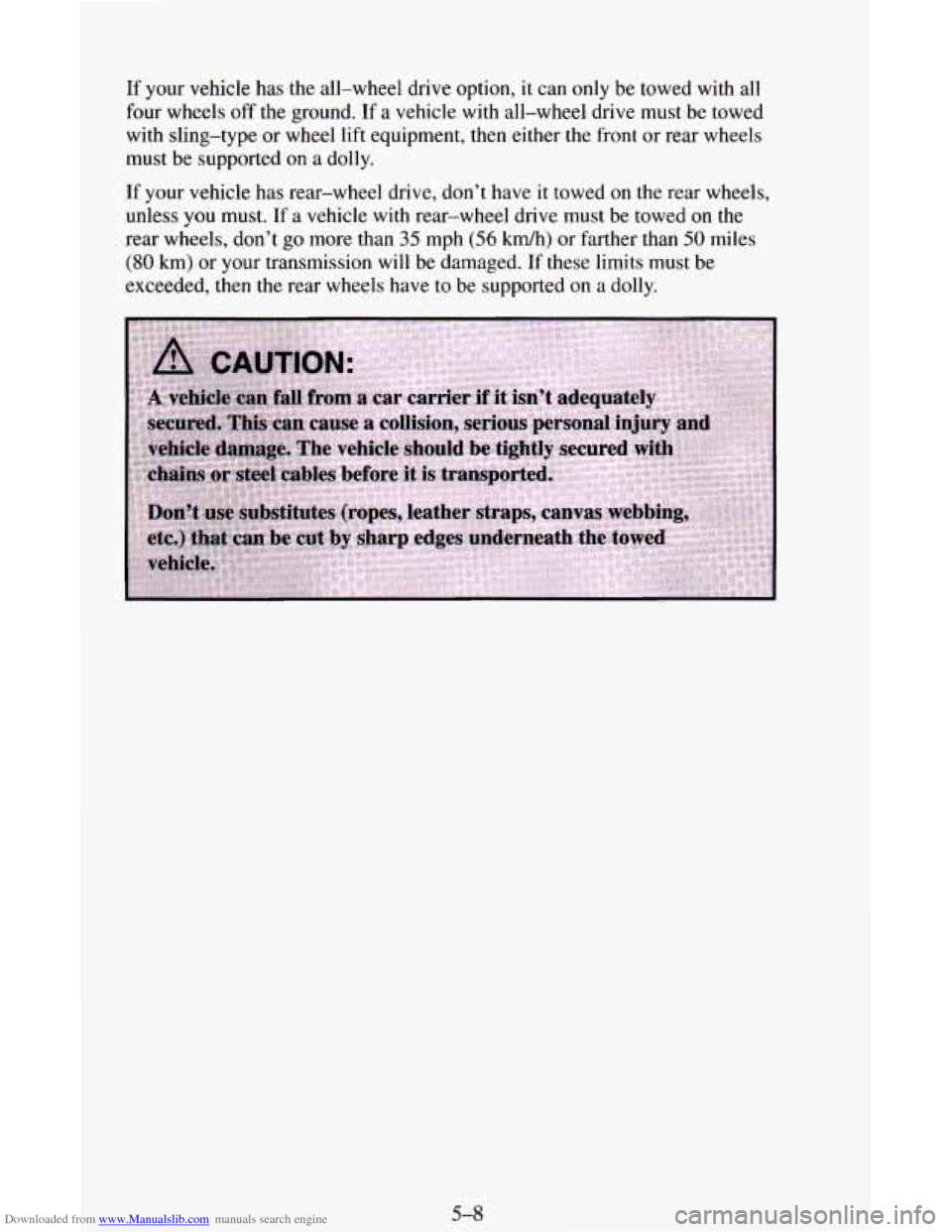
Downloaded from www.Manualslib.com manuals search engine If your vehicle has the all-wheel drive option, it can only be towed with all
four wheels off the ground. If a vehicle with all-wheel drive must be towed
with sling-type or wheel lift equipment, then either the front
or rear wheels
must be supported
on a dolly.
If your vehicle has rear-wheel drive, don’t have it towed on the rear wheels,
unless
you must. If a vehicle with rear-wheel drive must be towed on the
rear wheels, don’t go more than
35 mph (54 km/h) or farther than 50 miles
(80 km) or your transmission will be damaged. If these limits must be
exceeded, then the rear wheels have
to be supported on a dolly.
5-8
Page 181 of 342
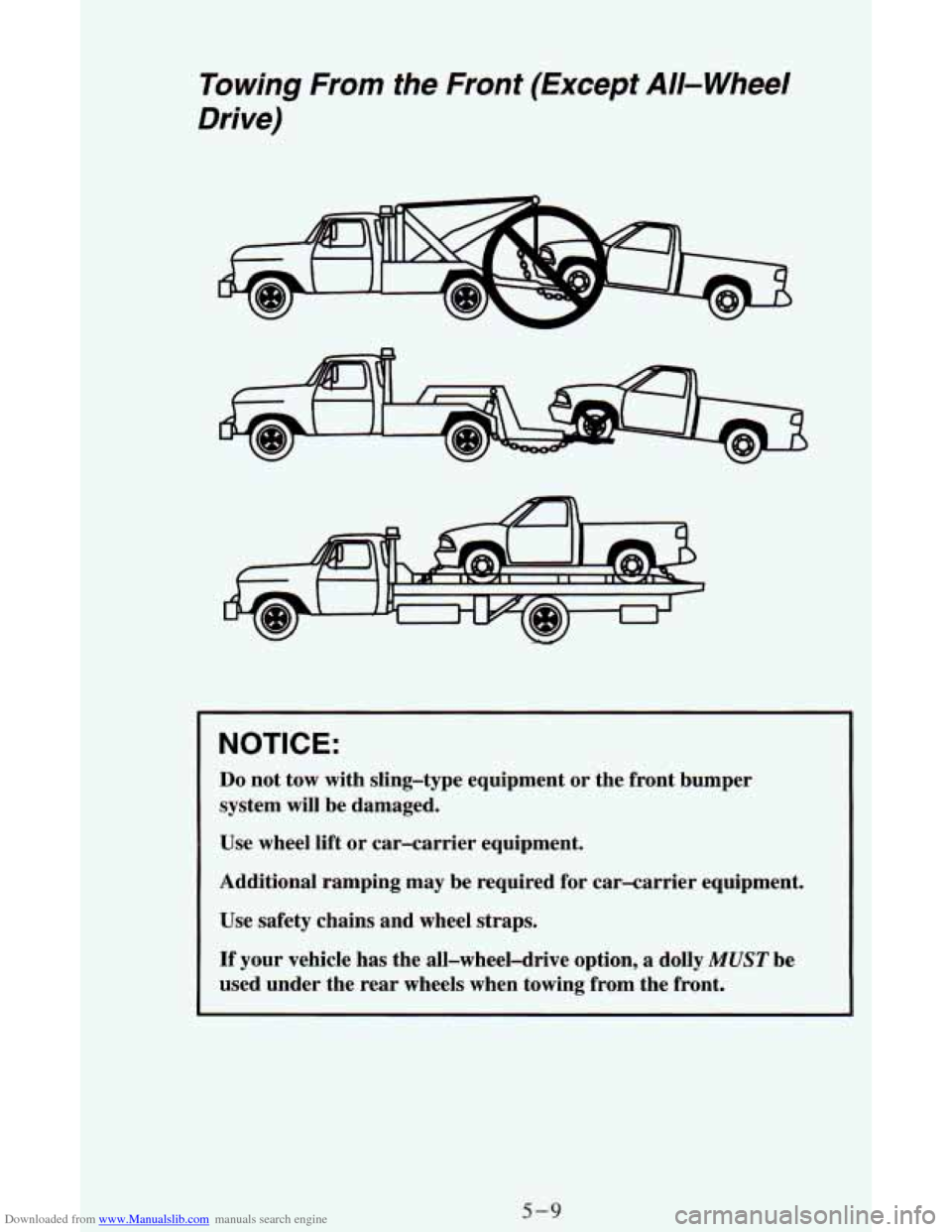
Downloaded from www.Manualslib.com manuals search engine Towing From the Front (Except All-Wheel
Drive)
NOTICE:
Do not tow with sling-type equipment or the front bumper
system will be damaged.
Use wheel lift or car-carrier equipment.
Additional ramping may be required for car-carrier equipment.
Use safety chains and wheel straps.
If your vehicle has the all-wheel-drive option, a dolly MUST be
used under the rear wheels when towing from the front.
5-9
Page 182 of 342
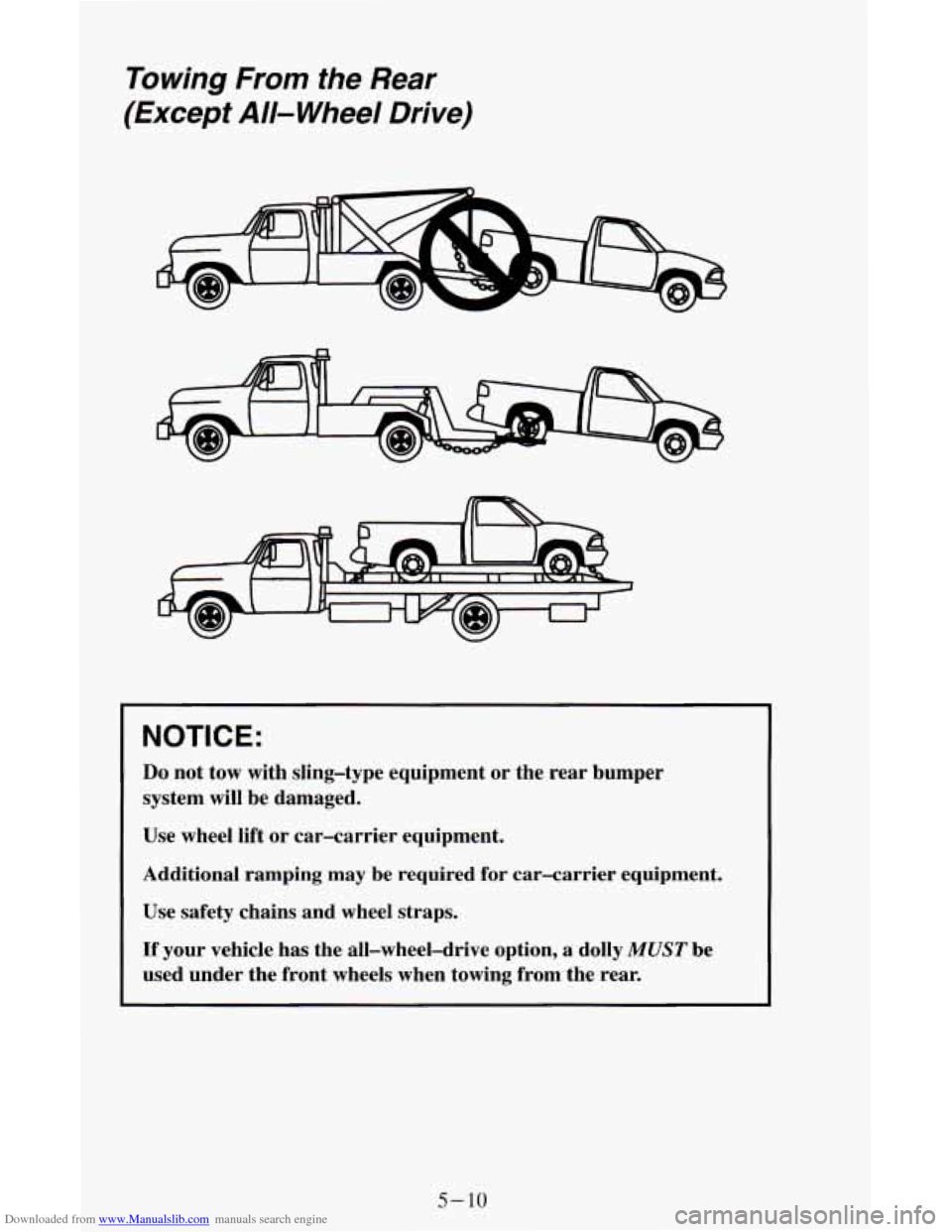
Downloaded from www.Manualslib.com manuals search engine Towing From the Rear
(Except
All- Wheel Drive)
NOTICE:
Do not tow with sling-type equipment or the rear bumper
system will be damaged.
Use wheel lift
or car-carrier equipment.
Additional ramping may be required for car-carrier equipment. Use safety chains
and wheel straps.
If your vehicle has the all-wheel-drive option, a dolly MUST be
used under the front wheels when towing
from the rear.
5-10
Page 183 of 342
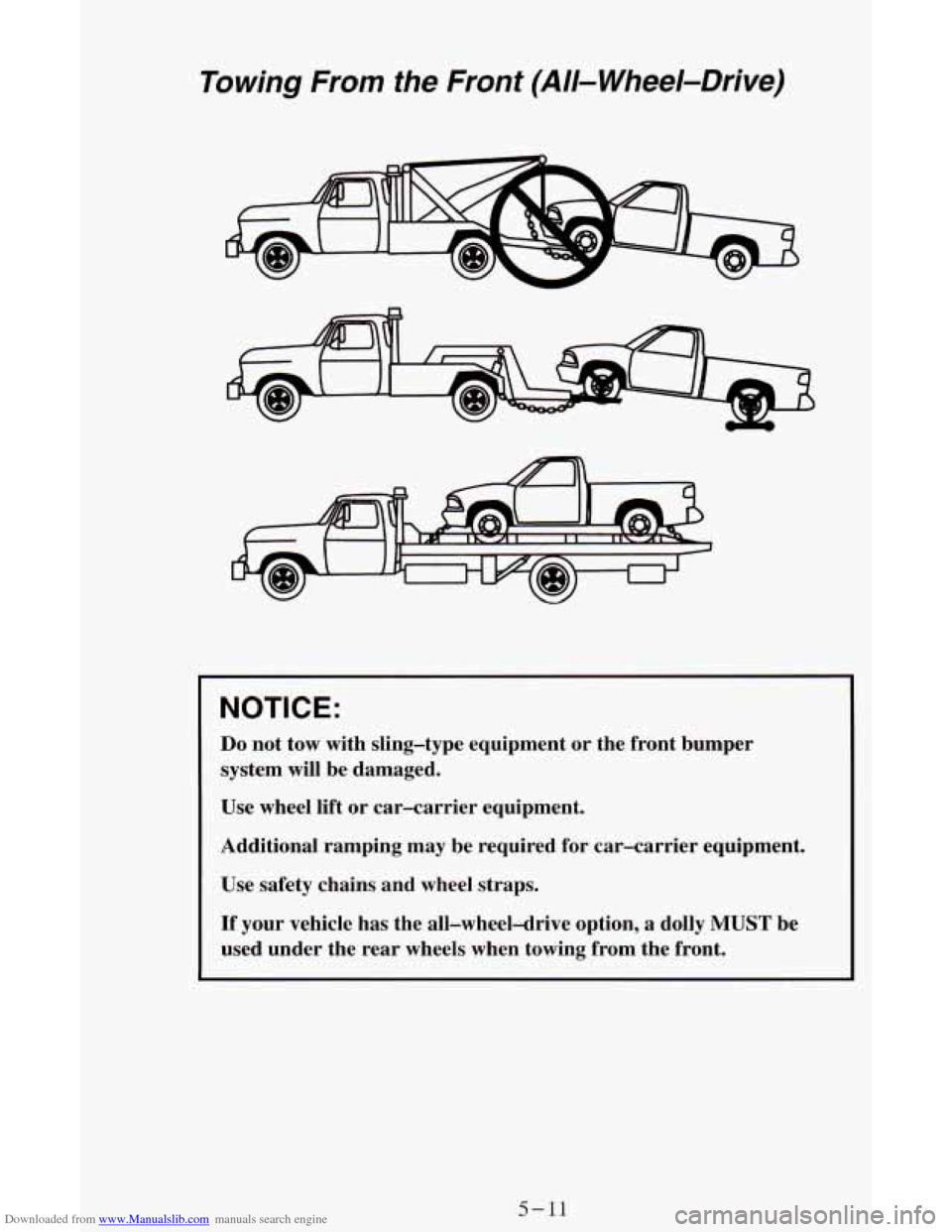
Downloaded from www.Manualslib.com manuals search engine Towing From the Front (All- Wheel-Drive)
NOTICE:
Do not tow with sling-type equipment or the front bumper
system will be damaged.
Use wheel lift or car-carrier equipment.
Additional ramping may be required for car-carrier equipment.
Use safety chains and wheel straps.
If your vehicle has the all-wheel-drive option, a dolly MUST be
used under the rear wheels when towing from the front.
5-11
Page 184 of 342
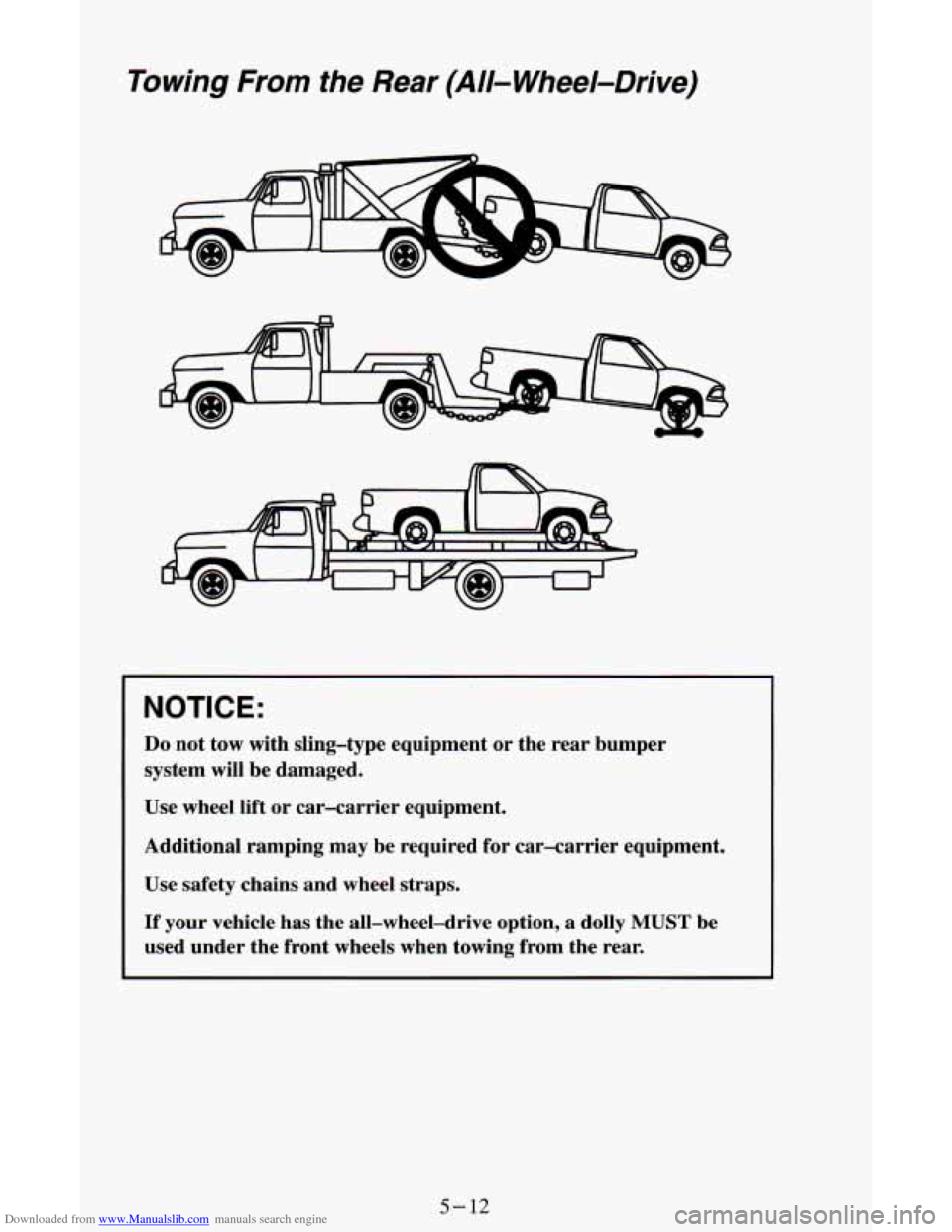
Downloaded from www.Manualslib.com manuals search engine To wing From the Rear (All- Wheel-Drive)
NOTICE:
Do not tow with sling-type equipment or the rear bumper
system will be damaged.
Use wheel lift or car-carrier equipment.
Additional ramping may be required for car-carrier equipment.
Use safety chains and wheel straps.
If your vehicle has the all-wheel-drive option, a dolly MUST be
used under the front wheels when towing from the rear.
5-12