Page 69 of 342
Downloaded from www.Manualslib.com manuals search engine NOTICE:
If your key seems stuck in LOCK and you can’t turn it, be sure
it is
all the way in. If it is, then turn the steering wheel left and
right while you turn the key hard. But turn the key only with
your hand. Using
a tool to force it could break the key or the
ignition switch.
If none of this works, then your vehicle needs
service.
Starting Your Engine
Move your shift lever to PARK (P) or NEUTRAL (N). Your engine won’t
start
in any other position - that’s a safety feature. To restart when you’re
already moving, use
NEUTRAL (N) only.
NOTICE:
Don’t try to shift to PARK (P) if your vehicle is moving. If you
do, you could damage the transmission. Shift to PARK
(P) only
when your vehicle is stopped.
1. Without pushing the accelerator pedal, turn your ignition key to
START. When the engine starts, let go of the key. The idle speed will
go down
as your engine gets warm.
NOTICE:
Holding your key in START for longer than 15 seconds at a time
will cause your battery
to be drained much sooner. And the
excessive heat can damage your starter motor.
2. If it doesn’t start right away, hold your key in START. If it doesn’t start
in ten seconds, push the accelerator pedal about one-quarter of the way
down
for five more seconds, or until it starts.
2-15
Page 72 of 342
Downloaded from www.Manualslib.com manuals search engine How long should you keep the coolant heater plugged in? The answer
depends
on the weather, the kind of oil you have, and some other things.
Instead
of trying to list everything here, we ask that you contact your GM
dealer in the area where you’ll be parking your vehicle. The dealer can give
you the best advice for that particular area.
Automatic Transmission
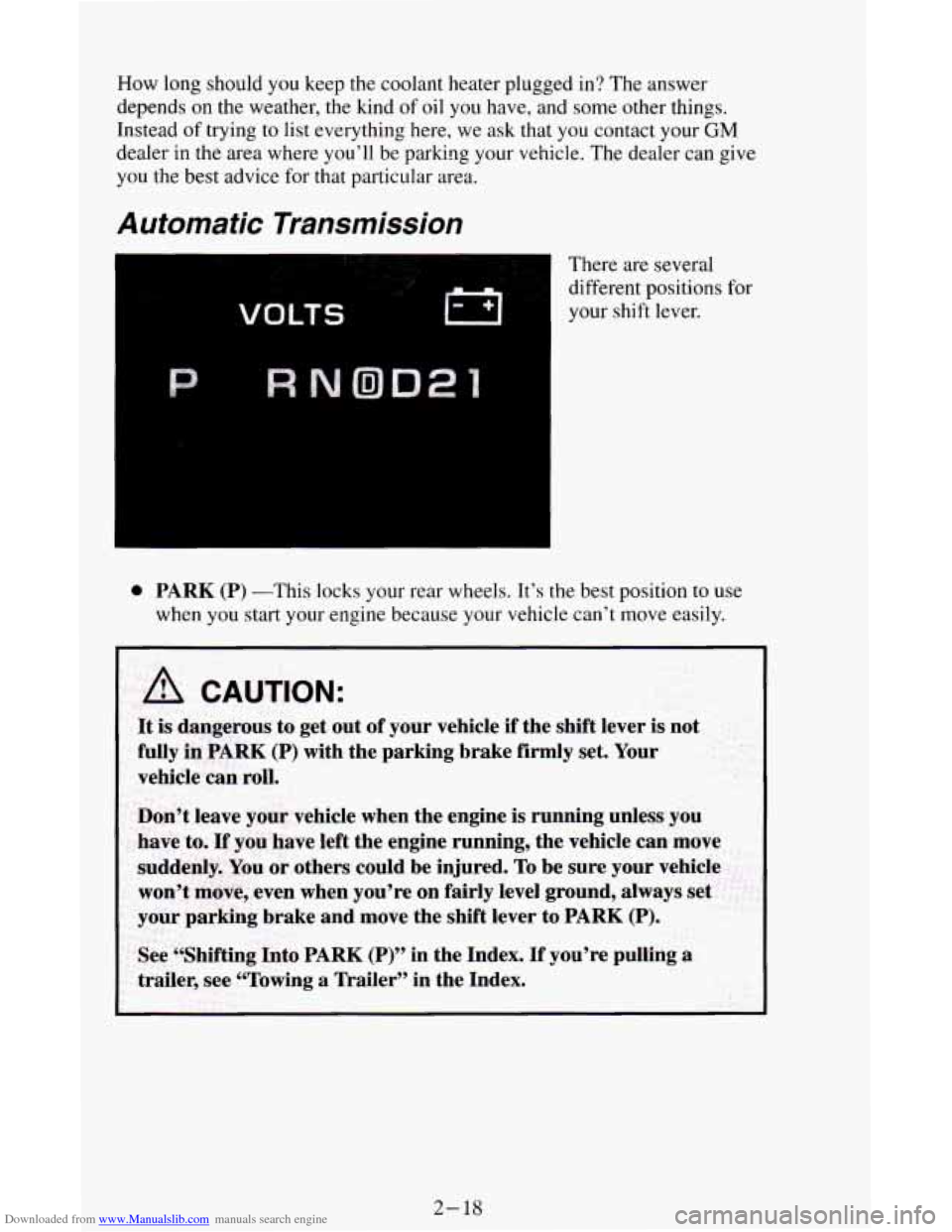
There are several
different positions for
your shift lever.
0 PARK (P) -This locks your rear wheels. It’s the best position to use
when you start your engine because your vehicle can’t move easily.
A CAUTION:
It is dangerous to get out of your vehicle if the shift lever is not I
fully in PARK (P) with the parking brake firmly set. Your
vehicle can roll.
Don’t leave your vehicle when the engine is running unless you
have to.
If you have left the engine running, the vehicle can move
suddenly.
You or others could be injured. To be sure your vehicle
won’t move, even when you’re on fairly level ground, always set
your parking brake and move the shift lever to PARK
(P). I
See “Shifting Into PARK (P)” in the Index. If you’re pulling a
trailer,
see “Towing a Trailer” in the Index.
2- 18
Page 73 of 342
Downloaded from www.Manualslib.com manuals search engine Ensure the shift lever is fully in PARK (P) range before starting the engine.
Your vehicle has a brake-transmission shift interlock. You have
to fully
apply your regular brakes before you can shift from PARK
(P) when the
ignition key is in the RUN position. If you cannot
shift out of PARK (P),
ease pressure
on the shift lever - push the shift lever all the way into
PARK
(P) as you maintain brake application. Then move the shift lever into
the gear you wish. See “Shifting Out of PARK (P)” in this section.
REVERSE (R) - Use this gear to back up.
NOTICE:
Shifting to REVERSE (R) while your vehicle is moving forward
could damage your transmission. Shift to REVERSE
(R) only
after your vehicle is stopped.
To rock your vehicle back and forth to get out of snow, ice or sand
without damaging your transmission, see “If You’re Stuck: In Sand,
Mud, Ice or
Snow’’ in the Index.
NEUTRAL (N) - In this position, your engine doesn’t connect with
the wheels.
To restart when you’re already moving, use NEUTRAL (N)
only. Also, use NEUTRAL
(N) when your vehicle is being towed.
A CAUTION:
Shifting out of PARK (P) or NEUTRAL (N) while your engine is
“racing” (running at high speed) is dangerous. Unless your foot
is firmly on the brake pedal, your vehicle could move very
rapidly. You could lose control and hit people or objects. Don’t
shift out
of PARK (P) or NEUTRAL (N) while your engine is
racing.
NOTICE:
Damage to your transmission caused by shifting out of PARK
(P) or NEUTRAL (N) with the engine racing isn’t covered by
your warranty.
2- 19
Page 76 of 342
Downloaded from www.Manualslib.com manuals search engine Locking Rear Axle
If you have this feature, your rear axle can give you additional traction on
snow, mud, ice, sand or gravel. It works like a standard axle most of the
time, but when one of the rear wheels has
no traction and the other does, the
locking feature will allow the wheel
with traction to move the vehicle.
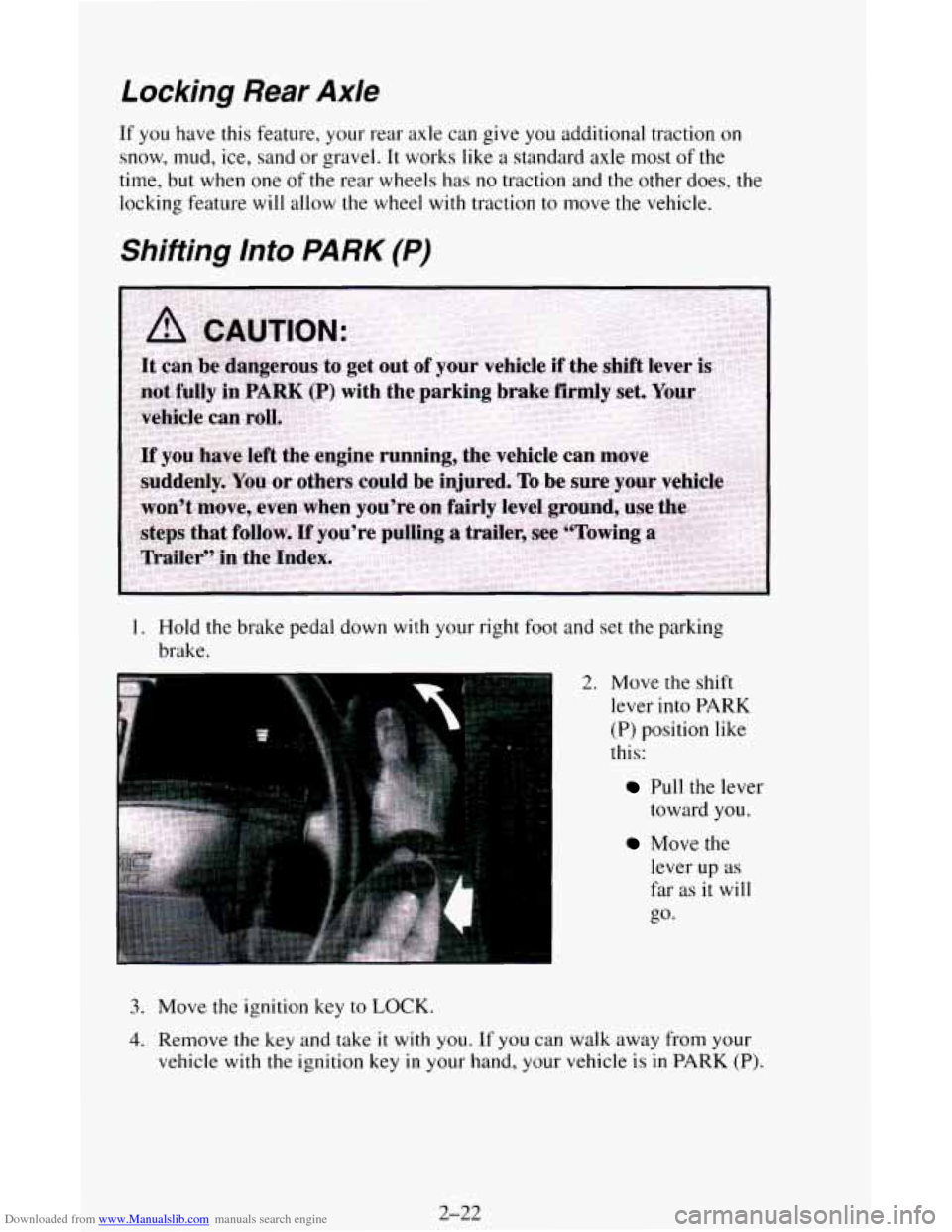
Shifting Into PARK (P)
1. Hold the brake pedal down with your right foot and set the parking
brake.
2. Move the shift
lever
into PARK
(P) position like
this:
Pull the lever
toward
you.
lever up as
far as
it will
go.
Move the
3. Move the ignition key to LOCK.
4. Remove the key and take it with you. If you can walk away from your
vehicle
with the ignition key in your hand, your vehicle is in PARK (P).
2-22
Page 77 of 342
Downloaded from www.Manualslib.com manuals search engine Leaving Your Vehicle With the Engine Running
If you have to leave your vehicle with the engine running, be sure your
vehicle
is in PARK (P) and your parking brake is firmly set before you leave
it. After you’ve moved the shift lever into the
PARK (P) position, hold the
regular brake pedal down. Then, see if you can move the shift lever away
from
PARK (P) without first pulling it toward you. If you can, it means that
the shift lever wasn’t fully locked into
PARK (P).
Torque Lock
If you are parking on a hill and you don’t shift your transmission into PARK
(P) properly, the weight of the vehicle may put too much force on the
parking pawl in the transmission. You may find it difficult to pull the shift
lever out of
PARK (P). This is called “torque lock.” To prevent torque lock,
set the parking brake and then shift into
PARK (P) properly before you
leave the driver’s seat.
To find out how, see “Shifting Into PARK (P)” in the
Index.
When you are ready to drive, move the shift lever out
of PARK (P) before
you release the parking brake.
If “torque lock” does occur, you may need to have another vehicle push
yours a little uphill
to take some of the pressure from the transmission, so
you can pull the shift lever out of PARK (P).
2-23
Page 78 of 342
Downloaded from www.Manualslib.com manuals search engine Shifting Out of PARK (P)
Your vehicle has a brake-transmission shift interlock. You have to fully
apply your regular brake before you can shift from PARK (P) when the
ignition is in the RUN position.
See “Automatic Transmission” in the Index,
If you cannot shift out
of PARK (P), ease pressure on the shift lever - push
the shift lever all the way into PARK (P) as you maintain brake application.
Then move the shift lever into the gear you want.
If you ever hold the brake pedal down but still can’t shift out of PARK (P),
try this:
1. Turn the key to OFF.
2. Apply and hold the brake until the end of Step 4.
3. Shift to NEUTRAL (N).
4. Start the vehicle and then shift to the drive gear you want.
5. Have the vehicle fixed as soon as you can.
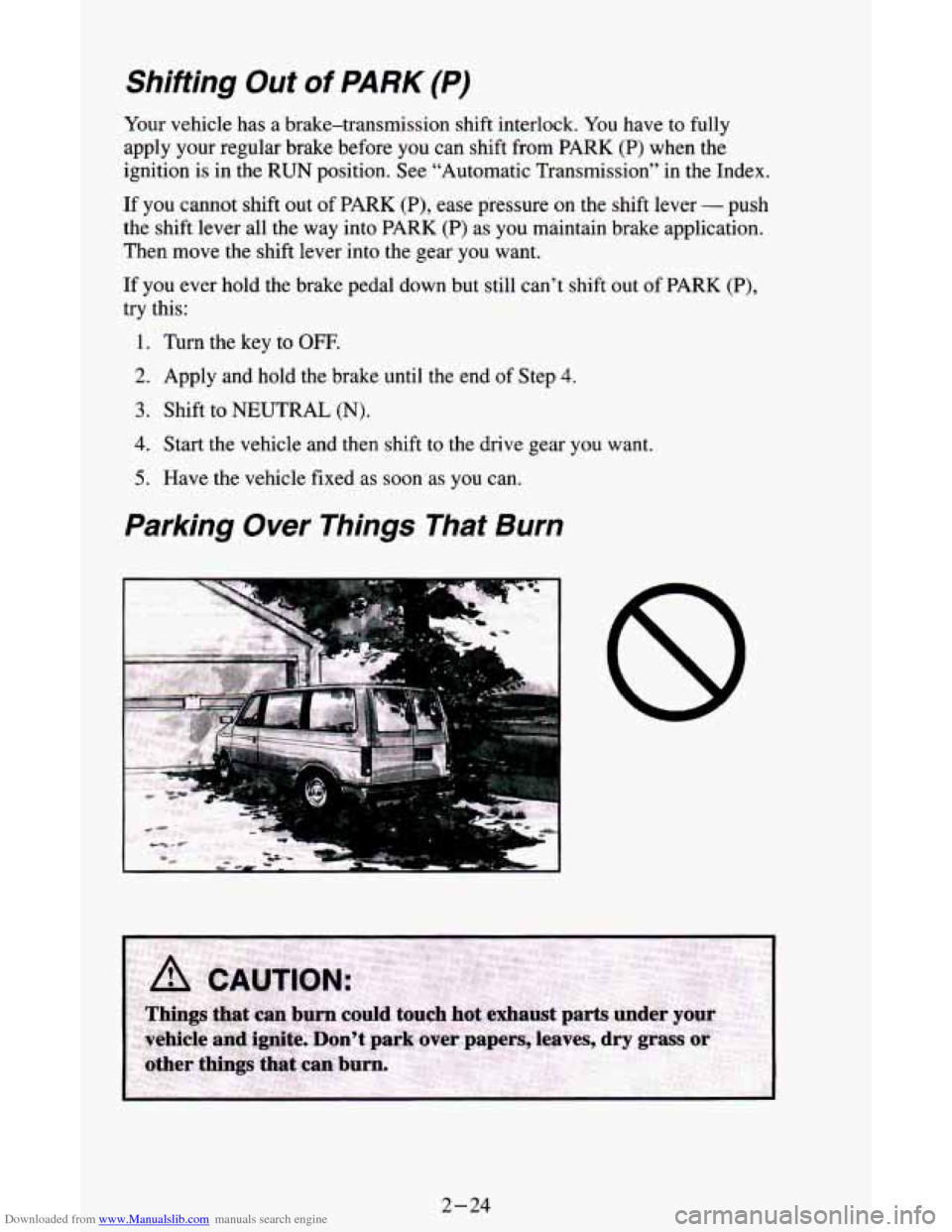
Parking Over Things That Burn
2-24
Page 83 of 342
Downloaded from www.Manualslib.com manuals search engine Horn Tilt
Wheel (Option)
To sound the horn,
press the pads on the
steering wheel with
the horn symbols.
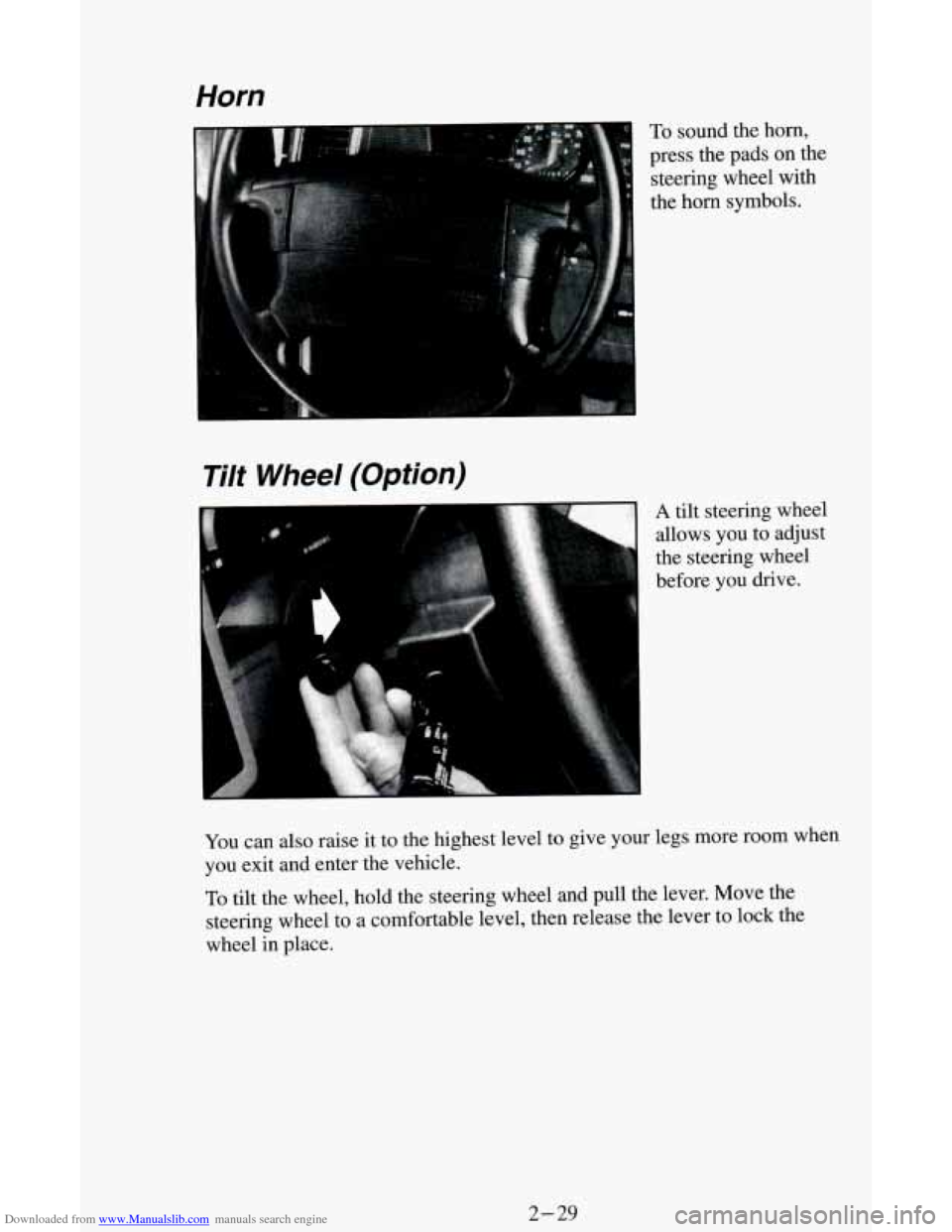
A tilt steering wheel
allows you to adjust
the steering wheel
before you drive.
You can
also raise it to the highest level to give your legs more room when
you exit and enter the vehicle.
To tilt the wheel, hold the steering wheel and pull the lever. Move the
steering wheel to a comfortable level, then release the lever to lock the
wheel in place.
2-29
Page 87 of 342
Downloaded from www.Manualslib.com manuals search engine Heavy snow or ice can overload your wipers. The windshield wiper motor is
protected from overload by a circuit breaker and
a fuse. If the motor
overheats due
to heavy snow, etc., the wiper will stop until the motor cools.
Although the circuit is protected from electrical overload, overload due to
heavy snow, etc. may cause wiper linkage damage. Always clear ice and
heavy snow from the windshield before using your windshield wipers.
Windshield Washer
I
lP
0-
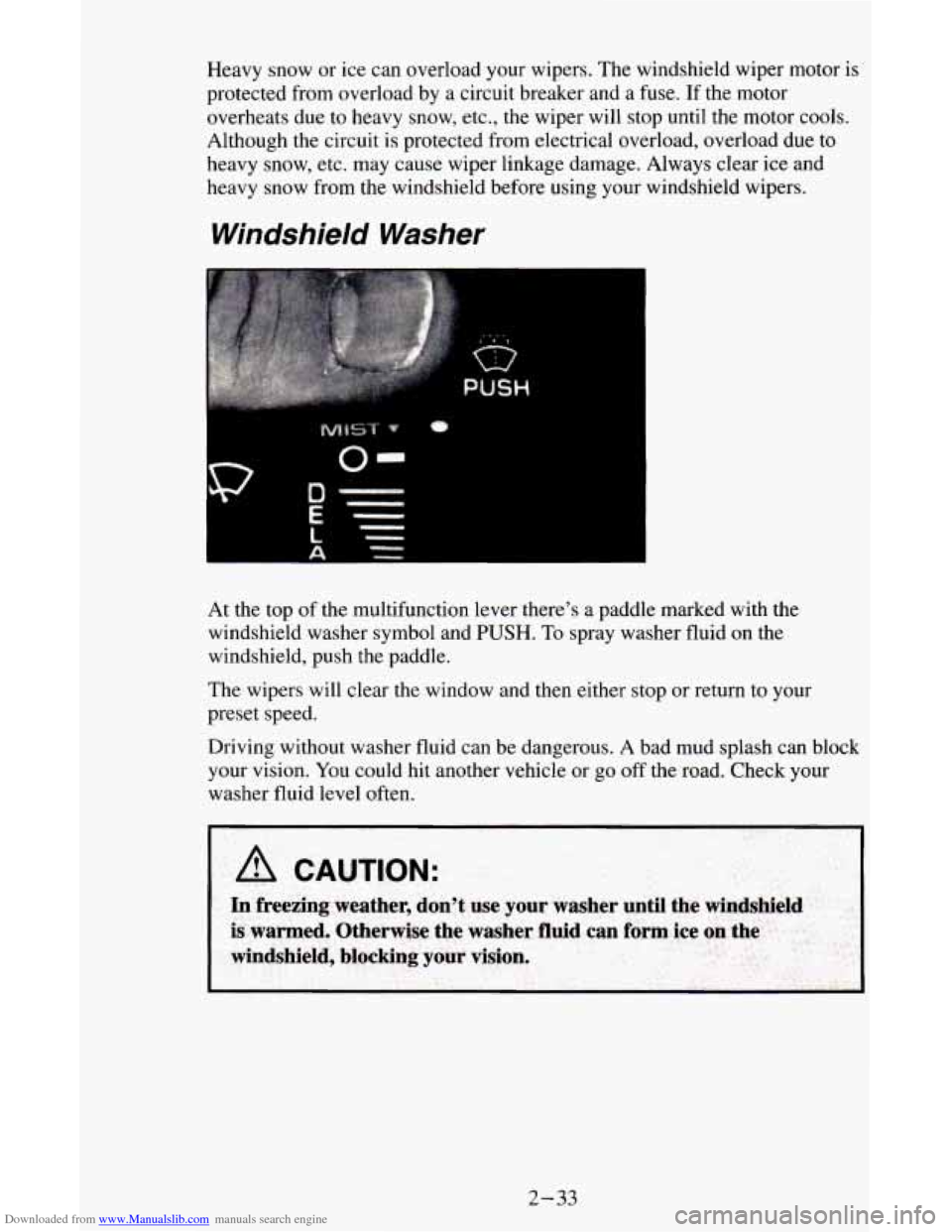
At the top of the multifunction lever there’s a paddle marked with the
windshield washer symbol and
PUSH. To spray washer fluid on the
windshield, push the paddle.
The wipers will clear the window and then either stop or return to your
preset speed.
Driving without washer fluid can be dangerous. A bad mud splash can block
your vision.
You could hit another vehicle or go off the road. Check your
washer fluid level often.
I A CAUTION:
In freezing weather, don’t use your washer until the windshield
is warmed. Otherwise the washer fluid can form ice on the
windshield, blocking your vision.
2-33