Page 146 of 342
Downloaded from www.Manualslib.com manuals search engine What should you do if this ever happens? Ease up on the accelerator pedal,
steer the vehicle the way you want it to go, and slow down.
Speed limit signs near curves warn that
you should adjust your speed. Of
course, the posted speeds are based on good weather and road conditions.
Under less favorable conditions you’ll want to go slower.
If you need to reduce your speed as you approach a curve, do it before you
enter the curve, while your front wheels are straight ahead.
Try to adjust your speed so you can “drive” through the curve. Maintain a
reasonable, steady speed. Wait to accelerate until you are
out of the curve,
and then accelerate gently into the straightaway.
Steering in Emergencies
There are times when steering can be more effective than braking. For
example,
you come over a hill and find a truck stopped in your lane, or a car
suddenly pulls out from nowhere, or a child darts out from between parked
cars and stops right in front
of you. You can avoid these problems by
braking
- if you can stop in time. But sometimes you can’t; there isn’t
room. That’s the time for evasive action - steering around the problem.
Your vehicle can perform very well
in emergencies like these. First apply
your brakes. It is better to remove as much speed as
you can from a possible
collision. Then steer around the problem, to the left or right depending
on
the space available.
An emergency like this requires close attention and
a quick decision. If you
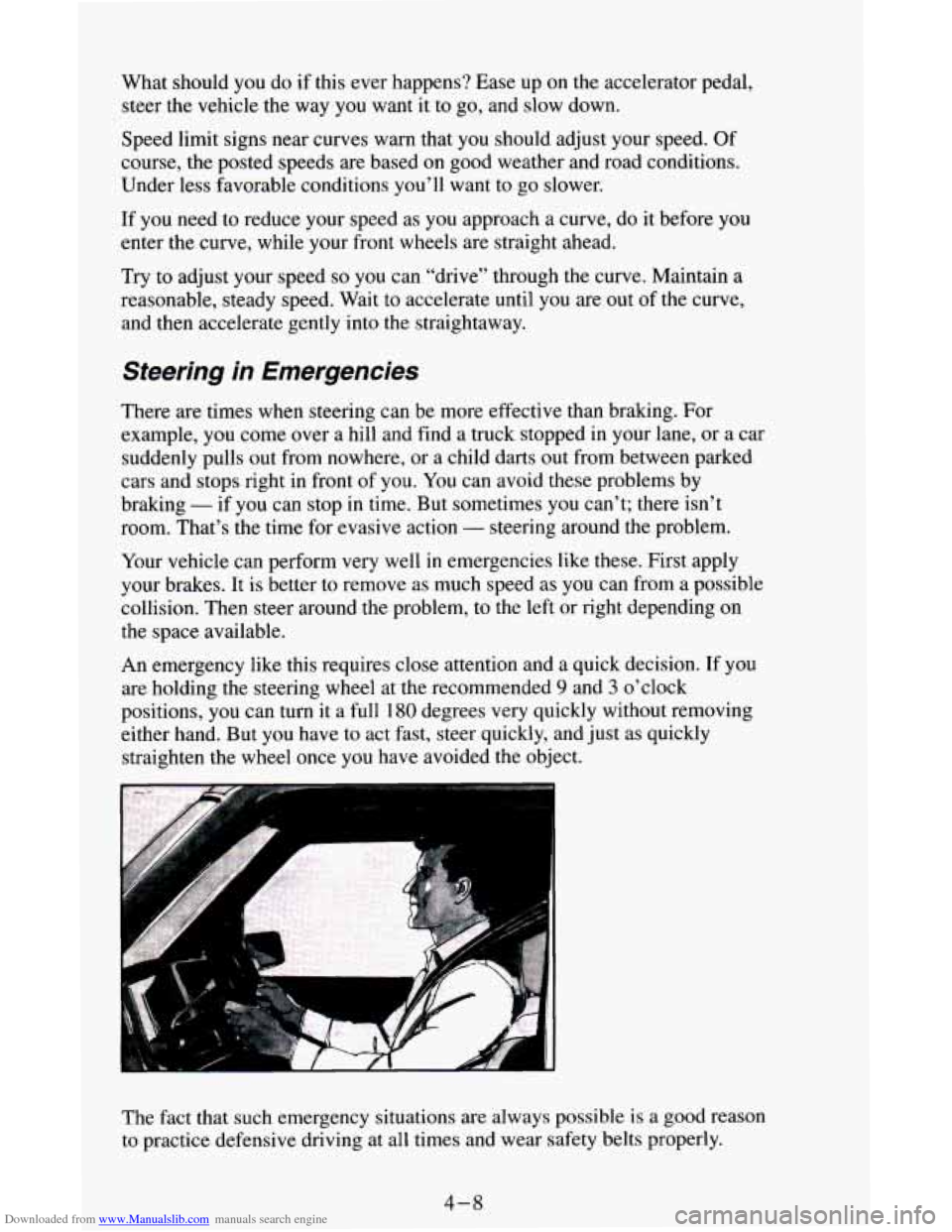
are holding the steering wheel at the recommended
9 and 3 o’clock
positions, you can turn it a full
180 degrees very quickly without removing
either hand. But you have
to act fast, steer quickly, and just as quickly
straighten the wheel once
you have avoided the object.
The fact that such emergency situations are always possible
is a good reason
to practice defensive driving at all times and wear safety belts properly.
4-8
Page 149 of 342
Downloaded from www.Manualslib.com manuals search engine Loss of Confrol
Let’s review what driving experts say about what happens when the three
control systems (brakes, steering and acceleration) don’t have enough
friction where the tires meet the road to do what the driver has asked.
In any emergency, don’t give up. Keep trying to steer and constantly seek an
escape route or area of less danger.
Skidding
In a skid, a driver can lose control of the vehicle. Defensive drivers avoid
most skids by taking reasonable care suited to existing conditions, and by
not “overdriving” those conditions. But skids are always possible.
The three types of skids correspond to your vehicle’s three control systems.
In the braking skid your wheels aren’t rolling. In the steering or cornering
skid, too much speed or steering in a curve causes tires to slip and lose
cornering force. And in the acceleration skid too much throttle causes the
driving wheels to spin.
A cornering skid and an acceleration skid are best handled by easing your
foot
off the accelerator pedal.
If your vehicle starts to slide, ease your foot off the accelerator pedal and
quickly steer the way you want the vehicle to go. If you start steering
quickly enough, your vehicle may straighten out. Always be ready for a
second skid if it occurs.
Of course, traction is reduced when water, snow, ice, gravel, or other
material is on the road. For safety, you’ll want to slow down and adjust your
driving to these conditions. It is important to slow down on slippery
surfaces because stopping distance will be longer and vehicle control more
limited.
While driving on a surface with reduced traction, try your best to avoid
sudden steering, acceleration, or braking (including engine braking by
shifting to a lower gear). Any sudden changes could cause the tires to slide.
You may not realize the surface is slippery until your vehicle is skidding.
Learn to recognize warning clues
- such as enough water, ice or packed
snow on the road to make a “mirrored surface”
- and slow down when you
have any doubt.
Remember: Any anti-lock brake system (ABS) helps avoid only the braking
skid.
4-11
Page 159 of 342
Downloaded from www.Manualslib.com manuals search engine Your anti-lock brakes improve your ability to make a hard stop on a
slippery road. Even though you have an anti-lock braking system, you'll
want to begin stopping sooner than you would on dry pavement. See
"Anti-Lock" in the Index.
0 Allow greater following distance on any slippery road.
0 Watch for slippery spots. The road might be fine until you hit a spot
that's covered with ice. On an otherwise clear road, ice patches may
appear in shaded areas where the sun can't reach: around clumps of
trees, behind buildings, or under bridges. Sometimes the surface of a
curve or
an overpass may remain icy when the surrounding roads are
clear.
If you see a patch of ice ahead of you, brake before you are on it.
Try not to brake while you're actually on the ice, and avoid sudden
steering maneuvers.
If You're Caught in a Blizzard
ha3 .. . - . .. .. ..
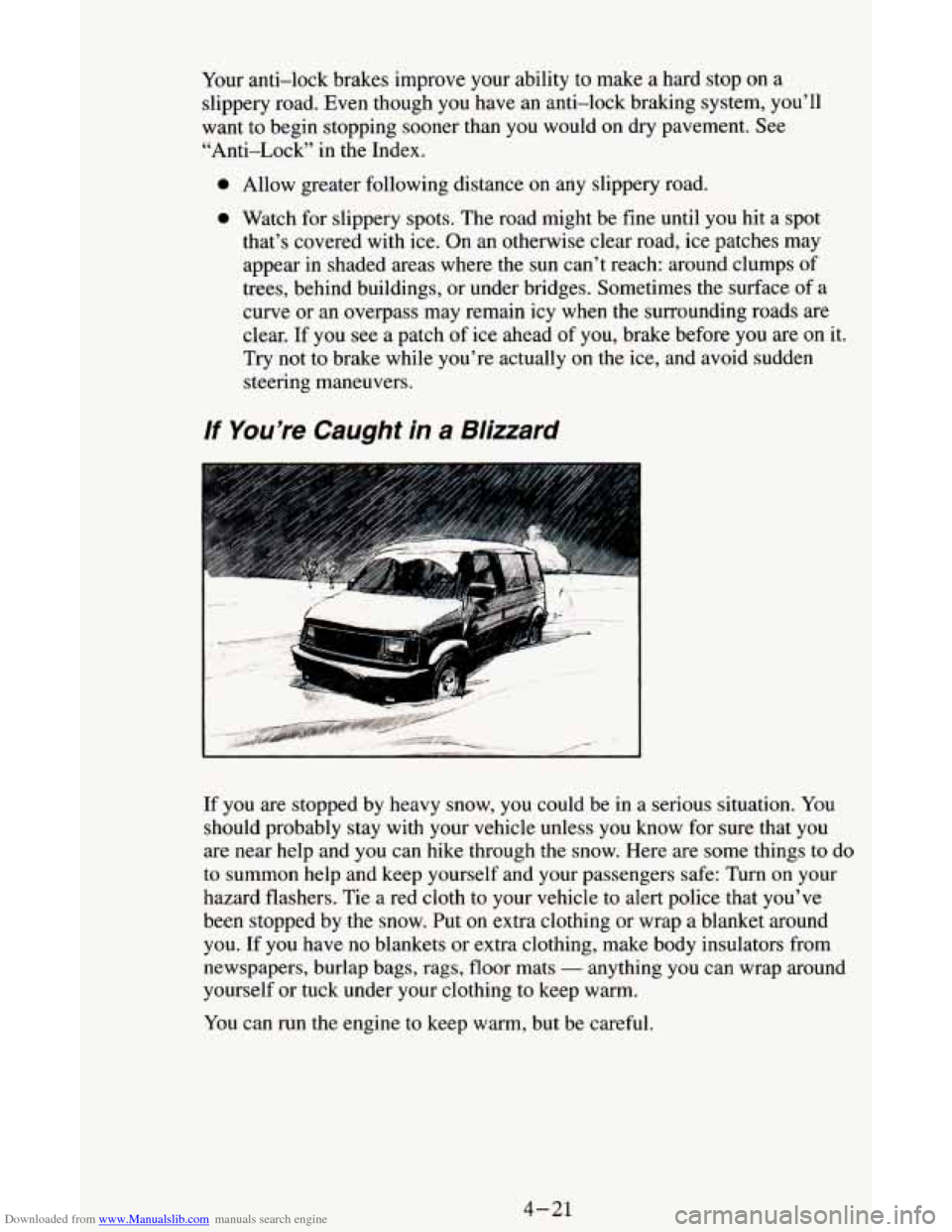
If you are stopped by heavy snow, you could be in a serious situation. You
should probably stay with your vehicle unless you know for sure that you
are near help and you can hike through the snow. Here are some things
to do
to summon help and keep yourself and your passengers safe: Turn on your
hazard flashers. Tie a red cloth to your vehicle to alert police that you've
been stopped by the snow. Put on extra clothing or wrap
a blanket around
you. If you have no blankets or extra clothing, make body insulators from
newspapers, burlap bags, rags, floor mats
- anything you can wrap around
yourself or tuck under your clothing to keep warm.
You can run the engine to keep warm, but be careful.
4-21
Page 179 of 342
Downloaded from www.Manualslib.com manuals search engine Towing Your Vehicle
Try to have a GM dealer or a professional towing service tow your vehicle.
They can provide the right equipment and know how to tow
it without
damage.
If your vehicle has been changed
or modified since it was factory-new by
adding aftermarket items like fog lamps, aero skirting, or special tires and
wheels, these things can be damaged during towing.
Before
you do anything, turn on the hazard warning flashers.
When
you call, tell the towing service:
0 Whether your vehicle has rear-wheel drive or the all-wheel-drive
option. If your vehicle has fog lamps, it cannot be towed from the front
with sling-type equipment.
The make, model, and year of your vehicle.
0 Whether you can still move the shift lever.
0 If there was an accident, what was damaged.
When your vehicle
is being towed, have the ignition key off. The steering
wheel should be clamped in a straight-ahead position, with
a clamping
device designed for towing service.
Do not use the vehicle’s steering
column lock for this.
The transmission should be in NEUTRAL (N) and the
parking brake released.
5-7
Page 193 of 342
Downloaded from www.Manualslib.com manuals search engine A rear blowout, particularly on a curve, acts much like a skid and may
require the same correction you’d use in
a skid. In any rear blowout, remove
your foot from the accelerator pedal. Get the vehicle under control by
steering the way you want the vehicle
to go. It may be very bumpy and
noisy, but
you can still steer. Gently brake to a stop, well off the road if
possible.
If a tire goes flat, the next part shows how to use your jacking equipment
to
change a flat tire safely.
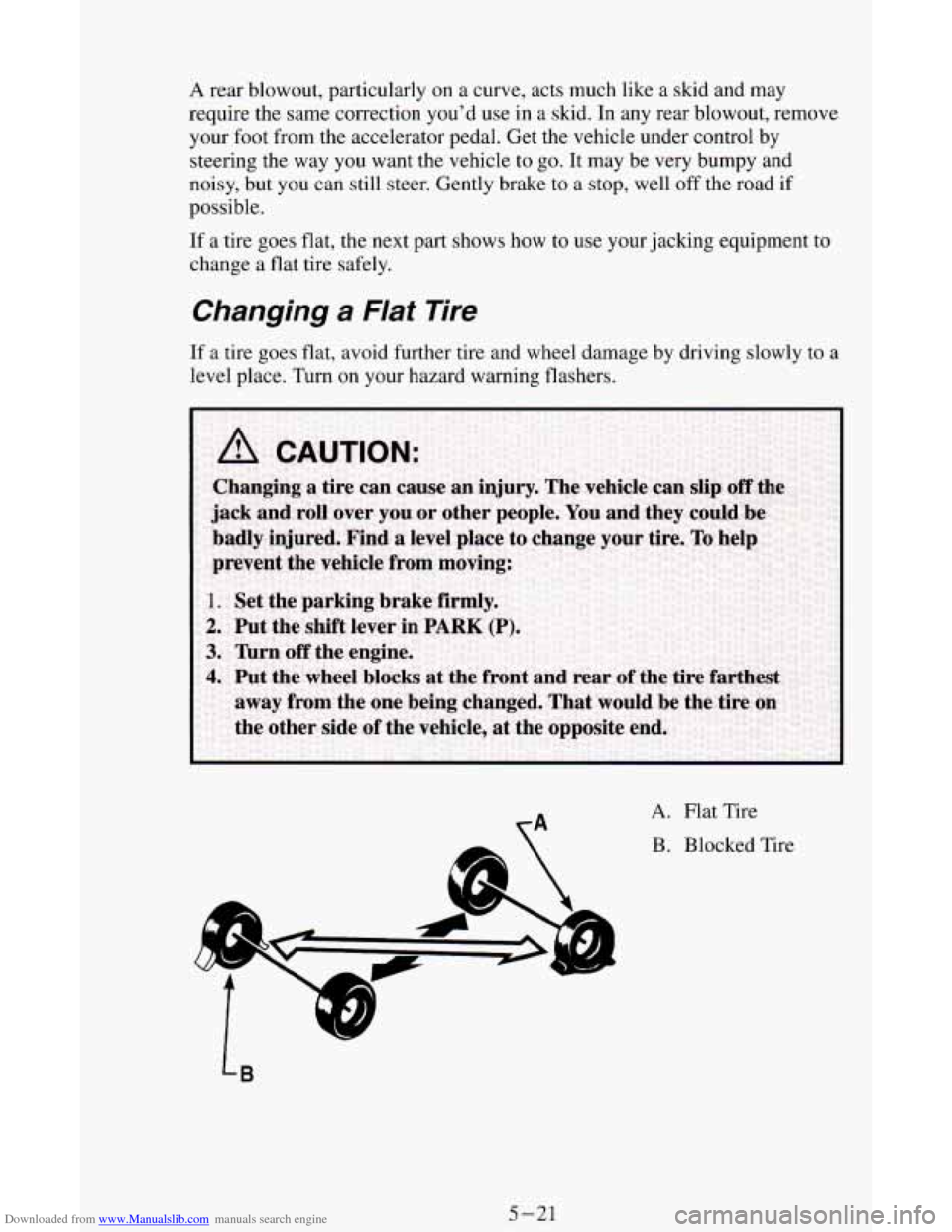
Changing a Flat Tire
If a tire goes flat, avoid further tire and wheel damage by driving slowly to a
level place.
Turn on your hazard warning flashers.
A. Flat Tire
B. Blocked Tire
5-21
Page 194 of 342
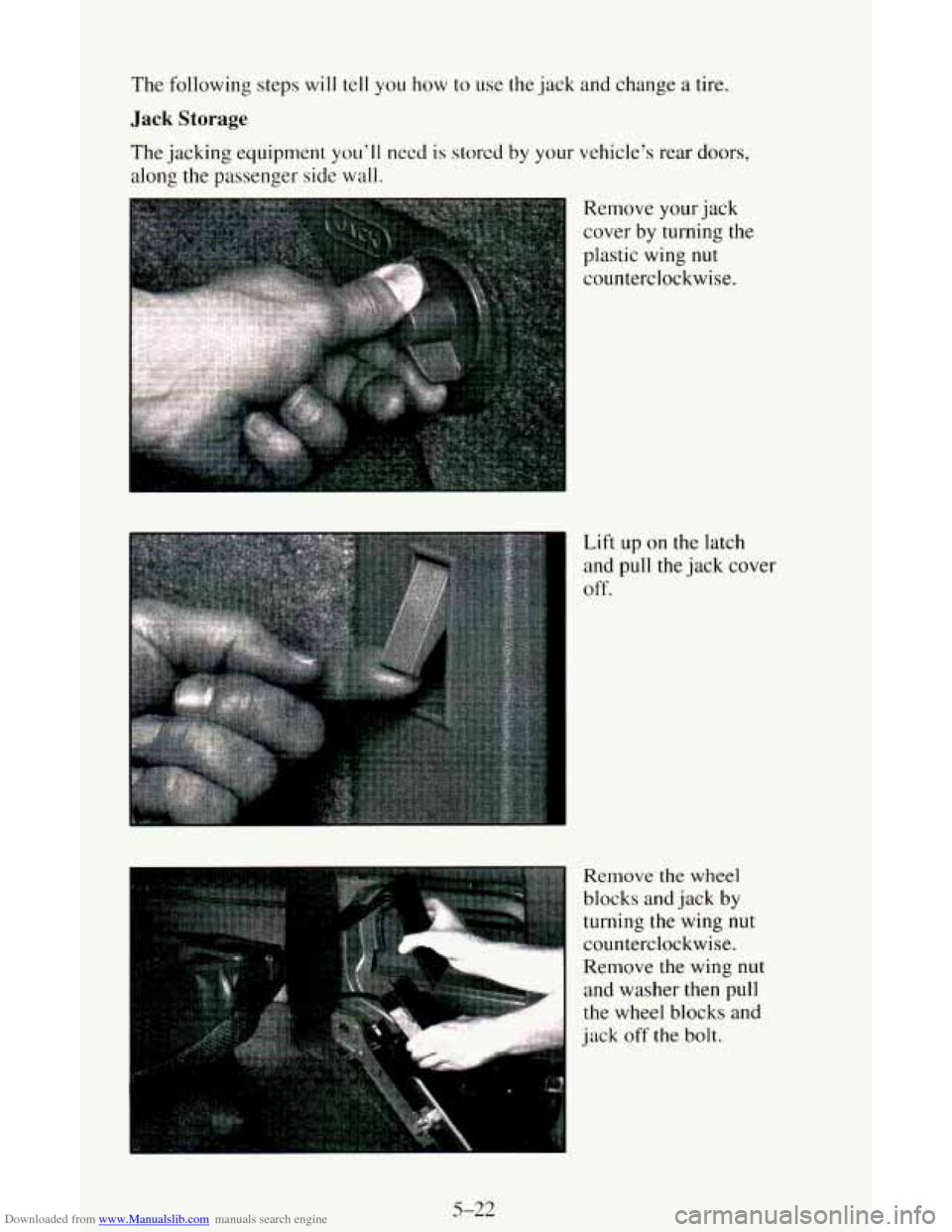
Downloaded from www.Manualslib.com manuals search engine The following steps will tell you how to use the jack and change a tire.
Jack Storage
Thejacking equipment you'll need is stored by your vehicle's rear doors,
along the passenger side
wall.
Remove your jack
cover
by turning the
plastic wing
nut
counterclockwise.
Lift
up on the latch
and pull
the jack cover
off
e
Remove the wheel
blocks and jack
by
turning the wing nut
.- counterclockwise. *b "' "" 1 Remove the wing nut
and washer then pull
the wheel blocks and
jack
off the bolt.
5-22
Page 195 of 342
Downloaded from www.Manualslib.com manuals search engine c
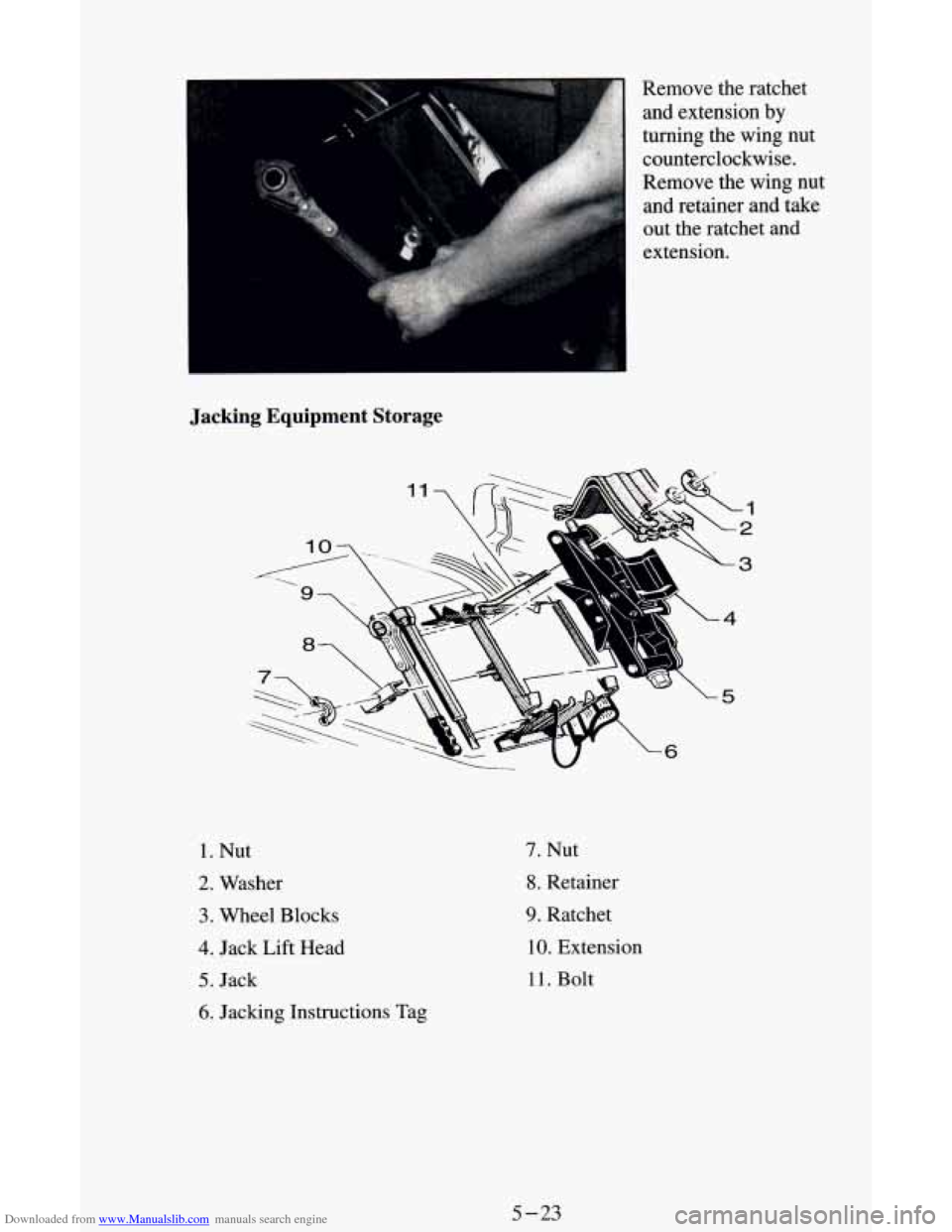
Remove the ratchet
and extension by
turning the wing nut
counterclockwise.
Remove the wing nut
and retainer and take
out the ratchet and
extension.
Jacking Equipment Storage
1. Nut
2. Washer
3. Wheel Blocks
4. Jack Lift Head
5. Jack
6. Jacking Instructions Tag
7. Nut
8. Retainer
9. Ratchet
10. Extension
11. Bolt
5-23
Page 197 of 342
Downloaded from www.Manualslib.com manuals search engine And a DOWN side.
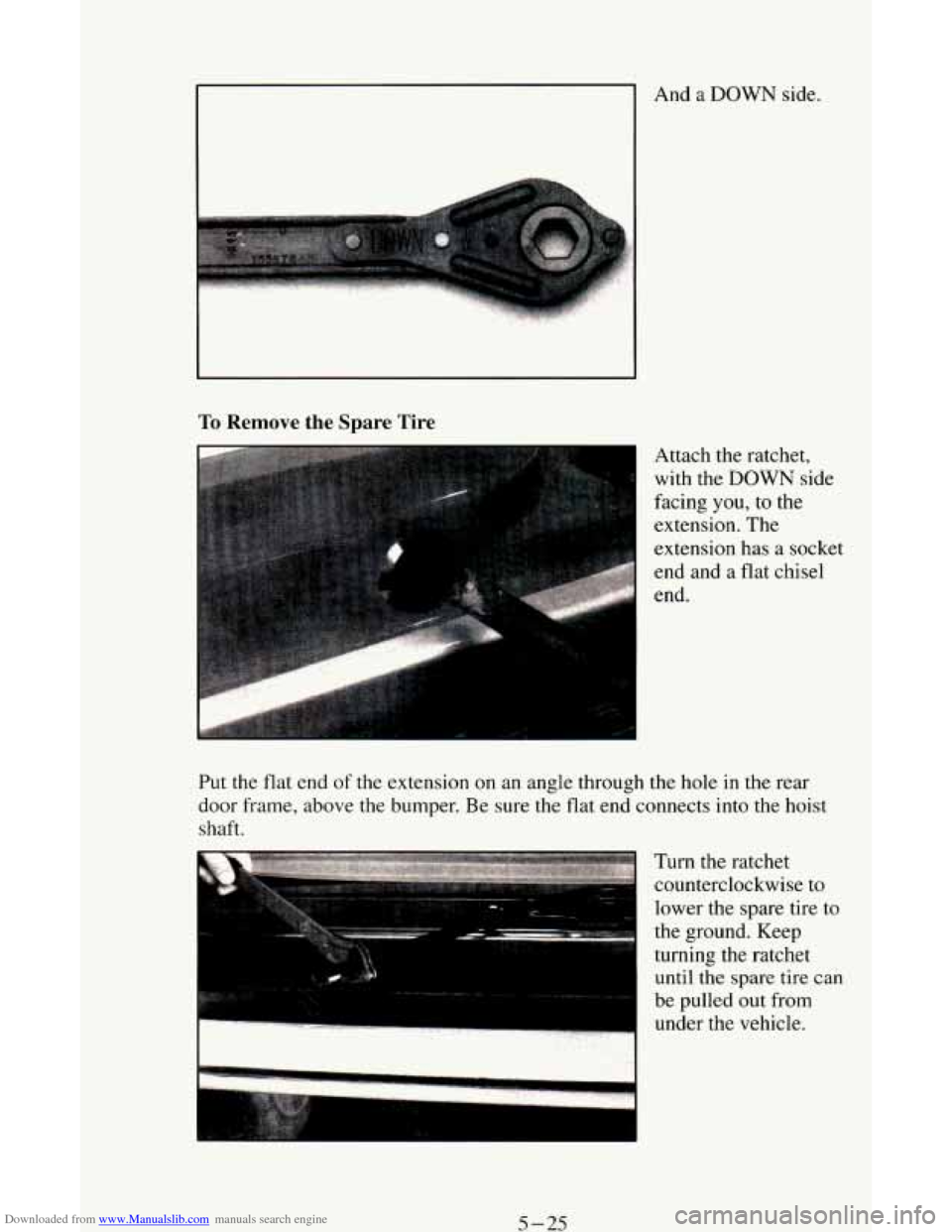
To Remove the Spare Tire
Attach the ratchet,
with the
DOWN side
facing you,
to the
extension. The
extension has a socket
3
Put the flat end of the extension on an angle through the hole in the rear
door frame, above the bumper. Be sure the flat end connects into the hoist
shaft.
Turn the ratchet
counterclockwise to
- lower the spare tire to
the ground, Keep
turning the ratchet
until the spare tire can
be pulled out from
under the vehicle.
5-25