Page 199 of 342
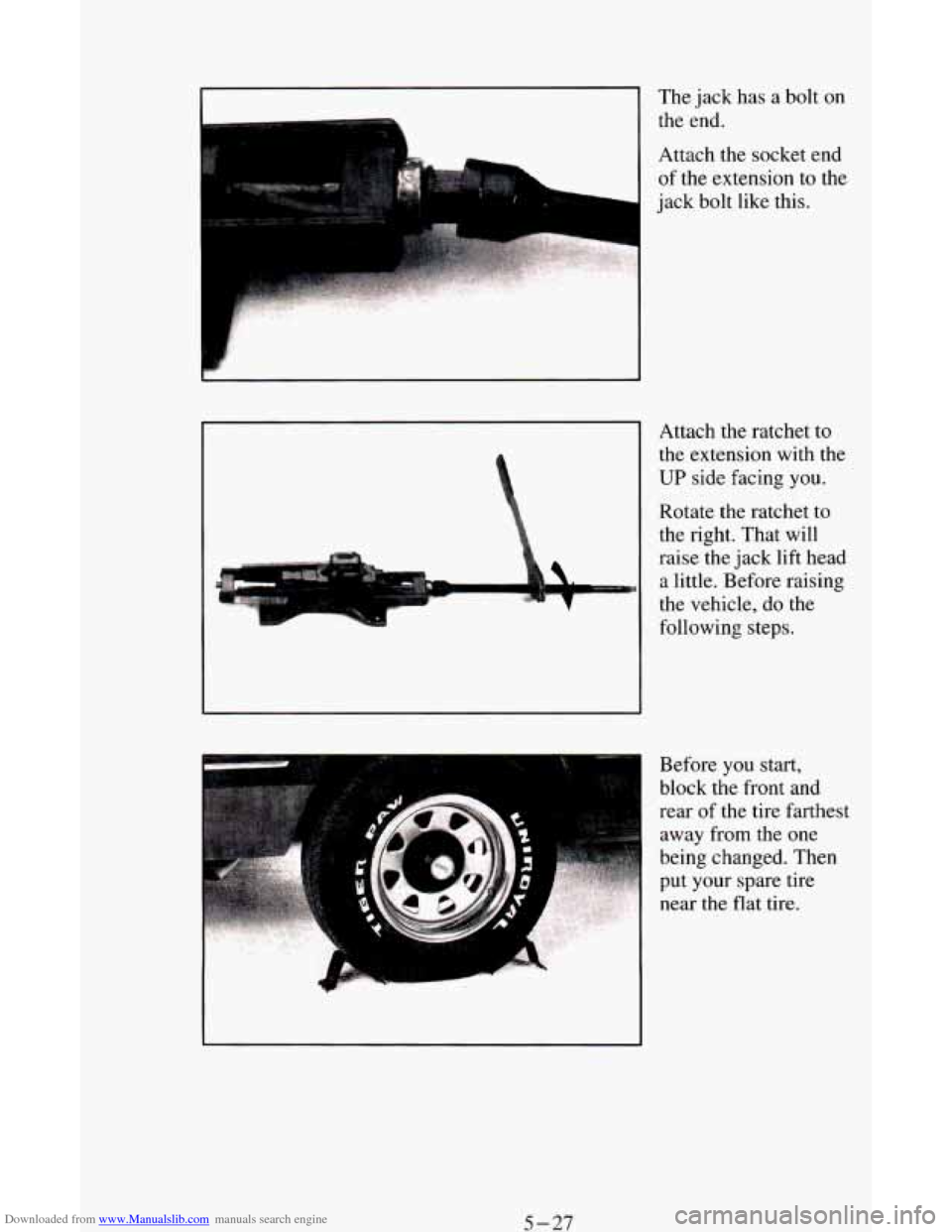
Downloaded from www.Manualslib.com manuals search engine The jack has a bolt on
the end.
Attach the socket end
of the extension to the
jack bolt like this.
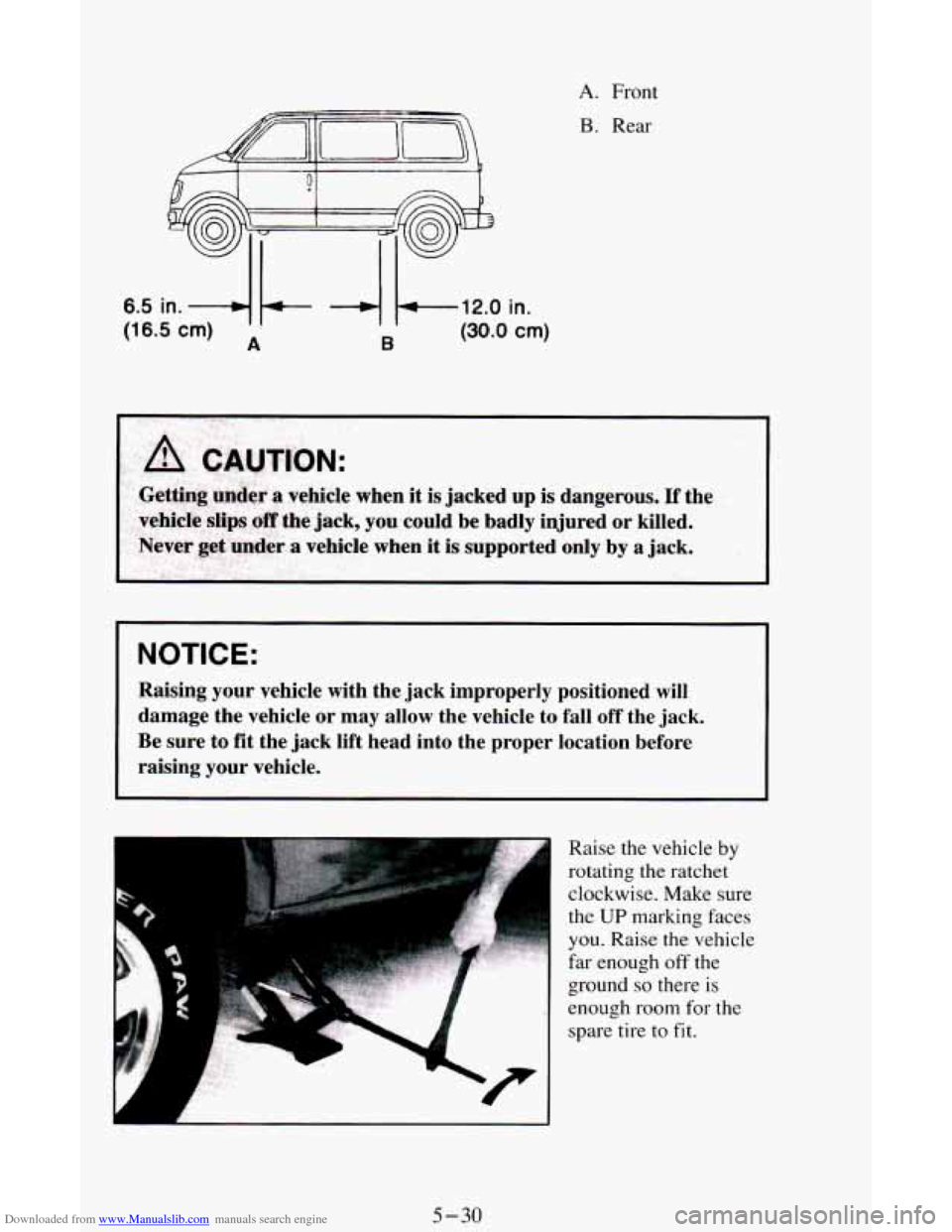
Attach the ratchet to
the extension with the
UP side facing you.
Rotate the ratchet to
the right. That will
raise the jack lift head
a little. Before raising
the vehicle, do the
following steps.
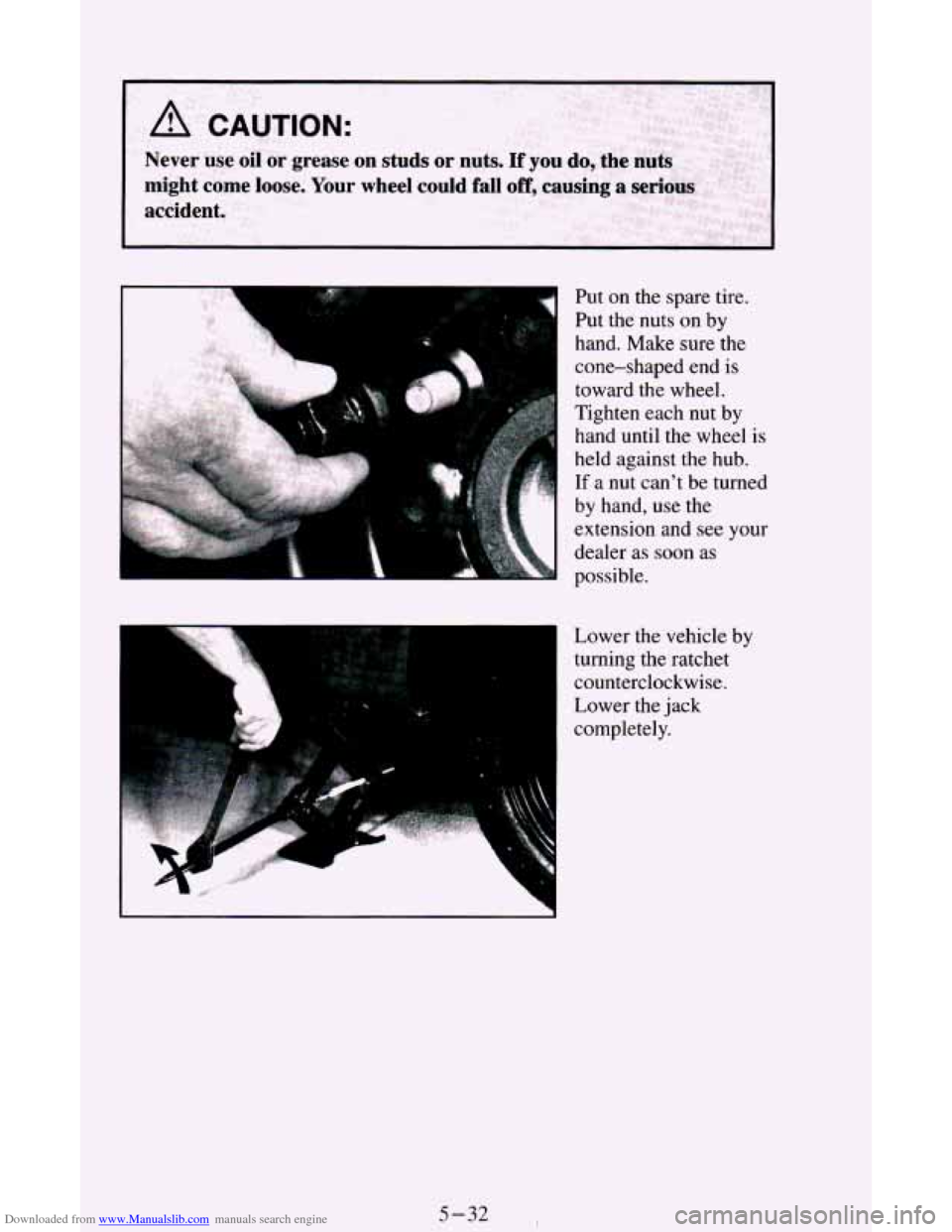
Before
you start,
block the front and
rear of the tire farthest
away from the one
being changed.
Then
put your spare tire
near the flat tire.
5-27
Page 202 of 342
Downloaded from www.Manualslib.com manuals search engine 5
6.5 in. -4 b- -4 k-,l2.0 in.
(16.5 cm) A B (30.0 em)
A. Front
B. Rear
NOTICE:
Raising your vehicle with the jack improperly positioned will
damage the vehicle or may allow the vehicle to fall off the \
jack.
Be sure to fit the jack lift head into the proper location b\
efore
raising your vehicle.
I
Raise the vehicle by
rotating the ratchet
clockwise. Make sure
the
UP marking faces
you. Raise the vehicle
far enough
off the
ground
so there is
enough room for the
spare tire
to fit.
5-30
Page 204 of 342
Downloaded from www.Manualslib.com manuals search engine Put on the spare tire.
Put the nuts
on by
hand. Make sure the
cone-shaped end
is
toward the wheel.
Tighten each nut by
hand until the wheel
is
held against the hub.
c If a nut can't be turned
by hand, use the
extension
and see your
dealer as soon
as
possible.
Lower the vehicle by
turning the ratchet
counterclockwise.
Lower the jack
completely.
5-32
Page 205 of 342
Downloaded from www.Manualslib.com manuals search engine Tightening Wheel Nut Tightening Sequence
I
Tighten the wheel nuts firmly in a criss-cross sequence as shown. Turn the
ratchet clockwise with the
UP marking facing you.
Remove the wheel blocks.
A CAUTION:
I NOTICE:
Wheel covers won’t fit on your compact spare. If you try to put
a wheel cover on your compact spare, you could damage the
cover or the spare.
5-33
Page 206 of 342
Downloaded from www.Manualslib.com manuals search engine Storing The Jack and Spare Tire
1. Put the tire on the ground at the rear of the vehicle, with the valve stem
pointed down.
2. Pull the retaining bar through the center of the wheel, making sure it is
properly attached. Attach the ratchet, with the UP side facing you, to
the extension.
3. Put the flat end of the extension on an angle through the hole in the rear
door frame, above the bumper. Turn the ratchet clockwise until the tire
is against the underside
of the vehicle.
You will hear two“c1icks” when the tire is up all the way. Try to move
the tire with your hands to make sure it is securely in place.
Return the jacking equipment to the proper location. Secure the items and
replace the jack cover.
Compact Spare Tire
Although the compact spare was fully inflated when your vehicle was new,
it can lose air after
a time. Check the inflation pressure regularly. It should
be
60 psi (420 kPa). After installing the compact spare on your vehicle, you
should stop as soon as possible and make sure your spare tire is correctly
inflated. The compact spare is made to perform well at posted speed limits
for distances up to
3,000 miles (5 000 km), so you can finish your trip and
have your full-size tire repaired or replaced where you want. Of course, it’s
best to replace your spare with a full-size tire as soon as you can. Your
spare will last longer and be in good shape in case you need
it again.
I NOTICE:
Don’t take your compact spare through an automatic car wash \
with guide rails. The compact spare can get caught
on the rails.
That can damage the tire and wheel, and maybe other parts
of
your vehicle.
Don’t use your compact spare on some other vehicle.
5-34
Page 213 of 342
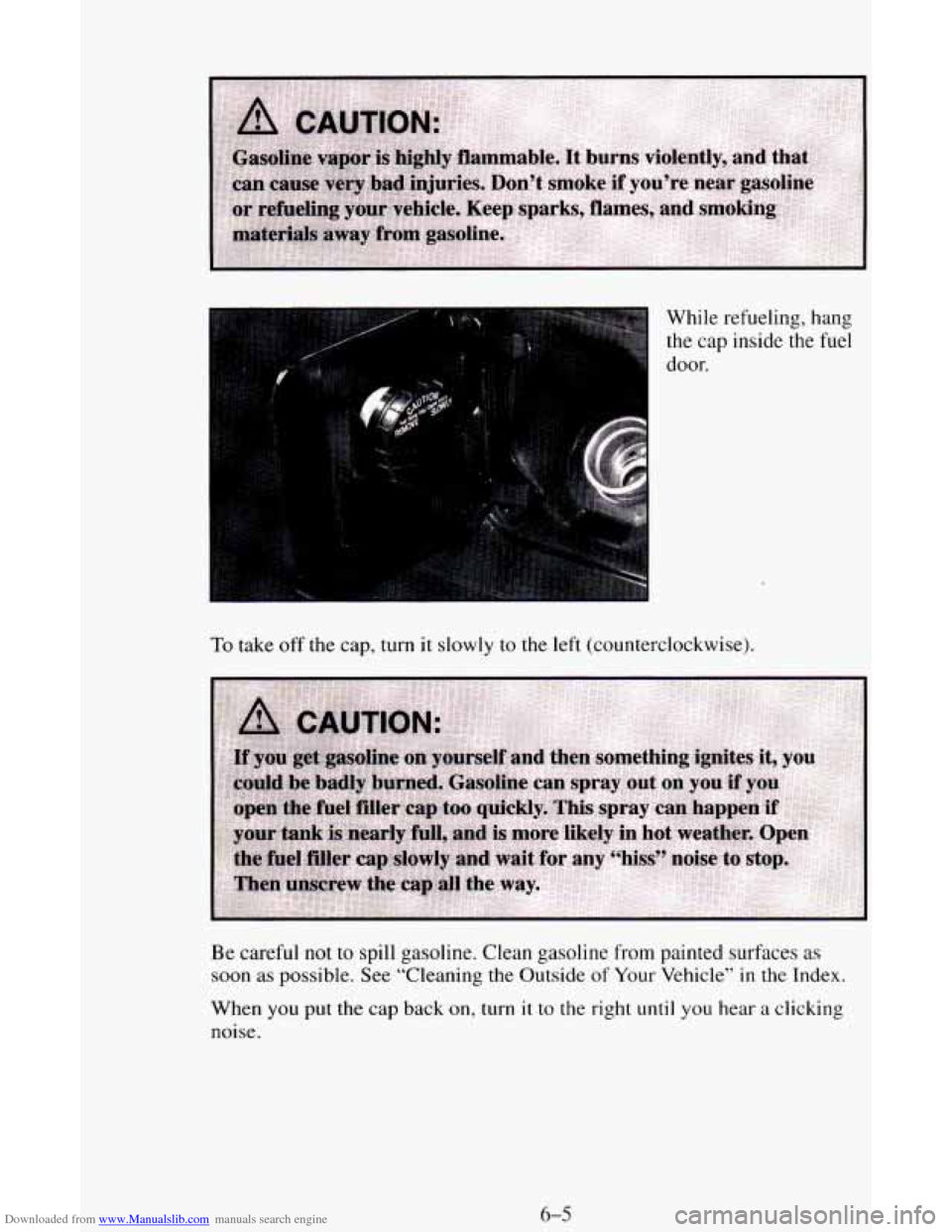
Downloaded from www.Manualslib.com manuals search engine While refueling, hang
the cap inside the fuel
door.
To take off the cap, turn it slowly to the left (counterclockwise).
Be careful not to spill gasoline. Clean gasoline from painted surfaces as
soon
as possible. See “Cleaning the Outside of Your Vehicle” in the Index.
When you put the cap back
on, turn it to the right until you hear a clicking
noise.
6-5
Page 228 of 342
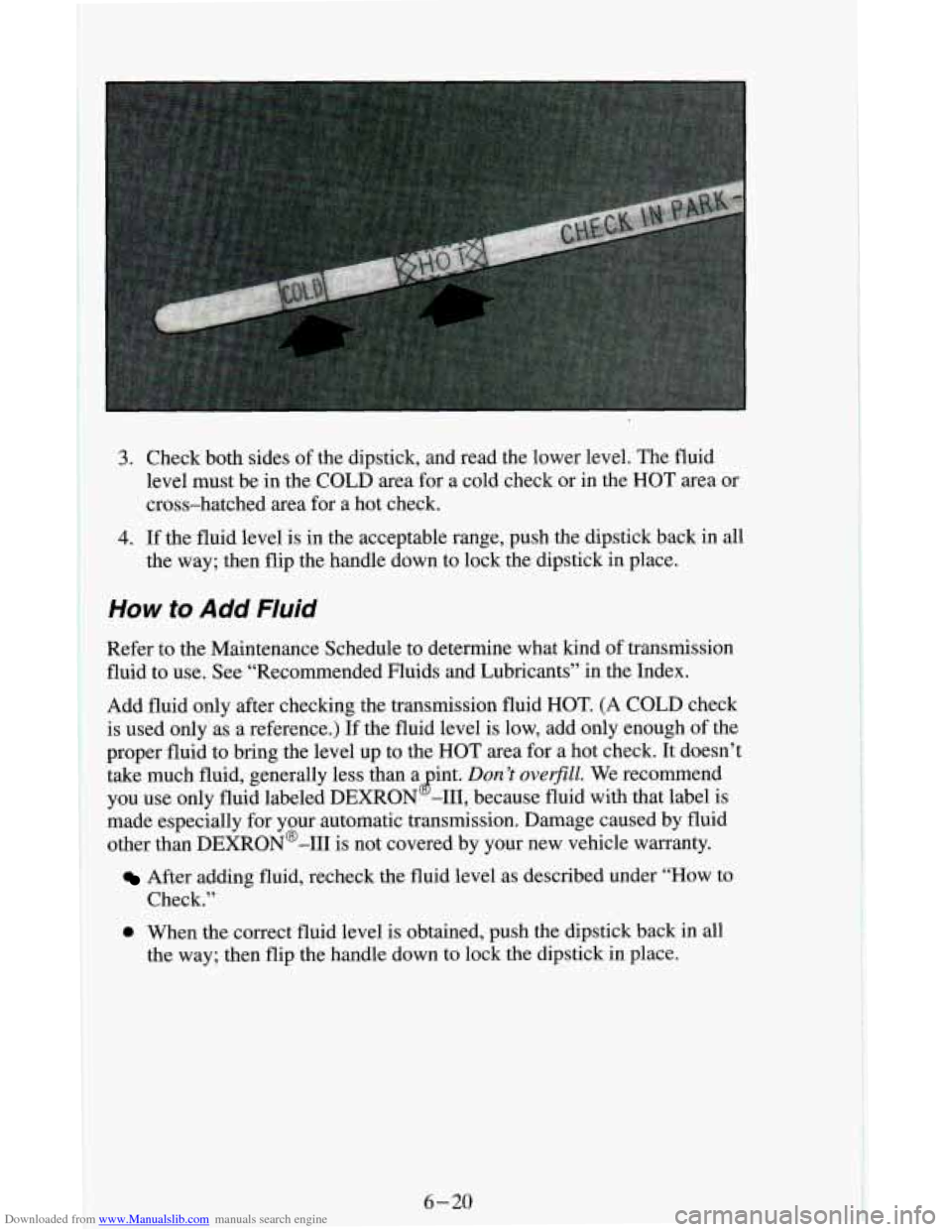
Downloaded from www.Manualslib.com manuals search engine 3. Check both sides of the dipstick, and read the lower level. The fluid
level must be in the COLD area for a cold check or in the
HOT area or
cross-hatched area for a hot check.
4. If the fluid level is in the acceptable range, push the dipstick back in all
the way; then flip the handle down to lock the dipstick in place.
How to Add Fluid
Refer to the Maintenance Schedule to determine what kind of transmission
fluid to use., See “Recommended Fluids and Lubricants” in the Index.
Add fluid only after checking the transmission fluid
HOT. (A COLD check
is used only’ as a reference.) If the fluid level is low, add only enough of the
proper fluid to bring the level up to the
HOT area for a hot check. It doesn’t
take much fluid, generally less than a int.
Don ’t overjill. We recommend
you use only fluid labeled DEXRON
8 -111, because fluid with that label is
made especially for your automatic transmission. Damage caused by fluid
other than DEXRON@-I11 is not covered by your new vehicle warranty.
After adding fluid, recheck the fluid level as described under “How to
Check.”
0 When the correct fluid level is obtained, push the dipstick back in all
the way; then flip the handle down to lock the dipstick in place.
6-20
Page 241 of 342
Downloaded from www.Manualslib.com manuals search engine For more information on vehicle storage, contact your dealer’s service
department, or write to:
Adistra Corporation
17 1 Hamilton Street
Plymouth, MI
48 170
In Canada, write to:
General Motors of Canada, Limited
Customer Services Department
Oshawa, Ontario
Ll J 5Z6
Fluid Leak Check
After the vehicle has been parked for awhile, inspect the surface beneath the
vehicle for water, oil,
fuel or other fluids. Water dripping from the air
conditioning system is normal. If you notice fuel leaks or fumes, the causes
should be found and corrected at once.
Bulb Replacement
Before replacing any bulbs, make sure all lights are off and the vehicle is
not running.
Sealed Beam Headlamps
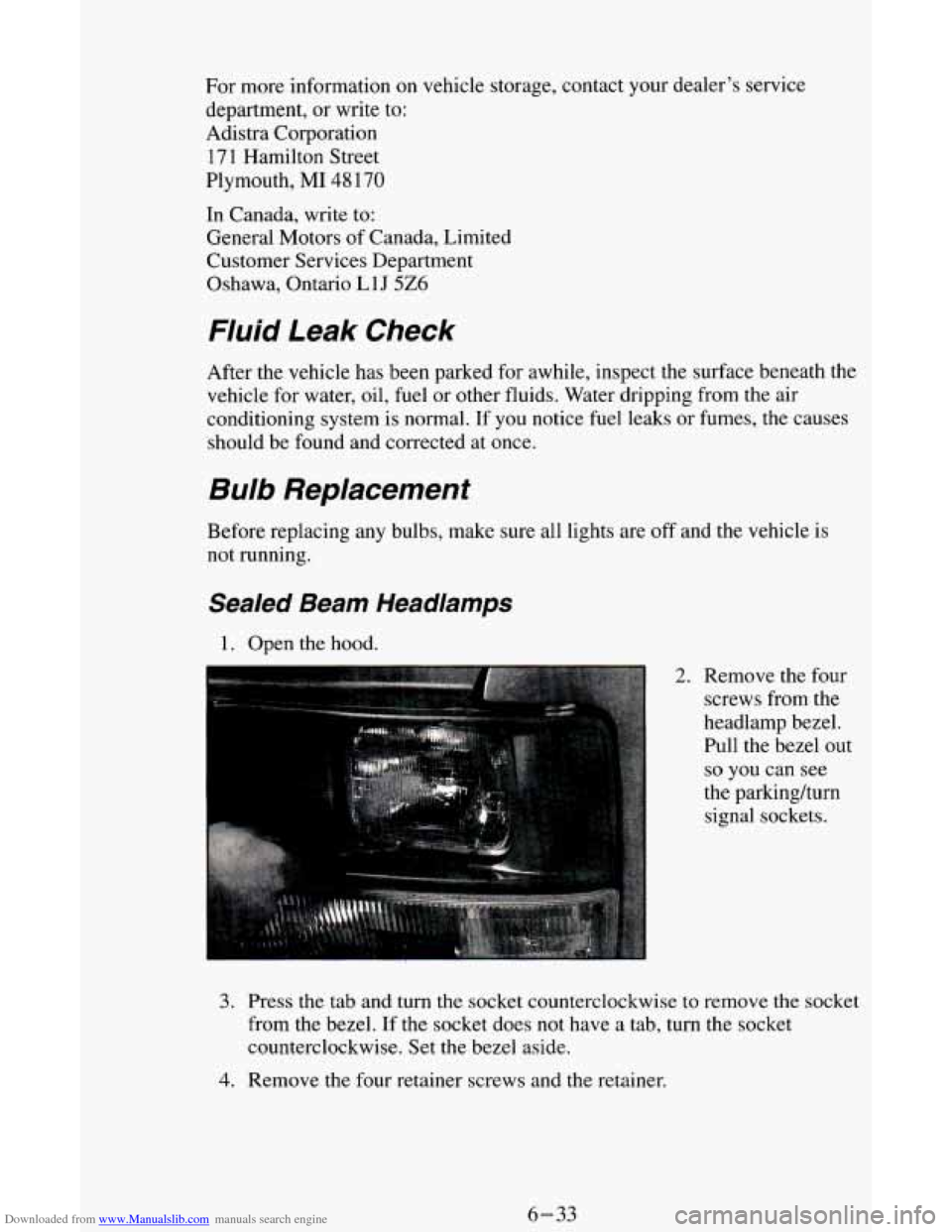
1. Open the hood.
2. Remove the four
screws from the
headlamp bezel.
Pull the bezel out
so you can see
the parkingkurn
signal sockets.
3. Press the tab and turn the socket counterclockwise to remove the socket
from the bezel. If the socket does
not have a tab, turn the socket
counterclockwise. Set the bezel aside.
4. Remove the four retainer screws and the retainer.
6-33