Page 209 of 342
Downloaded from www.Manualslib.com manuals search engine Service & Appearance Care
Section
Here you will find information about the care of your vehicle. This section
begins with service and fuel information, and then it shows how to check
important fluid and lubricant levels. There is also technical information
about your vehicle, and a part devoted to its appearance care.
Service
Your GM dealer knows your vehicle best and wants you to be happy with it.
We hope you’ll
go to your dealer for all your service needs. You’ll get
genuine GM parts and GM-trained and supported service people.
We hope you’ll want to keep your GM vehicle all GM. Genuine
GM parts
have one
of these marks:
Doing Your Own Service Work
If you want to do some of your own service work, you’ll want to get the
proper GM Service Manual.
It tells you much more about how to service
your vehicle than this manual can.
To order the proper service manual, see
“Service Publications’’
in the Index.
6-1
Page 229 of 342
Downloaded from www.Manualslib.com manuals search engine A//- Wheel Drive
If you have an all-wheel-drive vehicle, be sure to perform the lubricant
checks described in this section. However, they have two additional systems
that need lubrication.
Transfer Case
When to Check Lubricant
Refer to the Maintenance Schedule to determine how often to check the
lubricant. See “Periodic Maintenance Inspections’’ in the Index.
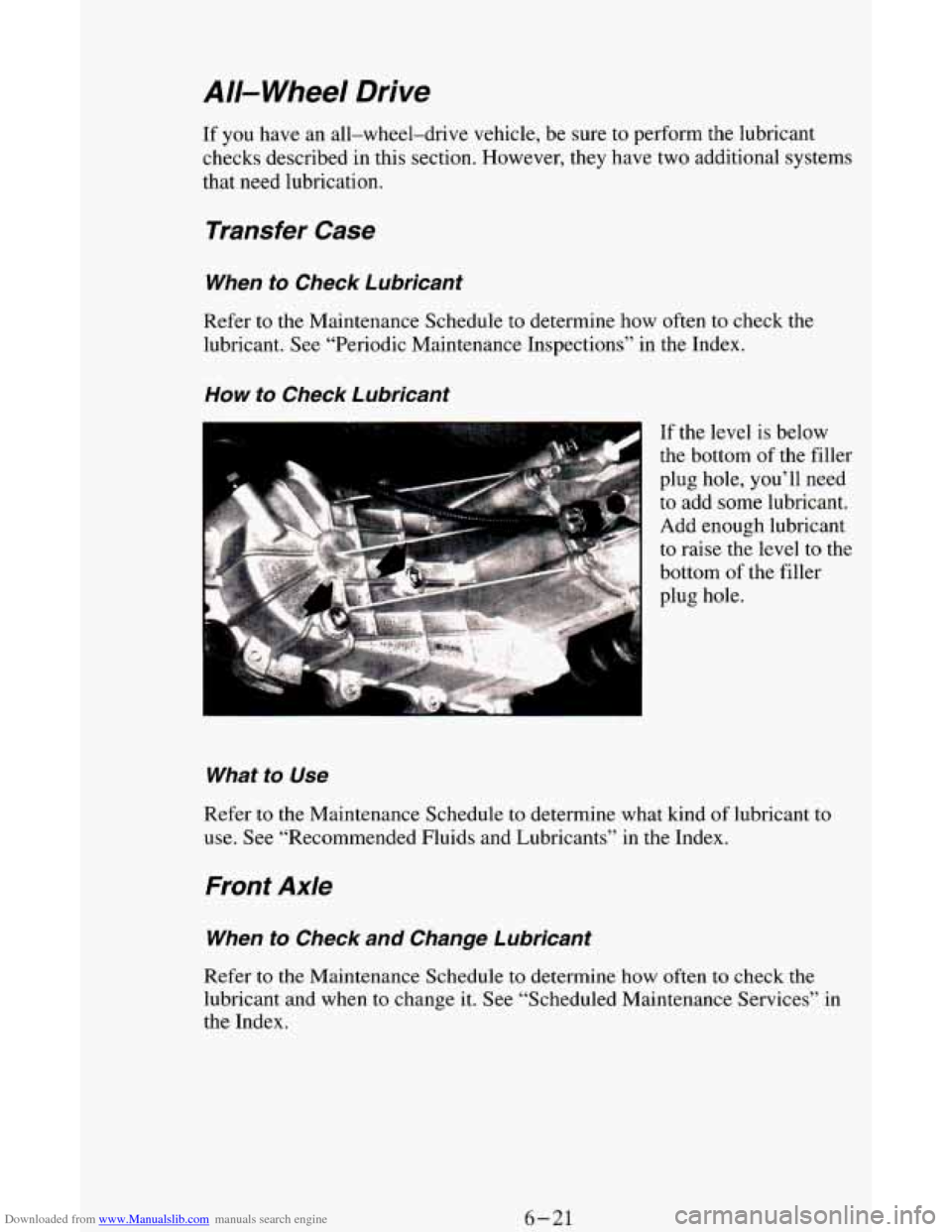
How to Check Lubricant
If the level is below
the bottom
of the filler
plug hole, you’ll need
to add some lubricant.
Add enough lubricant
to raise the level
to the
bottom
of the filler
plug hole.
What to Use
Refer to the Maintenance Schedule to determine what kind of lubricant to
use. See “Recommended Fluids and Lubricants” in the Index.
Front Axle
When to Check and Change Lubricant
Refer to the Maintenance Schedule to determine how often to check the
lubricant and when to change it.
See “Scheduled Maintenance Services’’ in
the Index.
6-21
Page 240 of 342
Downloaded from www.Manualslib.com manuals search engine Replacing Brake System Parts
The braking system on a modern vehicle is complex. Its many parts have to
be of top quality and work well together if the vehicle is to have really good
braking. Vehicles we design and test have topquality
GM brake parts in
them, as your vehicle does when it is new. When you replace parts of your
braking system
- for example, when your brake linings wear down and
you have to have
new ones put in - be sure you get new genuine GM
replacement parts. If you don’t, your brakes may no longer work properly.
For example, if someone puts in brake linings that are wrong for your
vehicle, the balance between your front and rear brakes can change
- for
the worse. The braking performance you’ve come to expect can change in
many other ways if someone puts in the wrong replacement brake parts.
Hydro-Boost Brake System
The power steering pump also powers the Hydro-Boost. Refer to “Power
Steering Fluid” in this section when checking the fluid level or adding fluid.
Battery
Every new vehicle has a Delco Freedom’ battery. You never have to add
water to one of these. When it’s time for a new battery, we recommend
a
Delco Freedom’ battery. Get one that has the replacement number shown
on the original battery’s label.
Vehicle Storage
If you’re not going to drive your vehicle for 25 days or more, take off the
black, negative (-) cable from the battery. This will help keep your battery
from running down.
Contact your dealer
to learn how to prepare your vehicle for longer storage
periods.
6-32
Page 251 of 342
Downloaded from www.Manualslib.com manuals search engine Tire lnspection and Rotation
Tires should be inspected every 6,000 to 8,000 miles ( 10 000 to 13 000 km)
for any signs of unusual wear. If unusual wear
is present, rotate your tires as
soon
as possible and check wheel alignment. Also check for damaged tires
or wheels. See “When It’s Time for New Tires” and “Wheel Replacement”
later
in this section for more information.
The purpose
of regular rotation is to achieve more uniform wear for all tires
on the vehicle. The first rotation is the most important. See “Scheduled
Maintenance Services”
in the Index for scheduled rotation intervals.
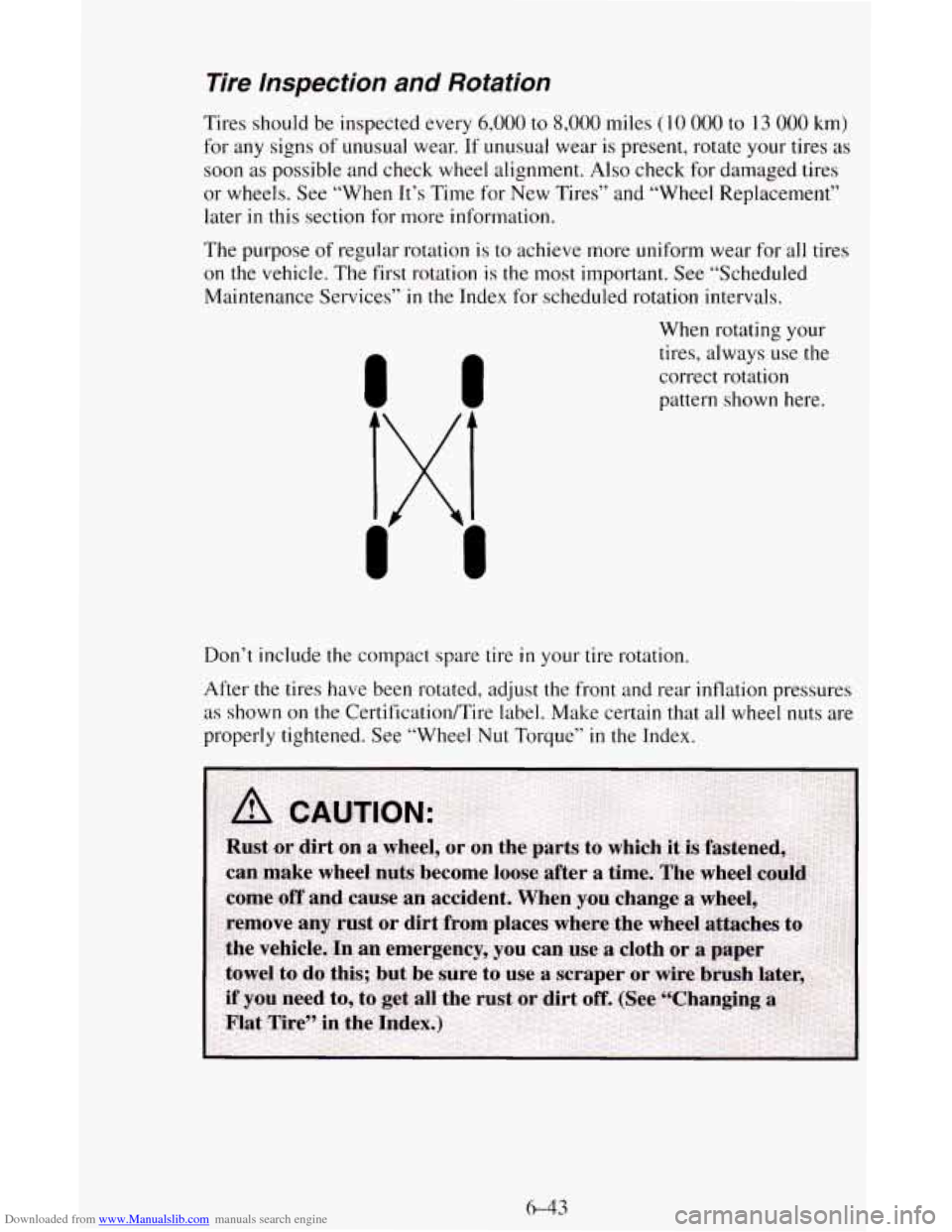
When rotating your tires, always use
the
correct rotation
pattern shown here.
Don’t include the compact spare tire
in your tire rotation.
After the tires have been rotated, adjust the front and rear inflation pressures
as shown on
the Certification/Tire label. Make certain that all wheel nuts are
properly tightened. See “Wheel
Nut Torque” in the Index.
6-43
Page 257 of 342
Downloaded from www.Manualslib.com manuals search engine Don’t use any of these unless this manual says you can. In many uses, these
will damage your vehicle:
0 Alcohol
Laundry Soap
Bleach
0 Reducing Agents
Cleaning the Inside of Your Vehicle
Use a vacuum cleaner often to get rid of dust and loose dirt. Wipe vinyl or
leather with a clean, damp cloth.
Your GM dealer has two GM cleaners, a solvent-type spot lifter and a
foam-type powdered cleaner. They will clean normal spots and stains very
well. Do not use them on vinyl or leather.
Here are some cleaning tips:
0 Always read the instructions on the cleaner label.
Clean up stains as soon as you can - before they set.
0 Use a clean cloth or sponge, and change to a clean area often. A soft
Use solvent-type cleaners in a well-ventilated area only. If you use
brush may be used
if stains are stubborn.
them, don’t saturate the stained area.
0 If a ring forms after spot cleaning, clean the entire area immediately or
it will set.
Using Foam-Type CIeaner on Fabric
0 Vacuum and brush the area to remove any loose dirt.
0 Always clean a whole trim panel or section. Mask surrounding trim
along stitch or welt lines.
0 Mix Multi-Purpose Powdered Cleaner following the directions on the
container label.
Use suds only and apply with a clean sponge.
0 Don’t saturate the material.
Don’t rub it roughly.
As soon as you’ve cleaned the section, use a sponge to remove the
suds.
6-49
Page 258 of 342
Downloaded from www.Manualslib.com manuals search engine Rinse the section with a clean, wet sponge.
Wipe off what’s left with a slightly damp paper towel or cloth.
Then dry it immediately with a blow dryer or a heat lamp.
NOTICE:
Be careful. A blow dryer may scorch the fabric.
Wipe with a clean cloth.
Using Solvent-Type Cleaner on Fabric
First, see if you have to use solvent-type cleaner at all. Some spots and
stains will clean off better
with just water and mild soap.
If you need to
use a solvent:
Gently scrape excess soil from the trim material with a clean, dull knife or
scraper. Use
very little cleaner, light pressure and clean cloths (preferably
cheesecloth). Cleaning should start at the outside
of the stain, “feathering”
toward the center. Keep changing
to a clean section of the cloth.
blow dryer to help prevent a cleaning ring. (See the previous NOTICE.)
0 When you clean a stain from fabric, immediately dry the area with a
Fabric Protection
Your vehicle has upholstery that has been treated with Scotchgard” Fabric
Protector,
a 3M product. Scotchgard“ protects fabrics by repelling oil and
water, which are the carriers of most stains. Even with this protection, you
still need to clean your upholstery often to keep it looking new.
Further information on cleaning is available by calling 1-800-433-3296
(in
Minnesota, 1-800-642-6 167).
Special Cleaning Problems
Greasy or Oily Stains
Stains caused by grease, oil, butter, margarine, shoe polish, coffee with
cream, chewing gum, cosmetic creams, vegetable oils, wax crayon, tar and
asphalt can be removed as follows:
Carefully scrape off excess stain.
Follow the solvent-type instructions described earlier.
Shoe polish, wax crayon, tar and asphalt will stain if left on a vehicle
seat fabric. They should be removed as soon
as possible. Be careful,
because the cleaner will dissolve them and may cause them to spread.
4-50
Page 269 of 342
Downloaded from www.Manualslib.com manuals search engine Fuse Block
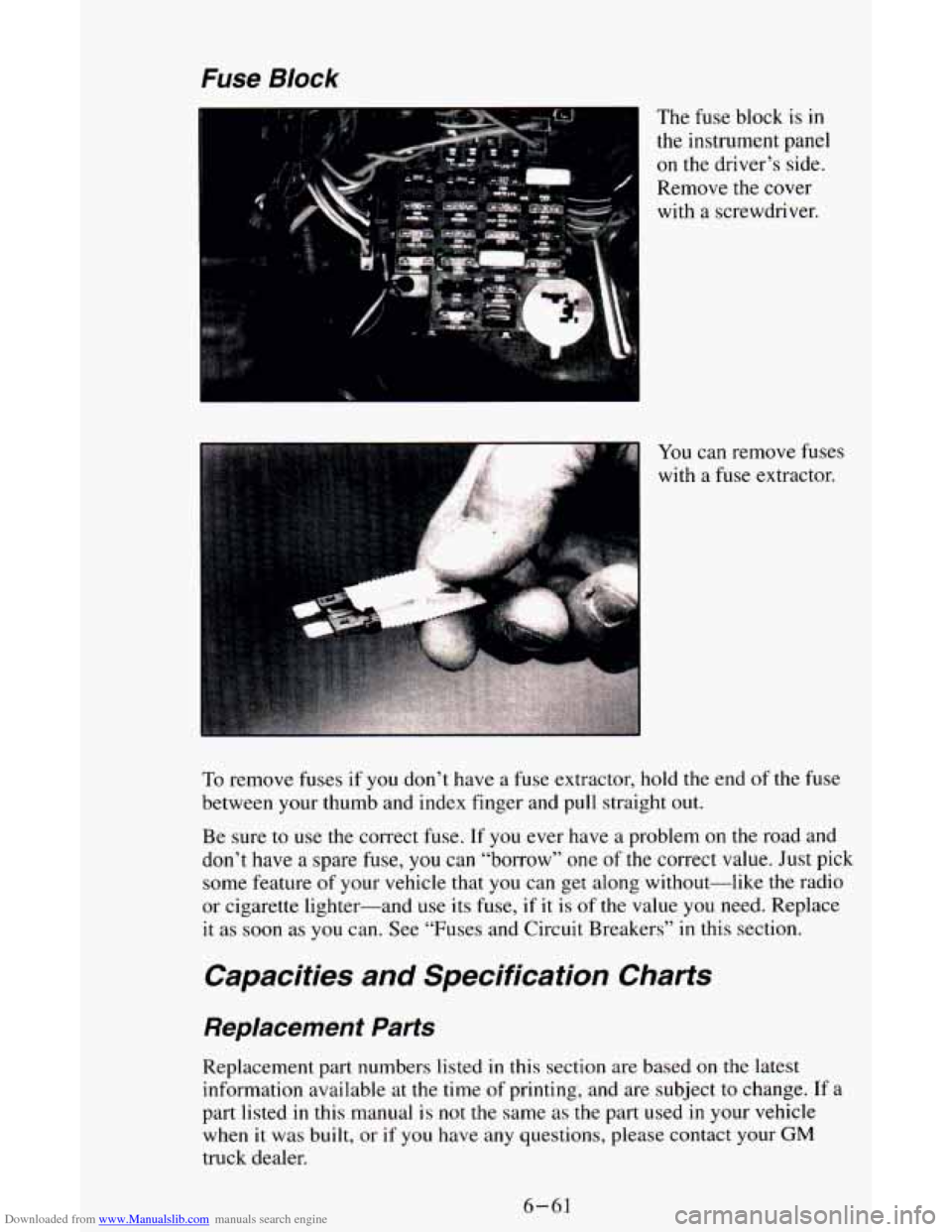
The fuse block is in
the instrument panel
on the driver’s side.
Remove
the cover
with a screwdriver.
You
can remove fuses
with a fuse extractor.
To remove fuses if you don’t have a fuse extractor, hold the end of the fuse
between your thumb and index finger and pull straight out.
Be sure
to use the correct fuse. If you ever have a problem on the road and
don’t have a spare fuse,
you can “borrow” one of the correct value. Just pick
some feature of your vehicle that
you can get along without-like the radio
or cigarette lighter-and use its fuse, if it is
of the value you need. Replace
it as soon as you can. See “Fuses and Circuit Breakers” in this section.
Capacities and Specification Charts
Replacement Parts
Replacement part numbers listed in this section are based on the latest
information available at the time
of printing, and are subject to change. If a
part listed
in this manual is not the same as the part used in your vehicle
when
it was built, or if you have any questions, please contact your GM
truck dealer.
6-61
Page 277 of 342
Downloaded from www.Manualslib.com manuals search engine Scheduled Maintenance Services
IMPORTANT:
KEEP ENGINE OIL
AT THE PROPER
LEVEL AND CHANGE
AS RECOMMENDED
Section
This section covers the maintenance required for your vehicle. Your vehicle
needs these services to retain its safety, dependability and emission control
performance.
Protection I
Have you purchased the GM Protection Plan? The Plan supplements your
new vehicle warranties. See your GM dealer for details.
Introduction
Your Vehicle and the Environment
Proper vehicle maintenance not only helps to keep your vehicle in good
working condition, but also helps the environment.
All recommended
maintenance procedures are important. Improper vehicle maintenance or the
removal of important components can significantly affect the quality of the
air we breathe. Improper fluid levels or even the wrong tire inflation can
increase the level
of emissions from your vehicle. To help protect our
environment, and
to help keep your vehicle in good condition, please
maintain your vehicle properly.
7-1