Page 178 of 290

If No Steam Is Coming
From Your Engine
If you get the overheat warning but see or
hear no steam, the problem may not be
too serious. Sometimes the engine can get
a little too hot when you:
0 Climb a long hill on a hot day.
0 Stop after high speed driving.
0 Idle for long periods in traffic.
Tow a trailer.
If you get the overheat warning with
no
sign of steam, try this for a minute or so:
1. Turn off your air conditioner.
2. Turn on your heater to full hot at the
highest fan speed and open the
window as necessary.
3. If you’re in a traffic jam, shift to “N”
(Neutral).
If you no longer have the overheat
warning, you can drive. Just to be safe,
drive slower for about ten minutes. If the
warning doesn’t come back on, you can
drive normally.
If the warning continues, pull over, stop,
and park your vehicle right away.
If there’s still no sign of steam, you can
idle the engine for two or three minutes
while you’re parked, to see
if the warning
stops.
But then,
if you still have the warning,
TURN
OFF THE ENGINE AND GET
EVERYONE OUT
OF THE VEHICLE
until it cools down.
You may decide not to lift the hood but to
get service help right away.
11
Cooling System
When you decide it’s safe to lift the hood,
here’s what you’ll see:
(A) Coolant recovery tank
(B) Radiator pressure cap
(C) Electric engine fan
. 177..
c
ProCarManuals.com
Page 181 of 290
Problems on the Road
How to Add Coolant to the
Radiator:
1. You can remove the radiator pressure
cap when the cooling system,
including the radiator pressure cap and
upper radiator hose, is no longer hot.
Turn the pressure cap slowly to the
left until
it first stops. (Don’t press
down while turning the pressure cap.)
If
you hear a hiss, wait for that to stop.
A hiss means there is still some
pressure left.
. . . 180
2. Then keep turning the pressure cap,
but now push down as you turn it.
Remove the pressure cap. 3. Fill the radiator with the proper mix,
up to the base
of the filler neck.
ProCarManuals.com
Page 182 of 290
4. Then fill the coolant recovery tank to
the
“FULL COLD” mark.
5. Put the cap back on the coolant
recovery tank, but leave the radiator
pressure cap
off.
6. Start the engine and let it run until you
can feel the upper radiator hose
getting hot. Watch out for the engine
fan.
7. By this time the coolant level inside
the radiator filler neck may be €ower.
If the level is lower, add more
of the
proper mix through the filler neck
until the level reaches the base of the
filler neck.
181 ...
ProCarManuals.com
Page 183 of 290
Problems on the Road
How to Add Coolant to the
Radiator:
(CONT.)
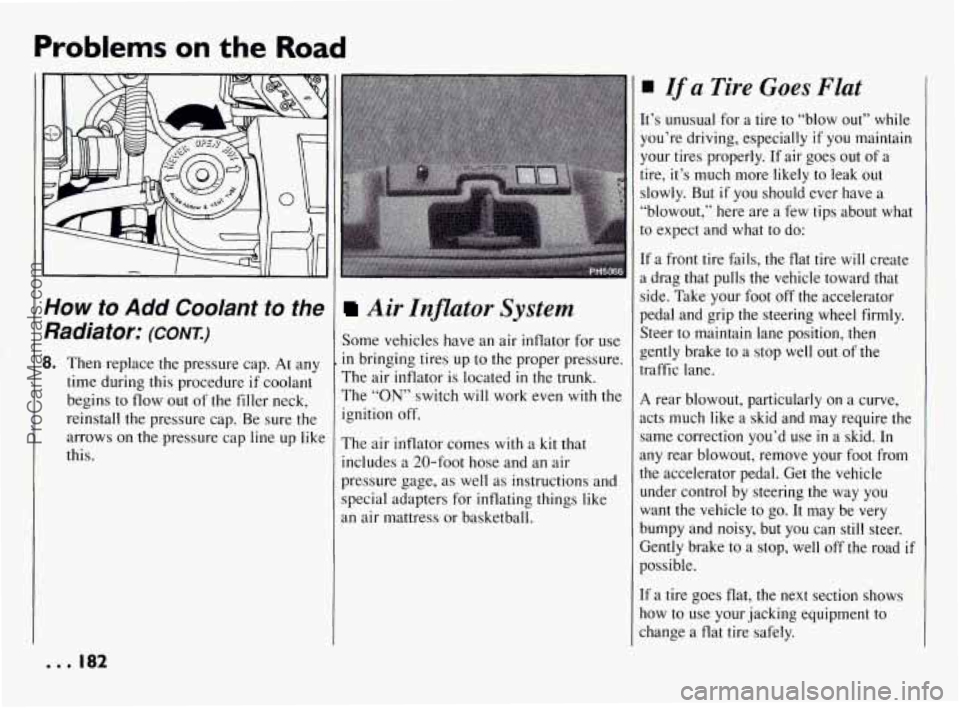
8. Then replace the pressure cap. At any
time during this procedure
if coolant
begins
to flow out of the filler neck,
reinstall the pressure cap. Be sure the
arrows
on the pressure cap line up like
this.
. . . 182
Air Inflator System
Some vehicles have an air inflator for use
in bringing tires up to the proper pressure.
The air inflator is located
in the trunk.
The “ON” switch will work even with the
ignition off.
The air inflator comes with a
kit that
includes a 20-foot hose and an air
pressure gage, as well as instructions and
special adapters for inflating things like
an air mattress or basketball.
If a Tire Goes FZat
It’s unusual for a tire to “blow out” while
you’re driving, especially
if you maintain
your tires properly. If air goes out of a
tire, it’s much more likely to leak out
slowly.
But if you should ever have a
“blowout,” here are a few tips about what
to expect and what to
do:
If a front tire fails, the flat tire will create
a drag that pulls the vehicle toward that
side. Take your foot
off the accelerator
pedal and grip
the steering wheel firmly.
Steer
to maintain lane position, then
gently brake
to a stop well out of the
traffic lane.
A rear blowout, particularly on a curve,
acts much like a skid and may require the
same correction you’d use
in a skid. In
my rear blowout, remove your foot from
the accelerator pedal. Get the vehicle
under control by steering the way you
want the vehicle
to go. It may be very
bumpy and noisy, but you can still steer.
Sently brake to a stop, well off the road
if
possible.
[fa tire goes flat, the next section shows
low
to use your jacking equipment to
:hange a flat tire safely.
ProCarManuals.com
Page 202 of 290
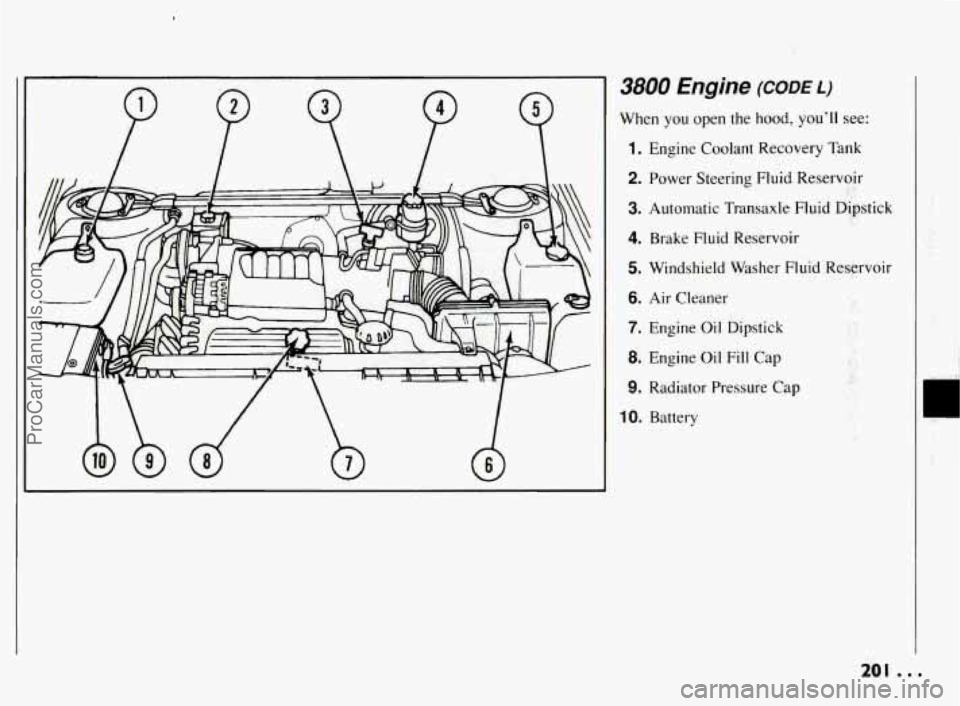
3800 Engine (CODE L)
When you open the hood, you'll see:
1. Engine Coolant Recovery Tank
2. Power Steering Fluid Reservoir
3. Automatic Transaxle Fluid Dipstick
4. Brake Fluid Reservoir
5. Windshield Washer Fluid Reservoir
6. Air Cleaner
7. Engine Oil Dipstick
8. Engine Oil Fill Cap
9. Radiator Pressure Cap
10. Battery I. .. I I 5 ;;$ " :. 1. ,.:.;
201 ..*
ProCarManuals.com
Page 203 of 290
Service & Appearance Care
. 0 202
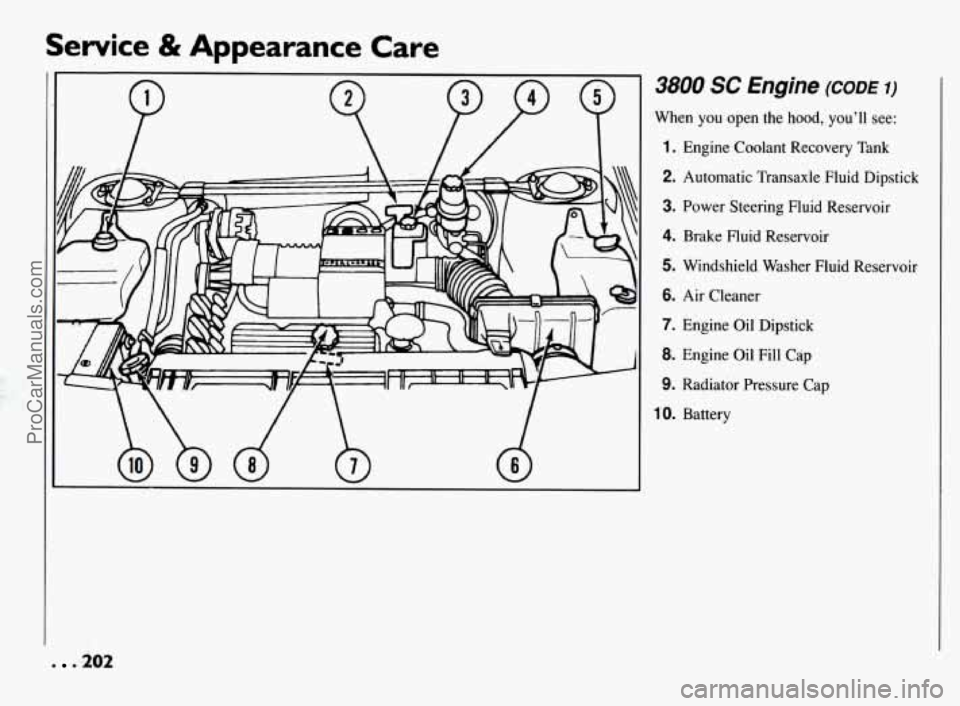
3800 SC Engine (CODE I)
When you open the hood, you’ll see:
1. Engine Coolant Recovery Tank
2. Automatic Transaxle Fluid Dipstick
3. Power Steering Fluid Reservoir
4. Brake Fluid Reservoir
5. Windshield Washer Fluid Reservoir
6. Air Cleaner
7. Engine Oil Dipstick
8. Engine Oil Fill Cap
9. Radiator Pressure Cap
lo. Battery
ProCarManuals.com
Page 216 of 290
If this light comes on, it means you're lo
on coolant.
L
LOW COOLANT
I'o Add C,oolant
[f you need more coolant, add the proper
mix at the coolant recovery tank.
Add coolant
mix at the recovery tank, but
be careful not to spill
it.
Radiator Pressure Cap
I NOTICE:
Your radiator cap is a 15 psi
( 105 kPa) pressure-type cap and
must be tightly installed to prevent
coolant loss and possible engine
damage from overheating. Be sure
the arrows on the cap line up with
the overflow tube on the radiator
filler neck.
When you replace your radiator pressure
cap, an AC@ cap
is recommended.
215...
ProCarManuals.com
Page 217 of 290
Service & Appearance Care
Thermostat
Engine coolant temperature is controlled
by a thermostat
in the engine coolant
system. The thermostat stops the flow
of
coolant through the radiator until the
coolant reaches a preset temperature.
When you replace your thermostat, an
AC@ thermostat is recommended.
Power Steering Fluid
How To Check Power
Steering
Fluid
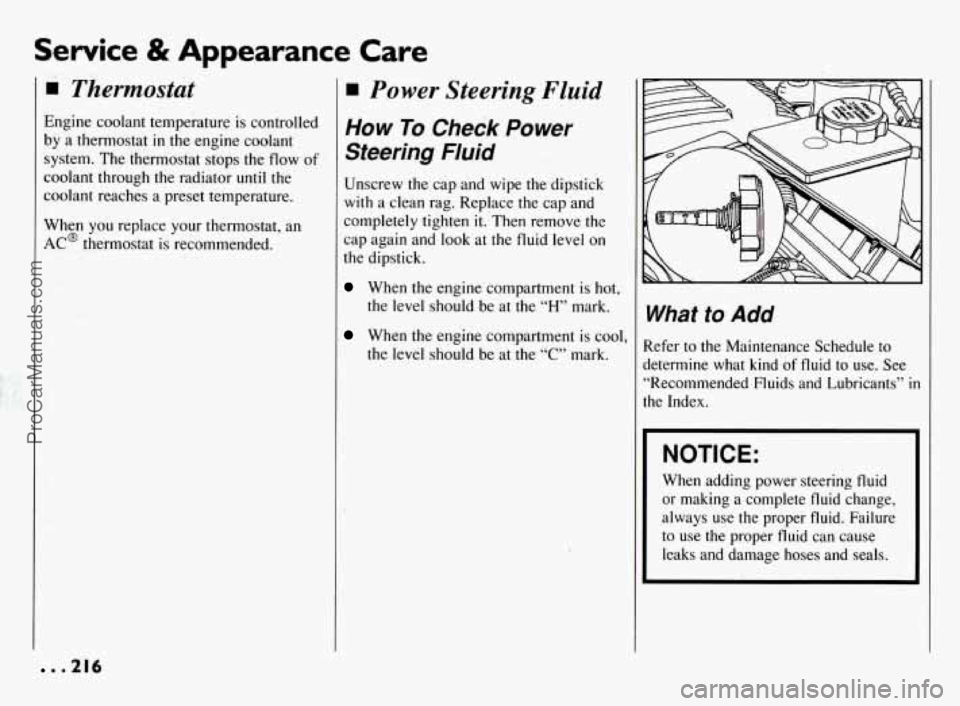
Unscrew the cap and wipe the dipstick
with a clean rag. Replace the cap and
completely tighten
it. Then remove the
cap again and look at the fluid level on
the dipstick.
When the engine compartment is hot,
the level should be at the
“H” mark.
When the engine compartment is cool,
the level should be at the “C” mark.
What to Add
Refer to the Maintenance Schedule to
determine what kind
of fluid to use. See
“Recommended Fluids and Lubricants”
in
the Index.
NOTICE:
When adding power steering fluid
or making a complete fluid change,
always
use the proper fluid. Failure
to use the proper fluid can cause
leaks and damage hoses and seals.
. .216
ProCarManuals.com