1994 PONTIAC BONNEVILLE brakes
[x] Cancel search: brakesPage 58 of 290

Ensure the shift lever is fully in “P”
(Park) range before starting the engine.
Your Pontiac has a brake-transaxle shift
interlock.
You have to fully apply your
regular brakes before you can shift from
“P,’ (Park) when the ignition key is in the
“On” position. If you cannot shift
gut of
“P’ (Park), ease pressure on the shift
lever-push the shift lever all the way
into
“P” (Park) and also release the shift
lever button on floor shift console models
as you maintain brake application. Then
move the shift lever into the gear you
wish. (Press the shift lever button before
moving the shift lever on floor shift
console models.) See “Shifting Out
of
‘P’ (Park)” later in this section.
Reverse
R (Reverse): Use this gear to back up.
NOTICE:
Shifting to “R” (Reverse) while
your vehicle is moving forward
could damage your transaxle. Shift
to “R” only after your vehicle is
stopped.
57. ..
ProCarManuals.com
Page 61 of 290
Features & Controls
Forward Gears (CONT)
D (Third Gear): This is like @ , but you
never
go into Overdrive.
Here are some times you might choose
“D’ instead of @ :
- When driving on hilly, winding roads
- When towing a trailer, so there is less
shifting between gears
- When going down a steep hill
2 (Second Gear): This position gives you
more power but lower
fuel economy. You
can use “2” on hills.
It can help control
your speed as you
go down steep
mountain roads, but
then you would also
want
to use your brakes off and on.
NOTICE:
Don’t drive in “2” (Second Gear) for
more than
5 miles (8 km), or at
speeds over
55 mph (88 km/h), or
you can damage your transaxle. Use
@ or “D’ as much as possible.
Don’t shift into “2” unless
you are
going slower than
65 mph
( 105 km/h), or you can damage
your engine.
1 (First Gear): This position gives you
even more power (but lower fuel economy) than
“2.” You can use it on
very steep hills, or in deep snow or mud.
If the selector lever is put
in “1,” the
transaxle won’t shift into first gear until
the vehicle is going slowly enough.
NOTICE:
If your front wheels can’t rotate,
don’t try to drive. This might
happen
if you were stuck in very
deep sand or mud or were up
against a solid object. You could
damage your transaxle.
Also,
if you stop when going uphill,
don’t hold your vehicle there with
only the accelerator pedal. This could overheat and damage the
transaxle. Use your brakes or shift
into
“P’ (Park) to hold your vehicle
in position on a hill.
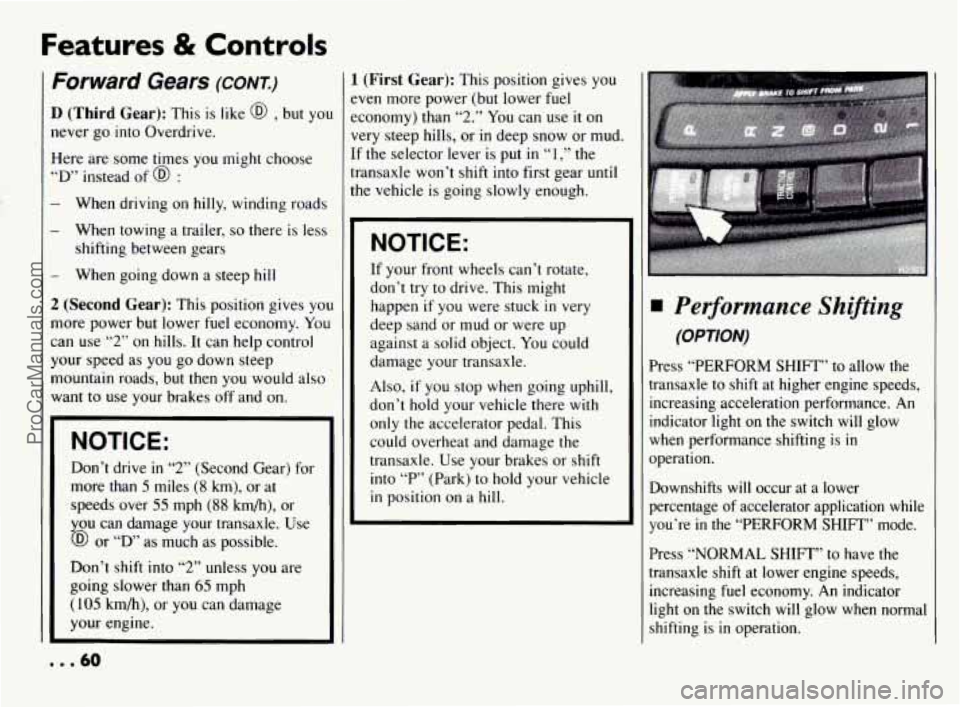
Performance Shiftins
(OPTION)
Press “PERFORM SHIFT” to allow the
transaxle to shift at higher engine speeds,
increasing acceleration performance.
An
indicator light on the switch will glow
when performance shifting is in
operation.
Downshifts
will occur at a lower
percentage of accelerator application while
you’re
in the “PERFORM SHIFT” mode.
Press “NORMAL
SHIFT” to have the
transaxle shift at lower engine speeds,
increasing fuel economy.
An indicator
light on the switch will glow when normal
shifting
is in operation.
... 60
ProCarManuals.com
Page 63 of 290
Features & Controls
Parking Brake (CONT.)
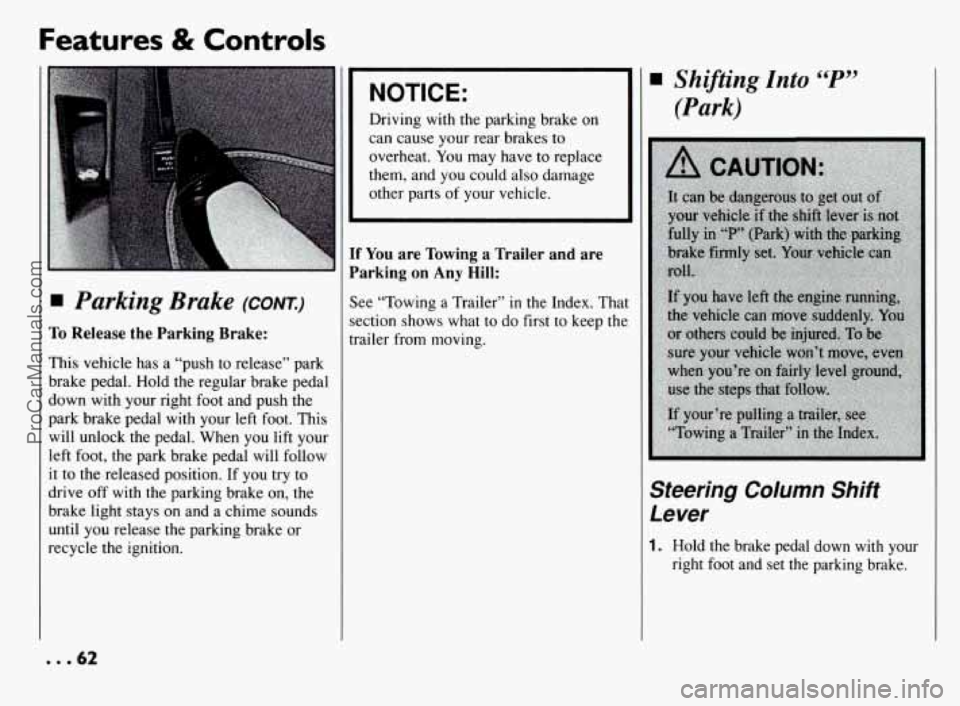
To Release the Parking Brake:
This vehicle has a “push to release” park
brake pedal. Hold the regular brake pedal
down with your right foot and push the
park brake pedal with your left foot. This
will unlock the pedal. When you lift your
left foot, the park brake pedal will follow
it to the released position. If you try to
drive
off with the parking brake on, the
brake light stays on and a chime sounds
until you release the parking brake or
recycle the ignition.
NOTICE:
Driving with the parking brake on
can cause your rear brakes to
overheat. You may have
to replace
them, and you could also damage
other parts
of your vehicle.
F You are Towing a Trailer and are
larking
on Any Hill:
ee “Towing a Trailer” in the Index. Tha
xtion shows what
to do first to keep the
+ailer from moving.
Shijiting Into “P”
(Park)
Steering Column Shift
Lever
1. Hold the brake pedal down with your
right foot and set the parking brake.
... 62
ProCarManuals.com
Page 65 of 290
Features & Controls
Leaving Your Vehicle With
the Engine Running
If you have to leave your vehicle with the
engine running, be sure your vehicle is
in
“P” (Park) and your parking brake is
firmly set before you leave it. After
you’ve moved the shift lever into the
“P”
(Park) position, hold the regular brake
pedal down. Then, see
if you can move
the shift lever away from
“P” (Park)
without first pulling it toward you (or,
if
you have the console shift lever, without
... 64
first pushing the button). If you can, it
means that the shift lever wasn’t fully
locked into
“P” (Park).
T~rque Lock
If you are parking on a hill and you don’t
shift your transaxle into
“P” (Park)
properly, the weight of the vehicle may
put too much force on
the parking pawl in
the transaxle. You may find it difficult to
pull
the shift lever out of “F’ (Park). This
is called “torque lock.” To prevent torque
lock, set the parking brake and then shift
into
“P” (Park) properly before you leave
the driver’s seat.
To find out how, see
“Shifting Into ‘P’ (Park)”
in the Index.
When you are ready to drive, move the
shift lever out of
“P’ (Park) BEFORE you
release the parking brake.
If “torque lock” does occur, you may
need to have another vehicle push yours a
little uphill to take some of the pressure
from the transaxle,
so you can pull the
shift lever out of
“P’ (Park).
Shifting Out of “P”
(Park)
Your Pontiac has a brake-transaxle shift
interlock. You have to fully a& your
regular brakes before you can shift from
“P” (Park) when the ignition is in the
“On” position. See “Shifting the
Automatic Transaxle” in the Index.
If you cannot shift out of “P” (Park), ease
pressure
on the shift lever - push the
shift lever ail the way into “P’ (Park) and
also release the shift lever button
on floor
shift models as you maintain brake
application. Then move the shift lever
into the gear you want. (Press the shift
lever button before moving the shift
lever.) If you ever hold the brake pedal
down but still can’t shift out of
“P’
(Park), try this:
ProCarManuals.com
Page 73 of 290

Features & Controls
Cruise Control (OPTION)
(CONK)
When you apply your brakes, the Cruise
Control shuts off.
To Set Cruise Control
1. Move the Cruise Control switch to
“ON”.
2. Get up to the speed you want.
3. Push in the “SE.T” button at the end of
the lever and release it.
4. Take your foot off the accelerator
pedal.
... 72
ProCarManuals.com
Page 99 of 290
Features & Controls
rn ANTILOCK (@)
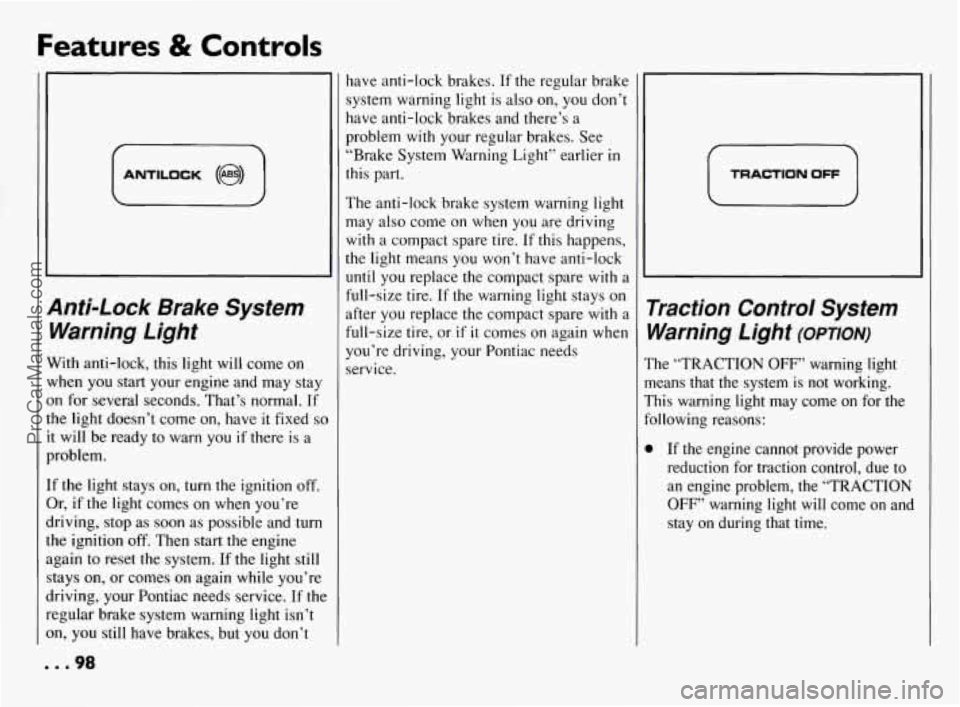
Anti-Lock Brake System Warning Light
With anti-lock, this light will come on
when you start your engine and may stay
on for several seconds. That’s normal. If
the light doesn’t come on, have it fixed
so
it will be ready to warn you if there is a
problem.
If the light stays on, turn the ignition off.
Or, if the light comes on when you’re
driving, stop as soon as possible and turn
the ignition
off. Then start the engine
again to reset the system. If the light still
stays on, or comes on again while you’re
driving, your Pontiac needs service. If the
regular brake system warning light isn’t
on, you still have brakes, but you don’t have anti-lock brakes.
If the regular brake
system warning light is also on, you don’t
have anti-lock brakes and there’s a
problem
with your regular brakes. See
“Brake System Warning Light” earlier
in
this part.
The anti-lock brake system warning light
may also come on when
you are driving
with a compact spare tire. If this happens,
the light means you won’t have anti-lock
until you replace the compact spare with a
full-size tire. If the warning light stays on
after you replace the compact spare with a
full-size tire, or
if it comes on again when
you’re driving, your Pontiac needs
service.
i TRACTION OFF
Traction Control System Warning Light
(omoN)
The “TRACTION OFF” warning light
means that the system is not working.
This warning light may come on for the
following reasons:
0 If the engine. cannot provide power
reduction for traction control, due to
an engine problem, the “TRACTION
OFF” warning light will come on and
stay on during that time.
... 98
ProCarManuals.com
Page 100 of 290
To prevent overheating, the traction control system will go off and the warning light will come on
until your
brakes cool down. The warning light
will come
on for varying periods of
time.
If
you turn the system off by pressing
the switch on the center console while
the vehicle is at any speed, the warning light will come
on and stay
on. To turn the system back on, press
the switch again at any vehicle speed.
The warning light should
go off. The
system
will also turn itself on if you
turn your ignition off and back on
again. When this warning light is
on, the
system
will not limit wheel spin. Adjust your
driving accordingly.
If the “TRACTION OFF” warning light
comes
on and stays on for an extended
period
of time, even when you’ve
switched the system on, your vehicle
needs service.
Gages
Your Pontiac may have many of the
following gages. Be sure to read about the
mes that came with your vehicle.
I
990..
ProCarManuals.com
Page 138 of 290

Defensive Driving
Your
................
Part 4
Driving and the Road
.................................
DrunkenDriving ..................................................
'Control of a Vehicle
Bmking .. ......................................................
Anti-LackBrakes ................................................
SteeringTips ....................................................
Steering in Emergencies ...........................................
Passling ........................................................
I)rivin>g in the Rain .................................................
City Driving ......................................................
Freeway Driving ..................................................
DrivingatNight ...................................................
Before Leaving on a Long Trip .......................................
HillandMountainRoads ............................................
WhterDriving ....................................................
Towing a Trailer ...................................................
138
138
141
142
144
145
146
148
149 151
151
152
153
155
158
ProCarManuals.com