1994 PONTIAC BONNEVILLE engine overheat
[x] Cancel search: engine overheatPage 4 of 290
How to Use This Manual
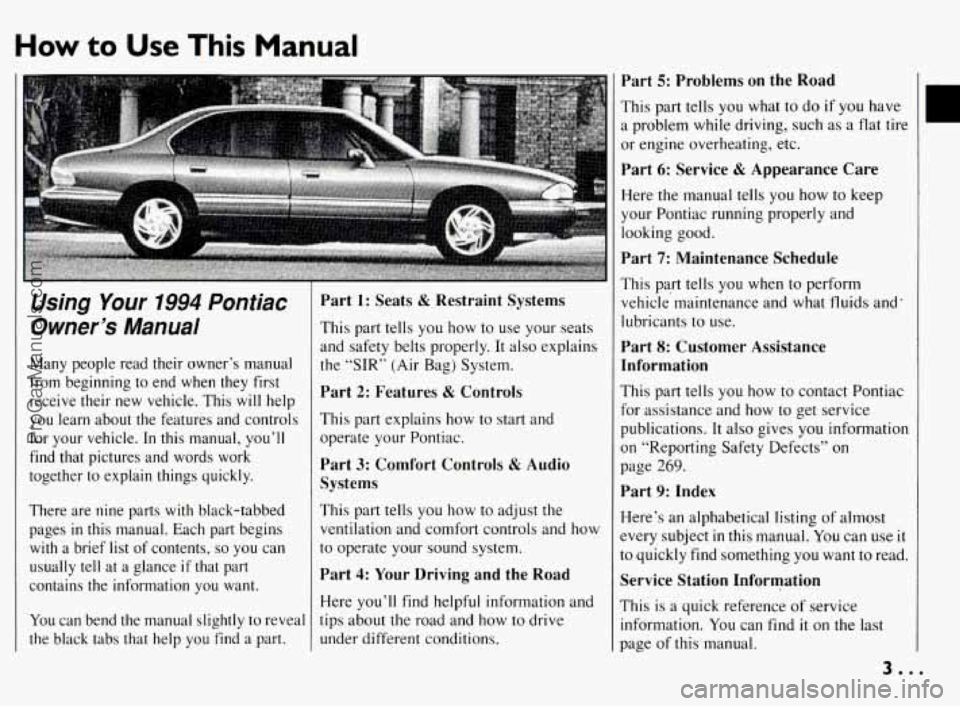
Using Your 1994 Pontiac
Owner’s Manual
Many people read their owner’s manual
from beginning
to end when they first
receive their
new vehicle. This will help
you learn about the features and controls
for your vehicle. In this manual, you’ll
find that pictures and words work
together
to explain things quickly.
There are nine parts with black-tabbed pages
in this manual. Each part begins
with a brief list of contents,
so you can
usually tell at a glance
if that part
contains the information you want.
You can bend the manual slightly to reveal
the black tabs that help you find a part.
This part tells you how to use your seats
and safety belts properly. It also explains
the “SIR’ (Air Bag) System.
Part 2: Features & Controls
This part explains how to start and
operate your Pontiac.
Part 3: Comfort Controls & Audio
Systems
This part tells you how to adjust the
ventilation and comfort controls and how
to operate your sound system.
Part 4: Your Driving and the Road
Here you’ll find helpful information and
tips about the road and how
to drive
under different conditions.
Part 5: Problems on the Road
This part tells you what to do if you have
a problem while driving, such as a flat tire
or engine overheating, etc.
Part 6: Service & Appearance Care
Here the manual tells you how to keep
your Pontiac running properly and
looking good.
Part 7: Maintenance Schedule
This part tells you when to perform
vehicle’maintenance and what fluids and’
lubricants to use.
Part 8: Customer Assistance
Information
This part tells you how to contact Pontiac
for assistance and how
to get service
publications. It also gives
you information
on “Reporting Safety Defects”
on
page 269.
Part 9: Index
Here’s an alphabetical listing of almost
every subject
in this manual. You can use it
to quickly find something you want to read.
Service Station Information
This is a quick reference of service
information.
You can find it on the last
page of this manual.
3..
ProCarManuals.com
Page 61 of 290
Features & Controls
Forward Gears (CONT)
D (Third Gear): This is like @ , but you
never
go into Overdrive.
Here are some times you might choose
“D’ instead of @ :
- When driving on hilly, winding roads
- When towing a trailer, so there is less
shifting between gears
- When going down a steep hill
2 (Second Gear): This position gives you
more power but lower
fuel economy. You
can use “2” on hills.
It can help control
your speed as you
go down steep
mountain roads, but
then you would also
want
to use your brakes off and on.
NOTICE:
Don’t drive in “2” (Second Gear) for
more than
5 miles (8 km), or at
speeds over
55 mph (88 km/h), or
you can damage your transaxle. Use
@ or “D’ as much as possible.
Don’t shift into “2” unless
you are
going slower than
65 mph
( 105 km/h), or you can damage
your engine.
1 (First Gear): This position gives you
even more power (but lower fuel economy) than
“2.” You can use it on
very steep hills, or in deep snow or mud.
If the selector lever is put
in “1,” the
transaxle won’t shift into first gear until
the vehicle is going slowly enough.
NOTICE:
If your front wheels can’t rotate,
don’t try to drive. This might
happen
if you were stuck in very
deep sand or mud or were up
against a solid object. You could
damage your transaxle.
Also,
if you stop when going uphill,
don’t hold your vehicle there with
only the accelerator pedal. This could overheat and damage the
transaxle. Use your brakes or shift
into
“P’ (Park) to hold your vehicle
in position on a hill.
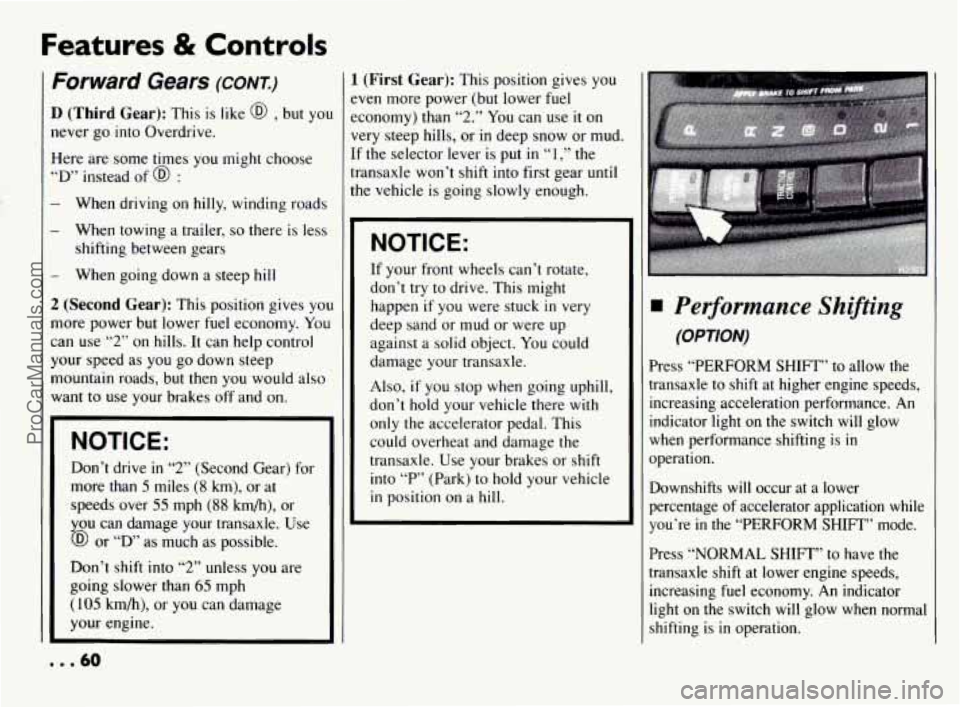
Performance Shiftins
(OPTION)
Press “PERFORM SHIFT” to allow the
transaxle to shift at higher engine speeds,
increasing acceleration performance.
An
indicator light on the switch will glow
when performance shifting is in
operation.
Downshifts
will occur at a lower
percentage of accelerator application while
you’re
in the “PERFORM SHIFT” mode.
Press “NORMAL
SHIFT” to have the
transaxle shift at lower engine speeds,
increasing fuel economy.
An indicator
light on the switch will glow when normal
shifting
is in operation.
... 60
ProCarManuals.com
Page 93 of 290

Features & Controls
SYSTEMS MONITOR
0
(-J[=zFz]
[HeURlTY][-))
Warning Lights (CONT.)
I
I-] INFORMATION DRIVER
CHECK OIL LEVEL - LAMP
WASHER FLUID
CHECK QAQES LOW
COOLANT
moo DOOR TRUNK AJAR TURN SIONAL
BACK UP TAIL
BRAKE LAMP
MILES TRIP
(][TEiir] ENGINE SOON
[E][--
Engine Coolant Temperature Warning
Light
This light tells you that your engine
coolant has overheated or your radiator
cooling fans are not working.
If you have
been operating your vehicle under normal
driving conditions, you
should pull off the
road, stop your vehicle and
turn the
engine off as soon as possible.
I #..92
ProCarManuals.com
Page 94 of 290
HOT COOLANT CAN BURN YOU
BADLY!
In “Problems on the Road”, this manual
shows
what to do. See “Engine
Overheating”
in the Index.
Some clusters
with gages do not have a
coolant temperature warning light. In
those clusters a “CHECK GAGES”
warning light
will alert you of a potential
coolant heating problem.
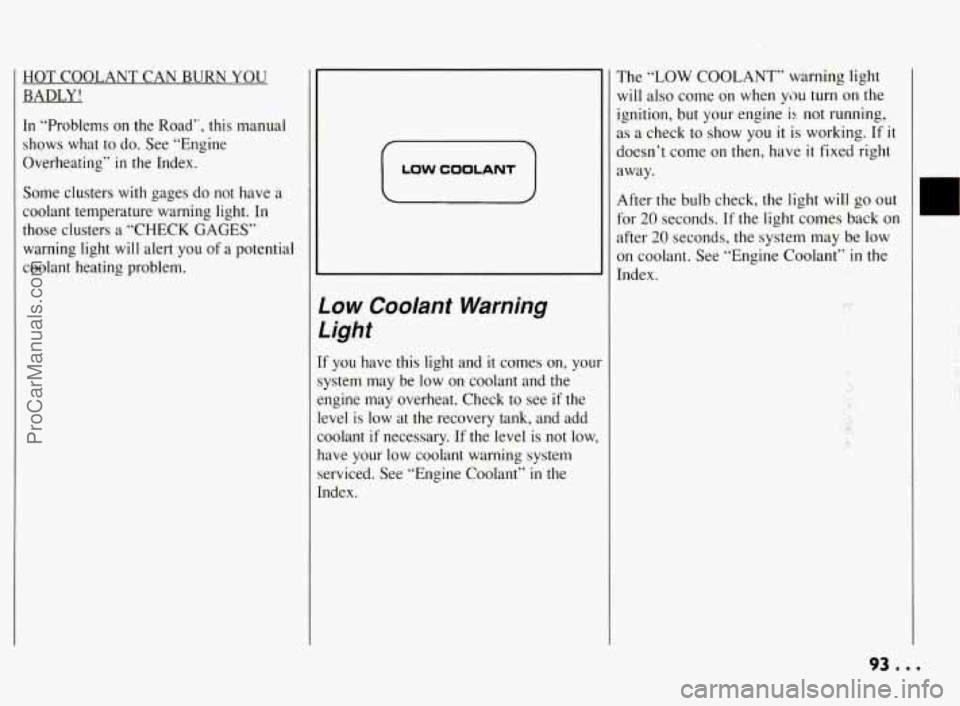
r LOW COOLANT
Low Coolant Warning
Light
If you have this light and it comes on, you
system may be low on coolant and the
engine may overheat. Check to see
if the
level is low
at the recovery tank, and add
coolant
if necessary. If the level is not low.
have your low coolant warning system serviced. See “Engine Coolant”
in the
Index. The
“LOW COOLANT” warning
light
will also come on when you
turn on the
ignition, but your engine
is not running,
as a check to show you
it is working. If it
doesn’t come on then, have it fixed right
away.
After the bulb check, the light will go out
for
20 seconds. If the light comes back on
after
20 seconds, the system may be low
on coolant. See “Engine Coolant” in the
Index.
93.0.
ProCarManuals.com
Page 102 of 290
HOTCOOLANTCANBURNYOU BADLY!
In “Problems on the Road”, this manual
shows what to
do. See “Engine
Overheating”
in the Index.
H2a
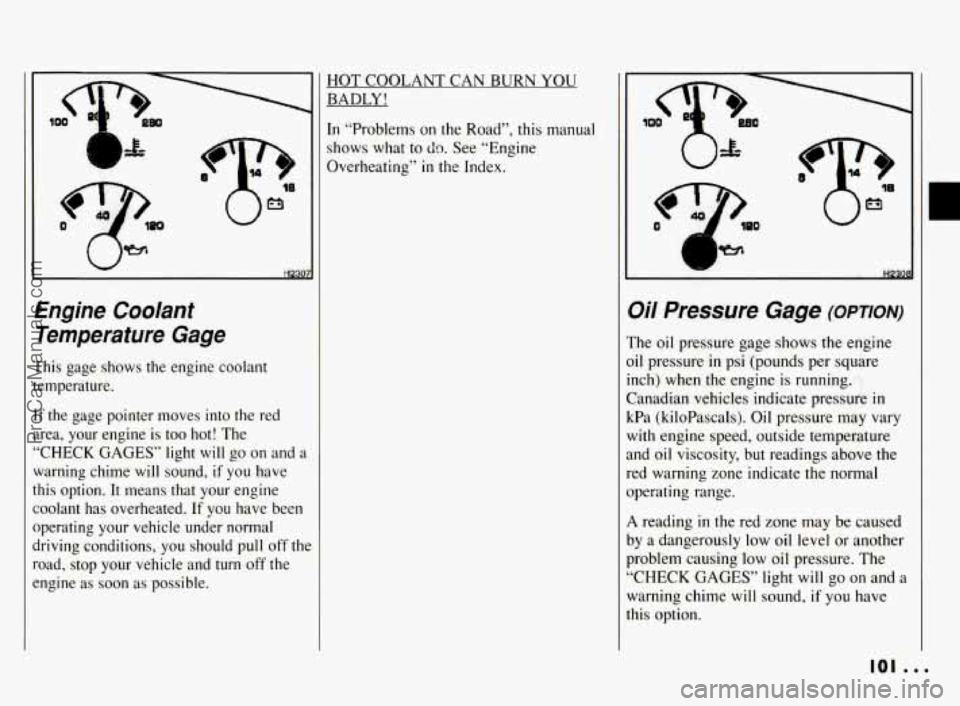
Engine Coolant
Temperature Gage
This gage shows the engine coolant
temperature.
If the gage pointer moves into the red
area, your engine is too hot! The
“CHECK GAGES” light
will go on and a
warning chime will sound, if you have
this option.
It means that your engine
coolant has overheated.
If you have been
operating your vehicle under normal
driving conditions, you should pull off
thc
road, stop your vehicle and turn off the
engine
as soon as possible.
Oil Pressure Gage (omom-)
The oil pressure gage shows the engine
oil pressure
in psi (pounds per square
inch) when the engine is running.
Canadian vehicles indicate pressure
in
kPa (kiloPascals). Oil pressure may vary
with engine speed, outside temperature
and oil viscosity, but readings above the
red warning zone indicate the normal
operating range.
A reading in the red zone may be caused
by a dangerously
low oil level or another
problem causing low oil pressure. The
“CHECK GAGES” light
will go on and a
warning chime will sound,
if you have
this option.
101 ...
ProCarManuals.com
Page 163 of 290

Your Driving and the Road
Driving with a Trailer
(CONT.)
Following Distance
Stay at least twice as far behind the
vehicle ahead as you would when driving
your vehicle without a trailer. This can
help you avoid situations that require
heavy braking and sudden turns.
Passing
You’ll need more passing distance up
ahead when you’re towing a trailer. And,
because you’re a good deal longer, you’ll
need to
go much farther beyond the
passed vehicle before you can return to
your lane.
Backing Up
Hold the bottom of the steering wheel
with one hand. Then, to move the trailer
to the left, just move that hand to the left.
To move the trailer to the right, move
your hand to the right. Always back up
slowly and,
if possible, have someone
guide you.
Making Turns
When you’re turning with a trailer, make
wider turns than normal. Do this
so your
trailer won’t strike soft shoulders, curbs,
road signs, trees, or other objects. Avoid
jerky or sudden maneuvers. Signal well
in
advance.
Turn Signals When Towing a Trailer
When you tow a trailer, your vehicle has
to have a different turn signal flasher and
extra wiring. The green arrows on your
instrument panel will flash whenever you
signal a turn or lane change. Properly
hooked up, the trailer lights will also
flash, telling other drivers you’re about to
turn, change lanes or stop.
When towing a trailer, the green arrows
on your instrument panel will flash for
turns even if the bulbs on the trailer are
burned out. Thus, you may think drivers
behind you are seeing your signal when
they are not. It’s important to check
occasionally to be sure the trailer bulbs
are still working. Your
vehicle has bulb warning lights.
When you plug trailer lights into your
vehicle’s lighting system, its bulb warning
lights may not let
you know if one of your
lights goes out.
So, when you have trailer
lights plugged
in, be sure to check your
vehicle and trailer lights from time
to time
to be sure they’re all working. Once you
disconnect the trailer lights, the bulb
warning lights again can tell you if one
of
your vehicle lights is out.
Driving On Grades
Reduce speed and shift to a lower gear
before you start down a long or steep
downgrade. If you don’t shift down, you
might have to use your brakes
so much
that they would get hot and no longer
work well.
On a long uphill grade, shift down to “D”
(Drive) and reduce your speed to around
45 mph (70 km/h) to reduce the
possibility
of engine and transaxle
overheating.
Parking on Hills
You really should not park your vehicle,
with a trailer attached, on a hill. If
something goes wrong, your rig could
. 162
ProCarManuals.com
Page 166 of 290

Here you'^^ find what to do about
some problems that can occur on the
road .
Problems on the
Part. 5
Hazard Warning Flashers ............................................
TowingYourPontiac ...............................................
EngineOverheating ................................................
Air Inflator System .................................................
If a Tire Goes Flat .................................................
ChangingaFlatTire ................................................
CompactSpare ....................................................
If You're Stuck: In Sand. Mud. Ice or Snow .... ......................
Jump Starting .....................................................
1;66
167
170
k76
182
182
183
191
192
165 .
ProCarManuals.com
Page 177 of 290
Problems on the Road
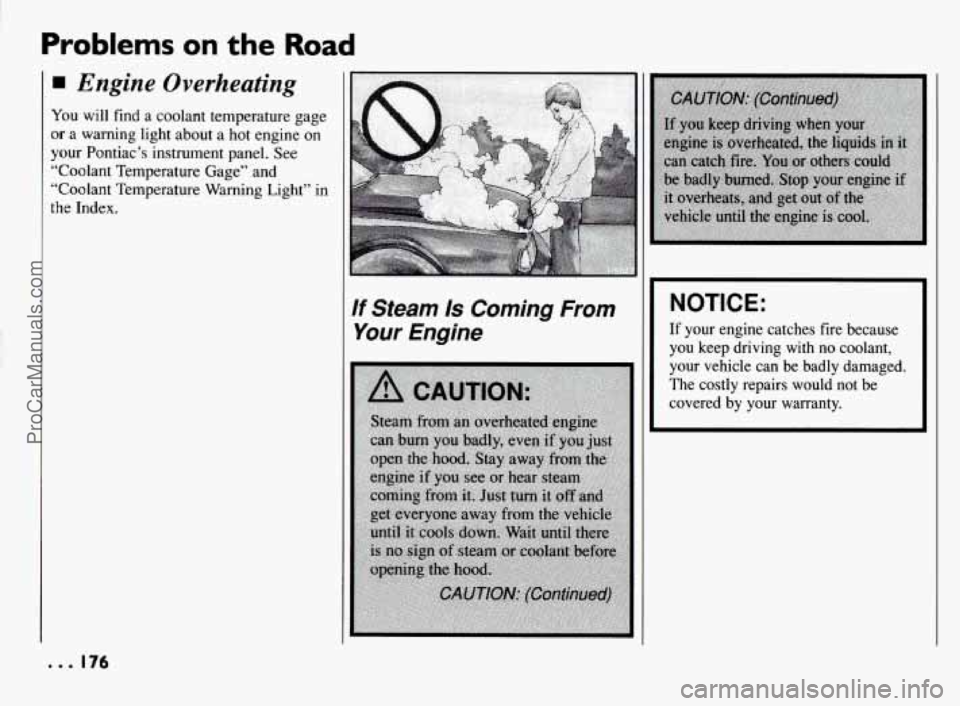
H Engine Overheating
You will find a coolant temperature gage
or a warning light about a hot engine on
your Pontiac’s instrument panel. See
“Coolant Temperature Gage” and
“Coolant Temperature Warning Light” in
the Index.
If Steam Is Coming From
Your Engine
NOTICE:
If your engine catches fire because
you keep driving with no coolant,
your vehicle can be badly damaged.
The costly repairs would not be
covered by your warranty.
ProCarManuals.com