1994 PONTIAC BONNEVILLE mirror
[x] Cancel search: mirrorPage 79 of 290
Features 4? Controls
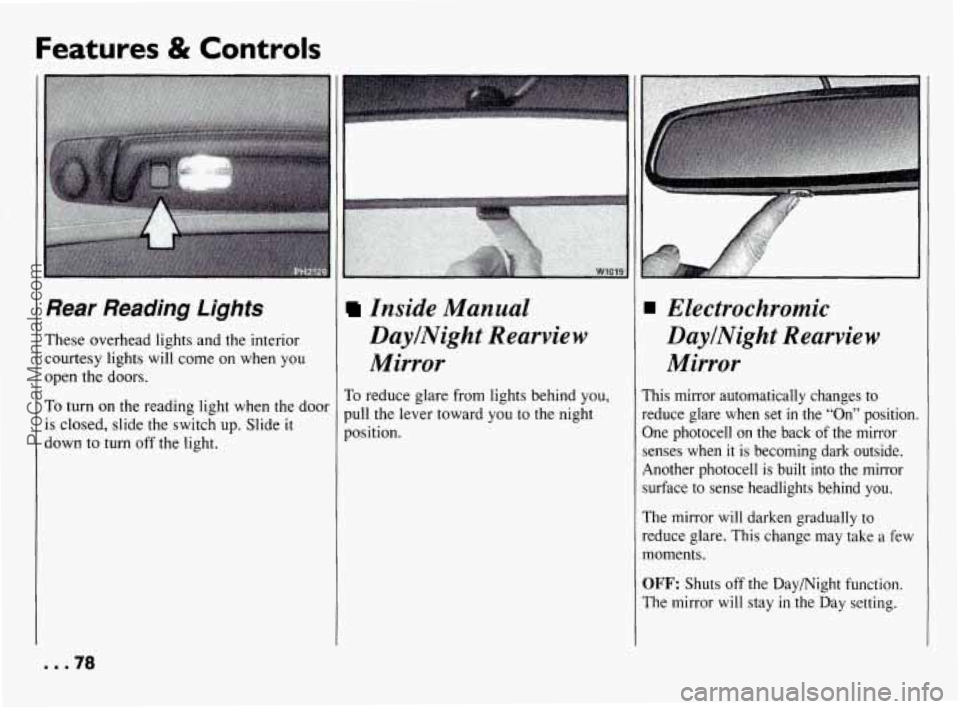
Rear Reading Lights
These overhead lights and the interior
courtesy lights will come on when
you
open the doors.
To turn on the reading light when the door
is closed, slide the switch up. Slide it
down to turn
off the light.
... 78
Inside Manual
DaylNight Rearview
Mirror
To reduce glare from lights behind you,
pull the lever toward you to the night
position.
w Electrochromic
RaylNight Rearview
Mirror
This mirror automatically changes to
reduce glare when set
in the “On” position.
One photocell on the back
of the mirror
senses when
it is becoming dark outside.
Another photocell is built into the mirror
surface to sense headlights behind you.
The mirror will darken gradually to
reduce glare. This change. may take a few
moments.
OFF: Shuts off the Daymight function.
The mirror will stay
in the Day setting.
ProCarManuals.com
Page 80 of 290
To keep the photocells operating well,
occasionally clean them
with a cotton
swab and glass cleaner.
Manual Remote
Control Mirror
The outside rearview mirror should be
adjusted
so you can just see the side of
your vehicle when you are sitting
in a
comfortable driving position.
Adjust the driver side outside mirror
with
the control lever on the driver’s door.
To adjust your passenger side mirror, sit
in the driver’s seat and have a passenger
adjust the mirror for you.
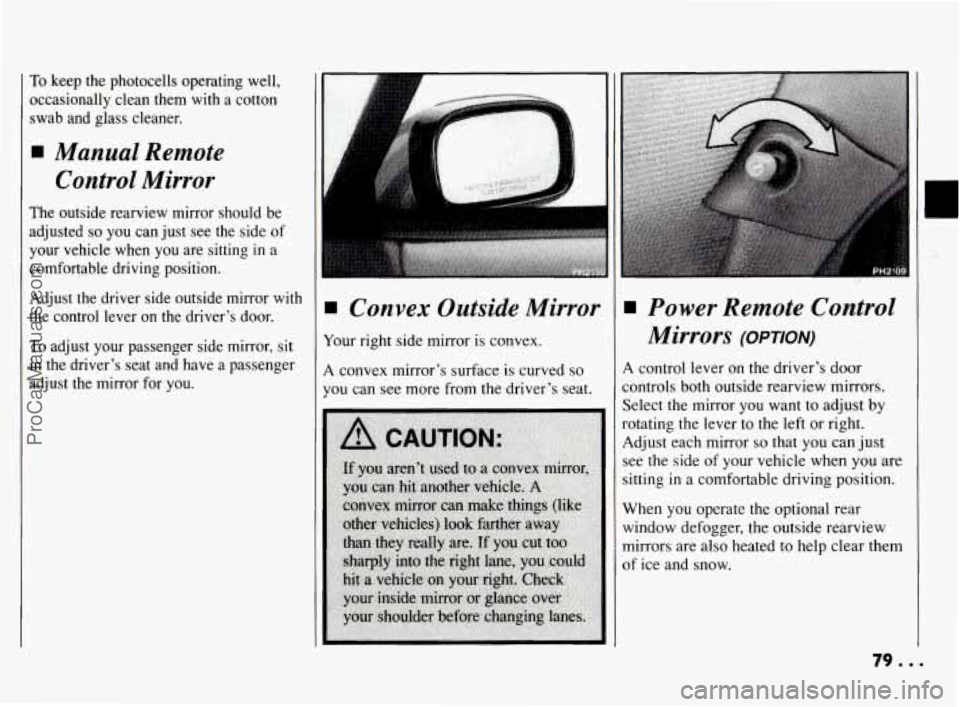
H Convex Outside Mirror
Your right side mirror is convex.
A convex mirror’s surface is curved so
you can see more from the driver’s seat.
Power Remote Control
Mirrors
(OPTION)
A control lever on the driver’s door
controls both outside rearview mirrors.
Select
the mirror you want to adjust by
rotating the lever to the left or right.
Adjust each mirror
so that you can just
see the side of your vehicle when you are
sitting in a comfortable driving position.
When you operate the optional rear
window defogger, the outside rearview
mirrors are also heated to help clear them
of ice and snow.
ProCarManuals.com
Page 81 of 290
Features & Controls
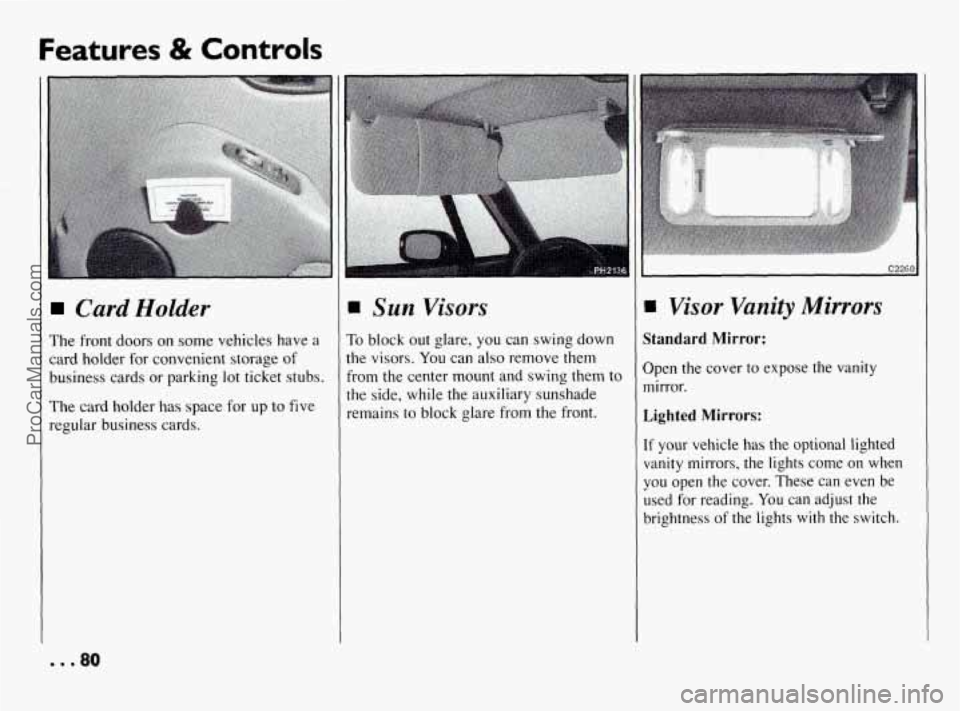
Card Holder
The front doors on some vehicles have a
card holder for convenient storage of
business cards or parking lot ticket stubs.
The card holder has space for up to five
regular business cards.
H Sun Visors
To block out glare, you can swing down
the visors. You can also remove them
from the center mount and swing them to
the side, while the auxiliary sunshade
remains
to block glare from the front.
Visor Vanity Mirrors
Standard Mirror:
Open the cover to expose the vanity
mirror.
Lighted Mirrors:
If your vehicle has the optional lighted
vanity mirrors, the lights come on when
you open the cover. These can even be
used for reading.
You can adjust the
brightness
of the lights with the switch.
... 80
ProCarManuals.com
Page 118 of 290
not be able to if it’s very warm or cold
outside.
ECON: Use in cold or cool weather. This
saves fuel because the air conditioner
compressor doesn’t run. But this setting
doesn’t remove humidity from the air.
(Defrost): Press this to remove fog
or ice from the windshield. It will start at
the mediumhigh fan speed, but you can
select another speed
if you want. It’s a
good idea to remove any ice or snow from
the hood and from the air inlet between
the hood and windshield.
(Rear Window Defogger): Press tc
warm the defogger grid on the rear
window. On some models, the outside
rearview mirrors are also warmed. The
rear window defogger will turn off
automatically after about 10 minutes of
use. If you turn it on again, the defogger
will operate for about five minutes only.
You can also turn the defogger off by
turning off the ignition or pressing the
switch again.
Do not attach a temporary vehicle licensc
across the defogger grid on the rear
window.
NOTICE:
Don’t use a razor blade or
something else sharp on the inside
of the rear window.
If you do, you
could cut or damage the warming
grid, and the repairs wouldn’t be
covered by your warranty.
Extended Idling With
Electronic Climate Control
When the engine idles for a long time, the
outside temperature sensor may cause the
system to blow air that is too cool.
This
should stop once the vehicle is moving
again. Extended idling is not
recommended, See “Engine Exhaust’’
in
the Index.
11/...
ProCarManuals.com
Page 148 of 290
0
0
0
cause you to cancel your pass, you
need only slow down and drop back
again’and wait for another
opportunity.
If other cars are lined up to pass a
slow vehicle, wait your turn. But take
care that someone isn’t trying to pass
you as you pull out to pass the slow
vehicle. Remember to glance over
your shoulder and check the blind
spot.
Check your mirrors, glance over your
shoulder, and start your left lane
change signal before moving out of
the right lane to pass. When you are
far enough ahead of the passed vehicle
to see its front
in your inside mirror,
activate your right lane change signal
and move back into the right lane.
(Remember that your right outside
mirror is convex. The vehicle you just
passed may seem to be farther away
from you than it really is.)
Try not to pass more than one vehicle
at a time on two-lane roads.
Reconsider before passing the next
vehicle.
0 Don’t overtake a slowly moving
vehicle too rapidly. Even though the
brake lights are not flashing, it may be
slowing down or starting to turn.
0 If you’re being passed, make it easy
for the following driver
to get ahead
of you. Perhaps you can ease a little to
the right.
Loss of Control
Let’s review what driving experts say
about what happens when the three
zontrol systems (brakes, steering and
acceleration) don’t have enough friction
where the tires meet the road to do what
the driver has asked.
In any emergency, don’t give up. Keep
trying to steer and constantly seek an
escape route or area of less danger.
Skidding
In a skid, a driver can lose control of the
vehicle. Defensive drivers avoid most
skids by taking reasonable care suited to
existing conditions, and by not
“overdriving” those conditions. But skids
are always possible. The
three types of skids correspond
to
your Pontiac’s three control systems. In
the braking skid your wheels aren’t
rolling. In the steering
or cornering skid,
too much speed or steering in a curve
causes tires to slip and lose cornering
force. And
in the acceleration skic€-.too
much throttle causes the driving wheels to
spin.
A cornering skid is best handled by
easing your foot off the accelerato? pedal.
If you have the traction control system,
remember: It helps avoid only the,
acceleration skid.
If you do not have traction control$ or if
the system is off, then an acceleration
skid is
also best handled by easing your
foot off the accelerator pedal.
If your vehicle starts to slide, ease your
foot off the accelerator pedal and quickly
steer the way you want the vehicle to
go.
If you start steering quickly enough, your
vehicle may straighten out. Always
be
ready for a second skid if it occurs.
147...
ProCarManuals.com
Page 149 of 290
Your Driving and the Road
Skidding (CONI)
Of course, traction is reduced when water,
snow, ice, gravel, or other material is on
the road. For safety, you’ll want to slow
down and adjust your driving to these
conditions. It is important to slow down
on slippery surfaces because stopping
distance
will be longer and vehicle
control more limited.
While driving on a surface with reduced
traction, try your best to avoid sudden
steering, acceleration, or braking
(including engine braking by shifting to a
lower gear). Any sudden changes could
cause the tires
to slide. You may not
realize the surface is slippery until your
vehicle is skidding. Learn to recognize
warning clues
-- such as enough water,
ice
or packed snow on the road to make a
“mirrored surface”
-- and slow down
when
you have any doubt.
Remember: Any anti-lock braking system
(ABS) helps avoid only the braking skid.
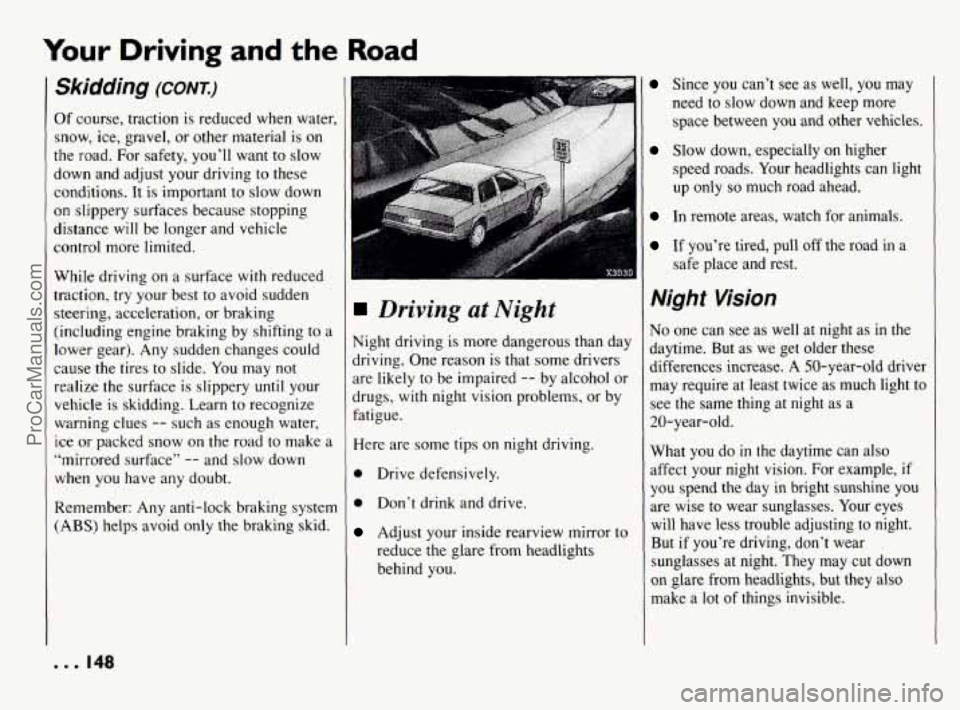
Driving at Night
Night driving is more dangerous than day
driving. One reason is that some drivers
are likely to be impaired
-- by alcohol or
drugs, with night
vision problems, or by
fatigue.
Here are some tips on night driving.
0 Drive defensively.
0 Don’t drink and drive.
Adjust your inside rearview mirror to
reduce the glare from headlights
behind you.
Since you can’t see as well, you may
need to slow down and keep more
space between you and other vehicles.
Slow down, especially on higher
speed roads. Your headlights can light
up only so much road ahead.
In remote areas, watch for animals.
If you’re tired, pull off the road in a
safe place and rest.
Night Vision
No one can see as well at night as in the
daytime.
But as we get older these
differences increase.
A 50-year-old driver
may require at least twice as much light to
see the same thing at night as a
20-year-old.
What you do
in the daytime can also
affect your night vision. For example, if
you spend the day
in bright sunshine you
are wise to wear sunglasses. Your eyes
will have less trouble adjusting to night.
But if you’re driving, don’t wear
sunglasses at night. They may cut down
on glare from headlights, but they also
make a lot of things invisible.
. . . 148
ProCarManuals.com
Page 153 of 290
Your Driving and the Road
H Freeway Driving (CONK)
along the entrance ramp, you should
begin to check traffic. Try to determine
where you expect to blend with the flow.
Try
to merge into the gap at close to the
prevailing speed. Switch on your turn
signal, check your mirrors and glance
over your shoulder as often as necessary.
Try to blend smoothly with the traffic
flow.
Once you are
on the freeway, adjust your
speed to the.posted limit or to the
prevailing rate if it’s slower. Stay in the
right lane unless
you want to pass.
Before changing lanes, check your
mirrors. Then use your turn signal.
Just before you leave the lane, glance
quickly over your shoulder to make sure
there isn’t another vehicle in your “blind”
spot.
Once you are moving
on the freeway,
make certain you allow a reasonable
following distance. Expect to move
slightly slower at night.
When you want to leave the freeway,
move to the proper lane well
in advance.
If you miss your exit do not, under any
,.. 152
circumstances, stop and back up. Drive on
to the next exit.
The exit ramp can be curved, sometimes
quite sharply.
The exit speed
is usually posted.
Reduce your speed according to your
speedometer, not to your sense of motion.
After driving for any distance at higher
speeds, you may tend to think
you are
going slower than you actually are.
Before Leaving on a
Long Trip
Make sure you’re ready. Try to be well
rested.
If you must start when you’re not
fresh
-- such as after a day’s work --
don’t plan to make too many miles that
first part
of the journey. Wear comfortable
clothing and shoes you can easily drive
in.
Is your vehicle ready for a long trip? If
you keep it serviced and maintained, it’s
ready to go. If it needs service, have it
done before starting out. Of course, you’ll
find experienced and able service experts
in Pontiac dealerships all across North America. They’ll
be ready and willing to
help if you need it.
Here are some things
you can check
before a trip:
0 Windshield Washer Fluid: Is the
reservoir full? Are all windows clean
inside and outside?
0 Wiper Blades: Are they in good
shape?
0 Fuel. Engine Oil. Other Fluids: Have
you checked all levels?
0 Lights: Are they all working? Are the
lenses clean?
Tires: They are vitally important to a
safe, trouble-free trip.
Is the tread
good enough for long-distance
driving? Are the tires all inflated to
the recommended pressure?
0 Weather Forecasts: What’s the weather outlook along your route?
Should you delay your trip a short
time to avoid a major storm system?
Maps: Do you have up-to-date maps?
ProCarManuals.com
Page 162 of 290
The bumpers on yaur vehicfe are not
intended for hitches.
Do not attach
rental hitches or other bumper-type
hitches to them. Use
only a
frame-mounted hitch that does not
attach to the bumper.
Safety Chains
You should always attach chains- between
your vehicle and your trailer. Cross the
safety chains under the tongue of.the
trailer
so that the tongue will not drop to
the road
if it becomes separated from the
hitch. Instructions about safety chains
may be provided by the hitch
manufacturer or by the trailer
manufacturer. Follow the manufacturer’s
recommendation for attaching safety
chains. Always leave just enough slack
so
you can turn with your rig. And, never
allow safety chains to drag
on the ground.
Trailer Brakes
Does your trailer have its own brakes? Be
sure to read and follow the instructions
for the trailer brakes
so you’ll be able to
install, adjust and maintain them properly.
Because you have anti-lock brakes, do not
try to tap into your vehicle’s brake
system. If you do both brakes systems
won’t work well, or at all.
Driving with a Trailer
Towing a trailer requires a certain amount
of experience. Before setting out for the
open road, you’ll want to get to know
your rig. Acquaint yourself with the feel
of handling and braking with the added
weight of the trailer. And always keep in
mind that the vehicle
you are driving is
now a good deal longer and not nearly
so
responsive as your vehicle is by itself. Before you
start, check the trailer hitch
and platform, safety chains, electrical
Eonnector, lights, tires and mirror
adjustment.
If the trailer has electric
brakes, start your vehicle and trailer
moving and then apply ‘the trailer brake
controller by hand to be sure the brakes
are working. This lets you check your
electrical connection at the same time.
During your trip, check occasionakky to be
sure that the load is secure, and that the
lights and any trailer brakes are still
working.
i.
,.
ProCarManuals.com