1994 PONTIAC BONNEVILLE oil additives
[x] Cancel search: oil additivesPage 197 of 290
Service & Appearance Care
MTBE is “methyl tertiary-butyl ether.”
Fuel that is no more than 15% MTBE is
fine
for your vehicle.
Ethanol is ethyl or grain alcohol.
Properly-blended fuel that is no more
than
10% ethanol is fine for your vehicle
Methanol is methyl or wood alcohol.
NOTICE:
Fuel that is more than 5% methanol
is bad for your vehicle. Don’t use it.
It can corrode metal parts
in your
fuel system and also damage plastic
and rubber parts. That damage
wouldn’t be covered under your
warranty. And even at
5% or less,
there must be “cosolvents” and
corrosion preventers
in this fuel to
help avoid these problems.
Gasolines for Cleaner Air
Your use of gasoline with deposit control
additives will help prevent deposits from
forming in your engine and fuel system.
That helps keep your engine
in tune and
your emission control system working
properly. It’s good for your vehicle, and
you’ll be doing your part for cleaner air.
Many gasolines are now blended with
oxygenates. General Motors recommends
that you use gasolines with these blending
materials, such as MTBE and ethanol. By
doing so, you can help clean the air,
especially
in those parts of the country
that have high carbon monoxide levels.
In addition, some gasoline suppliers are
now producing reformulated gasolines.
These gasolines are specially designed to
reduce vehicle emissions. General Motors recommends that you use reformulated
gasoline. By doing
so, you can help clean
the air, especially
in those parts of the
country that have high ozone levels.
You should ask your service station
operators
if their gasolines contain deposit
control additives and oxygenates, and if
they have been reformulated to reduce
vehicle emissions.
r
Countries
If you plan on driving in another country
outside the
U.S. or Canada, unleaded fuel
may ‘be hard to find.
Do not use leaded
gasoline. If you use even one
tankful, your
emission controls won’t work well
or at
all. With continuous use, spark plugs can
get fouled, the exhaust system can corrode,
and your engine
oil can deteriorate quickly.
Your vehicle’s oxygen sensor
will be
damaged. All of that means costly repairs
that wouldn’t be covered by your warranty.
To check on fuel availability, ask an auto
club,
or contact a major oil company that
does business
in the country where you’ll
be driving.
. . 196
ProCarManuals.com
Page 209 of 290
Service & Appearance Care
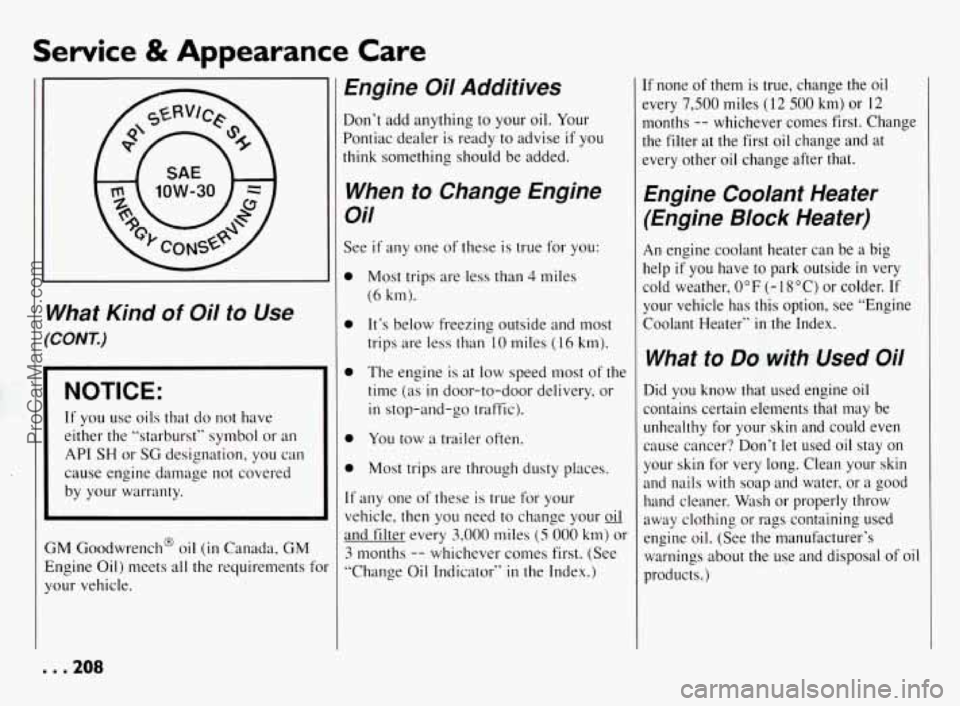
What Kind of Oil to Use
‘CONT.)
NOTICE:
If you use oils that do not have
either the “starburst” symbol or an
API SH or SG designation, you can
cause engine damage not covered
by
your warranty.
GM Goodwrench@ oil (in Canada, GM
Engine Oil) meets all the requirements fc
your vehicle.
Engine Oil Additives
I Don‘t add anything to your oil. Your
Pontiac dealer is ready
to advise if you
[hink something should be added.
When to Change Engine
Oil
See if any one of these is true for you:
0 Most trips are less than 4 miles
(6 km).
0 It’s below freezing outside and most
trips are less than
10 miles (16 km).
0 The engine is at low speed most of the
time (as
in door-to-door delivery, or
in stop-and-go traffic).
0 You tow a trailer often.
0 Most trips are through dusty places.
If any one of these is true for your
vehicle, then you need
to change your giJ
and filter every 3,000 miles (5 000 km) or
3 months -- whichever comes first. (See
“Change Oil Indicator”
in the Index.)
If none of them is true, change the oil
every
7,500 miles ( 12 500 km) or 12
months -- whichever comes first. Change
the filter at the first oil change and
at
every other oil change after that.
Engine Coolant Heater
(Engine Block Heater)
An engine coolant heater can be a big
help
if you have to park outside in very
cold weather,
0°F (-ISOC) or colder. If
your vehicle has this option, see “Engine
Coolant Heater”
in the Index.
What to Do with Used Oil
Did you know that used engine oil
contains certain elements that may be
unhealthy for your skin and could even
cause cancer‘? Don’t let used oil stay
on
your skin for very long. Clean your skin
and nails
with soap and water, or a good
hand cleaner. Wash or properly throw
away clothing or rags containing used
engine oil. (See the manufacturer’s warnings about the use and disposal of oil
products.)
. . .208
ProCarManuals.com
Page 282 of 290
Electrical Equipment.
Adding
............... 85. 120. 237
Electronic Climate Control
....... 1 15
Electronic Compass
............. 105
Emergencies. Braking
........... 144
Emergencies. Steering
in ......... 145
Emergencies on the Road
......... 165
Emergency Starting
............. 167
Emergency Towing
............. I70
Engine. Starting Your
............. 53
Engine Block Heater
......... 55. 208
Engine Coolant
................. 2 13
Engine Coolant Heater
........ 55. 208
Engine Coolant Temperature
Gage
....................... 101
Engine Coolant Temperature
Warning Light
................. 92
Engine Exhaust ............. 65. 157
Engine Identification
............ 237
Engine Oil
.................... 205
Additives
................... 208
Checking
& Adding ...... 205. 206
Disposing of Used Oil
........ 208
Energy Conserving
........... 207
Oil Warning Light
............. 94
Check Level Light
............ 95
Pressure Gage
............... 10 1
When to Change ............. 208
Engine Overheating
............. 176
Engine Specifications
............ 243
Ethanol
in Gasoline ............. 196 Exhaust
Dangerous Gas
in ...... 65.66. 157
Parking with the Engine
Running
................ 64. 66
Expectant Mothers. Use of
Safety Belts
................... 24
Express Open Sunroof
............ 81
Expressway Driving ............. I5 1
Exterior Appearance (see “Appearance
Extender. Safety
Belt
............. 39
Care and Materials”)
Fabric Cleaning (see “Appearance Care
Fan Warnings
.......... 168. 169. 177
Filling Your Tank
............... 197
Filter
Air Cleaner
............. 209. 243
Oil
.................... 208. 243
Flashers. Hazard Warning
........ 166
Flat Tire ...................... 182
Flooded Engine ................. 54
Flow-Through Ventilation
........ I 18
Fluid
Brake
.................. 217. 261
Capacities
.................. 242
Transaxle
........... 2 11. 242. 262
Windshield Washer
.... 70. 2 17. 262
and
Materials”)
Finish Damage
................. 235
Power Steering
...... 2 16. 242. 262 Fog
Lights
................. 77. 244
Foreign Material
................ 234
Foreign Operation
.............. 196
Freeway Driving ............... 151
French Language Manual .......... 2
Fuel ......................... 195
Alcohol in Fuel .............. 196
Capacity ................... 242
Door Lock
.................. 197
Door Release. Manual
........ 198
Door Release. Remote
........ 197
Exhaust Warnings ...... 65. 66. 157
Filling Your Tank
............ 197
Fuels
with Alcohol ........... 196
Gage ...................... 100
In Foreign Countries .......... 196
Requirements ............... 195
Function Monitor
............... 103
Fuse Panel
................ 239. 240
Fuses
& Circuit Breakers ......... 238
Gages
........................ 99
Coolant Temperature ......... 101
Fuel ....................... 100
Oil Pressure ................. 101
Voltmeter ................... 102
Gas Station Information
.......... 288
Gasoline
...................... 195
Gasoline Tank. Filling Your
....... 197
281 ...
ProCarManuals.com