1994 OLDSMOBILE SILHOUETTE key
[x] Cancel search: keyPage 62 of 276
Features & Controls
60
NOTICE:
Holding your key in Start for longer
than
15 seconds at a time will cause
your battery to be drained much
sooner. And the excessive heat can
damage your starter motor.
2. If it doesn’t start right away, hold
your key in
Start for about three to
five seconds at a time until your
engine starts. Wait about
15 seconds
between each try to help avoid
draining your battery.
3. If your engine still won’t start (or
starts but then stops), it could be
flooded with too much gasoline. Try
pushing your accelerator pedal all the
way to the floor and holding it there
as you hold the key in
Start for about
three seconds.
If the vehicle starts
briefly but then stops again, do the
same thing, but this time keep the
pedal down for five
or six seconds.
This clears the extra gasoline from
the engine. After waiting about
15
seconds, repeat the normal starting
procedure.
NOTICE:
Your engine is designed to work
with the electronics in your vehicle.
If you add electrical parts or
accessories, you could change the
way the fuel injection system
operates. Before adding electrical
equipment, check with your dealer.
If you don’t, your engine might not
perform properly.
If you ever have
to have your vehicle towed, see the
part of this manual that tells how to
do it without damaging your
vehicle. See
Towing Your Vehicle
in the Index.
I Driving Through Deep
Standing Water
NOTICE:
If you drive too quickly through
deep puddles or standing water,
water can come in through your
engine’s air intake and badly
damage your engine.
If you can’t
avoid deep puddles or standing
water, drive through them very
slowly.
ProCarManuals.com
Page 68 of 276
Features & Controls
66
I Sh@ing Into P (Park)
1. Hold the brake pedal down with your
right
foot and set the parking brake.
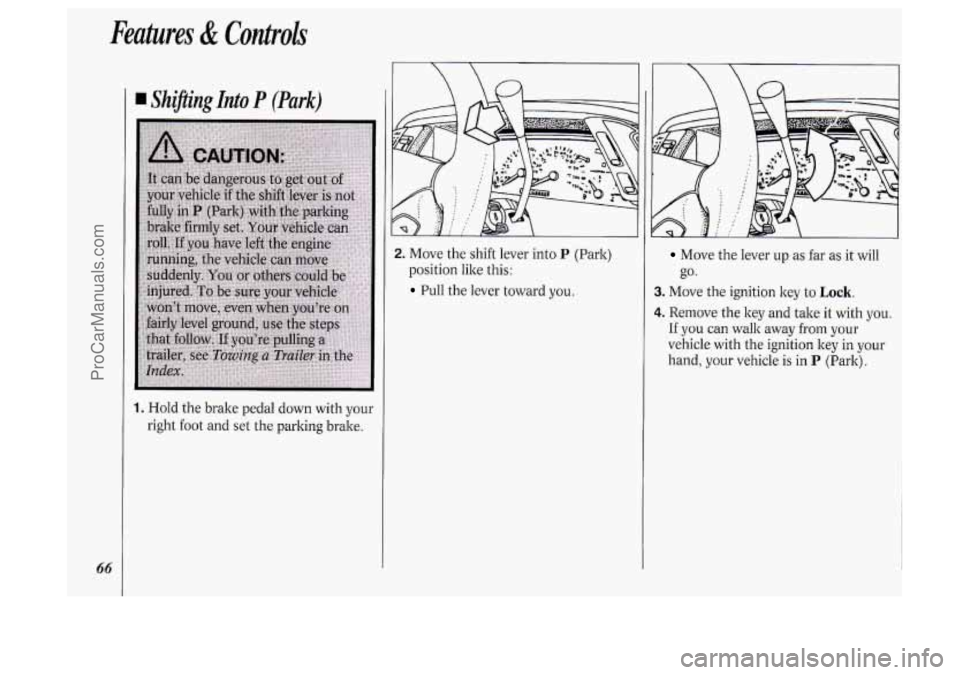
2. Move the shift lever into P (Park)
position like this:
Pull the lever toward you.
Move the lever up as far as it will I I
go.
3. Move the ignition key to Lock.
4. Remove the key and take it with you.
If you can walk away from your
vehicle with the ignition key in your
hand, your vehicle is in
P (Park).
ProCarManuals.com
Page 77 of 276
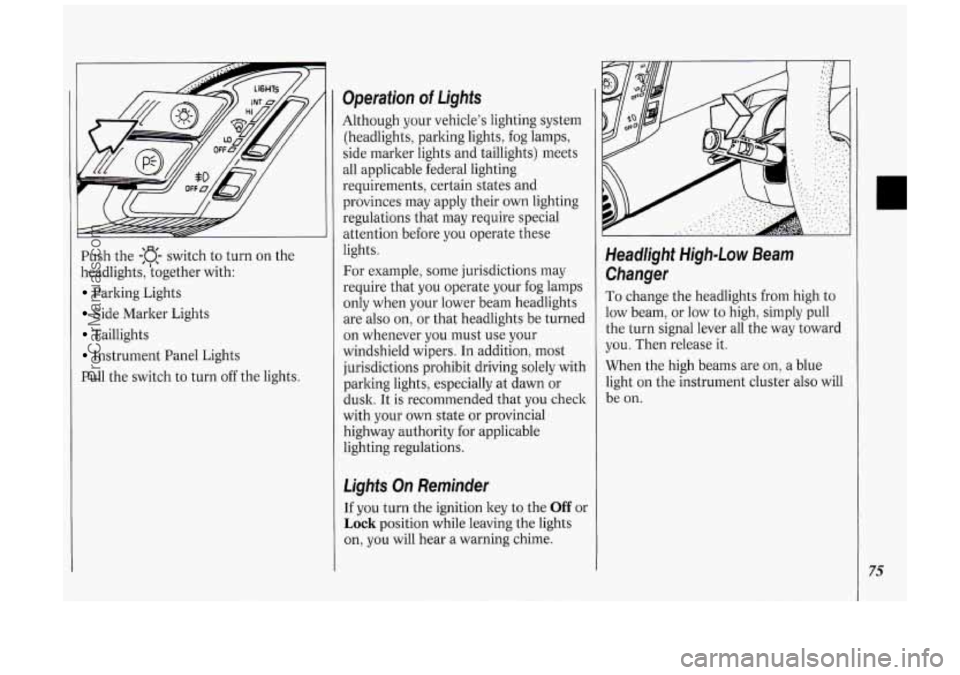
Push the -:a- switch to turn on the
headlights, kogether with:
Parking Lights
Side Marker Lights
Taillights
Instrument Panel Lights
Pull the switch to turn off the lights.
Operation of Lights
Although your vehicle’s lighting system
(headlights, parking lights, fog lamps,
side marker lights and taillights) meets
all applicable federal lighting
requirements, certain states and
provinces may apply their own lighting
regulations that may require special
attention before you operate these
lights.
For example, some jurisdictions may
require that you operate your fog lamps
only when your lower beam headlights
are also on, or that headlights be turned
on whenever you must use your
windshield wipers.
In addition, most
jurisdictions prohibit driving solely with
parking lights, especially at dawn or
dusk. It is recommended that you check
with your
own state or provincial
highway authority for applicable
lighting regulations.
Lights On Reminder
If you turn the ignition key to the Off or
Lock position while leaving the lights
on, you will hear
a warning chime.
Headlight High-Low Beam
Changer
To change the headlights from high to
low beam, or low to high, simply pull
the turn signal lever all the way toward
you. Then release it.
When the high beams are
on, a blue
light on the instrument cluster also will
be on.
75
ProCarManuals.com
Page 92 of 276
Features & Controls
90
Locking Storage Bin
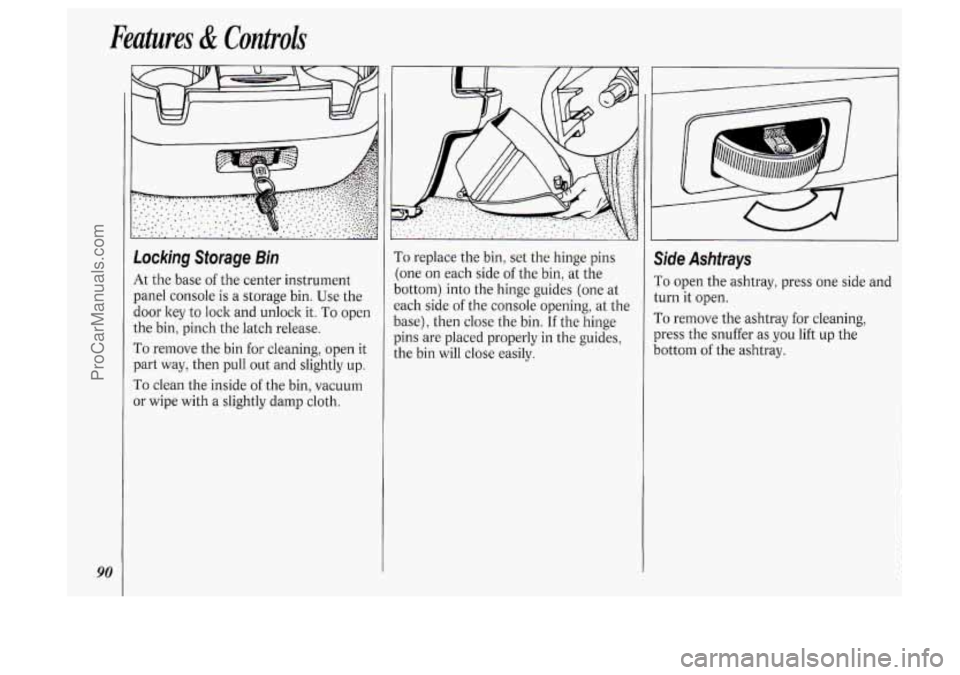
At the base of the center instrument
panel console is a storage bin. Use the
door key
to lock and unlock it. To open
the bin, pinch the latch release.
To remove the bin for cleaning, open it
part way, then pull out and slightly up.
To clean the inside of the bin, vacuum
or wipe with a slightly damp cloth.
To replace the bin, set the hinge pins
:one on each side
of the bin, at the
lottom) into the hinge guides (one at
:ach side
of the console opening, at the
lase), then close the bin.
If the hinge
)ins are placed properly in the guides,
he bin will close easily.
Side Ashtrays
To open the ashtray, press one side and
turn it open.
To remove the ashtray for cleaning,
press the snuffer as
you lift up the
bottom
of the ashtray.
ProCarManuals.com
Page 102 of 276
Features & Controls
100
Warning Lights, Gages and
Indicators
This section describes the warning
lights and gages that may be on your
vehicle. The pictures will help you
locate them.
Warning lights and gages can signal that
something
is wrong before it becomes
serious enough to cause an expensive
repair or replacement. Paying attention
to your warning lights and gages could
also save you or others from injury.
Warning lights go on when there may
be or is a problem with one of your
vehicle's functions. As you will see in
the details on the next few pages, some
warning lights come on briefly when
you turn the ignition key just to let you
know they're working. If you are
familiar with this section, you should
not be alarmed when this happens.
Gages can indicate when there may be
or
is a problem with one of your
vehicle's functions. Often gages and
warning lights work together to let you
know when there's a problem with your
vehicle. When
one of the warning lights comes
on and stays on when you are driving,
or when one
of the gages shows there
may be a problem, check the section
that tells you what to do about it. Please
follow the manual's advice. Waiting to
do repairs can be costly
- and even
dangerous.
So please get to know your
warning lights and gages. They're a big
help.
- UNLtADtU FUtL
-
I
loo= ,
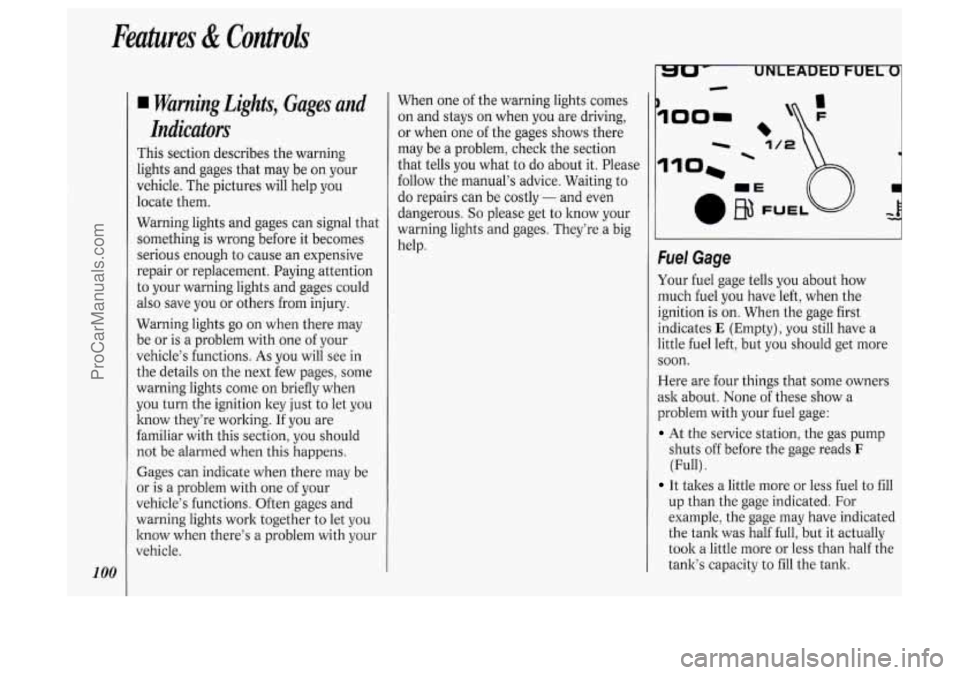
fuel Gage
Your fuel gage tells you about how
much fuel you have left, when the
ignition is
on. When the gage first
indicates
E (Empty), you still have a
little fuel left, but you should get more
soon.
Here are four things that some owners
ssk about. None of these show a
problem with your fuel gage:
At the service station, the gas pump
shuts off before the gage reads
F
(Full) .
It takes a little more or less fuel to fill
up than the gage indicated. For
example, the gage may have indicated
the tank was half full, but it actually
took a little more or less than half the
tank's capacity to
fill the tank.
ProCarManuals.com
Page 135 of 276
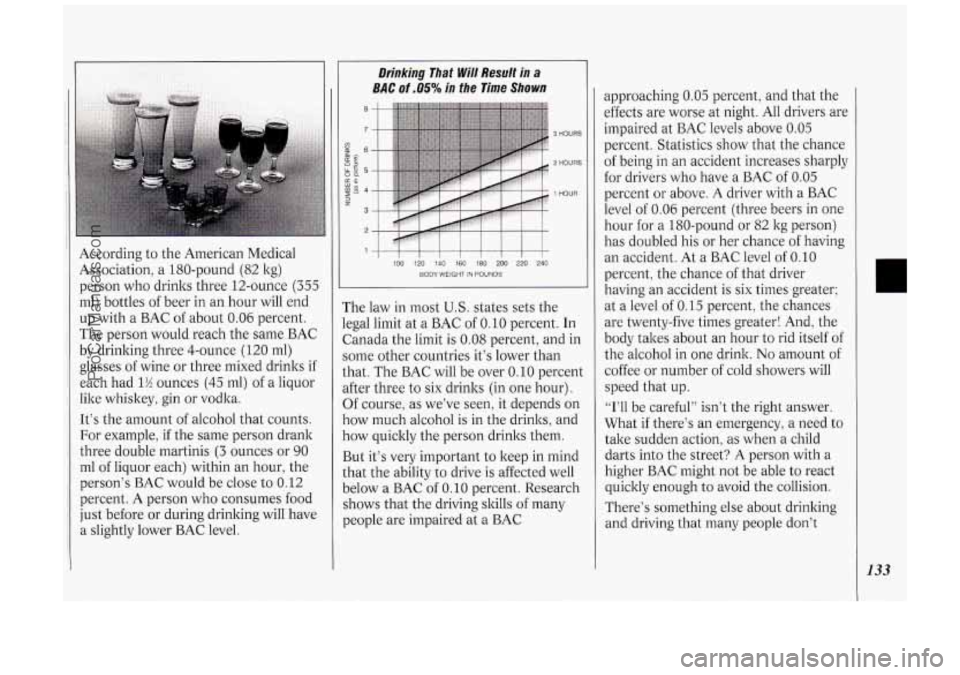
According to the American Medical
Association, a 180-pound (82 kg)
person who drinlts three 12-ounce
(355
ml) bottles of beer in an hour will end
up with a BAC of about
0.06 percent.
The person would reach the same BAC
by drinking three 4-ounce (120 ml)
glasses of wine or three mixed drinks
if
each had 1% ounces (45 ml) of a liquor
like whiskey, gin or vodka.
It’s the amount of alcohol that counts.
For example, if the same person drank
three double martinis
(3 ounces or 90
ml of liquor each) within an hour, the
person’s BAC would be close to 0.12
percent. A person who consumes food
just before or during drinking will have
a slightly lower BAC level.
Drinking That Will Result in a
BAC of -05% in the Time Shown
3 HOURS
2 HOURS
1 HOUR
1 f \- ++ .... +-.: ........ t.....-L.. r 1””’ I 100 120 140 160 180 200 220 240 BODY ViEIGHT IN POUNDS
The law in most U.S. states sets the
egal limit at a BAC of 0.10 percent. In
2anada the limit
is 0.08 percent, and in
some other countries it’s lower than
:hat. The BAC will be over 0.10 percent
lfter three to six drinlts (in one hour).
3f course, as we’ve seen, it depends on
low much alcohol is in the drinks, and
low quickly the person drinks them.
But it’s very important to keep in mind
:hat the ability to drive is affected well
3elow a BAC of
0.10 percent. Research
shows that the driving skills of many
?eople are impaired at a BAC approaching
0.05 percent, and
that the
effects are worse at night. All drivers are
impaired at BAC levels above
0.05
percent. Statistics show that the chance
of being in
an accident increases sharply
for drivers who have a BAC of
0.05
percent or above. A driver with a BAC
level of
0.06 percent (three beers in one
hour for a 180-pound or
82 kg person)
has doubled his or her chance of having
an accident. At a BAC level of
0.10
percent, the chance of that driver
having an accident is six times greater;
at a level of 0.15 percent, the chances
are twenty-five times greater! And, the
body takes about an hour to rid itself
of
the alcohol in one drink. No amount of
coffee or number
of cold showers will
speed that up.
Wl be careful” isn’t the right answer.
What
if there’s an emergency, a need to
take sudden action, as when a child
darts into the street? A person with a
higher BAC might not be able to react
quickly enough to avoid the collision.
There’s something else about drinking
and driving that many people don’t
133
ProCarManuals.com
Page 160 of 276
Problems on the Road
158
I Hazard Warning Flashers
Your hazard warning flashers let you
warn others. They also let police know
you have a problem. Your front and rear
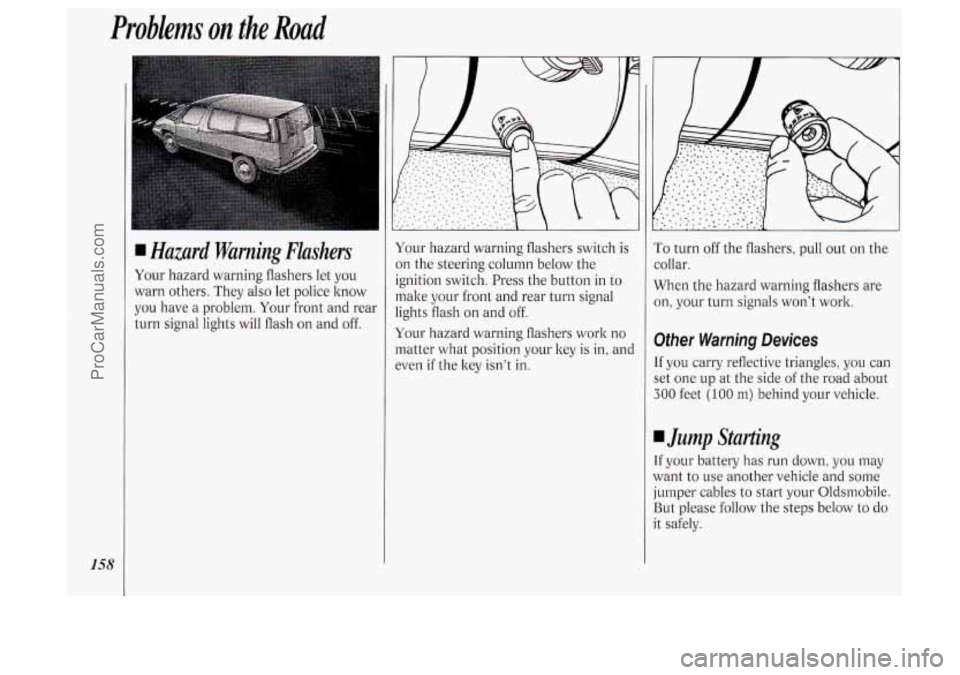
turn signal lights will flash on and off. Your
hazard warning flashers switch is
on the steering column below the
ignition switch. Press the button in to
make your front and rear turn signal
lights flash on and off.
Your hazard warning flashers work no
matter what position your key
is in, and
even
if the key isn’t in.
To turn off the flashers, pull out on the
collar.
When the hazard warning flashers are
on, your turn signals won’t work.
Other Warning Devices
If you carry reflective triangles, you can
set one up at the side of the road about
300 feet (100 m) behind your vehicle.
I Jump Starting
If your battery has run down, you may
want to use another vehicle and some
jumper cables
to start your Oldsrnobile.
But please follow the steps below to do
it safely.
ProCarManuals.com
Page 165 of 276
When you call, tell the towing service:
That your vehicle cannot be towed
from the front with sling-type
equipment.
drive.
vehicle.
lever. damaged.
That your vehicle has front-wheel
The make, model, and year of your
Whether you can still move the shift
If there W~S an accident, what was
When the towing service arrives, let the
tow operator know that this manual
contains detailed towing instructions
and illustrations. The operator may
want to see them.
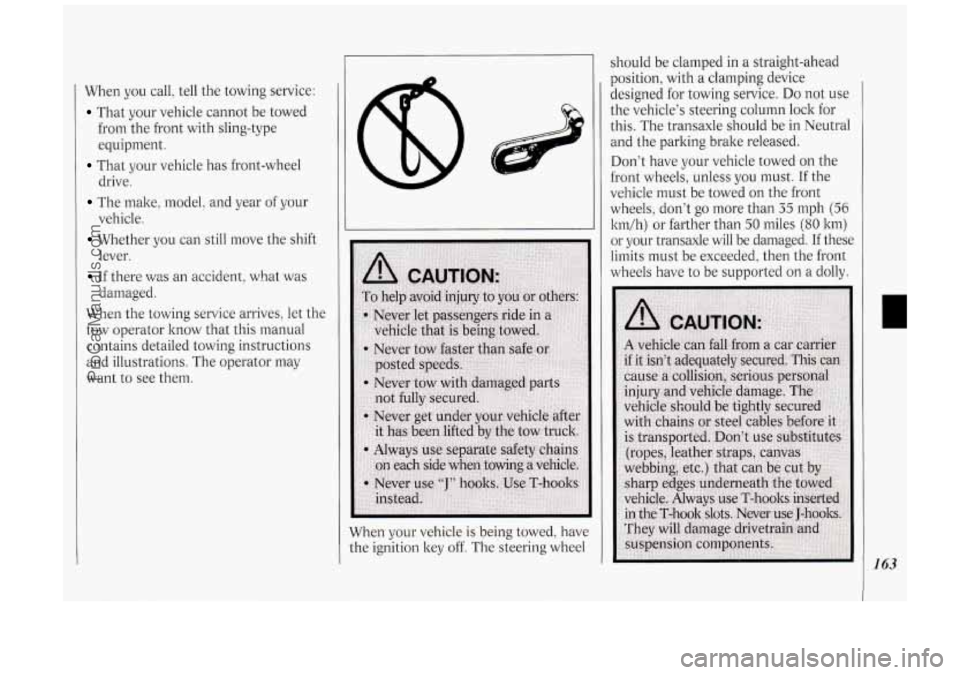
I should be clamped in a straight-ahead
When your vehicle
is being towed, have
the ignition key
off. The steering wheel designed for towing service.
Do not
use
the vehicle’s steering column lock for
this. The transaxle should be in Neutral
and the parking brake released.
Don’t have your vehicle towed on the
front wheels, unless
you must. If the
vehicle must be towed on the front
wheels, don’t go more than
35 mph (56
l
If these
limits must be exceeded, then the front
wheels have to be supported on a dolly.
1 63
ProCarManuals.com