1994 CHEVROLET S10 coolant temperature
[x] Cancel search: coolant temperaturePage 11 of 340
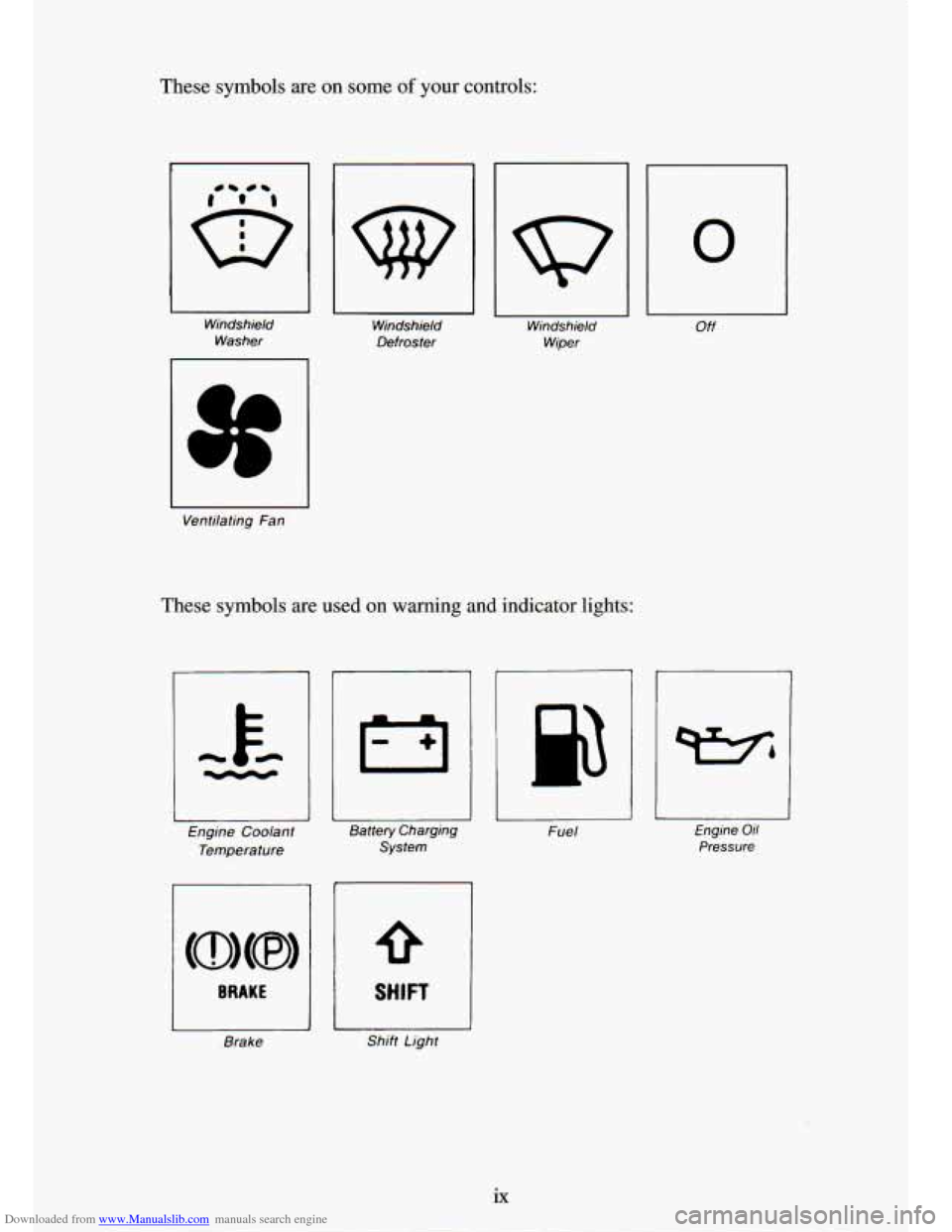
Downloaded from www.Manualslib.com manuals search engine These symbols are on some of your controls:
Windshield Washer Windshield
Defroster Windshield
Wiper
I
Ventilating Fan
These symbols are used on warning and indicator lights:
Engine Coolant
Temperature
BRAKE
Brake Battery Charging
System
I SHIFT
I
Shift Light Fuel
0
Off
Engine Oil
Pressure
Page 106 of 340
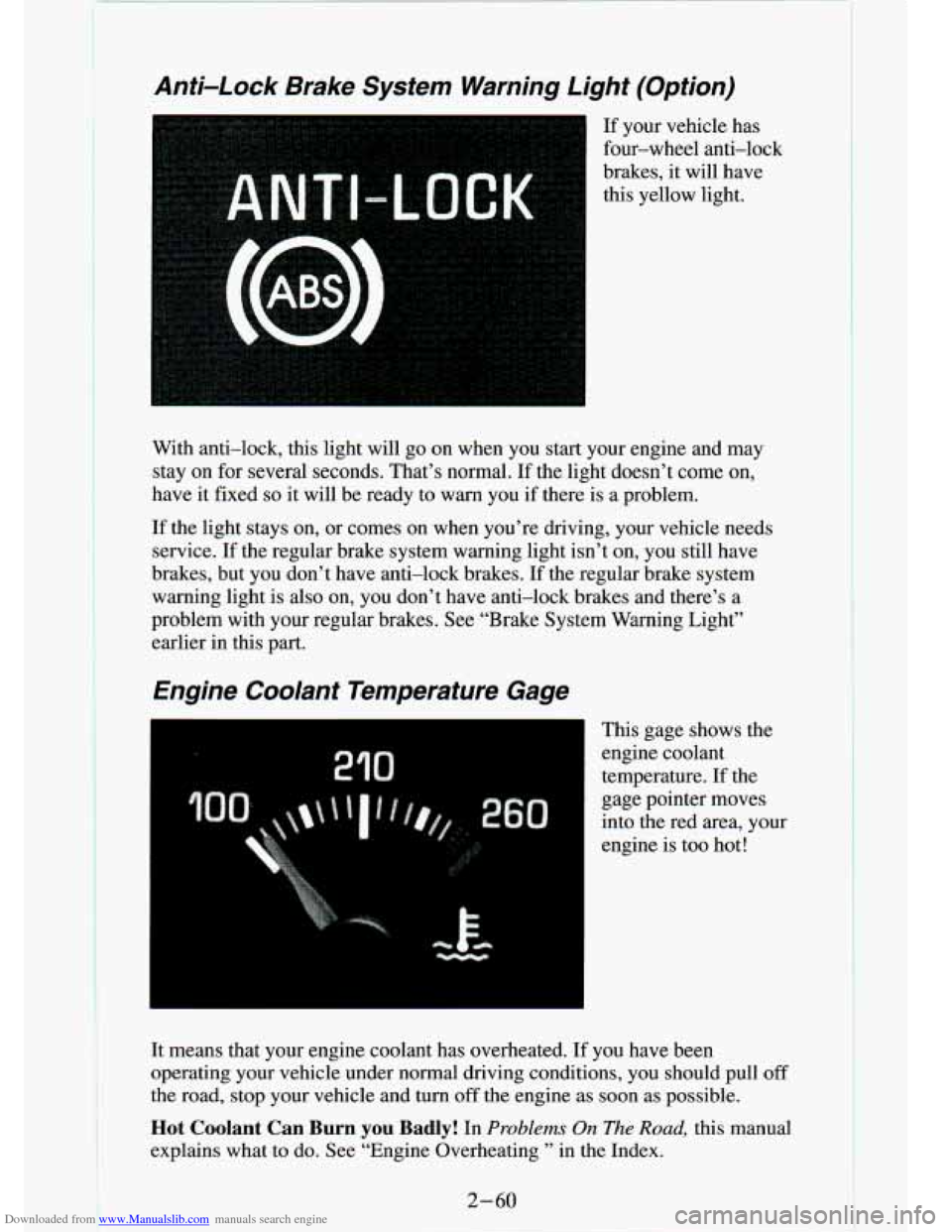
Downloaded from www.Manualslib.com manuals search engine Anti-Lock Brake System Warning Light (Option)
If your vehicle has
four-wheel anti-lock
brakes, it will have
this yellow light.
3
With anti-lock, this light will go on when you start your engine and may
stay on for several seconds. That’s normal. If the light doesn’t come \
on,
have it fixed
so it will be ready to warn you if there is a problem.
If the light stays on, or comes on when you’re driving, your vehic\
le needs
service.
If the regular brake system warning light isn’t on, you still \
have
brakes, but you don’t have anti-lock brakes.
If the regular brake system
warning light is also on, you don’t have anti-lock brakes and there’s a
problem with your regular brakes. See “Brake System Warning Light”
earlier in this part.
Engine Coolant Temperature Gage
I This gage shows the
engine coolant
temperature. If the
gage pointer moves
into the red area, your
engine is too hot!
It means that your engine coolant has overheated. If you have been
operating your vehicle under normal driving conditions, you shou\
ld pull
off
the road, stop your vehicle and turn off the engine as soon as possible.
Hot Coolant Can Burn you Badly! In Problems On The Road, this manual
explains what
to do. See “Engine Overheating ’’ in the Index.
2-60
Page 194 of 340

Downloaded from www.Manualslib.com manuals search engine Engine Overheating
You will find a coolant temperature gage on your vehicle’s instr\
ument
panel.
If Steam Is Coming From Your Engine
NOTICE:
If your engine catches fire because you keep driving with no
coolant, your vehicle cdh be badly damaged. The costly repairs
would not be covered by your warranty.
Page 201 of 340
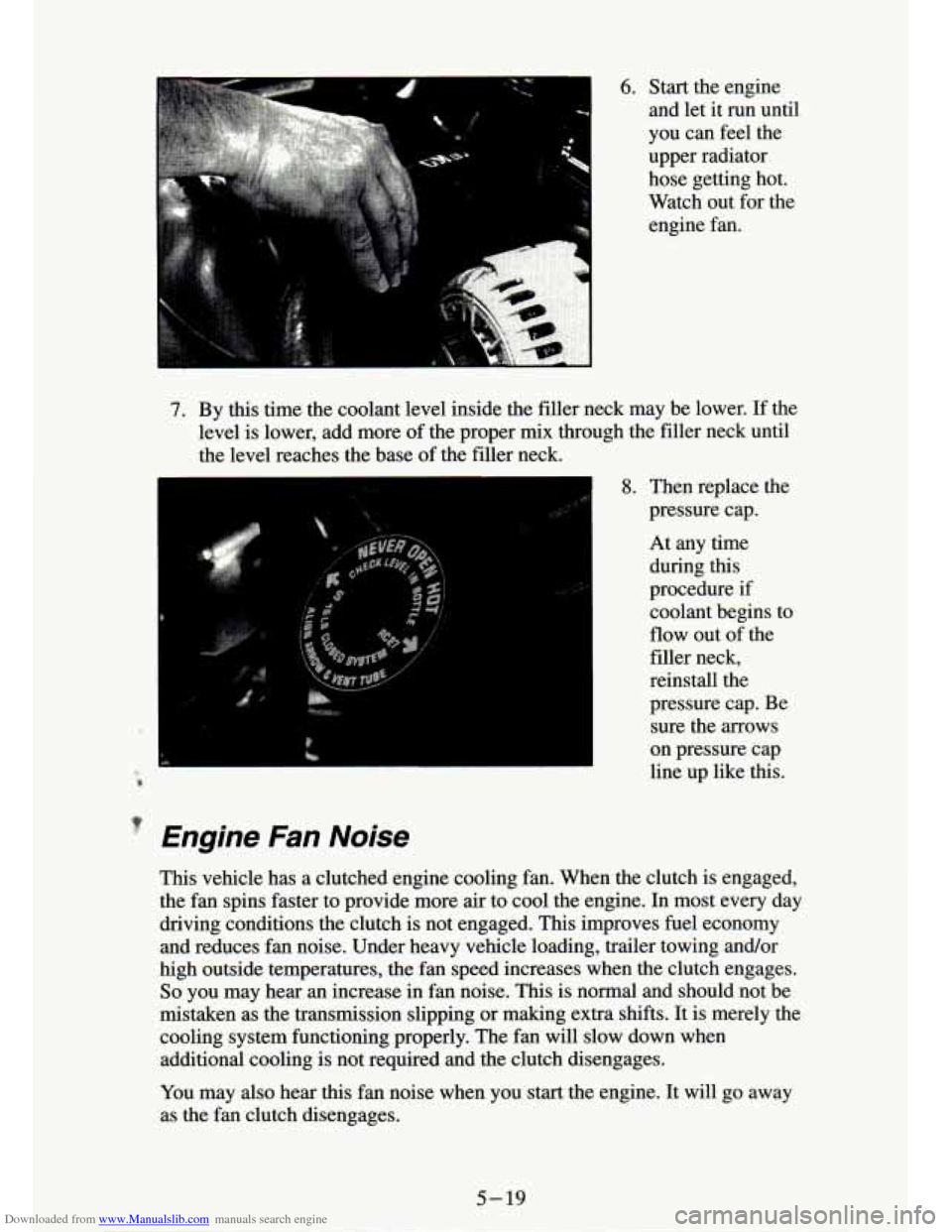
Downloaded from www.Manualslib.com manuals search engine 7. By this time the coolant level inside the filler neck may be lower. If the
level is lower, add more of the proper
mix through the filler neck until
the level reaches the base of the filler neck.
8. Then replace the
pressure cap.
At any time during
this
procedure if coolant begins to
flow out of the
filler neck,
reinstall the
pressure cap. Be sure the arrows
on pressure cap
line up like this.
P
' Engine Fan Noise
This vehicle has a clutched engine cooling fan. When the clutch is engaged,
the fan spins faster to provide more air
to cool the engine. In most every day
driving conditions the clutch is not engaged. This improves fuel economy
and reduces fan noise. Under heavy vehicle loading, trailer towing and/or
high outside temperatures, the fan speed increases when the clutch engages.
So you may hear an increase in fan noise. This is normal and should not be
mistaken as the transmission slipping or making extra shifts. It is merely the
cooling system functioning properly. The fan will slow down when
additional cooling is not required and the clutch disengages.
You may also hear this fan noise when you
start the engine. It will go away
as the
fan clutch disengages.
5-19
Page 241 of 340
, add enou\
gh lubricant
to raise the level to the bottom of the filler")
Downloaded from www.Manualslib.com manuals search engine If the differential is at operating temperature (w,arm), add enou\
gh lubricant
to raise the level to the bottom of the filler plug hole.
If the differential is cold, add enough lubricant to raise the level to 1/2 inch
(12
mm) below the filler plug hole.
What to use
Refer to the Maintenance Schedule to determine what kind of lubricant to
use. See “Recommended Fluids and Lubricants” in the Index.
Engine Coolant
The following explains your cooling system and how to add coolant \
when it
is low.
If you have a problem with engine overheating, see “Engine
Overheating” in the Index.
The proper coolant for your vehicle will:
Give freezing protection down to -20 “F (-29” C), or -34°F (-37 “C) in
Canada and for vehicles with the cold climate option.
e Give boiling protection up to 258°F (125°C).
Protect against rust and corrosion.
Help keep the proper engine temperature.
Let the warning lights and gages work as they should.
What to Use
Use a mi,xture of one-half clean water (preferably distilled) and one-half
antifreeze that meets “GM Specification 603%” or “GM Specification
6043-M ”for the 2.2L (LN2) Code 4 engine, which won’t damage
aluminum parts. You can also use
a recycled coolant conforming to “GM
Specification 603%” or “GM Specification 6043-M ”for the 2.2L (LN2)
Code 4 engine with a complete coolant flush and refill.
If you use this
mixture, you don’t need to add anything else.
6-23
Page 244 of 340
Downloaded from www.Manualslib.com manuals search engine Thermostat
Engine coolant temperature is controlled by a thermostat in the engine
coolant system. The thermostat stops the
flow of coolant through the
radiator
until the coolant reaches a preset temperature.
When you replace your thermostat, an
AC@ thermostat is recommended.
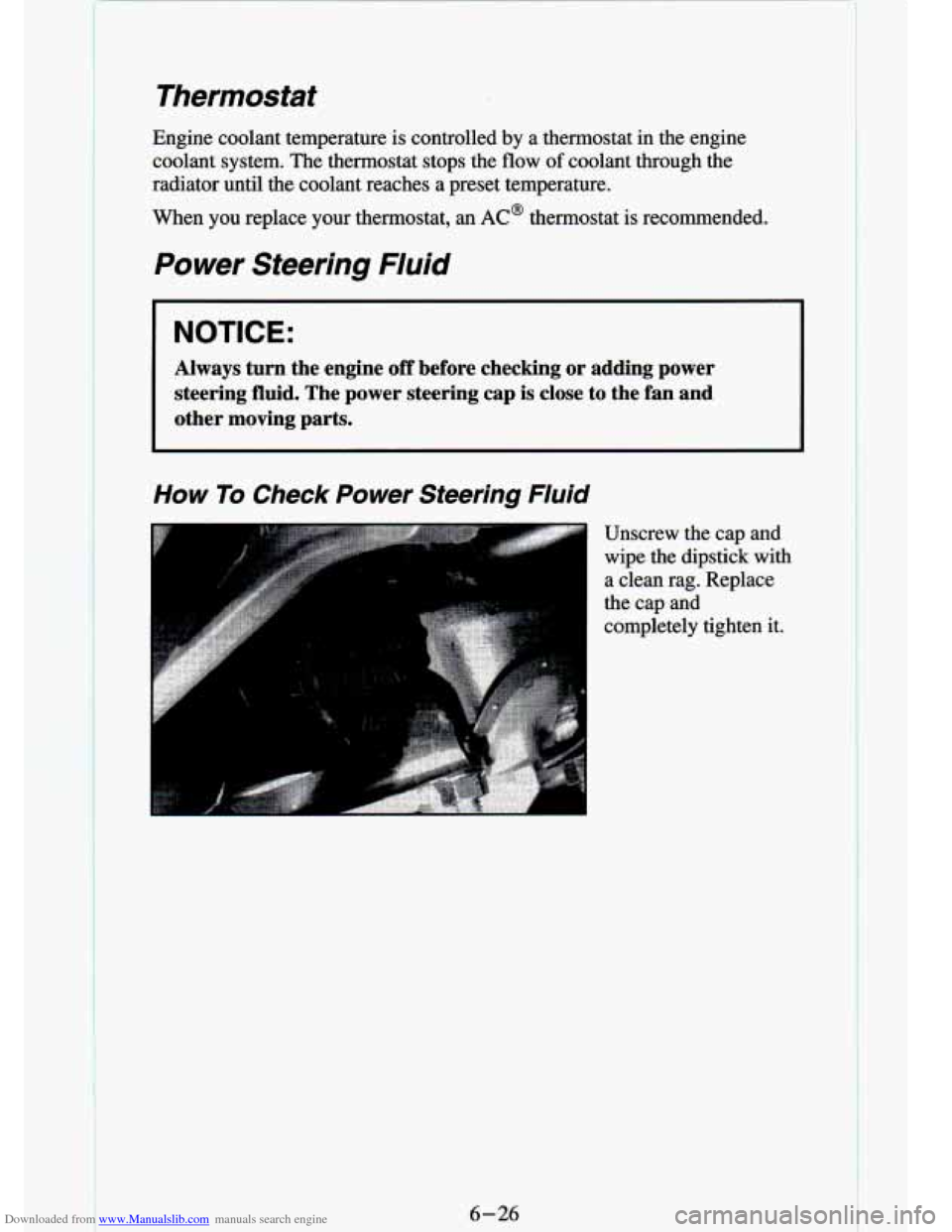
Power Steering Fluid
NOTICE:
Always turn the engine off before checking or adding power
steering fluid. The power steering cap is close
to the fan and
other moving parts.
6-26
Page 303 of 340
Downloaded from www.Manualslib.com manuals search engine Explanation Of Scheduled Maintenance Services
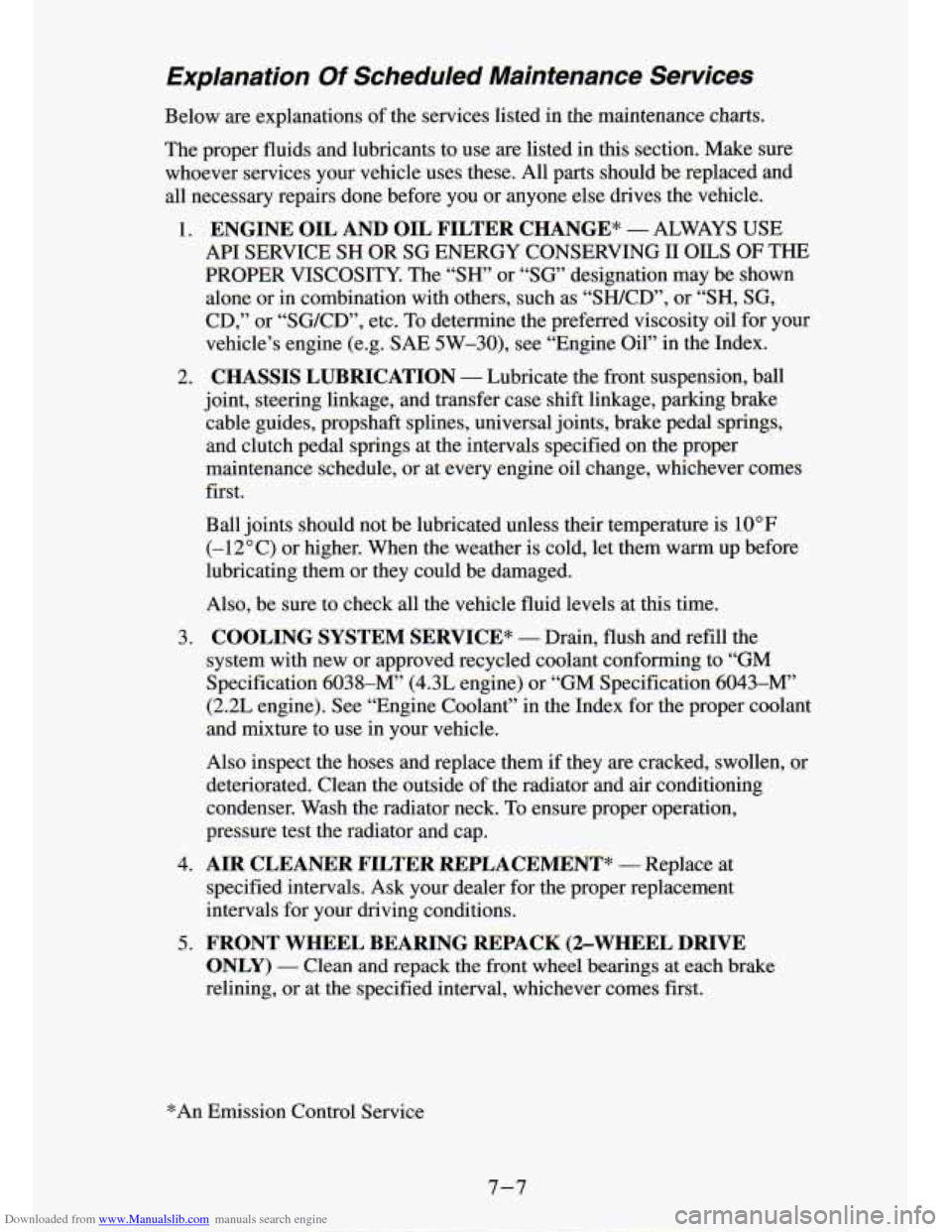
Below are explanations of the services listed in the maintenance charts.
The proper fluids and lubricants to use are listed
in this section. Make sure
whoever services your vehicle uses these. All parts should be \
replaced and
all necessary repairs done before you or anyone else drives the vehicle.
1. ENGINE OIL AND OIL FILTER CHANGE* - ALWAYS USE
API SERVICE SH OR SG ENERGY CONSERVING I1 OILS
OF THE
PROPER VISCOSITY. The “SH” or
“SG’ designation may be shown
alone or in combination with others, such as “SWCD”, or
“SH, SG,
CD,” or “SGKD”, etc. To determine the preferred viscosity oil for your
vehicle’s engine (e.g. SAE 5W-30), see “Engine
Oil” in the Index.
2. CHASSIS LUBRICATION - Lubricate the front suspension, ball
joint, steering linkage, and transfer case shift linkage, parking brake\
cable guides, propshaft splines, universal joints, brake pedal springs,
and clutch pedal springs at the intervals specified on the proper
maintenance schedule, or at every engine oil change, whichever comes
first
.
Ball joints should not be lubricated unless their temperature is 10°F
(-12°C) or higher. When the weather is cold, let them warm up before
lubricating them or they could be damaged.
Also, be sure
to check all the vehicle fluid levels at this time.
3.
COOLING SYSTEM SERVICE* - Drain, flush and refill the
system with new or approved recycled coolant conforming to “\
GM
Specification 6038-M” (4.3L engine) or “GM Specification 6043-M”
(2.2L engine). See “Engine Coolant” in the Index for the proper coolant
and mixture to use in your vehicle.
Also inspect the hoses and replace them if they are cracked, \
swollen, or
deteriorated. Clean the outside of the radiator and air conditioning
condenser. Wash the radiator neck. To ensure proper operation,
pressure test the radiator and cap.
4. AIR CLEANER FILTER REPLACEMENT* - Replace at
specified intervals. Ask your dealer for the proper replacement
intervals for your driving conditions.
5. FRONT WHEEL BEARING REPACK (%WHEEL DRIVE
ONLY) - Clean and repack the front wheel bearings at each brake
relining, or at the specified interval, whichever comes first.
*An Emission Control Service
7-7
Page 329 of 340
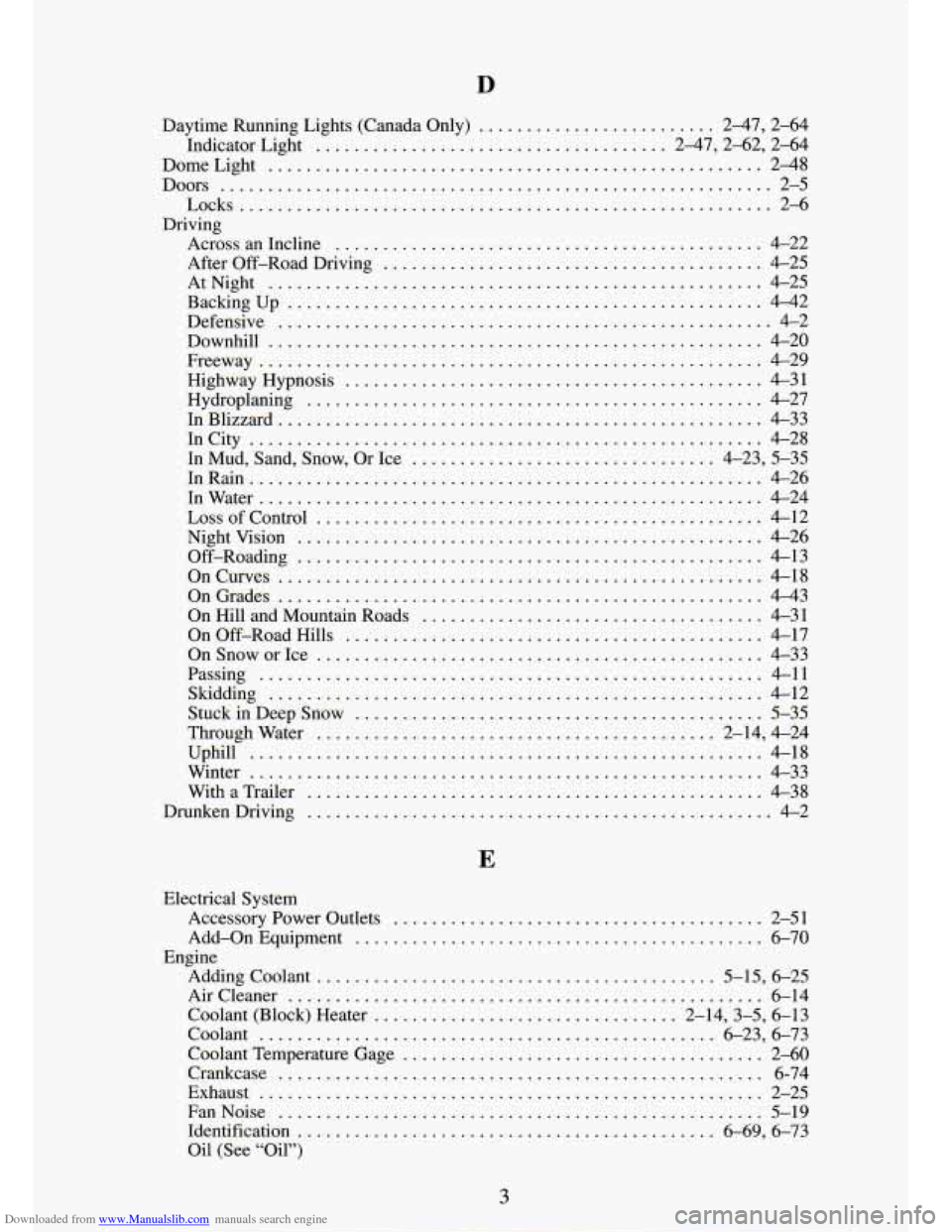
Downloaded from www.Manualslib.com manuals search engine Daytime Running Lights (Canada Only) ......................... 247. 2-64
Indicator Light
..................................... 2-47.2-62. 2-64
DomeLight
.................................................... 2-48
Doors
.......................................................... 2-5
Driving Locks
........................................................ 2-6
Across an Incline
............................................. 4-22
After Off-Road Driving
........................................ 4-25
AtNight
.................................................... 4-25
Backingup
.................................................. 4-42
Defensive
.................................................... 4-2
Downhill ...................................................... 4-20
Freeway
..................................................... 4-29
Highway Hypnosis
............................................ 4-31
Hydroplaning
................................................ 4-27
InBlizzard
................................................... 4-33
InCity
...................................................... 4-28
In Mud. Sand. Snow. Or Ice ................................ 4-23. 5-35
InRain
...................................................... 4-26
InWater
..................................................... 4-24
LossofControl
............................................... 4-12
Nightvision
................................................. 4-26
Off-Roading
................................................. 4-13
OnCurves
................................................... 4-18
OnGrades
................................................... 4-43
On Hill and Mountain Roads
.................................... 4-31
On Off-Road Hills
............................................ 4-17
OnSnoworIce
............................................... 4-33
Passing
..................................................... 4-11
Skidding
.................................................... 4-12
Stuck in Deep Snow
........................................... 5-35
Throughwater
.......................................... 2-14. 4-24
Uphill
...................................................... 4-18
Winter ...................................................... 4-33
WithaTrailer
................................................ 4-38
DrunkenDriving
................................................. 4-2
E
Electrical System Accessory Power Outlets
....................................... 2-51
Add-on Equipment
........................................... 6-70
Adding Coolant
.......................................... 5-15, 6-25
Aircleaner
.................................................. 6-14
Coolant (Block) Heater
................................ 2.14.3-5. 6.13
Coolant
................................................ 6.23. 6.73
Coolant Temperature Gage
...................................... 2-60
Crankcase
................................................... 6-74
Exhaust
..................................................... 2-25
FanNoise
................................................... 5-19
Identification
............................................ 6-69, 6-73
Oil (See “Oil”)
Engine
3