1994 CHEVROLET BLAZER wheel
[x] Cancel search: wheelPage 174 of 348
Downloaded from www.Manualslib.com manuals search engine When you drive over bumps, rocks, or other obstacles, your wheels can
leave the ground.
If this happens, even with one or two wheels, you can’t
control the vehicle as well or at all.
Because you
will be on an unpaved surface, it’s especially important to
avoid sudden acceleration, sudden turns, or sudden braking.
In a way, off-road driving requires a different kind
of alertness from driving
on paved roads and highways. There are no road signs, posted speed limits
or signal lights. You have to use your own good judgment about what is safe
and what isn’t.
Drinking and driving can be very dangerous on any road. And this is
certainly true for off-road driving. At the very
time you need special
alertness and driving skills, your reflexes, perceptions and judgment
can be
affected by even a small amount of alcohol. You could have a serious
- or
even fatal - accident if you drink and drive or ride with a driver who has
been drinking. (See “Drunken Driving”
in the Index.)
Driving On Ofl-Road Hills
Off-road driving often takes you up, down, or across a hill. Driving safely
on hills requires good judgment and an understanding of what your vehicle
can and can’t do. There are some hills that simply can’t be driven, no matter
how well built the vehicle.
1
Approaching a Hill
When you approach a hill, you need to decide if it’s one of those hills that’s
just
too steep to climb, descend, or cross. Steepness can be hard to judge.
On a very small hill, for example, there may be a smooth, constant incline
with only a small change
in elevation where you can easily see all the way
to the top.
On a large hill, the incline may get steeper as you near the top,
but
you may not see this because the crest of the hill is hidden by bushes,
grass, or shrubs.
4-16
Page 175 of 348
Downloaded from www.Manualslib.com manuals search engine Here are some other things to consider as you approach a hill.
0
0
0
0
0
0
Is there a constant incline, or does the hill get sharply steeper in places?
Is there good traction on the hillside, or will the surface cause tire
slipping?
Is there a straight path up or down the
hill so you won’t have to make
turning maneuvers?
Are there obstructions on
the hill that can block your path (boulders,
trees, logs or ruts)?
What’s beyond the hill?
Is there a cliff, an embankment, a drop-off, a
fence? Get out and walk the hill
if you don’t know. It’s the smart way
to find out.
Is the hill simply too rough? Steep hills often have ruts, gullies, troughs
and exposed rocks because they are more susceptible to the effects of
erosion.
Driving Uphill
Once you decide you can safely drive up the hill, you need to take Some
special steps.
0
0
0
Use a low gear and get a firm grip on the steering wheel.
Get a smooth start up the hill and try
to maintain your speed. Don’t use
more power
than you need, because you don’t want your wheels to start
spinning or sliding.
Try to drive straight up the hill
if at all possible. If the path twists and
turns, you might want to find another route.
0
0
0
0
Ease up on your speed as you approach the top of the hill.
Attach a flag to the vehicle to make you more visible to approaching
traffic on trails or hills.
Sound the horn
as you approach the top of the hill to let opposing
traffic know you’re there.
Use your headlights even during the day. They make you more visible
to oncoming traffic.
4- 17
Page 176 of 348
Downloaded from www.Manualslib.com manuals search engine -
1’
Q: What should I do if my vehicle stalls, or is about to stall, and I
A: If this happens, there are some things you should do, and there are
some things
you must not do. First, here’s what you should do:
can’t make it up the hill?
Push the brake pedal to stop the vehicle and keep it from rolling
backwards.
Also, apply the parking brake.
If your engine is still running, shift the transmission into reverse,
release the parking brake, and slowly back down
the hill in reverse.
If your engine has stopped running, you’ll need to restart it. With the
brake pedal depressed and
the parking brake still applied, shift the
transmission
to “P” (Park) (or, shift to “N” (Neutral) if your vehicle has
a manual transmission) and restart the engine. Then, shift to reverse,
release the parking brake, and slowly back down the
hill as straight as
possible in reverse.
wheel at the 12 o’clock position. This way, you’ll be able to tell if your
wheels are straight and maneuver as you back down. It’s best that
you
back down the hill with your wheels straight rather than in the left or
right direction. Turning the wheel too far
to the left or right will
increase the possibility of a rollover.
Here
are some things you must not do if you stall, or are about to stall,
when going up a
hill.
Never attempt to prevent a stall by shifting into “N” (Neutral) (or
depressing the clutch, if
you have a manual transmission) to “rev-up”
the engine and regain forward momentum. This won’t work. Your
vehicle will roll backwards very quickly and
you could go out of
control
.
e As you are backing down the hill, put your left hand on the steering
Instead, apply the regular brake
to stop the vehicle. Then apply the parking
brake. Shift into reverse, release
the parking brake, and slowly back straight
down.
4-18
Page 178 of 348
Downloaded from www.Manualslib.com manuals search engine Q: Are there some things I should not do when driving down a hill?
A: Yes! These are important because if you ignore them you could lose
control and have a serious accident.
When driving downhill, avoid turns that take you across the incline of
the
h11. A hill that’s not too steep to drive down may be too steep to
drive across. You could roll over if you don’t drive straight down.
Never go downhill with the transmission in “N” (Neutral) , or with the
clutch pedal depressed
in a manual shift . This is called
“free-wheeling.” Your brakes will have to do all the work and could
overheat and fade.
Q: Am I likely to stall when going downhill?
A: It’s much more likely to happen going uphill. But if it happens going
downhill, here’s what to do.
Stop your vehicle by applying the regular brakes. Apply the parking
brake.
Shift to “P’ (Park) (or to Neutral with the manual transmission) and,
while still braking, restart the engine.
Shift back to a low gear, release the parking brake, and drive straight
down.
If the engine won’t start, get out and get help.
4-20
Page 179 of 348
Downloaded from www.Manualslib.com manuals search engine Driving Across an Incline
Sooner or later, an off-road trail will probably go across the incline of a hill.
If this happens, you have to decide whether to try to drive across the incline.
Here are some things
to consider:
0
0
0
A hill that can be driven straight up or down may be too steep to drive
across. When you go straight up or down a hill,
the length of the wheel
base (the distance from the front wheels to the rear wheels) reduces the
likelihood the vehicle will tumble end over end. But when you drive
across an incline, the much more narrow track width (the distance
between the left and right wheels) may not prevent the vehicle from
tilting and rolling over. Also, driving across an incline puts more
weight
on the downhill wheels. This could cause a downhill slide or a
rollover.
Surface conditions can
be a problem when you drive across a hill.
Loose gravel, muddy spots, or even wet grass can cause your tires to
slip sideways, downhill.
If the vehicle slips sideways, it can hit
something that will trip it (a rock, a rut, etc.) and roll over.
Hidden obstacles can make the steepness
of the incline even worse. If
you drive across a rock
with the uphill wheels, or if the downhill
wheels drop into
a rut or depression, your vehicle can tilt even more.
For reasons like these, you need to decide carefully whether to try
to drive
across an incline. Just because
the trail goes across the incline doesn’t mean
you
have to drive it. The last vehicle to try it might have rolled over.
Q: What if I’m driving across an incline that’s not too steep, but I hit
some loose gravel and start to slide downhill. What should
I do?
At If you feel your vehicle starting to slide sideways, turn downhill. This
should help straighten out the vehicle and prevent the side slipping.
However, a much better way to prevent this
is to get out and “walk the
course”
so you know what the surface is like before you drive it.
4-21
Page 180 of 348
Downloaded from www.Manualslib.com manuals search engine Stalling on an lncline
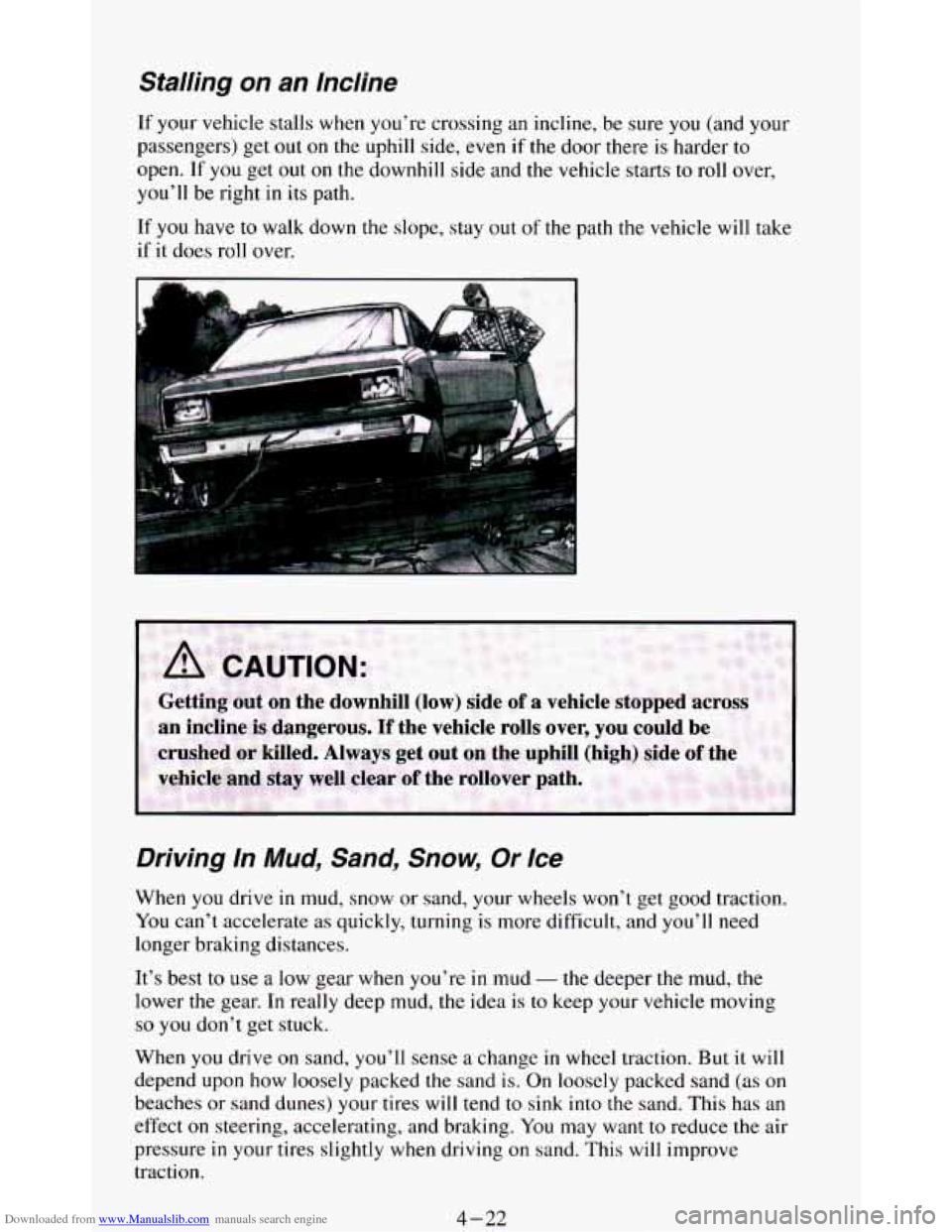
If your vehicle stalls when you’re crossing an incline, be sure you (and your
passengers) get
out on the uphill side, even if the door there is harder to
open. If
you get out on the downhill side and the vehicle starts to roll over,
you’ll be right in its path.
If
you have to walk down the slope, stay out of the path the vehicle will take
if it does roll over.
Driving In Mud, Sand, Snow, Or lce
When you drive in mud, snow or sand, your wheels won’t get good traction.
You can’t accelerate as quickly, turning is more difficult, and you’ll need
longer braking distances.
It’s best
to use a low gear when you’re in mud - the deeper the mud, the
lower
the gear. In really deep mud, the idea is to keep your vehicle moving
so you don’t get stuck.
When
you drive on sand, you’ll sense a change in wheel traction. But it will
depend upon how loosely packed
the sand is. On loosely packed sand (as on
beaches or sand dunes) your tires will tend to sink into the sand. This has an
effect
on steering, accelerating, and braking. You may want to reduce the air
pressure in your tires slightly when driving on sand. This
will improve
traction.
4-22
Page 181 of 348
Downloaded from www.Manualslib.com manuals search engine Hard packed snow and ice offer the worst tire traction. On these surfaces,
it’s very easy
to lose control. On wet ice, for example, the traction is so poor
that you will have difficulty accelerating. And if you do get moving, poor
steering and difficult braking can cause you to slide out of control.
Driving In Water
Light rain causes no special off-road driving problems. But heavy rain can
mean flash flooding, and flood waters demand extreme caution.
Find out how deep the water is before you drive through it. If it’s deep
enough to cover your wheel hubs, axles, or exhaust pipe, don’t try it
- you
probably won’t get through. Also, water that deep can damage your axle and
other vehicle parts.
If the water isn’t too deep, then drive through it slowly. At fast speeds, water
splashes on your ignition system and your vehicle can stall. Stalling can also
occur if you get your tailpipe under water. And, as long as your tailpipe is
under water, you’ll never be able to start your engine. When you go through
water, remember that when your brakes get wet, it may take you longer to
stop.
4-23
Page 182 of 348
Downloaded from www.Manualslib.com manuals search engine After Off-Road Driving
Remove any brush or debris that has collected on the underbody, chassis or
under the hood. These accumulations can be a fire hazard.
After operation in mud or sand, have the brake linings cleaned and checked.
These substances can cause glazing and uneven braking. Check
the body
structure, steering, suspension, wheels, tires, and exhaust system for
damage. Also, check the
fuel lines and cooling system for any leakage.
Your vehicle will require more frequent service due
to off-road use. Refer
to the Maintenance Schedule for additional information.
Driving at Night
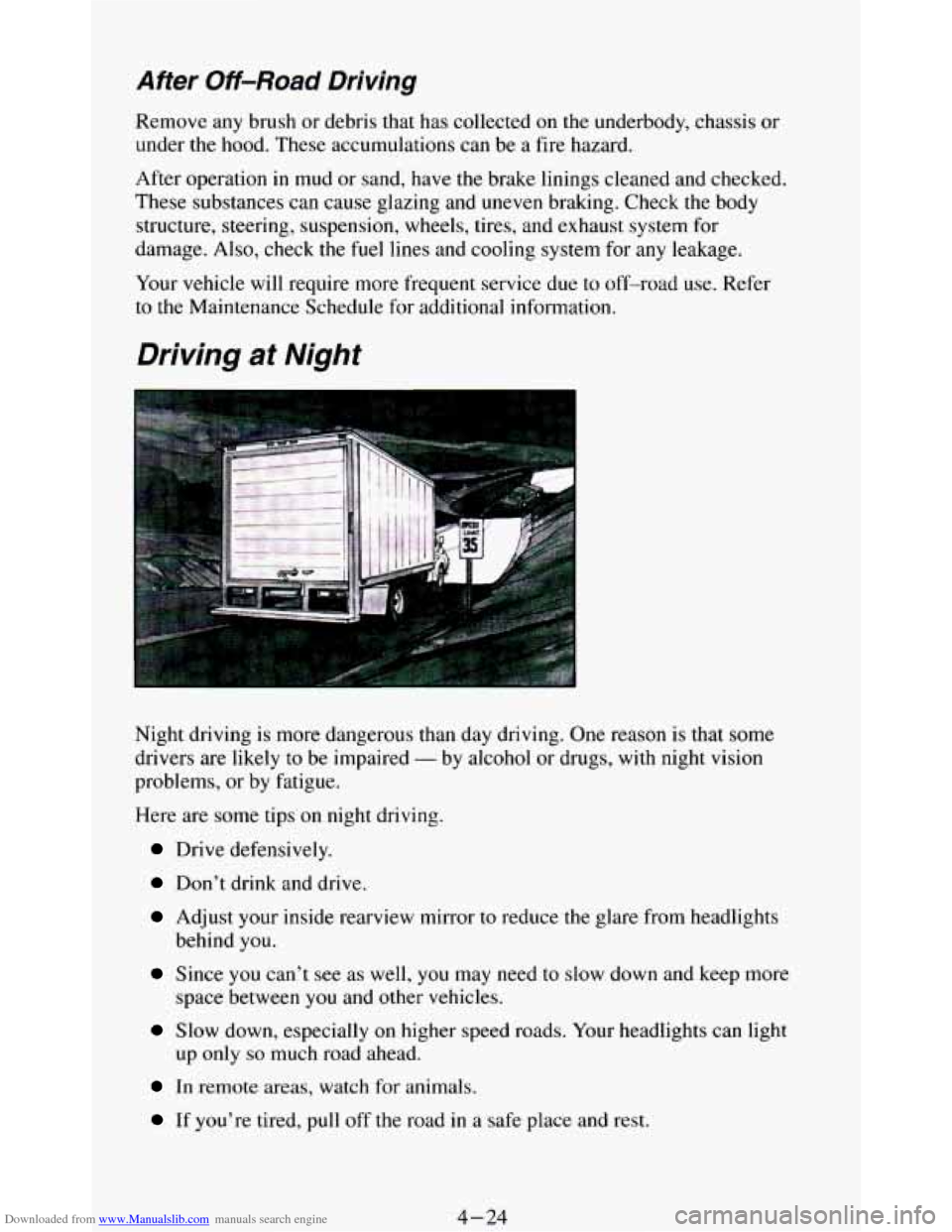
Night driving is more dangerous than day driving. One reason is that some
drivers are likely
to be impaired - by alcohol or drugs, with night vision
problems, or by fatigue.
Here are some tips
on night driving.
Drive defensively.
Don’t drink and drive.
Adjust your inside rearview mirror to reduce the glare from headlights
behind you.
space between
you and other vehicles.
up
only so much road ahead.
Since you can’t see as well, you may need to slow down and keep more
Slow down, especially on higher speed roads. Your headlights can light
In remote areas, watch for animals.
If you’re tired, pull off the road in a safe place and rest.
4-24