Page 62 of 348
Downloaded from www.Manualslib.com manuals search engine Endgate
From the outside, use your door key to unlock the endgate assembly.
With the key in the
lock, turn the lock
handle to the left to
unlock the glass. The
endgate cannot be
opened without first
~ opening the endgate
glass.
Raise the glass, then
turn the lock handle to
the right to unlock the
endgate.
If your
vehicle has a
endgate-mounted spare tire carrier, you
must move the carrier
arm out
of the way to
open the glass.
2-8
Page 64 of 348
Downloaded from www.Manualslib.com manuals search engine Endgate-Mounted Spare Tire Carrier
If your vehicle has a
endgate-mounted spare tire carrier, you
must move the carrier
arm out of the way to
open the glass.
You must move the
carrier arm out
of the
way
to open the
endgate glass. Here's
how
to move the arm:
1. Squeeze the release handle to free the carrier arm.
2. Swing the carrier arm away from the endgate. You may need to give it
a slight tug.
3. To latch the carrier arm, swing it toward the endgate. The latch has two
catches, so push on the carrier arm to make sure it has locked into the
second one. It shouldn't move.
2- 10
Page 171 of 348
Downloaded from www.Manualslib.com manuals search engine Off-Road Driving with Your Four-wheel Drive Vehicle
This off-road guide is for vehicles that have four-wheel drive.
Also, see “Anti-lock Brakes”
in the Index.
If your vehicle doesn’t have four-wheel drive,
you shouldn’t drive off-road
unless you’re on a level, solid surface.
Off-road driving can be great
fun. But it does have some definite hazards.
The greatest
of these is the terrain itself.
“Off-roading” means you’ve left the great North American road system
behind. Traffic lanes aren’t marked. Curves aren’t banked. There are no
road signs. Surfaces can be slippery, rough, uphill or downhill. In short,
you’ve gone right back to nature.
Off-road driving involves some new skills. And that’s
why it’s very
important that you read this guide. You’ll find many driving tips and
suggestions. These
will help make your off-road driving safer and more
enjoyable.
Before You Go Off-Roading
There are some things to do before you go out. For example, be sure to have
all necessary maintenance and service work done. Be sure you read all the
information about your four-wheel drive vehicle
in this manual. Is there
enough fuel? Is the spare tire
fully inflated? Are the fluid levels up where
they should be? What are the local
laws that apply to off-roading where
you’ll be driving? If you don’t know, you should check with law
enforcement people
in the area. Will you be on someone’s private land? If
so, be sure to get the necessary permission.
Loading Your Vehicle for Off-Road Driving
There are some important things to remember about how to load your
vehicle.
The heaviest things should be on the load floor and forward of your
rear axle. Put heavier items as far forward as you can.
Be sure the load is secured properly, so driving on the off-road terrain
doesn’t toss things around.
4-13
Page 197 of 348
Downloaded from www.Manualslib.com manuals search engine If you’re using a “dead-weight” hitch, the trailer tongue (A) should weigh
10%
of the total loaded trailer weight (B). If you have a
“weight-distributing” hitch, the trailer tongue (A) should weigh 12% of the
total loaded trailer weight (B).
After you’ve loaded your trailer, weigh the trailer and then the tongue,
separately,
to see if the weights are proper. If they aren’t, you may be able to
get them right simply by moving some items around
in the trailer.
Total Weight on Your Vehicle’s Tires
Be sure your vehicle’s tires are inflated to the limit for cold tires. You’ll find
these numbers
on the Certification label on the driver’s door lock pillar or
see “Tire Loading”
in the Index. Then be sure you don’t go over the GVW
limit for your vehicle.
Hitches
It’s important to have the correct hitch equipment. Crosswinds, large trucks
going by, and rough roads are
a few reasons why you’ll need the right hitch.
Here are some rules
to follow:
If you’ll be pulling a trailer that, when loaded, will weigh more than
2,000 pounds (900 kg), be sure to use a properly mounted,
weight-distributing hitch and sway control of the proper size. This
equipment is very important for proper vehicle loading and good
handling when you’re driving.
0 Will you have to make any holes in the body of your vehicle when you
install a trailer hitch? If you do, then be sure to seal the holes later
when
you remove the hitch. If you don’t seal them, deadly carbon
monoxide (CO) from your exhaust can get
into your vehicle (see
“Carbon Monoxide”
in the Index). Dirt and water can, too.
If your vehicle has a deadweight hitch and a endgate-mounted spare tire,
and your trailer has
a winch or tongue jack, you could have interference
between them.
Safety Chains
You should always attach chains between your vehicle and your trailer.
Cross
the safety chains under the tongue of the trailer so that the tongue will
not drop
to the road if it becomes separated from the hitch. Instructions
about safety chains may be provided by the hitch manufacturer
or by the
trailer manufacturer. Follow
the manufacturer’s recommendation for
attaching safety chains. Always leave just enough slack
so you can turn with
your rig. And, never allow safety chains
to drag on the ground.
4-39
Page 224 of 348
Downloaded from www.Manualslib.com manuals search engine Side-Mounted Spare Tire (Two-Door Models except P235/75R15 Tire)\
1
3
Rear-Mounted Spare Tire (Two-Door Models)
1. Hook
2. Valve Stem
(Pointed
Outboard)
3. Nut
4. Retainer
(2-wheel drive)
5. Retainer
(4-wheel drive)
6. Spare Tire
1. Valve Stem
(Pointed
Rearward)
2. Wheel Carrier
3. Spare Tire
4. Wheel Nut
Floor-Mounted Spare Tire (P235/75R15 Tire Two-Door Models)
Steel Wheel:
1. Nut
2. Retainer
3. Valve Stem
(Pointed
Up)
4. Hook
5. Spare Tire
5-22
Page 225 of 348
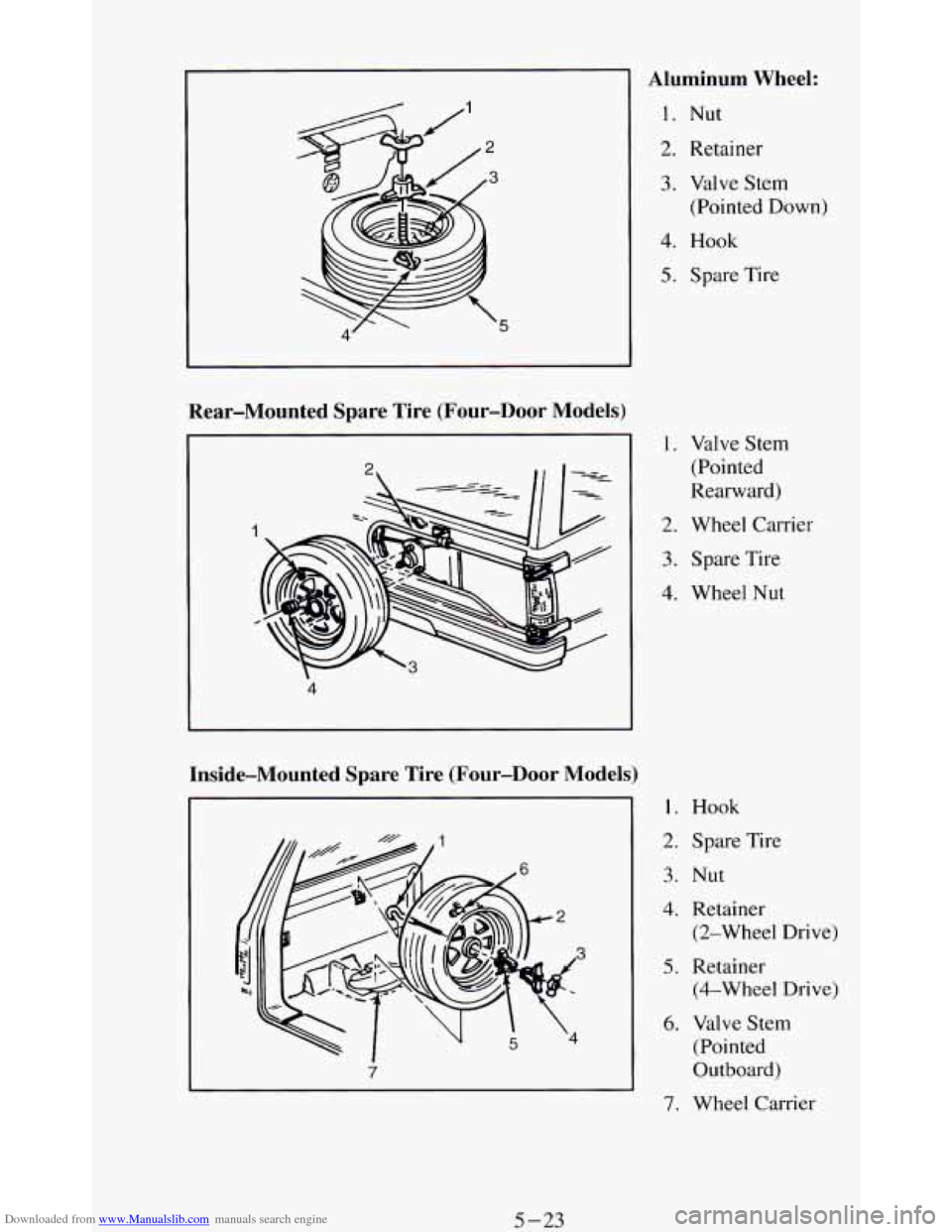
Downloaded from www.Manualslib.com manuals search engine Rear-Mounted Spare Tire (Four-Door Models)
4
Aluminum Wheel:
I. Nut
2. Retainer
3. Valve Stem
(Pointed Down)
4. Hook
5. Spare Tire
1. Valve Stem
(Pointed
Rearward)
2. Wheel Carrier
3. Spare Tire
4. Whee
Inside-Mounted Spare Tire (Four-Door Models)
1. Hook
:1 Nut
?
2. Spare Tire
3. Nut
4. Retainer
(2-Wheel Drive)
5. Retainer
(4-Wheel Drive)
6. Valve Stem
(Pointed
Outboard)
7. Wheel Carrier
5-23
Page 226 of 348
Downloaded from www.Manualslib.com manuals search engine Spare Tire
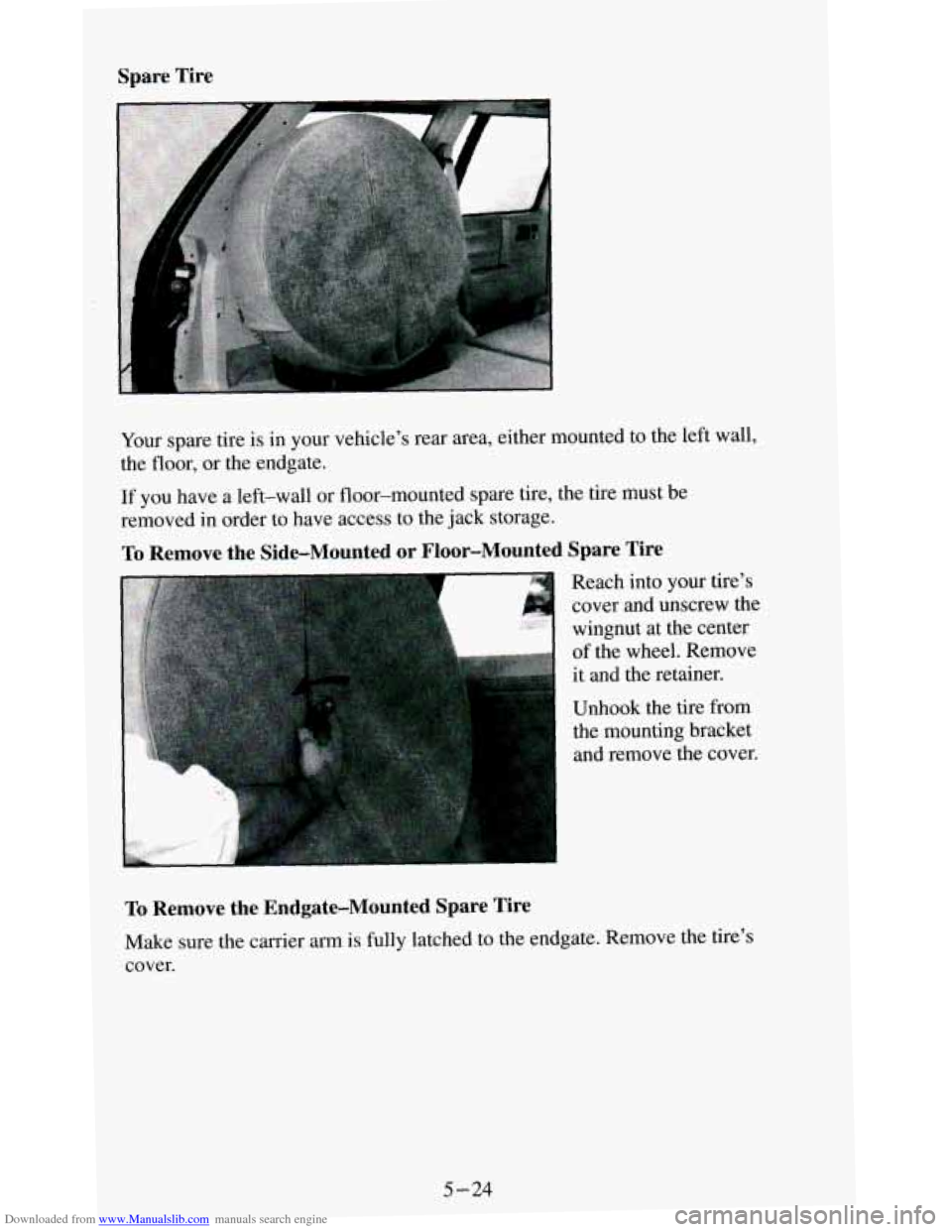
Your spare tire is in your vehicle's rear area, either mounted to the left wall,
the floor, or the endgate.
If you have a left-wall or floor-mounted spare tire, the tire must be
removed
in order to have access to the jack storage.
TO Remove the Side-Mounted or Floor-Mounted Spare Tire
Reach into your tire's
cover and unscrew the
wingnut at the center
of the wheel. Remove
it and the retainer.
Unhook the tire from
the mounting bracket
and remove the cover.
To Remove the Endgate-Mounted Spare Tire
5-24
Page 228 of 348
Downloaded from www.Manualslib.com manuals search engine e
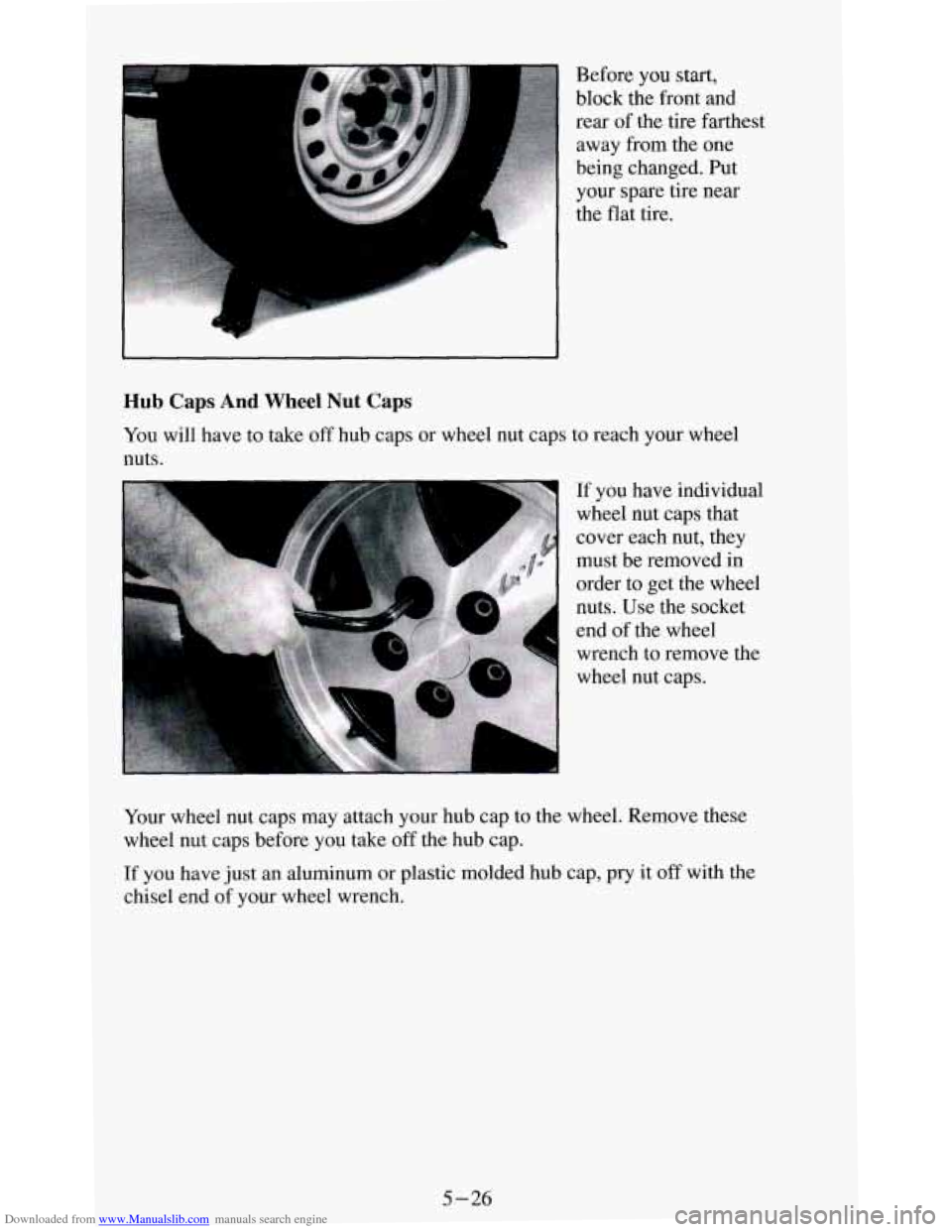
Before you start,
block the front and
rear of the tire farthest
away from the one
being changed. Put
your spare tire near
the flat tire.
Hub Caps And Wheel Nut Caps
You will have to take off hub caps or wheel nut caps to reach your wheel
nuts.
I --
If you have individual
wheel nut caps that
cover each nut, they
must be removed in
order to get the wheel
nuts. Use the socket
end
of the wheel
wrench to remove the
wheel nut caps.
Your wheel nut caps may attach your hub cap to the wheel. Remove these
wheel nut caps before you take
off the hub cap.
If you have just an aluminum or plastic molded hub cap, pry it off with the
chisel end of your wheel wrench.
5-26
\
1
3
Rear-Mounted Spare Tire (Two-Door Models)
1. Hook
2. Va")