1994 CHEVROLET BLAZER light
[x] Cancel search: lightPage 78 of 348
Downloaded from www.Manualslib.com manuals search engine a
0
a
To Stop - Let up on the accelerator pedal and press the brake pedal.
Just before the vehicle stops, press
the clutch pedal and the brake pedal,
and shift to
“N” (Neutral).
N (Neutral) - Use this position when you start or idle your engine.
R (Reverse) - To back up, press down the clutch pedal, wait about 6
seconds, then shift into “R” (Reverse). Then let up on the clutch pedal
slowly while pressing the accelerator pedal.
NOTICE:
Shift to “R” (Reverse) only after your vehicle is stopped.
Shifting to
“R” (Reverse) while your vehicle is moving could
damage your transmission.
Also, use “R’ (Reverse), along with the parking brake, for parking your
vehicle.
Shift Light
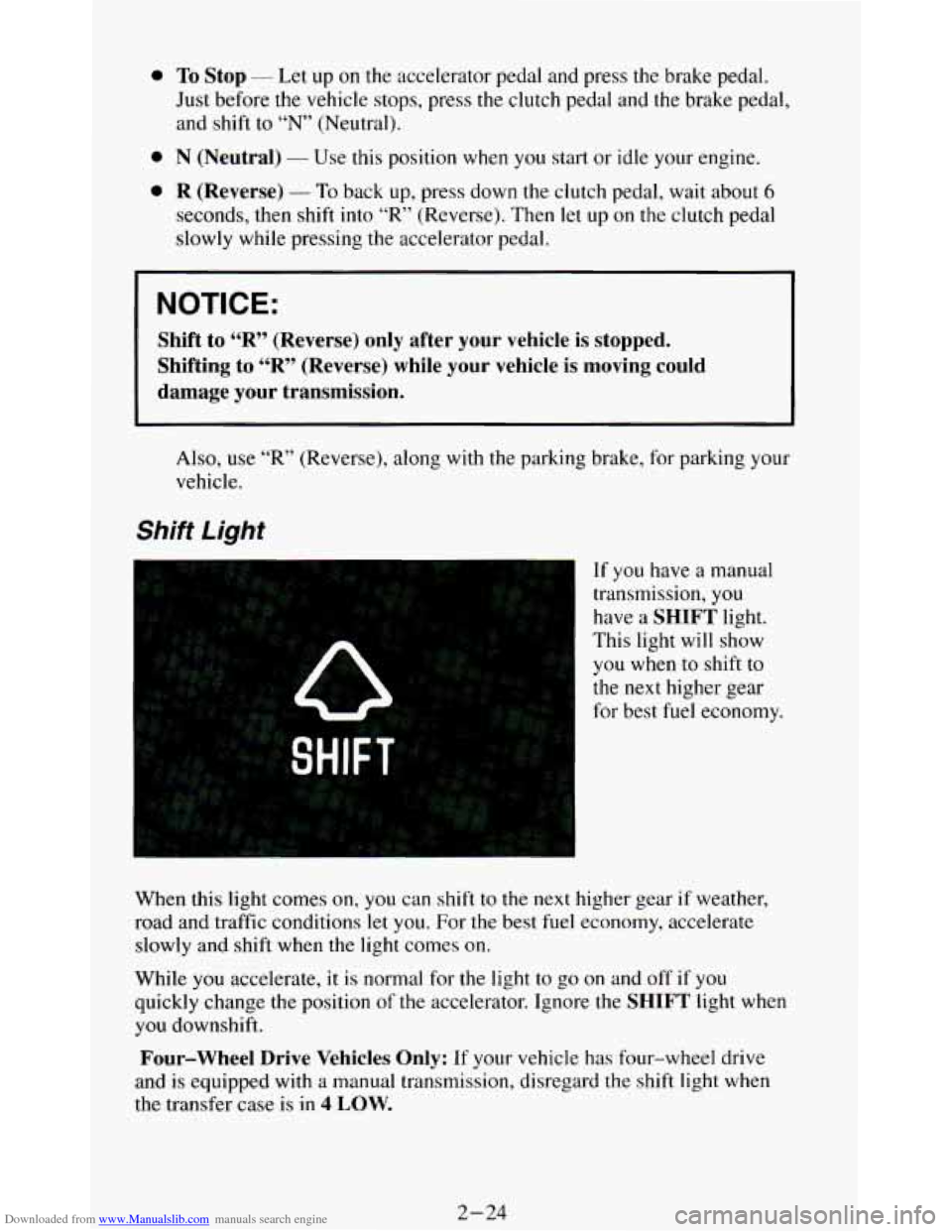
If you have a manual
transmission,
you
have a SHIFT light.
This light will show
you when to shift to
the next higher gear
for best fuel economy.
When this light comes
on, you can shift to the next higher gear if weather,
road and traffic conditions
let you. For the best fuel economy, accelerate
slowly and shift when the light comes on.
While
you accelerate, it is normal for the light to go on and off if you
quickly change the position
of the accelerator. Ignore the SHIFT light when
you downshift.
Four-wheel Drive Vehicles Only: If your vehicle has four-wheel drive
and
is equipped with a manual transmission, disregard the shift light when
the transfer case is in
4 LOW.
2-24
Page 79 of 348
Downloaded from www.Manualslib.com manuals search engine Locking Rear Axle
If you have this feature, your rear axle can give you additional traction on
snow, mud, ice, sand or gravel. It works like a standard axle most of the
time, but when one of the rear wheels has no traction and the other does, the
locking feature will allow the wheel with traction
to move the vehicle.
Parking Brake
-
To Set the Parking Brake:
To Release the Parking Brake:
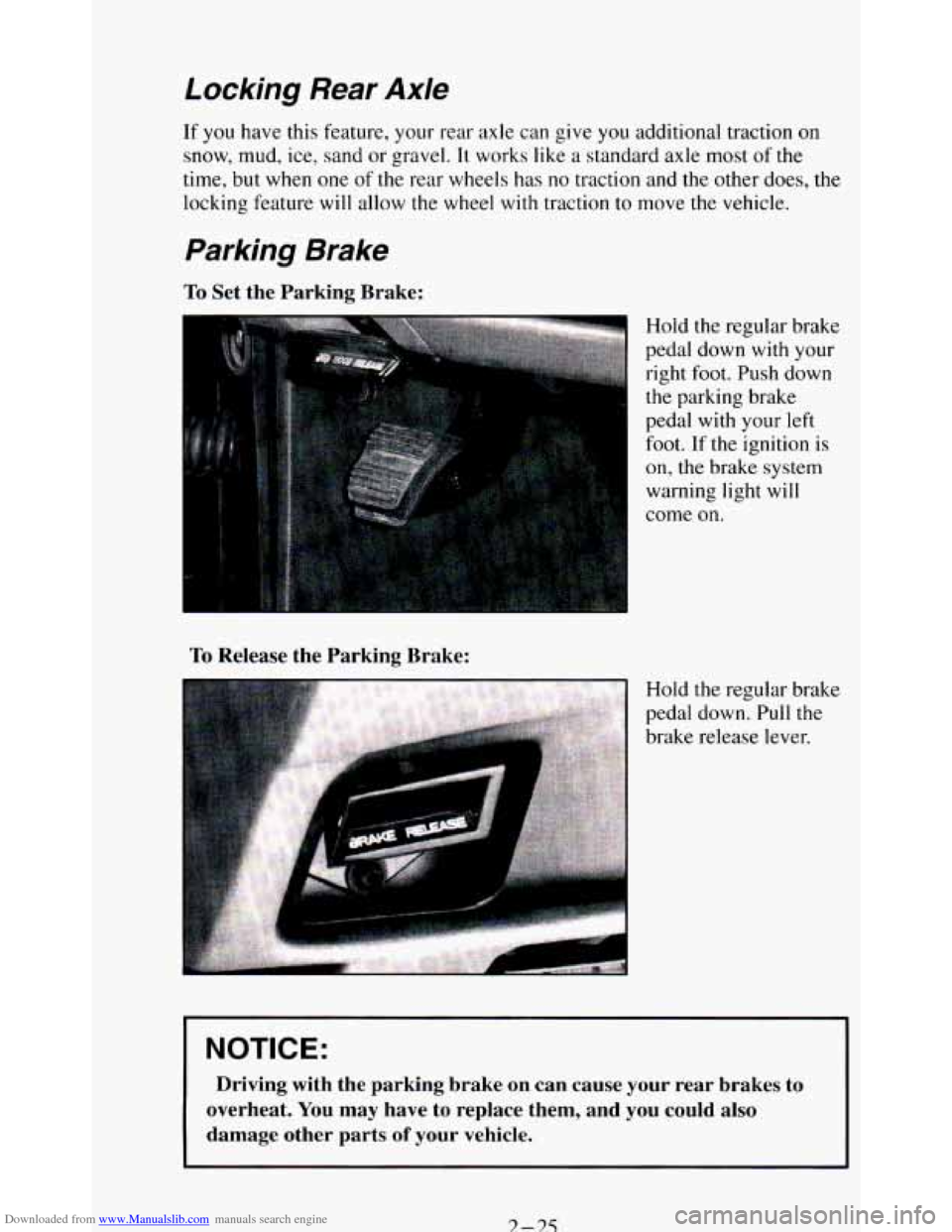
Hold the regular brake
pedal down
with your
right foot. Push down
the parking brake
pedal with your left
foot. If the ignition is
on, the brake system
warning light will
come
on.
Hold the regular brake
pedal down. Pull the
brake release lever.
I NOTICE: I
Driving with the parking brake on can cause your rear brakes to
overheat.
You may have to replace them, and you could also
damage other parts
of your vehicle.
3 -3.5
Page 86 of 348
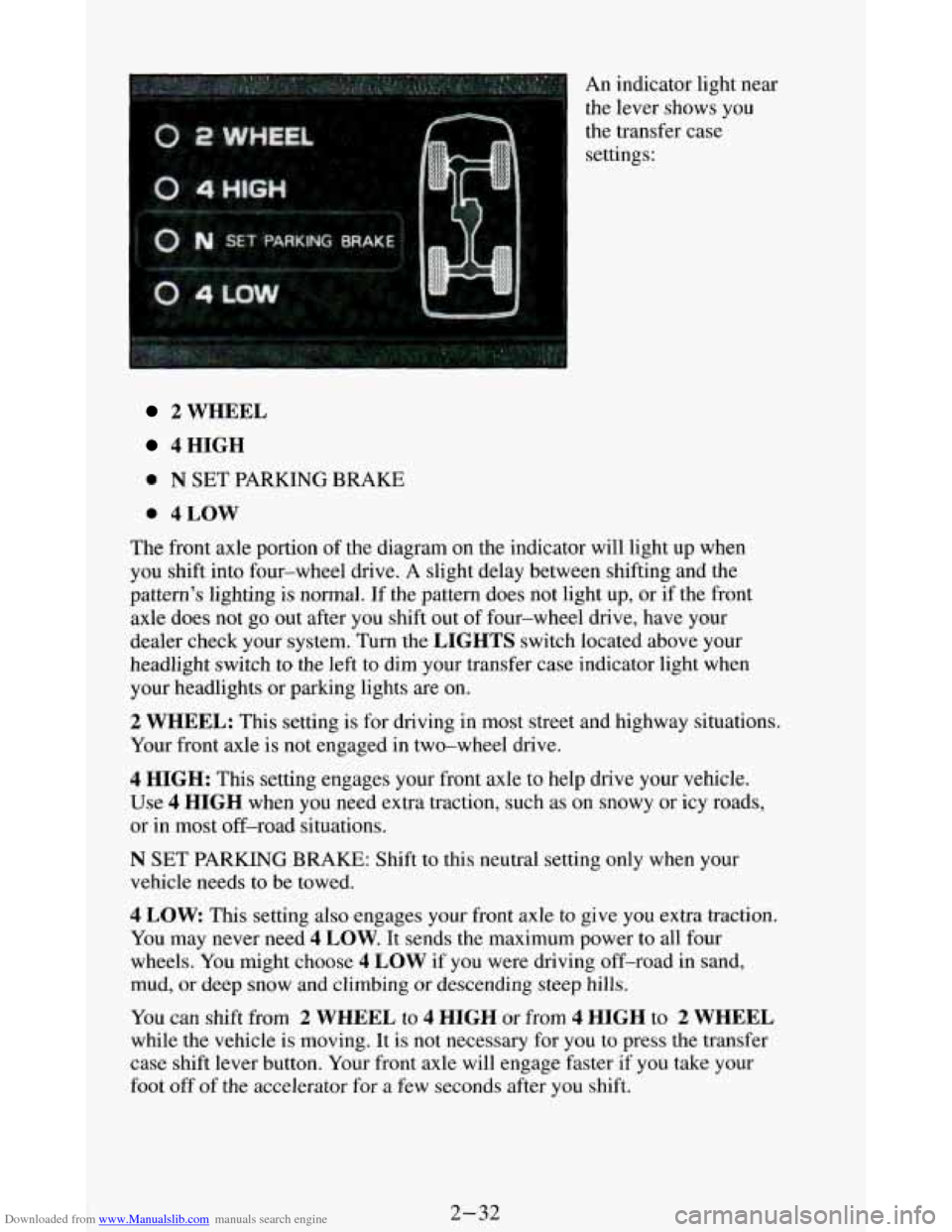
Downloaded from www.Manualslib.com manuals search engine An indicator light near
the lever shows you
the transfer case
settings:
2 WHEEL
4HIGH
0 N SET PARKING BRAKE
0 4LOW
The front axle portion of the diagram on the indicator will light up when
you shift into four-wheel drive.
A slight delay between shifting and the
pattern's lighting
is normal. If the pattern does not light up, or if the front
axle does not go out after you shift out of four-wheel drive, have your
dealer check your system. Turn the
LIGHTS switch located above your
headlight switch
to the left to dim your transfer case indicator light when
your headlights or parking lights are on.
2 WHEEL: This setting is for driving in most street and highway situations.
Your front axle
is not engaged in two-wheel drive.
4 HIGH: This setting engages your front axle to help drive your vehicle.
Use 4 HIGH when you need extra traction, such as on snowy or icy roads,
or
in most off-road situations.
N SET PARKING BRAKE: Shift to this neutral setting only when your
vehicle needs to be towed.
4 LOW This setting also engages your front axle to give you extra traction.
You may never need
4 LOW. It sends the maximum power to all four
wheels. You might choose
4 LOW if you were driving off-road in sand,
mud, or deep snow and climbing or descending steep hills.
You can shift from 2 WHEEL to 4 HIGH or from 4 HIGH to 2 WHEEL
while the vehicle is moving. It is not necessary for you to press the transfer
case shift lever button. Your front axle will engage faster if you take your
foot off of the accelerator for a few seconds after you shift.
2-32
Page 87 of 348
Downloaded from www.Manualslib.com manuals search engine To shift your transfer case into N SET PARKING BRAKE:
1. Stop the vehicle and shift your transmission into “N” (Neutral).
2. Set the parking brake. Your vehicle can roll unless the brakes are
applied.
To shift into or out of 4 LOW :
1. Allow your vehicle to roll at one-to-two mph or stop your vehicle and
shift your transmission into
“N” (Neutral).
2. Press the transfer case shift button and shift in one continuous motion.
Don’t pause in
N SET PARKING BRAKE as you shift into or out of 4
LOW, or your gears could clash.
Kemember that driving in
4 HIGH or 4 LOW may reduce fuel economy.
Also, driving in four-wheel drive on dry pavement could cause your tires to
wear faster and make
your transfer case harder to shift.
Electronic Transfer Case
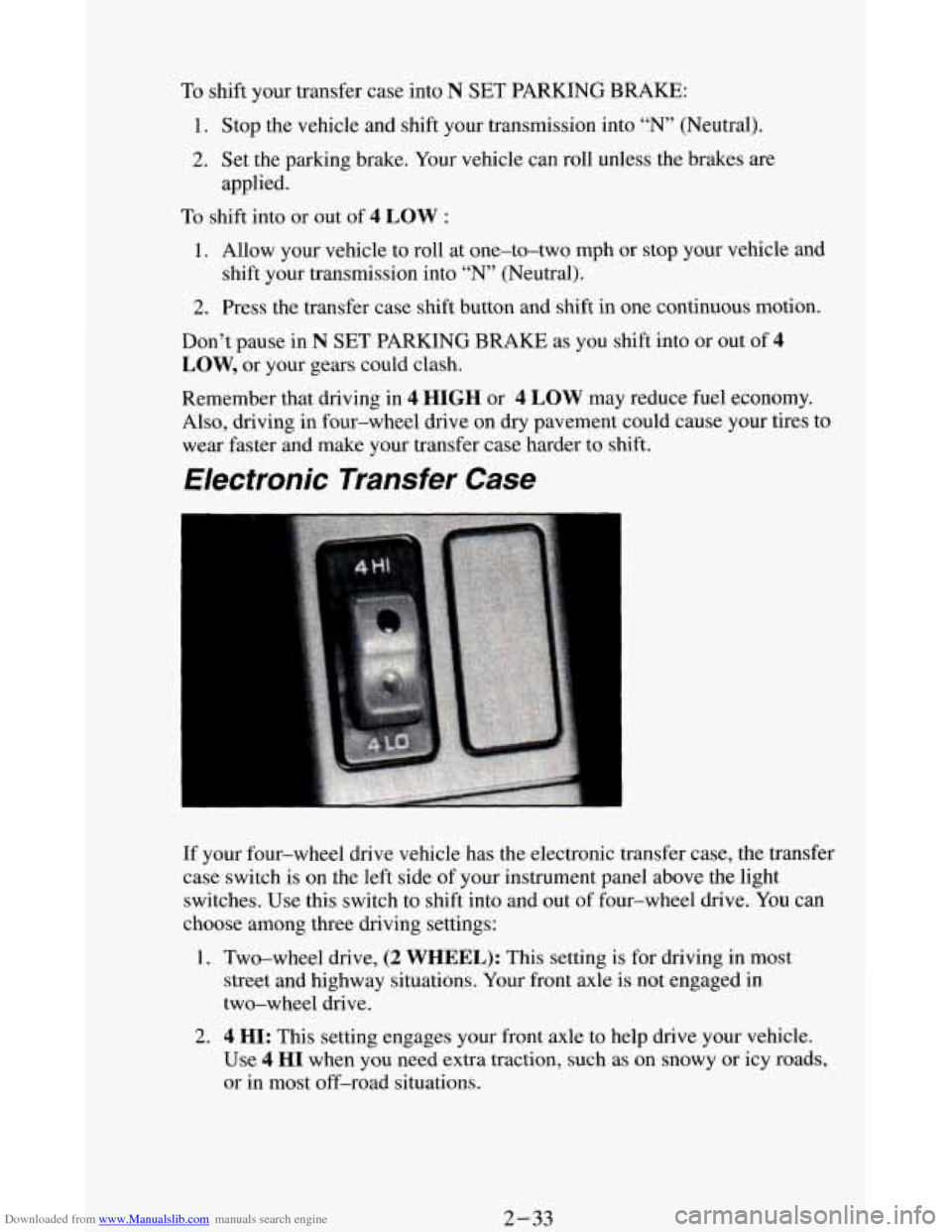
If your four-wheel drive vehicle has the electronic transfer case, the transfer
case switch is on the left side of your instrument panel above the light
switches. Use this switch to shift into and out
of four-wheel drive. You can
choose among three driving settings:
1. Two-wheel drive, (2 WHEEL): This setting is for driving in most
street and highway situations. Your front axle is not engaged in
two-wheel drive.
2. 4 HI: This setting engages your front axle to help drive your vehicle.
Use
4 HI when you need extra traction, such as on snowy or icy roads,
or in most off-road situations.
2-33
Page 88 of 348
Downloaded from www.Manualslib.com manuals search engine 3. 4 LO: This setting also engages your front axle to give you extra
traction. You may never need
4 LO. It sends the maximum power to all
four wheels.
You might choose 4 LO if you were driving off-road in
sand, mud, deep snow and climbing or descending steep hills.
Indicator lights
in the switch show you which setting you are in. Both
indicator lights will come on briefly when
you turn on the ignition. If both
lights do
not come on, you should take your vehicle in for service. The 4 HI
position has a green indicator light and the 4 LO position has an amber
indicator light. When shifting, an indicator light will flash
until the shift is
completed then remain solidly lit.
Two-wheel drive, (2 WHEEL), does not have a switch position or an
indicator light. Your vehicle will be
in two wheel drive if neither indicator
light is
on.
To shift from two-wheel drive, (2 WHEEL) to 4 HI: Press and release the
4 HI switch. This can be done at any speed, and the front axle will lock
automatically.
To shift from 4 HI to two-wheel drive (2 WHEEL): Press and release the
4 HI switch. This can be done at any speed, and the front axle will unlock
automatically.
To shift from two-wheel drive (2 WHEEL) to 4 LO: The vehicle must be
stopped or moving less than
3 mph (4.8 km/h) with the transmission in “N’
(Neutral) or the clutch pedal depressed. The preferred method for shifting
into
4 LO is to have your vehicle slowly moving one-to-two mph (1.6 to
3.2 kdh). Press and release the 4 LO switch. You must wait for the amber
4 LO indicator light to stop flashing and go solid amber before shifting your
transmission
into gear or releasing the clutch pedal.
If the
4 LO switch is pressed when your vehicle is in gear and/or moving,
the amber
4 LO indicator light will flash for 30 seconds and not complete
the shift unless your vehicle is below
3 mph (4.8 kdh) and the transmission
is in
“N” (Neutral) or the clutch pedal depressed.
On automatic transmission equipped vehicles: If your transfer case does not
shift into
4 LO, your transmission indicator switch may require adjustment.
With your transmission in
“N” (Neutral), press and release the 4 LO
switch. While the amber 4 LO indicator light is flashing, shift your
transmission into
P (Park).
2-34
Page 89 of 348
Downloaded from www.Manualslib.com manuals search engine Wait until the 4 LO indicator light goes solid amber before shifting your
transmission into gear. This
will get you into 4 LO, but you should take
your vehicle in for service so normal operation can be restored.
To shift from 4 LO to 4 HI: Your vehicle must be stopped or moving less
than
3 mph (4.8 kdh) with the transmission in “N” (Neutral) and the clutch
pedal depressed. The preferred method for shifting out of
4 LO is to have
your vehicle slowly moving
1 to 2 mph (1.6 to 3.2 kmh). Press and release
the
4 HI switch. You must wait for the 4 HI indicator light to stop flashing
and
go solid amber before shifting your transmission into gear or releasing
the clutch pedal.
If the 4 HI switch is pressed when your vehicle is in gear and/or moving,
the
4 HI indicator light will flash for 30 seconds but not complete the shift
unless the vehicle is below
3 mph (4.8 kdh) and the transmission is in “N”
(Neutral) or the clutch pedal depressed.
On automatic transmission equipped vehicles:
If your transfer case does not
shift into
4 HI, your transmission indicator switch may require adjustment.
With your transmission
in “N” (Neutral), press and release the 4 HI switch.
While the
4 HI indicator light is flashing, shift your transmission into P
(Park). Wait until the 4 HI indicator light goes solid green before shifting
your transmission into gear. This
will get you into 4 HI, but you should
take your vehicle
in for service so normal operation can be restored.
To shift from 4 LO to two-wheel drive (2 WHEEL): You must shift from
4 LO to 4 HI before shifting back into two-wheel drive.
Windows
1
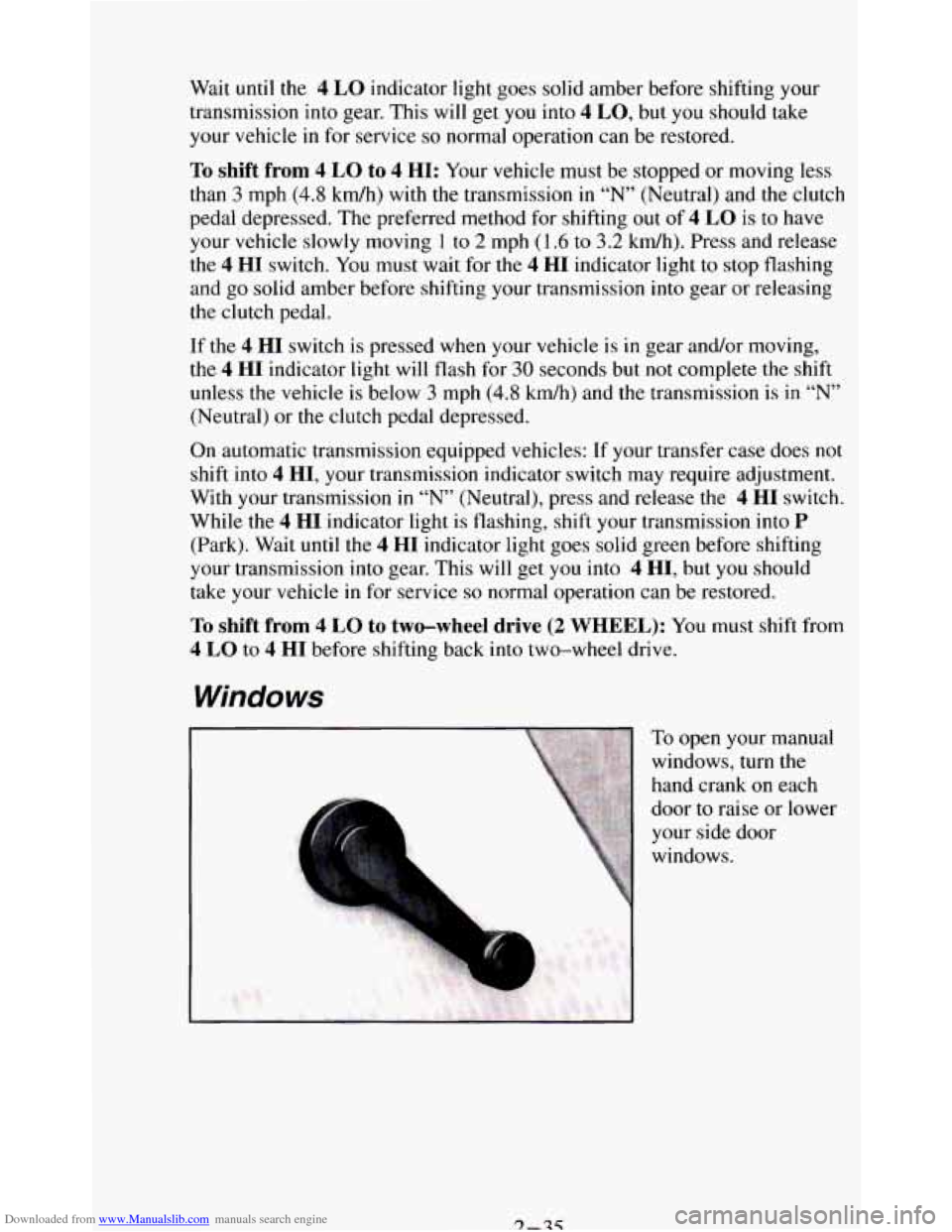
To open your manual
windows,
turn the
hand crank
on each
door to raise or lower
your side door
windows.
Page 92 of 348
Downloaded from www.Manualslib.com manuals search engine Turn SignaVMultifunction Lever
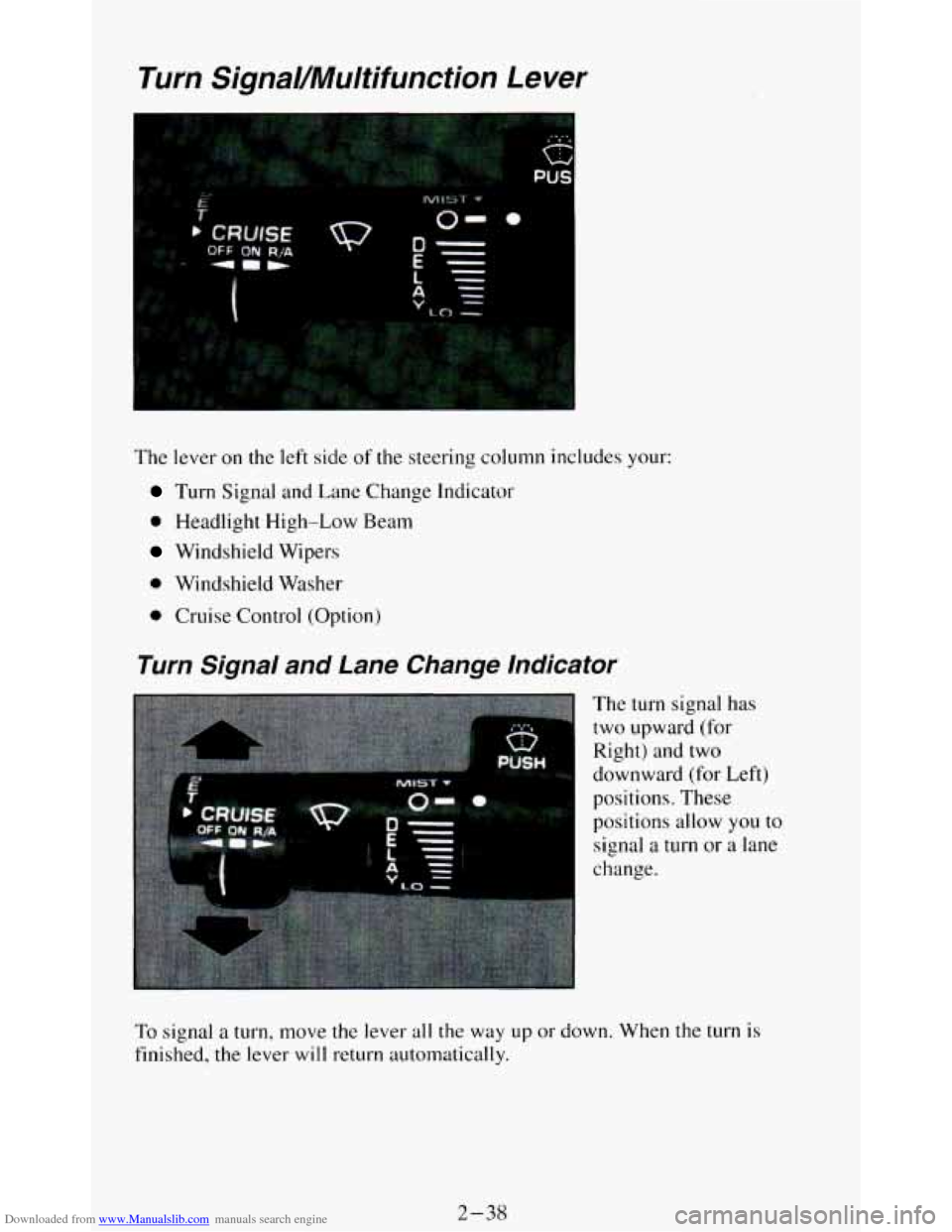
The lever on the left side of the steering column includes your:
Turn Signal and Lane Change Indicator
0 Headlight High-Low Beam
Windshield Wipers
0 Windshield Washer
0 Cruise Control (Option)
Turn Signal and Lane Change Indicator
The turn sign2 11 has
two upward (for
Right) and two
downward (for Left)
positions. These
positions allow you to
signal
a turn or a lane
change.
To signal a turn, move the lever all the way up or down. When the turn is
finished,
the lever will return automatically.
2-38
Page 93 of 348
Downloaded from www.Manualslib.com manuals search engine Standard Cluster Digital Cluster
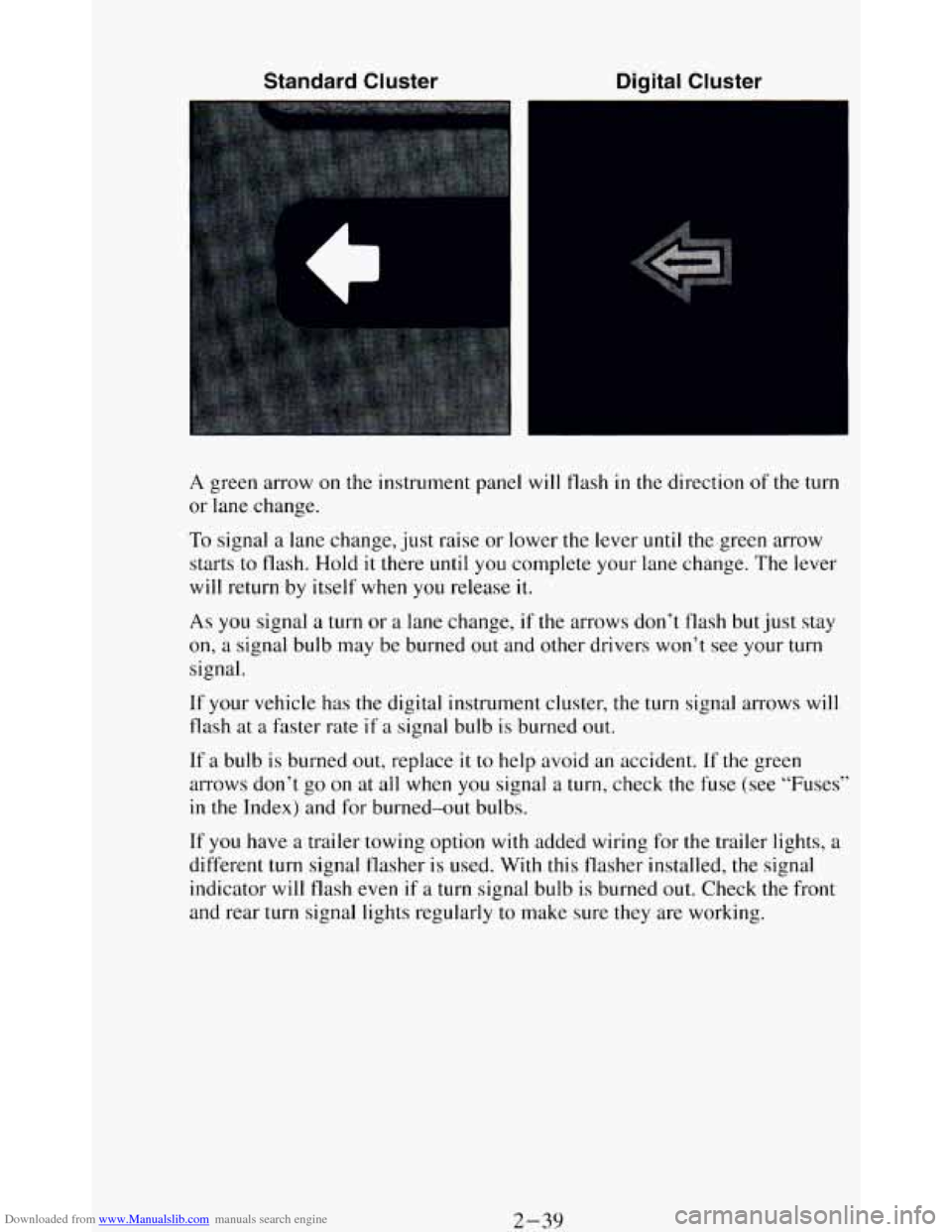
A green arrow on the instrument panel will flash in the direction of the turn
or lane change.
To signal
a lane change, just raise or lower the lever until the green arrow
starts to flash. Hold
it there until you complete your lane change. The lever
will return by itself when you release it.
As you signal a turn or a lane change, if the arrows don’t flash but just stay
on,
a signal bulb may be burned out and other drivers won’t see your turn
signal.
If your vehicle has the digital instrument cluster, the turn signal arrows will
flash at
a faster rate if a signal bulb is burned out.
If a bulb is burned out, replace it to help avoid an accident. If the green
arrows don’t go on at all when you signal a turn, check the fuse (see “Fuses”
in the Index) and for burned-out bulbs.
If
you have a trailer towing option with added wiring for the trailer lights, a
different turn signal flasher is used. With this flasher installed, the signal
indicator will flash even if
a turn signal bulb is burned out. Check the front
and rear turn signal lights regularly to make sure they are working.
2-39