1993 VOLKSWAGEN GOLF lock
[x] Cancel search: lockPage 67 of 156
Downloaded from www.Manualslib.com manuals search engine CONTROLS AND EQUIPMENT
Sliding/tilting roof*
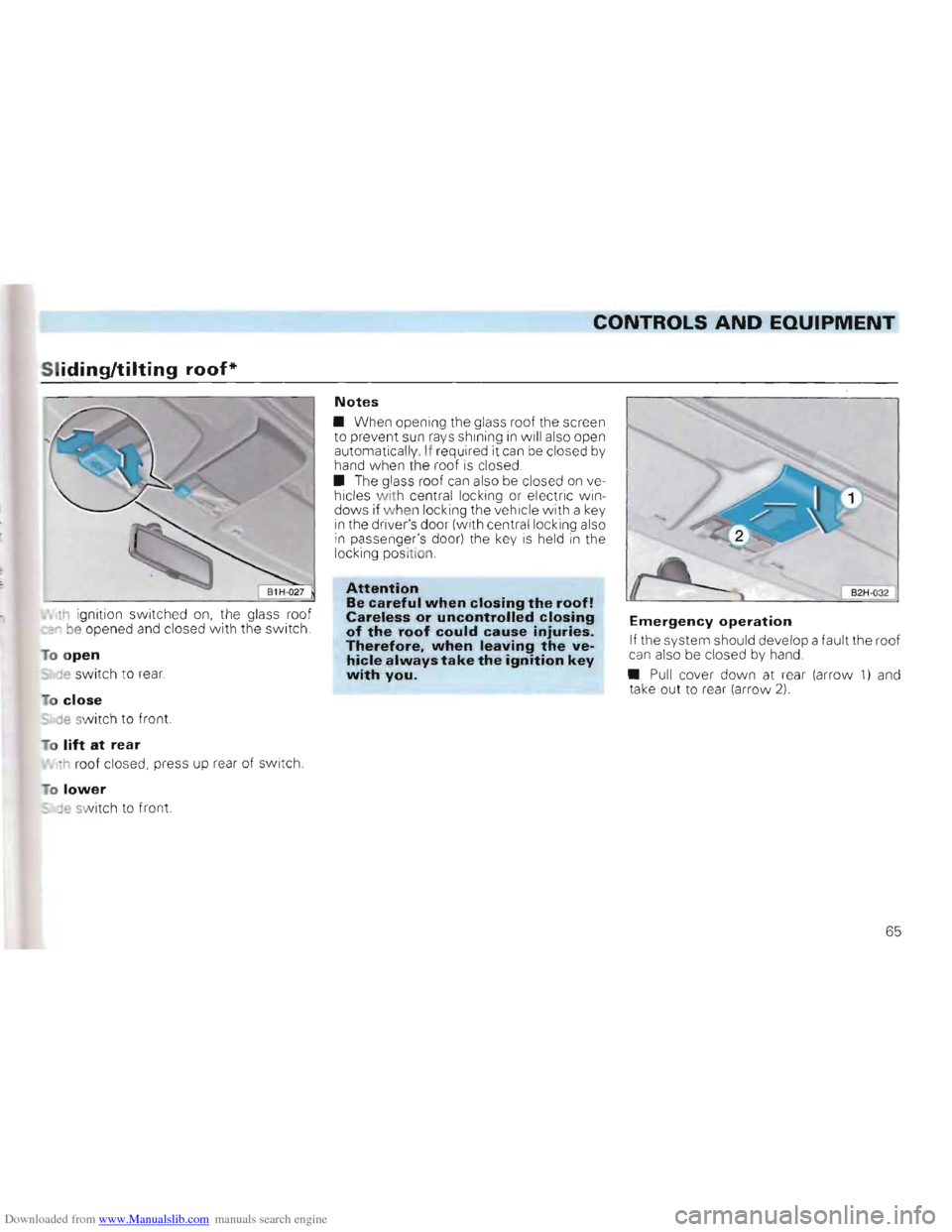
lh ignition sWit ched on, the glass roof
cl' be opened and closed with the switch.
T o
open
'de switch to rear.
o close
- de sw itc h to front.
To lift at rear
Ih ro of closed, press up rear of switch.
o
lower
lJe swi tc h to fro nt.
Notes
• When opening the glass roof the screen to prevent sun rays shining in w ill also open
automatical ly. I f req u ired it can be closed by hand whe n th e roof is closed .
• The glass roof can also be closedon ve
hicle s with central locking or electric win
dows if w he n loc king the vehicle with a key in the driv er' s door (with central locking al so in passeng er's door) the key is held in the
locking position.
Attention
Be careful when closing the roof!
Careless or uncontrolled closing
of the roof could cause injuries.
Therefore, when leaving the ve
hicle always take the ignition key
with you.
Emergency operation
If the system should develop a fault the roof
can also be c losed by hand .
• Pu
ll cover dow n at rear (arrow 1) and
take out to rear (arrow 2).
65
Page 71 of 156
Downloaded from www.Manualslib.com manuals search engine CONTROLS AND EQUIPMENT
Shelves and boxes
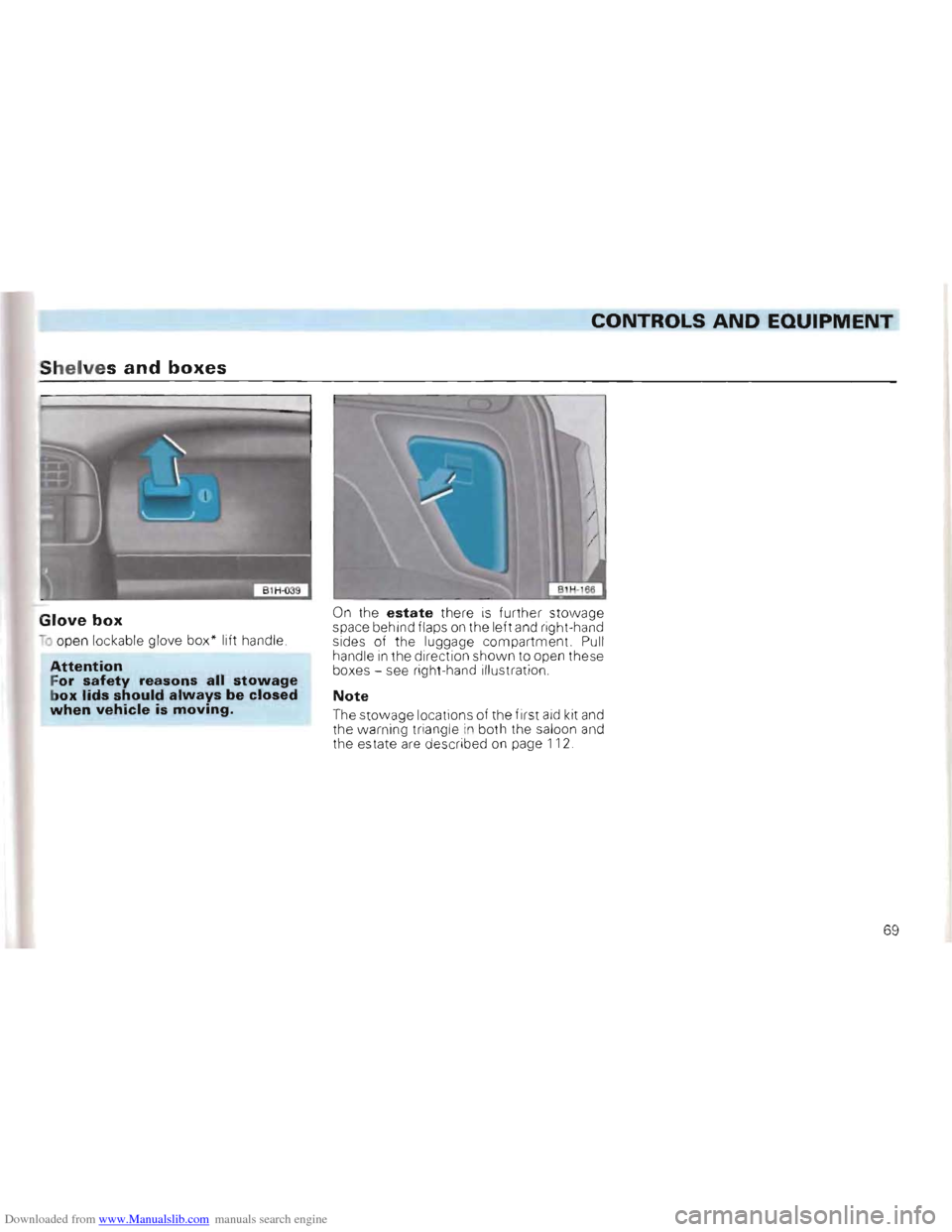
Glove box
-0 open lockable glove box* lift handle .
Attention For safety reasons all stowage box lids should always be closed w hen vehicle is moving.
On the estate there is further stowage
space behind flaps on the left and right-hand
sides of the luggage compartment. Pull handle in the direction shown to open these
boxes -see right-hand illustration .
Note
The stowage locations of the first aid kit and the warning triangle in both the saloon and
the estate are described on page 112.
69
Page 78 of 156
Downloaded from www.Manualslib.com manuals search engine DRIVING TIPS
Anti-locking brake system *
The AB S plays a major part in i ncreasing the active safety of the vehicle . The big adva ntage when compa red with a conve ntional brake system is t hat even when braking
hard on a s lippery road surfac e the bes t
poss ib le ste erabili ty is retained for the road
cond it io n because the wheels do not lock.
H
owever o ne mus t not expec t the ABS
sys tem t~ sho rt en the brak ing dis ta nce in all co nditions. When driv ing on grave l or o n
fr esh snow cove ring a slipp ery surf ace, I.e. when one shou ld be driving very care fully In
a ny case, the s topping distance may even be slightly longer
How the ABS system works
A n automatic check is made when a speed
of approx. 7 km/h is reached,. When this
hap pens a pumping no ise can be heard. W
he n the tu
rning speed of a w heel reac hes a leve l which is too low fo r the ve hicle speed
and it ten ds to lock , the brake pre ssu re to
t his whee l is r educ ed. On the fron t axle the
b rake press ure is regulated fo r eac h wheel
ind iv idually, whereas on the rear axle, the
press ure is regulated fo r bo th wheels at the
sam e tim e. As a result the braking effect IS the same f or both rear w heels and the driving stabi lity is reta ined as f a r as po~sible. This regulating process makes Itself known by movement .of the b~ake pedal and is accompanied by nOises. This is do ne deli berat ely as a warni ng to the
driver that a wheel or the wheels a re In th e
lock ing range So that the ABS can r egu la te
effec tively in th is range the brake peda l
must remai n depressed -on no account
should it be pumped l
Attention However the ABS system cannot overcome the physical limits. This must be borne in mind particularly on slippery or wet roads. When the ABS com es into the control range the speed must immediately be adapted to the road and traffic conditions. The increased amount of safety available must not tempt one into taking risks.
If a def ect occurs o n the ASS It is indicated by a warni ng lamp -see page 49.
76
Page 82 of 156
Downloaded from www.Manualslib.com manuals search engine DRIVING TIPS
Brake testing
For brake testing on a brake test stand th e
props haft does not have to be detached .
On the rear w heels the brake test is carried
out in the same way as on two-wheel drive
vehicle .
When testing the front w heel brakes how
ever there are some special points to
be noted:
• The
ve hicle must be reversed onto the
te st stand so that the test stand rollers drive
the front w heels backwards .
• Then the gear lever
must be moved into
1 st gear w ith the ignition on and then back
into neutral again Th is disengages the free
wheel lock in the back axle.
Note
On no account must the reverse gear be se
lected when the rollers are running other
wise the freewheel lock would be engaged
again.
This would cause the rear wheel s to
be driven suddenly.
80
Page 83 of 156
Downloaded from www.Manualslib.com manuals search engine Filling the tank
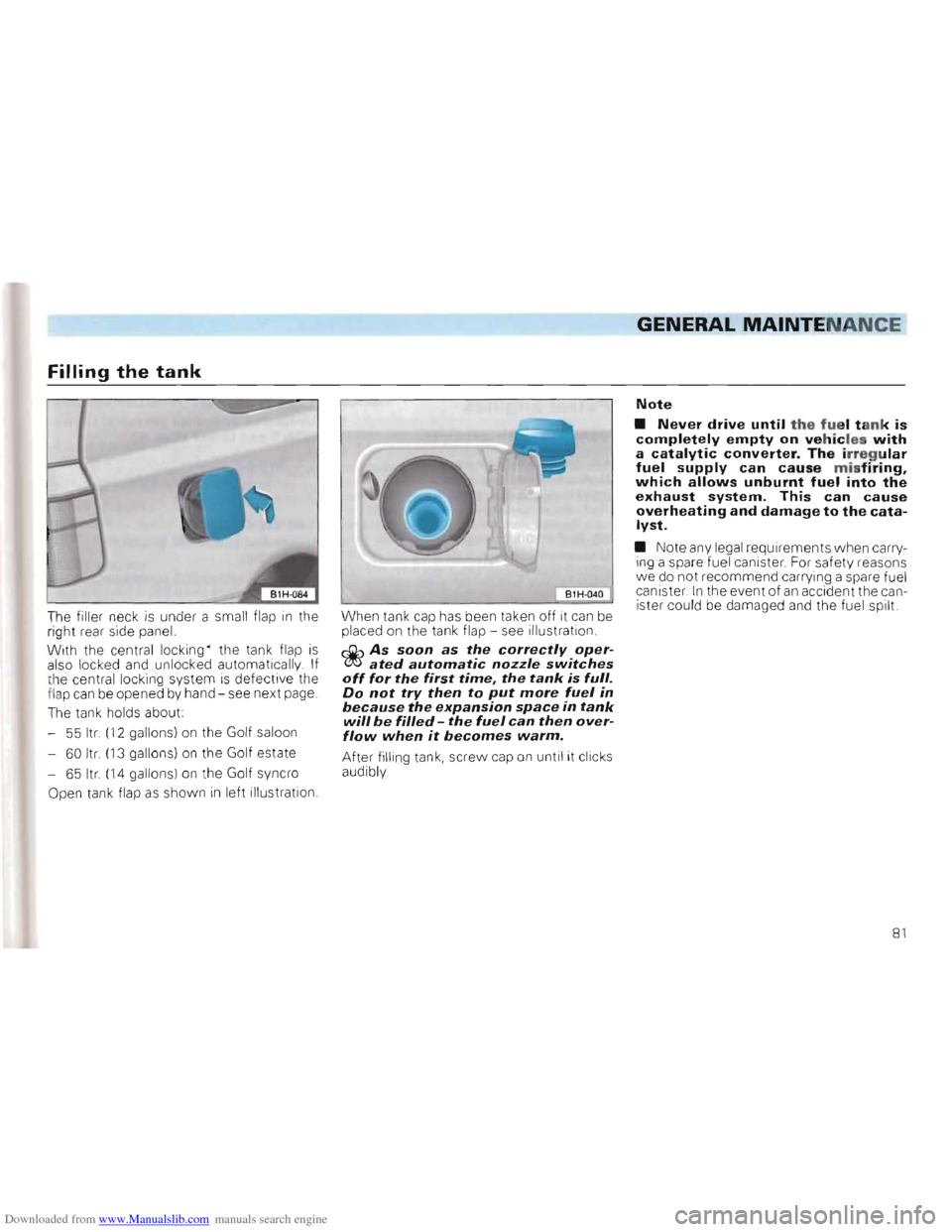
B1H-040
When tank cap has been taken off it can be
placed on the tank flap -see illustration.
r::ljb As soon as the correctly oper~ated automatic nozzle switches off for the first time, the tank is full. Do not try then to put more fuel in because the expansion space in tank will be filled -the fuel can then overflow when it becomes warm.
After filling tank, screw cap on until it clicks
audibly .
The
filler neck
is under a small flap in the
right rear side panel.
With the central locking ' the tank flap is also locked and unlocked automatically. If the central locking system is defective the fiapcanbeopenedbyhand-seene~page.
The tank holds about
-55 Itr (12 gallons) on the Golf saloon
- 60 Itr.
(13 gal lons) on the Golf estate
- 651tr .
(14 gallons) on the Golf syncro
Open
tank flap as shown in left illustr ation.
Note
• Never drive until 1he fuel tank is completely empty on vehicles with a catalytic converter. The irregular fuel supply can cause misfiring, which allows unburnt fuel into the exhaust system. This can cause overheating and damage to the catalyst.
• Note any lega l requirements when carry
ing a spa re fuel canis ter. For safety reasons we do not recommend carrying a spare fuel
canister. In the event of an accident the can
ister could be damaged and the fuel spilt.
81
Page 84 of 156
Downloaded from www.Manualslib.com manuals search engine GENERAL MAINTENANCE
Fuel
Releasing tank flap manually
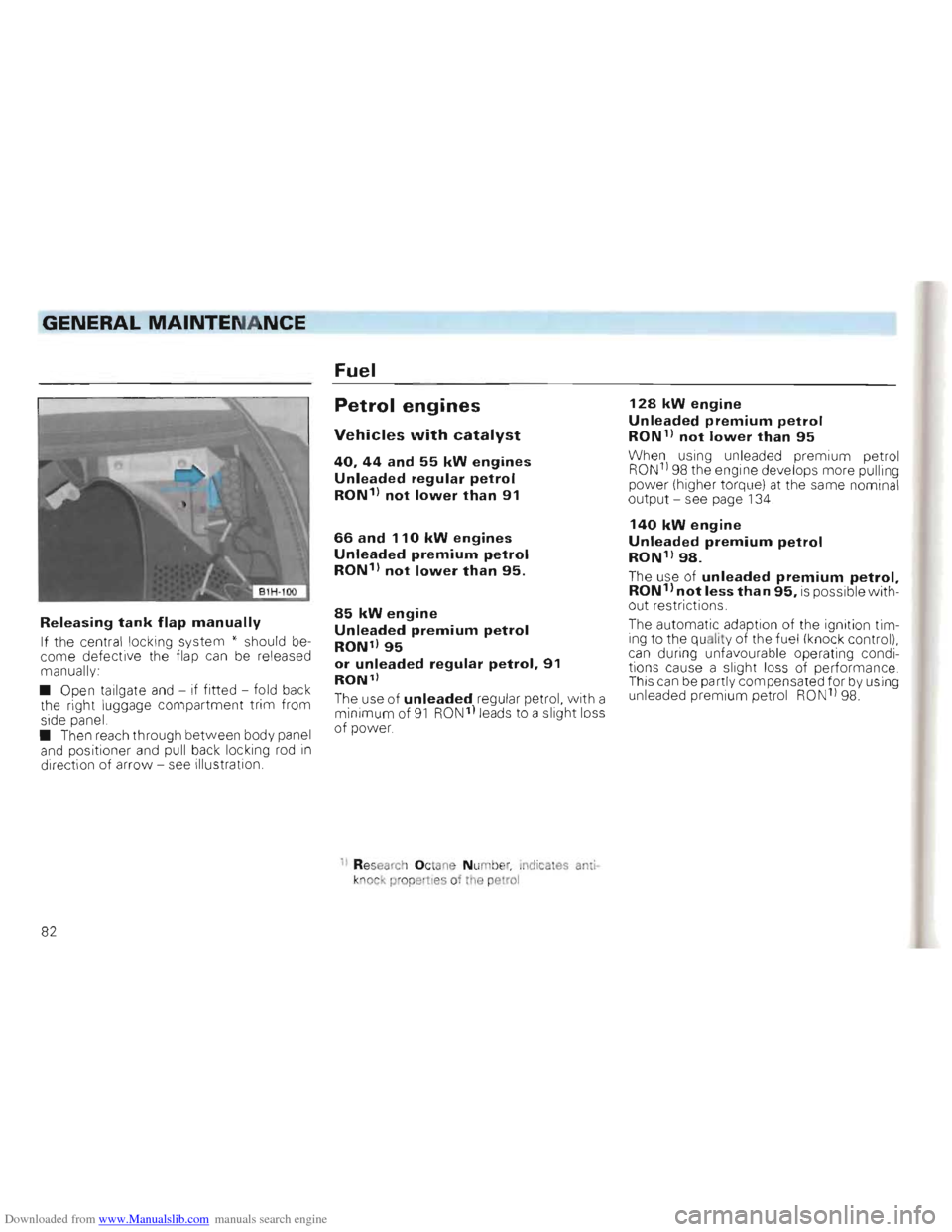
If the central locking system * should become defective the flap can be released
manually :
• Open tailgate and -if
fitted -fold back
t he righ t luggage compartment trim from
side panel.
• Then reach through bet
ween body panel
and positioner and pull back loc king rod In directio n of arrow - see Illustration .
Petrol engines
Vehicles with catalyst
40. 44 and 55 kW engines
Unleaded regular petrol
RON1) not lower than 91
66 and 110 kW engines
Unleaded premium petrol
RON1) not lower than 95.
85 kW engine
Unleaded premium petrol
RON') 95
or unleaded regular petrol. 91
RON')
The use of unleaded regular petrol, with a
min imum of 91 RON ') leads to a slight loss
o f power
11 Re se arch O ctane Num b r, indicates anti
k nock properties of the pe rol
128 kW engine
Unleaded premium petrol
RON1) not lower than 95
When u sing un leaded premium petrol RON1) 98 the engine develops more pulling power (higher torque) at the same nominal output -see page 134.
140 kW engine
Unleaded premium petrol
RON') 98.
The use
of unleaded premium petrol. RON1) not less than 95. is possible without restrictions.
The automatic adaption
of the ignition tim
ing to the quality of the fuel (knock control),
can during unfavou rable operating condi
tions cause a s
light loss of performance
This can be partly compensated for by uS ing
un lead ed prem ium petro l RONlI 98 .
82
Page 88 of 156
Downloaded from www.Manualslib.com manuals search engine GENERAL MAINTENANCE
W ashing the vehicle by hand
~In the interests ofe n vironmental ~protection the vehicle s hould only be washed in specially provided wash bays. In some districts, washing cars elsewhere may even be forbidden .
First soften the dirt
with plenty of water and
rinse off as well as possible.
Th en clean the car with a soft sponge, glove
or brush starting on the roof and going from
t o p to bottom using only slight pressure.
Pain t sham poo should only be used for very
p ersis tent dirt.
Rinse the s ponge or glove out thoroughly at
s l
lort intervals.
Wheels and sill panels should be cleaned
last, using a different sponge if possible.
After clea nin g the vehicle, rinse thoroughly
with water and leather it off.
Notes
• The vehicle should not be washed In strong sunshine.
• If the vehicle
is rinsed with a hose, do not
direct the jet of water at the lock cylinders
- they can freeze up in the winter.
Washing vehicle with high pressure
cleaner
• The operating instructions for the high
pressure cleaner must be followed closely
- particularly with regard to pressu re and working distance.
•
Do not use a concentrated Jet. • The water temperature must not be
above 60°e.
Attention
Tyres must never be cleaned with
a concentrated jet! Even at a rela
tively large working distance and
a very short spraying time, dam
age can occur.
Waxing
A good coat of "vax pro tects the vehicle
paintwork to a large extent again st the envi
ronmental influences listed under "Washing" on the previous page an d even against
light mechanical damage
At the latest
when water on th e clean paint
does not form small drops an d roll off, the
vehicle should be protec te d b y applying a
coat of good hard wax. Even when a wax
solution
is used regular ly in the washing water it is advisable to prote ct th e paint vVlth a coat of hard wax at least twice a year.
Polishing
Should only be done if paint has lost its
shine and gloss cannot be brought back
with wax. If the polish used does not con
tain preservative compounds, th~ pain t must be waxed afterwards.
Note
Matt painted and plastic parts should
not be treated with pol is h or hard wax.
86
Page 90 of 156
Downloaded from www.Manualslib.com manuals search engine GENERAL MAINTENANCE
Cleaning seat belts
Keep belts clean because they ma y not
retract properly if very dirty .
Dirt y be
lts can be cleaned by was hing w ith
a mild soap solutio n without taking the belts
out of the vehicle.
Note
Inert ia reel belts should be completel y dry
before they are allowed to roll up.
Attention Do not have the belts cleaned chemically because the cleaning compounds damage the webbing material. Ensure that the belts do not come into contact with corrosive fluids.
Steel wheels
The wheels and the whee l tr ims should be
cle aned thoroughly at regular inter vals w hen the vehicle is being washed. This w ill
prevent brake dust , dirt and road salt from
accu mulating on the wheel. Persistent
ingr ained brake dust can be removed With an industrial grim e remov er. P aint damage
should be repaired before rust can form.
Alloy wheels
In order to maintain th e smart appearan ce
of all oy wheels for a long period, regular
car e is necessary . In particular, salt and brake pad dust must be washed off th or ough
ly
at leas t every tw o w eeks otherwise
the surface of the alloy Will be damaged
After being w ashed, the w heels shou ld be treated with an acid-free cleaner for al loy wheels. About every three months it is necessary to give wheels a good rubbing
w ith hard wax. Paint polish or other abrasiv e
solutions must not
be used. If the protecti ve
paint coat has been damaged , eg. by stone
impact, the damaged spots should be dealt with as soon as possible.
Cleaning and anti-corrosion
treatment of engine compart
ment
Attention Before doing any work in the engine compartment it is essential to read the notes on page 91!
The leaves, blossoms etc . w hich drop into
the water box (underneath the engine
bonnet
in f ront of the windscreen) should
be cleaned out occasional ly This w ill pre
v ent the water drain holes becoming
blocked
and -on veh ic les w ithout a fresh air
filter -foreign bodies entering the vehicle
interior v
ia the heating and ventilat ion sys
tem.
Attention For safety reasons pull out ignition key before reaching into the water box. Otherwise if the windscreen wipers are switched on unintentionally the movement of the wiper linkage could cause injury.
The engine compartment an d th e outsi de
surface of the power unit are given anti-cor
rosion treatment at the factor y.
In th e winter w hen the vehicle is being
driven frequ entl y on salted roads, good anti
corrosion treatment is very important. For
th is reason the entire engin e comp
artment and the plen um chamber should be thor
ough ly cleaned before and after the salting
period
and then preserved so that the salt cannot have a damag ing effect
The ignition must be switched off before washing the engine.
If the engine compartment is cle aned at any
time with greas e removing solution s 1) or if
one has the engine washed, the anti-cor
rosion compound is nearly alwa ys removed as wel l. It is the refore essential to ask for
durable preserv ation of all surfaces, seams,
joints and components in the engine compartment to be carried out. This applies also
1) Only the corre e clean ing solutions may be use d -on no aecoun petrol or Diesel.
88