1993 VOLKSWAGEN GOLF stop start
[x] Cancel search: stop startPage 77 of 156
Downloaded from www.Manualslib.com manuals search engine DRIVING TIPS
Brakes
General notes
• Brake lining wear depends to a la rge ex
t e nt on the operating conditions and style of riving. On vehicles which are used mainly
n town traffi c and stop/start conditions or are driven hard it may be nece ssary to have the thickness of the brake linings checked by a Volkswagen dealer in be tween the in
t er vals given in the Ser vice Schedule. On 'ehic les with brake pad wear indicato r, worn front pads w ill b e indic ated by a wa rnIng lamp -see page 48.
• Change down in good time when driving
d ownhill , in order to make use of the engine
braking effect. This relieves strain on the
brake system . When the brakes are appl ied
d o not keep them on conti nuo usly, apply
a n d release alternately.
• Under certain
operating conditions, for
ex ample after driv ing through water, after
h eavy ra in or after washi ng the vehicle the
braking effect may be reduced by wet, or in linter iced-up brake discs and linings -the
brakes must be dried out first by applying th e footbrake. The
fu
ll braking effect may also be reduced
when vehicle has been driven for som e
tim e on heavily salted roads witho ut using the bra kes, because th e layer of salt on
discs and pads has to wear off first.
Attention
If a front spoiler or full size wheel trims are retrofitted, it is necessary to ensure that the flow of air to the front brakes is not restricted -otherwise the brakes can overheat.
Brake serve
Attention The servo is operated by vacuum which is only generated when en
gine is running. For this reason the vehicle should not be allowed to roll with the engine switched off.
When the brake servo is not working because, for example, the vehicle is being towed or because a defect has occurred on the brake servo itself, the brake pedal must be pressed considerably harder to compensate for the absence of servo assistance.
75
Page 89 of 156
Downloaded from www.Manualslib.com manuals search engine GENERAL MAINTENANCE
Paint damage
Small marks in the paint su ch as scratches
or stone damage should be touched up im
mediately with paint (Vol kswagen touch-up
stick or spray can) before the meta l starts to
rust.
H
owever, should rust be fou nd at any time it must be remo ved thoroughly and then the
area treated first with an ant i-corrosion
p rimer and then the correct pain t applied .
Y
ou can of course have this work done by a
V olkswagen dealer.
T he number of the original vehicl e paint
is given on the data sticke r (see page 147 )
Windows
Remov e sno w and ice from w indows and mirrors with a p lastic scraper only To avoid
s cratches due to dirt on the glass , the
s c raper should only be pushed in one direc
t ion and not moved to and fro.
Traces of rubber , oil, grease or silicone can
b e remo ved with a window cleaning solution or a si lic one remover.
- he
windows sho uld also be cleaned on the
n side at regular intervals.
0 0 not dry the w
indows with the leather
u sed for the paintwork because traces of paint cleaner wil l cause streaks to appear on the glass.
To avoid damaging the heating element wires in the rear window do not put
stickers over the wires on the inside.
Door, boot and window
weatherstrips
The w eatherstrips will rema in fle xible and last longer if the y are rubbed lightly with a
rubb er protec tive compound from time to
time . This will also stop the weatherstrips
from freezing on in the w inter.
Plastic parts and leatherette
Exterior plastic parts are cleaned with normal w ashing and interior parts wit h a damp
cloth. If this is not suff ic ient. these parts and
leatherette may only be cleaned with special solvent-free plastic cleaners.
Upholstery cloth and textile
trim
Upho ls tery cloth and textile trim on door
panels, parcel shelv es, lu ggage compart
ment co vers , h eadlining ete.
must be cleaned with special cleane rs or dry foam
and a soft brush .
Leather
Le athe r shou ld, depe nding on usage, be
treated from time to tim e in ac cordance with the follo wing instruc tions. It mus t be
not ed t hat on no account may solvents,
f loor w ax, shoe polish, spot remo vers and similar products be used for this purpose.
For the norma l clean ing of leather covered
steering wheels, seat upholstery etc . a cot
ton or woollen cloth lightly moistened
with w ater should be used to clean dirty leath er
surfaces. Dirtie r areas can be cleaned with a mild soap solution (2 dess er t spoonfuls of
a neutral soap to 1 litre of water) . It is essen
t ia l to note that the leather must not be made too wet and that no water seeps
th roug h th e seams . After cleaning, wipe dry with a soft cloth .
F u rthermore we recomme nd th a
t. w ith nor
mal usage, the leat her is treat ed at half
y ear ly interva ls with a special leather care
age nt which can be obtained from Volkswagen dealers. This age nt is to be app lied
very sparingly. After it has dried in, wipe w ith a soft cloth.
87
Page 100 of 156
Downloaded from www.Manualslib.com manuals search engine GENERAL MAINTENANCE
Coolant losses
Coolant loss normally indicates leaks in the
system . In this case the cooling system
should be checked by a Volkswagen dealer
w it h out delay . It is not sufficient merely to
add coolant.
Ii'! ~ ~MI~d ~v~t~m IMMS canonly occur if the boiling point of the coolant is exceeded as a result of overheating, and coolant is forced out of the system.
Topping up coolant
Switch engine off and let it cool down . Then
cover expansion tank cap with a cloth and
turn cap carefully
to the left
and remove.
Attention Do not remove expansion tank cap when engine is hot -Danger of scalding. System is under pressure.
If, in an emergency only water can be added the correct mixture concentration
must be restored with the specified coolant
additive (see previous page) as soon as possible. If
a lot of coolant has been lost.
on l y add cold
coolant after the engine has cooled down.
This will prevent engine damage.
Do not fill above the MAX. mark.
The excess coolant will be forced out
through the pressure rel ief valve in the cap
when engine becomes hot.
Screw cap on again tightly.
Attention The coolant additive and the coolant are a danger to health. The additive must therefore only be stored in the original container well out of reach of children. If the coolant has to be drained at any time it must be caught and also stored in a safe place.
dih Drained coolant should not nor~mally be reused, it must be disposed of, bearing in mind environmental protection regulations.
Fan
The radiator fan is driven electrically and controlled by a thermoswitch from the cool
ant temperature (also from the engine com
partment temperature
on some models).
Attention After the engine has been stopped the fan can continue running for a while -even with the engine switched off -(up to about 10 minutes). It can also start to run again suddenly after a short time if -the coolant temperature increases due to heat build-up
when engine is hot and the engine compartment is heated additionally by strong sunlight.
Special care must therefore be taken when working in the engine compartment.
98
Page 130 of 156
Downloaded from www.Manualslib.com manuals search engine ----DO-lT-YOURSELF
Emergency starting
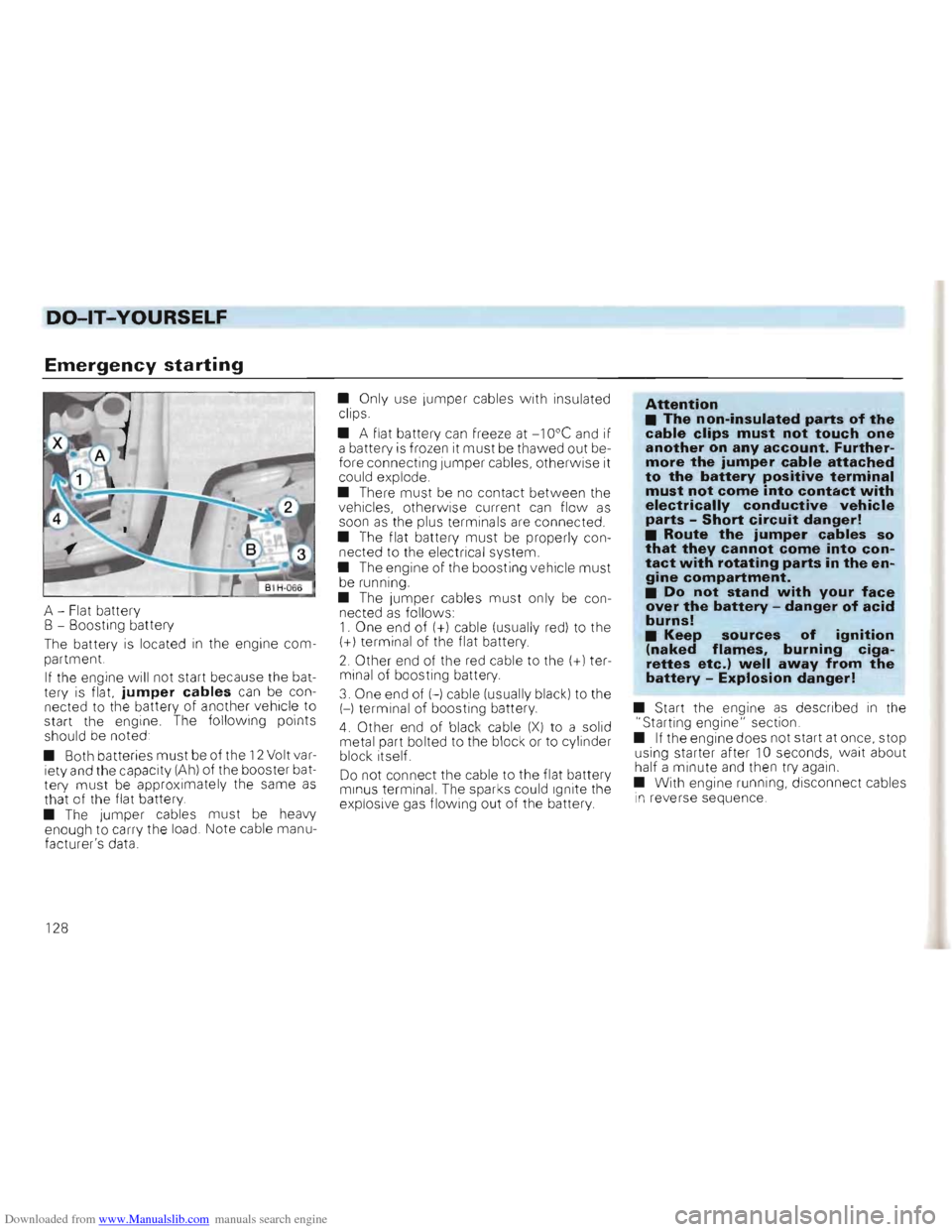
A -Flat battery
B - Boosting battery
The battery
is located in the engine com
partment.
I f the engine will not start because the bat
tery is flat.
jumper cables can be con
nected to the battery of another vehicle to
start the engine . The follow ing points
should be noted
• Both batteries
must be of the 12 Volt var
iety and the capacity (Ah) of the booster bat
tery must be app roximately the same as that of the flat battery .
• The jumper cables must be heavy
enough to carry the load. Note cable manu
facture r's data. •
Only use Jumper cabl
es with insulated
clips.
• A flat battery
can freeze at -1 Ooe and if
a battery is frozen it must be thawed out be
fore connecting Jumper cables, o th erwise it
could explode.
• There
must be no contact between the
vehic les, other wise current can flo w as soon as the plus terminal s are connected .
• The flat battery
must be properly con
nected to the electrical system.
• The engine of the boosting vehicle
must be running.
•
The jumper cables must only be con
nected as follo w s: 1. One end of (+) cable (usually red) to the (+) term inal of the flat battery.
2 . Other end of the red cable to the (+l ter
minal
of boosting battery.
3. One end of H cable (usually black) to the
H terminal of boosting battery.
4. Other end of blac k cable (X) to a solid
metal part bolted to th e block or to cylinder
block itself.
Do not connect the cable to the flat battery
m in us terminal. The sparks could Ignite the
exp losive gas flowing out of the battery
Attention • The non-insulated parts of the cable clips must not touch one another on any account. Furthermore the jumper cable attached to the battery positive terminal must not come into contact with electrically conductive vehicle parts -Short circuit danger! • Route the jumper cables so that they cannot come into contact with rotating parts in the engine compartment. • Do not stand with your face over the battery -danger of acid burns! • Keep sources of igni~ion(naked flames, burning cIgarettes etc.) well away from the battery -Explosion danger!
• Start the engine as described in the
"Starting engine" section.
• If the engine does not start at once, stop
using starter after
10 seconds, wait about
half a minute and then try aga in.
• With engine running, disconnect cables in reverse sequence .
1 28
Page 131 of 156
Downloaded from www.Manualslib.com manuals search engine DO-lT-YOURSELF
Tow startingfTowing
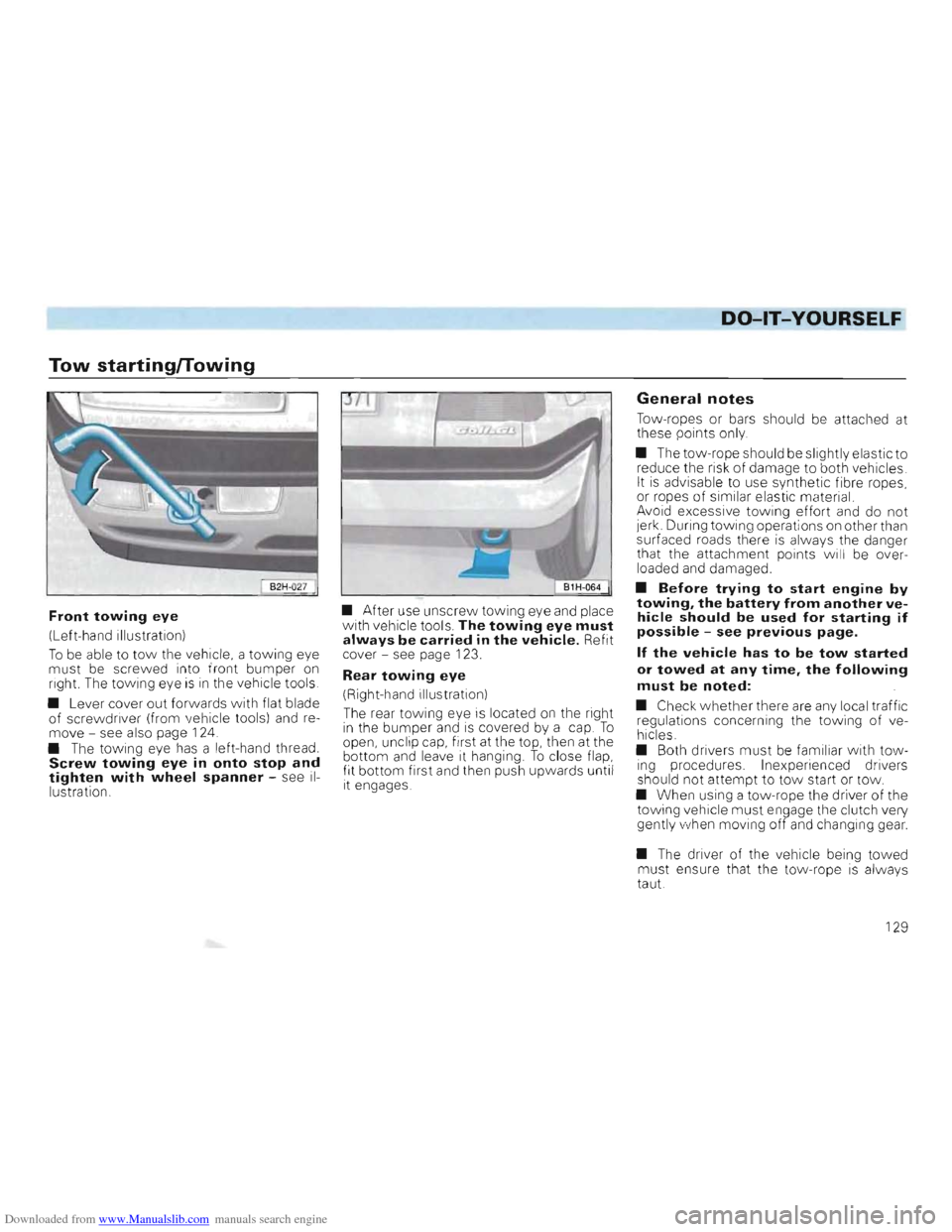
Front towing eye
(Left-hand illustration)
To be able to tow the vehicle, a towing eye
must be screwed into front bumper on
right. The towing eye is in the vehicle tools .
•
Lever cover out forwards with flat blade
of screwdri ver (fro m vehicle tools) and remove -see also page 124.
• The towing eye has a left- hand thread . ~crew to~ing eye in onto stop and tighten with wheel spanner -see illustration.
• . After use unscrew towing eye and place with vehicle tools. The towing eye must always be carried in the vehicle_ Refit
cove r -see page 123.
Rear towing eye
(Right-hand illustration)
The rear
towing eye is located on the right In the bumper and is covered by a cap. To
open, unclip ca p, first at the top, then at the
botto m and leave it hanging To close flap, lit bottom first and then push upwa rds unti l It engages .
General notes
Tow-ropes or bars should be atta ch ed at
these points only.
• The tow- rope
should be slight ly elastic to
reduce the risk of damage to both vehicles .
It IS advi sable to use synthe tic fibre ropes ,
or ropes of Similar elastic materia l.
Avoid excessive towing effort and do not
Jerk. DUring tow ing opera tions on other than
surfaced roads there is always the danger
that the attachment points will be over
loaded and damaged.
• Before trying to start engine by t?wing, the battery from another vehicle. should be used for starting if possible -see previous page.
If the vehicle has to be tow started
or towed at any time, the following
must be noted: .
• Check whethe r there are any local traffic regulat ions concerning the towing of ve
hicles .
• Both drivers
must be familiar with towIng procedures. Inexperienced drivers
should not attempt to tow start or tow.
• When using a to w-rope the driver of the
towing vehicle must engage the clutc h very
gent ly
v,/hen moving off and changing gear.
• The driver of the veh ic le being
towed must ensure that the tow -rope is always ta ut.
129
Page 151 of 156
Downloaded from www.Manualslib.com manuals search engine ALPHABETICAL INDEX
E F H Electri
c windows 10.52 Fan . . .. 98 Hand brake 31 Emergency li ght s 51 Filling the tank ...... . . 81 Head restraints .. ............... 24
E me rgency startin g 128
Filter preheating .......... . . 84 Headlight flasher ........ .. . 53 Engine First
aid kit ........... . . . 112 Headlight range control ........... 51 -Code letters 147
Folding/sliding cover 30 Headlig ht washer system
55
- Data 134 Foot mats ............ . 31 Heated rear window 52 -Number 147 Four wheel drive 79 Heating
56 -Oil .. 92 Fresh air filte r ........ . 104 Height adjustable seat. 26
- Oil capacity. 146 Fresh air venti lation
58, 61 Height adjustable steering wheel
35
- Oil change intervals 2.95 Front fogligh ts ........... . .
50 High beams. ........... 48
- Oil consumption
94 Front
seats
25 Horn
4
- Oil level
..... . . .. . . 94 Fuel ........... . . . 82
- Oil pressure 47 -Additives. 83, 84
- Starting/stopping 36 -
Consumption ........ . 72,137 Engine compartment. 91 -Filter preh eating . 84 Identification
data
147
E ngine number. 147 -Gauge
45 Idling speed boost ......... 37 ~Environment -Saving
72 Ignition lock. . . . . . . . . 35
-Battery. . . . . . . . . . . . .
. . . . . . . .. 102 Fuel gauge Fuses. 45
119 Increasing
luggage space
I nertia reel belts ......... 27 14 -Brake fluid. . . . . . . . . . . . . . . . . . .. 99 InSide mirror . . . . . . . . . . . . 12 -Care ofcar. . . . . . . . . . . . . . . . . . .. -Coolant ...................... 85 98 G Inspection intervals
Instruments 95
39
-Driving with low emissions and n
oise......... ............... 72 Gear change marks
Gear stick ....... . . 39, 71 31 Interior
lights 67
-Engine oil .................... -En vironmentally conscious drivin g . . . . . . . . . . . . . . . . . . . . . .. - Exhaust gas system .... . .. . ...
95
72
74
Glove box light .......... .
Glow plugs
Gross vehicle
weight
67,126 37
143
- Filling th e tank ................ 81 -~~.......................... ~ -Maintenance. . . . . . . . . . . . . . . . . .. 2 - Old oil . ....................... 95 - Old tyres .................... 107 - Tyre pressure ................ 105 - Tvres .... . .. . . ............... 107 - Unfeade d fuel. . . . . . . . . . . . . . . .. 83 - Washing th e vehicle ........... 86 Exha..JS. gas system 74
149