1993 VOLKSWAGEN GOLF fuel pressure
[x] Cancel search: fuel pressurePage 5 of 156
Downloaded from www.Manualslib.com manuals search engine CONTROLS AND EQUIPMENT
Dashboard and Controls ..... 4
. ey s, Cen tral locking . . .... 6, 7
::"tl-thef t warning system .... 8
Joors .......................... .... 9
oot lid .... ........... . . . . . 10
::Iectric windows .. . .. 10
• ~Irrors . . ..... . ... 12
Seal belts 13
"" rbag System . . . . . 18
Safe ty for children .. ... 21
ead restraints . . . . . .. 24
= ro nt seats . . . . . . . . . . . .. 25
Rear seat . . . 27
L u ggage compartment ... . ... . ...... 28
M esh partition (Estate) ...... 29
L u ggage compartment cover /
F olding/sliding cover
... 30
Pedals, Hand brake .. 31
Manual gearbox .... ... .... 31
Automati c gearbox . . . .. .......... 32
H eig ht-adjustable steering wheel ..... 35
I gnition lock. . . . . .. 35
Starting/stopp ing engine 36, 38
\lIstrumellts .. .... 39
Warning lamps ....... 46
Switches . . . . . . . . . . . . . . 50
Turn signal and dip lever ............. 53
Cruise control system ........... 54
Wi ndscreen wipe r and washer system 55
Heating an d ventilation .. . ...... 56
Air cond itioner ......' 59
Sliding/ti ltin g roof. . . . . . . . . . . . ... 65
Sun visors / Interior lights 66,67
Cigarette lighter, Ash tray ..... 68
Shelves and boxes . . . . . . . . . . . ... 69
Roof rack / Roof ra ilings ... 70
DRIVING TIPS
The firs t 1500 km -and after wards .... 71
Driving economically and ecologically .. 72
Brakes. . . . . . . . . . . . . . . . 75
Tra iler tow ing . .. ..... . .... ... ...... 77
Driving a four- wheel drive vehicle .. 79
GENERAL MAINTENANCE
Filling the tan k, Fuel. 81, 82
Care of vehicle ........ .. . . 85
Bonnet . . ... 90
Engine compartment .. ...... .... .... 91
Engine oil ..... .......... ........... 92
Automatic transmission fluid (ATF)* ... 96
Power-assisted steering .. 96
Cooling system . . . . . . . . . . .. . 97
B rake fluid ...... 99
Battery . . . . .. 100
Spark plugs. V-belts . . . . . . . . . 102
Washer system
... . .. 103
Windscreen w iper blades . . . 104
Dust a
nd pollen filter * . 104
Wheel s . 105
D riving abroad ..... ............... 110
Accessories, modifications and
renewa l ot parts .............. III
Mobile telephones and tw o-way rad ios 111
DO -lT-YOURSELF
First -aid kit, Warn ing triangle ........ 112
Storage of vehicle tools, spare wheel
a n d ball coupling trailer bracket ...... 113
Vehicle tools, Spare wheel 114
CONTENTS
Changing w heels . 116
F uses . ........ .. .. . . . ... . .... 119
Changing bulbs. . .... .. . 121
Installing radio . . . . .. 127
E mergency starting .. .. 128
Tow starting / to wing . . .. 129
L ift ing vehicle ......... 131
SPECIAL INFORMATION
Body ..... .... . .......... 132
Environmental compatibility ... 133
TECHNICAL DATA
Engine data . .. , .... .... . 134
P er forman ce .. ... ... ... . .. 136
Fuel consump tion .. 137
Wh eels
. . 139
T yre pressures
.. .. ... .. . . .. ... 1 4 1
Weights ... 143
Trailer weights .. 144
Dimensions. ...... .. ... 145
Capacities " ..... 146
Vehicle identification data ... 147
ALPHABETICAL INDEX
Alph abetical index ... 148
3
Page 38 of 156
Downloaded from www.Manualslib.com manuals search engine CONTROLS AND EQUIPMEN-=-T-=------___
Starting the engine
General hints
Attention When starting the engine in confined spaces there is a danger of poisoning.
• Before starting, move gear lever to neu·
tral (with automatic gearbox: Selector lever in "P" or"N" position) and apply handbrake fi rmly
•
On vehicles with a manual gearbox de
press the clutch pedal when operating
starter
so that starter only has to turn en
gine .
• As soon
as engine starts, release the
ignition key so that starter can dise ngage .
• After starting a co
ld engine It may sound
noisy for a moment or two because the 011 pressure has to build up in the hydraulic
tappets first. This is normal and no cause for
alarm .
~Do not warm engine up by run~ning it with vehicle stationary. Drive off straight away.
Do not overrev or use full throttle until the
engine has reached the normal operating
temperature .
• On vehicles with a catalytic converter the engine must not be started by towing the vehicle in ex· cess of 50 m. Otherwise unburnt fuel can pass into the converter and lead to damage.
• Before trying to start engine by towing, the battery from another ve· hicle should be used for starting if possible -see page 128.
Petrol engines
These engines are equipped with a petrol in
jection system that automat ically supp lies
the correct fuel/air mixture at all ambient
temperatures.
When engine
is cold or at operating temperature do not accelerate before or
during the starting procedure.
I f the engin e does not start at once, stop
us ing th e starter after 10 secs. wait about
half a m in ute and then try again.
If the engine sti
ll does not start, the electric
fuel pump fuse may have blown -see page
119 .
When the engine
is very hot it may be
neces sary to accelerate slightl y after the
engine has start
ed.
/
36
Page 49 of 156
Downloaded from www.Manualslib.com manuals search engine CONTROLS AND EQUIPMENT
2 -Engine oil pressure ~
e wa rning lamp flashes when ignition is :ched on. the lamp must go out when ,=~g ne has started.
, 'Il e warning lamp does not go out or
ash es when driving -a buzzer also sounds
-' e!,gine spe,eds above 2000 rpm -stop, switch engine off, check oil level and if ecessary, add oil -see page 94.
- - he lamp comes
on although the oil level 5 n order, do not drive on. Do not even "'., t he engine at idling speed -call in expert ~slstance.
-du ring the Journe y the engine is operated
a : a speed less than idling speed, it ca n ~ appen that the oil warning lamp lights up. "crease engine speed by accelerating or :'langing down .
Note Th e oil pressure warning lamp is not an oil level indicator. The oil level shou.'d therefore be checked at reg, ular Intervals, preferably every time the fuel tank is filled.J
3 -Alternator
The warning lamp comes on w hen the igni
tion IS sWitched on and must go out when
the engine is started .
The alternator
is driven by a long-life ribbed
belt.
If the warning lamp lights during the
Journey ,
stop, switch off engine and
check ribbed belt.
If
t~e ribbed belt is loose or broken, do not
drive on -the coolant pump is no longer
being driven. The ribbed belt must be
checked/renewed by the next Volkswagen
dealer.
If the ribbed belt
is not loose or broken, one
can normally drive on to the next Vo lks
wag en dea ler. However as the battery is
then discharging co ntinuously , all electrical
consumers which are not absolutely essen
tial should be switched off.
4 -Glow plugs
(Diesel engines only)
When the engine
is cold the w arning lamp
come s on when key IS turned to Drive posi
tion (ignition on)
If the warning lamp does not come on, there IS a defectln the glow plug system -call in expert assistance.
When the lamp goes out, start the engine
Immediately -see page 37.
As the 55 kWDiesel engine glow period be
gins automatically after closing the drivers'
door,
It can happen that after switching to
the driving position (Ignition on) with a cold
engine, that the glow plug warning lamp
does not light up . The engine
can be started
straight away
When the engine
is warm the glow plug
lamp does not come on -the engine ca n be started straight away
Note
If while driving a fault occurs in the engine
management system of the 66 kW Diesel
engine, this
is indicated by a flashing warnIng lamp The engine must be checked by a
Volkswagen dealer as soon as possible.
47
Page 75 of 156
Downloaded from www.Manualslib.com manuals search engine DRIVING TIPS
The technical prerequisites
for a low fuel consumpt ion and efficienc y "" ere " built in" at the factory. Particular Im
p ortance was placed on the lowes t possible
d is turban ce to the enviro nme nt. To retain and make the best possible use of these characteristics attent ion should be paid to the fo llow ing points
~Even those vehicles which do W not have a catalytic converter should be driven on unleaded petrol for the sake of the environment.
~The prescribed maintenance W operations should be carried out exactly as specified in the Service Schedule.
Having your vehicle regularly serviced by a Volkswagen dealer not only ensures that it is always operationally fit, but it also ensures economy, lowest possible burden on the environment and a long service life.
~Check the tyre pressures every 4 W weeks.
Low tyre pressures increase the rolling resistance. This not only increases the fuel consumption and tyre wear, but the handling is also impaired.
~Do not carry unnecessary ballast W in the luggage boot
Particularly in town traffic when one has to accelerate often, weight has a great influence on the fuel consumption. As a
rule ofthumb: For every 100 kg ofweight the consumption increases by approximately litre per 100 km.
~Remove roof rack immediately Wafter use
Particularly at high speeds the increased air resistance makes itself felt considerably.
~Electrical consumers should W only be switched on when they are actually required
Heated rear windows, additional driving lights and heater blower consume a considerable amount of current. The higher alternator load also increases the fuel consumption. For instance, overa period of 10 hours, the heated rear window will increase the fuel consumption by approximately 1 litre.
~Check the fuel consumption regW ularly
The fuel consumption should be checked each time the tank is filled up. By doing this inconsistencies on the vehicle which lead to an increased fuel consumption can be discovered sooner.
• Check the engine oil level each time the tank is filled up The oil consumption depends to a g reat ex
tent on the engine load and speed. Depend
ing on the style of driving the consumption
can be as much as 1 .0 litr es/1 000 km .
It
IS no rmal fo r the oil consumption of a ne w
engine to reach its lowest level after a cer
tain mileage has be en covered . The con
sumption cannot be properly assessed until
the vehicle has run appro x. 5000 km.
This also applies to the fuel consumption
and the engine output.
73
Page 107 of 156
Downloaded from www.Manualslib.com manuals search engine GENERAL MAINTENANCE
Wheels
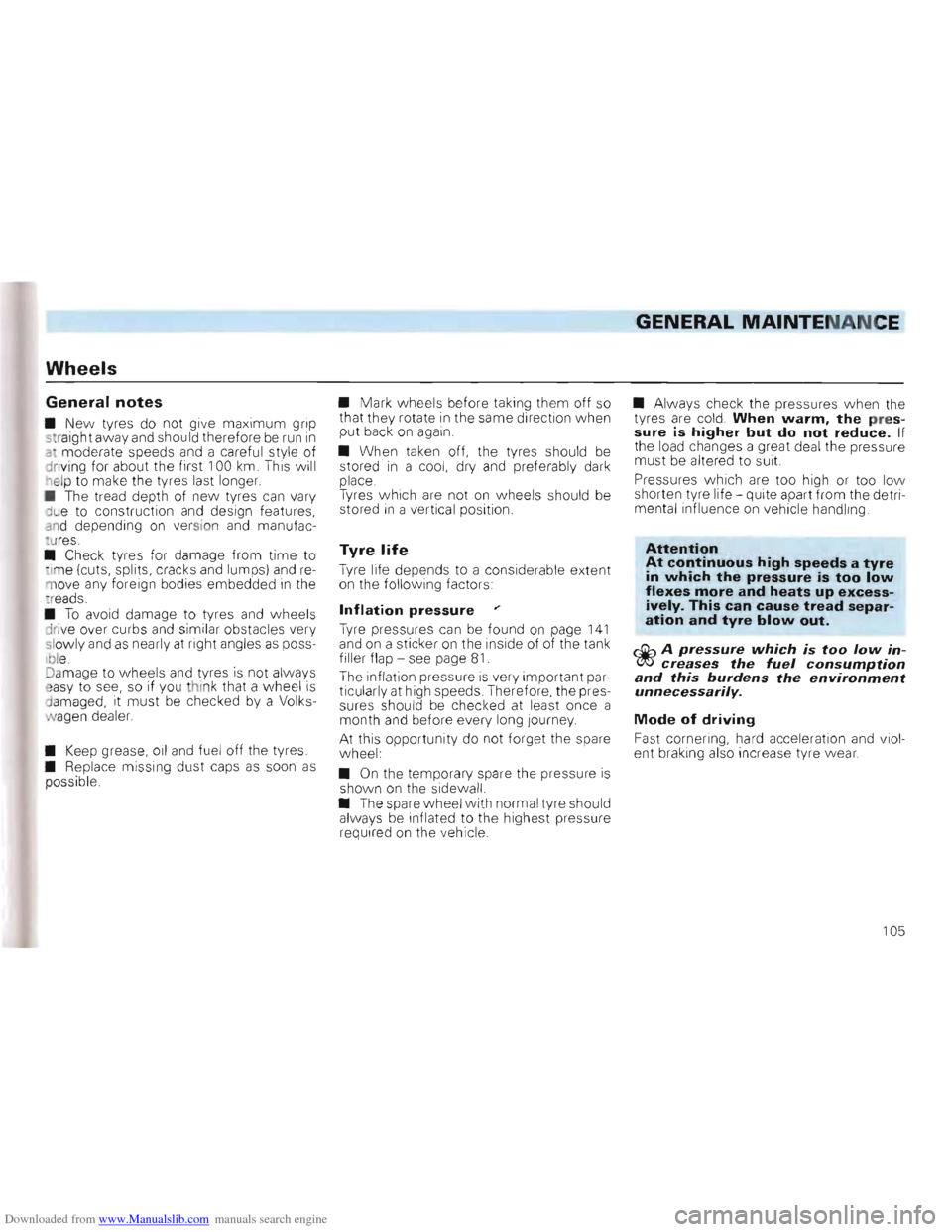
General notes
• New tyres do not give maximum grip
str aight away and should therefore be run in
a moderate speeds and a careful style of
driving for about the first 100 km . This will
"Ielp to make the tyres last longer.
• The tread depth of
new tyres can vary
du e to constructi on and design features,
and depending on version and manufac
:u res.
• Check tyres for damage from
time to
-lin e (cuts, splits, cracks and lumps) and re
m ove any foreign bodies embedded in the
- r eads.
•
To a v oid damage to tyres and wheels
drive over curbs and similar obst acles very
slowly and as nearly at right angles as poss
Ible .
Damage to w he els and tyres is not always
e asy to see, so if you think that a wheel is
d a maged, It must be checked by a Volks
w agen dealer.
• Keep grease,
011 and fuel off the tyres.
• Replace missing dust caps as soon as possib le.
• Mark wheels before taking them off so
that they rotate in the same direction when put back on again
•
When taken off, the tyres should be
stored in a cool, dry and preferably dark
place
T y res
which are not on wheels shou ld be
stored In a vertical position.
Tyre life
Tyre life depends to a considerable extent
on the following factors:
Inflation pressure ..-
Tyre pressures can be found on page 141
and on a sticker on the inside of of the tank
filler flap -see page 81.
The inflation pressure
is very important par
ticularly at high speeds . Therefore, the pres
sures should be che cked at least once a
month and before every long Journey.
At this opportunity do not
forget the spare
w heel
• On the temporary spare the pressure is shown on the side wall.
• The spare
wheel w ith normal tyre shou ld alw ays be inflated to the highest pressure required on the veh icle. •
Always check the pressures
when the
ty res are cold. When warm, the pressure is higher but do not reduce. If the load changes a great deal the pressure must be altered to suit.
Pressures
which are too high or too low short en tyre life -quite apart from the detrimental influence on vehicle handling .
Attention
At continuous high speeds a tyre
in which the pressure is too low
flexes more and heats up excess
ively. This can cause tread separ
ation and tyre blowout.
dit-. A pressure which is too low in~creases the fuel consumption and this burdens the environment unnecessarily.
Mode of driving
Fast cornering, hard acceleration and Viol
ent braking also increase tyre wear.
105
Page 111 of 156
Downloaded from www.Manualslib.com manuals search engine GENERAL MAINTENANCE
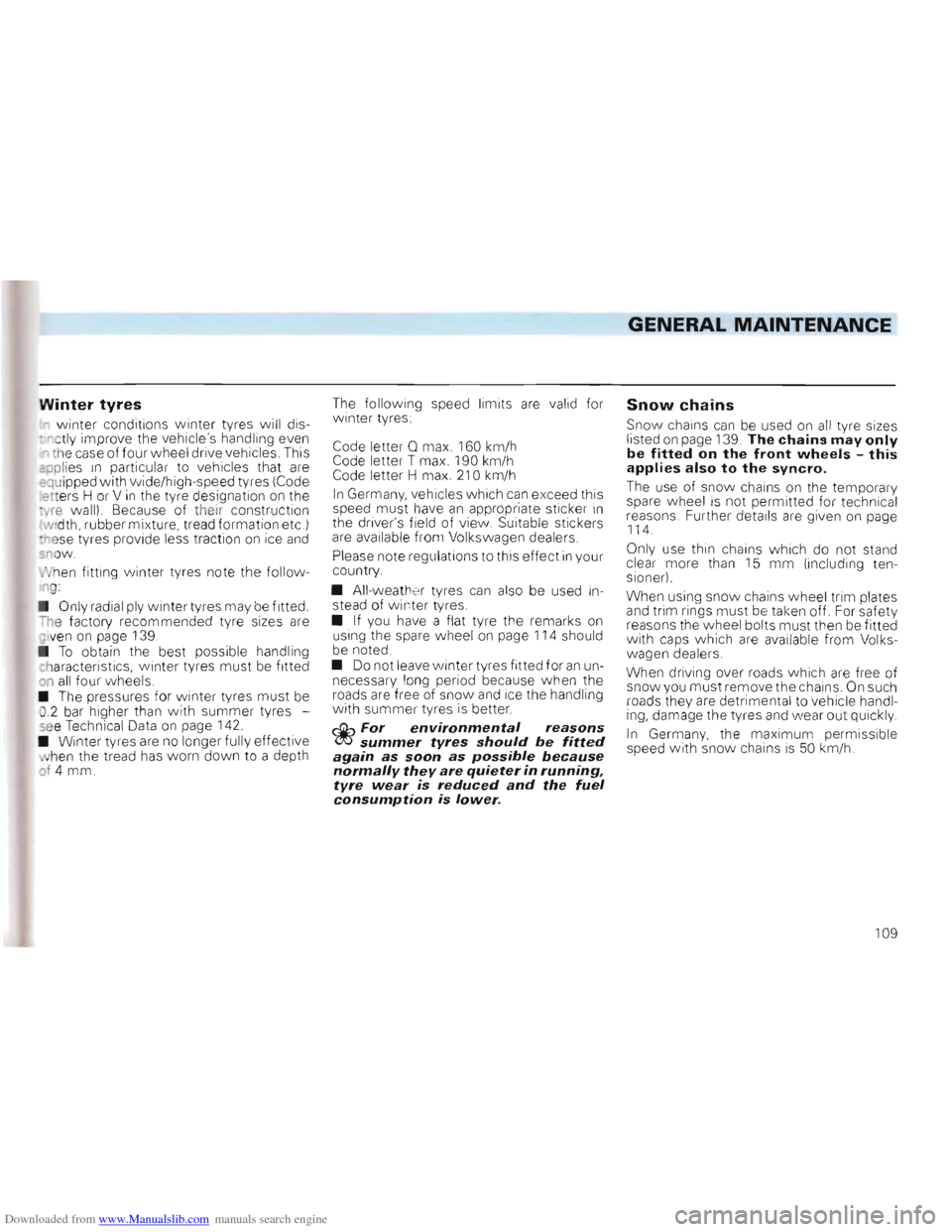
Winter tyres
winter conditions win ter tyres w ill dis
- n ctly improve the vehicle's handling even
th e case of four
wheel drive ve hicles. This
ap plies In particular to veh icles that are
eq uipped with wide/high -speed tyres (Code
e
tters H or V in the tyre designation on the
: r e wall). Because of their construction
,lIdth, rubber mixture, tread formation etc) :n se tyres provide less traction on ice and
sn ow.
h
en fitting winter tyres note the follow
n g:
• Onl y radial ply winter tyres may
be fitted.
h e factory recommended tyre sizes are given on page 139.
•
To obtain the best possible handling ch aracteristics, wint er tyres must be fitted o n all fou r wheels.
• The pressures for
winter tyres must be
0.2 bar higher than with summer tyres
s e e Technical Data on page 142.
•
Winter tyres are no longe r fully effec tive
h en the tread has worn down to a depth
o f 4 mm.
The following speed limits are valid for winter tyres:
Code letter
Q max. 160 km/h
Code letter T max. 190 km/h
Code letter H ma
x. 210 km/h
In Germany, vehicles w hich can exceed this
speed must have an appropriate sticker in the driver's field of view. Suitable stickers
are available from Volkswagen dealers.
Please note regulations to this effect
in your
cou ntry .
• All-weath er t yres
can also be used in
stead of winter ty res .
• If you have a flat tyre the remarks on
using the spare wheel on page 114 should
be noted .
•
Do not leave winter tyres fitted for an un
necessary long period because w hen the
roads are free of
snow and ice the handling with summer tyres is better.
r:lil:.-. For environmental reasons (!Jtf summer tyres should be fitted again as soon as possible because normally they are quieterin running, tyre wear is reduced and the fuel consumption is lower_
Snow chains
Snow chains can be used on all tyre sizes
listed on page 139. The chains may only be fitted on the front wheels -this applies also to the syncro.
The use of sno w chains on the temporary
spare wheel is not permitted for technical
reasons. Further details are given on page
114 .
Only use thin chains w hich do not stand
clea r
more than 15 mm (including ten
sioner).
When using snow chains wheel trim plates
and trim rings must be ta ken off . For sa fety
reasons the w heel bolts must then be fitted with caps w hich are available from Volks
wagen dealers.
When driving over roads whic h are free of snow you must remo ve the chains. On such
road s they are detrimental to vehic le handl
ing, damage
the tyres and wear out Quickly .
In Germany , the maximum permissible
speed w ith snow chains is 50 m/h
109
Page 151 of 156
Downloaded from www.Manualslib.com manuals search engine ALPHABETICAL INDEX
E F H Electri
c windows 10.52 Fan . . .. 98 Hand brake 31 Emergency li ght s 51 Filling the tank ...... . . 81 Head restraints .. ............... 24
E me rgency startin g 128
Filter preheating .......... . . 84 Headlight flasher ........ .. . 53 Engine First
aid kit ........... . . . 112 Headlight range control ........... 51 -Code letters 147
Folding/sliding cover 30 Headlig ht washer system
55
- Data 134 Foot mats ............ . 31 Heated rear window 52 -Number 147 Four wheel drive 79 Heating
56 -Oil .. 92 Fresh air filte r ........ . 104 Height adjustable seat. 26
- Oil capacity. 146 Fresh air venti lation
58, 61 Height adjustable steering wheel
35
- Oil change intervals 2.95 Front fogligh ts ........... . .
50 High beams. ........... 48
- Oil consumption
94 Front
seats
25 Horn
4
- Oil level
..... . . .. . . 94 Fuel ........... . . . 82
- Oil pressure 47 -Additives. 83, 84
- Starting/stopping 36 -
Consumption ........ . 72,137 Engine compartment. 91 -Filter preh eating . 84 Identification
data
147
E ngine number. 147 -Gauge
45 Idling speed boost ......... 37 ~Environment -Saving
72 Ignition lock. . . . . . . . . 35
-Battery. . . . . . . . . . . . .
. . . . . . . .. 102 Fuel gauge Fuses. 45
119 Increasing
luggage space
I nertia reel belts ......... 27 14 -Brake fluid. . . . . . . . . . . . . . . . . . .. 99 InSide mirror . . . . . . . . . . . . 12 -Care ofcar. . . . . . . . . . . . . . . . . . .. -Coolant ...................... 85 98 G Inspection intervals
Instruments 95
39
-Driving with low emissions and n
oise......... ............... 72 Gear change marks
Gear stick ....... . . 39, 71 31 Interior
lights 67
-Engine oil .................... -En vironmentally conscious drivin g . . . . . . . . . . . . . . . . . . . . . .. - Exhaust gas system .... . .. . ...
95
72
74
Glove box light .......... .
Glow plugs
Gross vehicle
weight
67,126 37
143
- Filling th e tank ................ 81 -~~.......................... ~ -Maintenance. . . . . . . . . . . . . . . . . .. 2 - Old oil . ....................... 95 - Old tyres .................... 107 - Tyre pressure ................ 105 - Tvres .... . .. . . ............... 107 - Unfeade d fuel. . . . . . . . . . . . . . . .. 83 - Washing th e vehicle ........... 86 Exha..JS. gas system 74
149
Page 153 of 156
Downloaded from www.Manualslib.com manuals search engine s
21 72 25 13
51 25
28
32
2 40 2 2 50 65
109 77
:; savin g temporary spare wheel 114
113 , 114
102 39
71 36
35
35
38 66
50
-~ - € ;estJn g 80 ; '19 w ith four wheel drive. 79 e .. tyr es. 107 - _ '3 mg tyre s 107
- - • hams 79
. e vheel . . 107
s -artin g 130
9 .. 1~
T Tailgate 10
Technical Data ............. . 134
Telephone 111 Temperature regulation
- Air conditioner ............. . 59
- Climatronic 62
- Heating and
ventilation. 56
Temporary spare wheel. 113 114
The fi rst 1500 km / 1000 miles 71 Thermotronic
56
Tilting roof . . .. .... . ... . .
65
Tool kit .
113
Tow start ing 77,130 Tow ing ....... . 130 Towing eye .......... .
129
Trailer tow ing 77
Trailer w eights
..... ..... . . . .... . 144
Tread depth. . ... . . .. . . . ..... .
106
T rip meter 39 Trip recorder ... . ... .
39
Trolley Jack 131 Turn signal lever . 53
Turn signals ...... . . 48
, 124 , 125
Two way radios 111 Type plate 147
Tyre pressures ... . ... . . 141 Tyres 105
- Condition .. 106 -Inflation pressure 105
- Running in . . . . . . . . . . 105
ALPHABETICAL INDEX
U
Unbalanced w heels. . . .. . . . . . ... 106
Underseal ....... .. . . . . 89
Unleaded fuel 82
V
V-belts
102
Vehicle data sticker
147
Vehicle hoist
131 Vehicle identification data 147
Vehicle identification number. 147
Vehicle literature 2 Vehicle tools 113,114
Vent i lation 56, 58, 64
151