1993 VOLKSWAGEN CORRADO stop start
[x] Cancel search: stop startPage 406 of 920

ALTERNATOR & REGULATOR
Article Text (p. 2)
1993 Volkswagen Corrado
For Volkswagen Technical Site: http://vw.belcom.ru
Copyright © 1998 Mitchell Repair Information Company, LLC
Wednesday, March 22, 2000 08:56PM
(1) - Turn tensioning nut on toothed rack with Torque Wrench
(VAG1410) and Ring Insert (SW VAG 1410-2).
(2) - Start engine and let it idle for 5 minutes. Loosen bolts and
retighten belt to specification.
(3) - Serpentine belt tension automatically adjusted by tensioner.ÄÄÄÄÄÄÄÄÄÄÄÄÄÄÄÄÄÄÄÄÄÄÄÄÄÄÄÄÄÄÄÄÄÄÄÄÄÄÄÄÄÄÄÄÄÄÄÄÄÄÄÄÄÄÄÄÄÄÄÄÄÄÄÄÄÄÄÄÄÄ ON-VEHICLE TESTING
WIRING CONTINUITY TEST
1) With ignition off, connect a voltmeter between alternator
B+ terminal and ground. Voltmeter should indicate battery voltage. If
battery voltage is not present, check wiring between alternator and
battery.
2) Turn ignition on and ensure alternator indicator light
comes on. If light does not come on, check wiring between alternator
and warning light, including indicator bulb.
OUTPUT TEST
CAUTION: DO NOT load electrical system for more than 15-20 seconds
during output test or possible system damage may occur.
1) Ensure connections at battery, alternator, and starter
(most vehicles) are clean and tight. Ensure alternator, engine and
body are properly grounded. Ensure alternator drive belt is tight and
in good condition.
2) Turn off all accessories. Start engine and allow to idle.
Connect ammeter following manufacturer's instructions. Run engine at
2000 RPM. Adjust carbon pile on tester to obtain maximum alternator
output. DO NOT allow battery voltage to drop to less than 12.6 volts.
3) Alternator output should equal alternator rated output,
minus 16-20 amps. If reading is more than 20 amps less than alternator
rating, replace regulator and retest. If output is still low, repair
or replace alternator.
REGULATOR CONTROL VOLTAGE TEST
1) Connect ammeter following manufacturer's instructions.
Connect voltmeter leads to battery terminals. Start engine and run at
3000 RPM.
2) Run engine until voltage stops rising. Voltage should be
13.5-14.5 volts. If reading is incorrect, remove regulator and ensure
brushes are longer than 3/16" (5 mm). Replace if necessary.
3) If brushes are okay and regulator fails to keep voltage
within specified limits, replace regulator and retest. If voltage is
still incorrect, repair or replace alternator.
BENCH TESTING
Page 414 of 920
ANTI-LOCK BRAKE SYSTEM
Article Text (p. 4)
1993 Volkswagen Corrado
For Volkswagen Technical Site: http://vw.belcom.ru
Copyright © 1998 Mitchell Repair Information Company, LLC
Wednesday, March 22, 2000 08:57PM
HYDRAULIC MODULATOR/PUMP
Depressurize brake system. See DEPRESSURIZING BRAKE SYSTEM.
Turn ignition on. Hydraulic modulator/pump should operate for 60
seconds maximum and then stop. Depress brake pedal a few times; pump
should operate again for a few seconds. If pump motor does not
operate, check electrical system. If pump motor operates for more than
60 seconds, internal or external hydraulic leak may be indicated.
Check for external leaks. If external leak is not found, further
testing may be needed to check for internal leaks.
ANTILOCK WARNING LIGHT
Start engine. ANTILOCK warning light should come on, then
turn off after a few seconds. If light does not come on when engine is
started, check electrical system. If light comes on and stays on,
fault has been detected by the ECU and testing will be needed. See
SYSTEM TESTING under DIAGNOSIS & TESTING.
DIAGNOSIS & TESTING
SYSTEM TESTING
NOTE: Check battery condition, brake fluid level, electrical
connections and wiring for damage. If fluid level is
incorrect or battery and/or electrical connections are
faulty, correct problem before preceding. Perform each step,
in sequence, to test entire system, except for ECU. If
faulty ECU is suspected, replace with a known good one, and
retest system. Unplug ECU connector for all test steps.
Power-To-ECU Test
Turn ignition off. Unplug ECU connector. Turn ignition on.
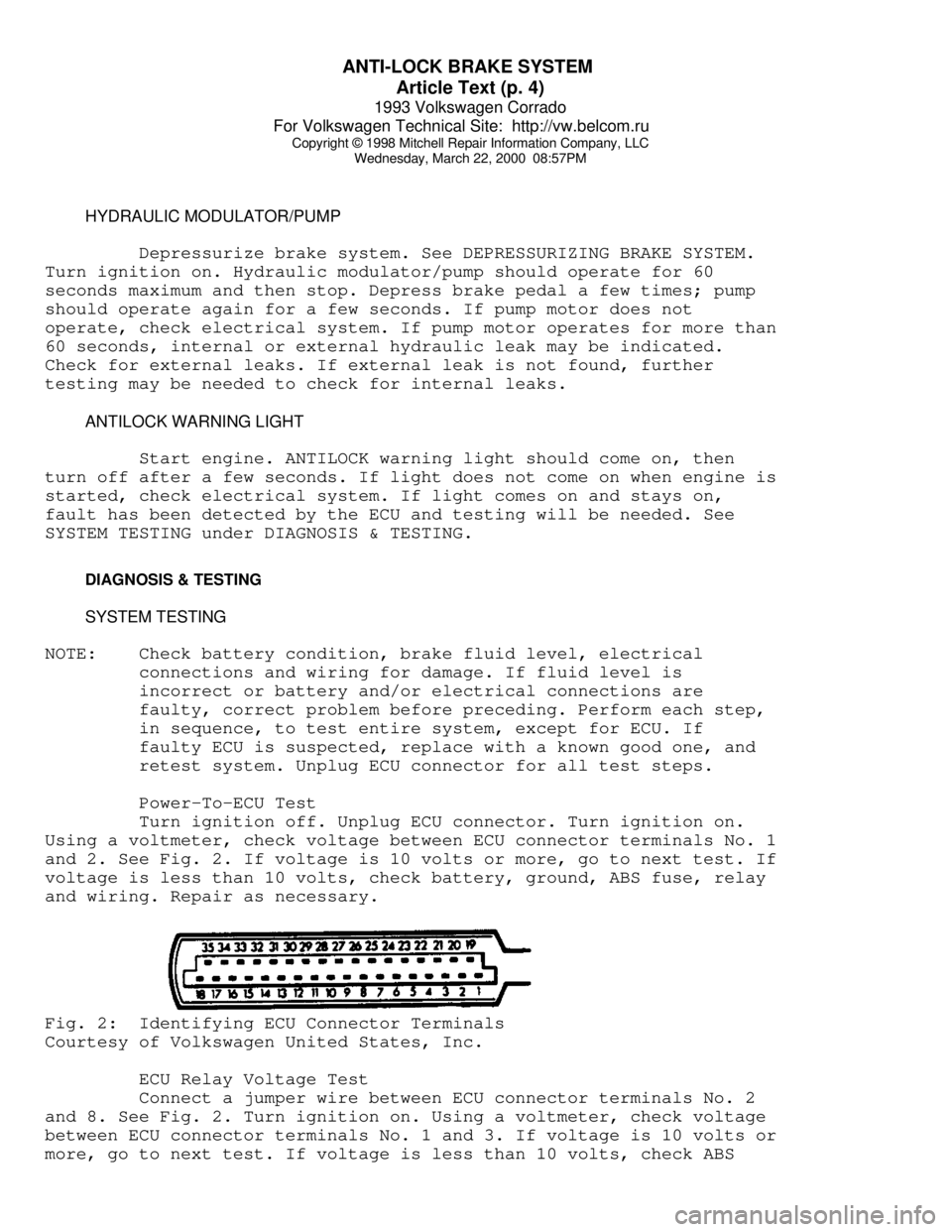
Using a voltmeter, check voltage between ECU connector terminals No. 1
and 2. See Fig. 2. If voltage is 10 volts or more, go to next test. If
voltage is less than 10 volts, check battery, ground, ABS fuse, relay
and wiring. Repair as necessary.Fig. 2: Identifying ECU Connector Terminals
Courtesy of Volkswagen United States, Inc.
ECU Relay Voltage Test
Connect a jumper wire between ECU connector terminals No. 2
and 8. See Fig. 2. Turn ignition on. Using a voltmeter, check voltage
between ECU connector terminals No. 1 and 3. If voltage is 10 volts or
more, go to next test. If voltage is less than 10 volts, check ABS
Page 452 of 920

COMPUTER RELEARN PROCEDURES
Article Text (p. 2)
1993 Volkswagen Corrado
For Volkswagen Technical Site: http://vw.belcom.ru
Copyright © 1998 Mitchell Repair Information Company, LLC
Wednesday, March 22, 2000 08:58PM
"D" and allow engine to idle for one minute.
* Accelerate at normal throttle position (20-50%) until vehicle
shifts into top gear.
* Cruise at light to medium throttle.
* Decelerate to a stop, allowing vehicle to downshift, and use
brakes normally.
* Process may be repeated as necessary.
Manual Transmission
* Place transmission in Neutral position.
* Ensure emergency brake has been set and all accessories
are turned off.
* Start engine and bring to normal operating temperature.
* Allow vehicle to idle in Neutral for one minute.
* Initial relearn is complete: process will be completed during
normal driving.
Some manufacturers identify a specific relearn procedure
which will help establish suitable driveability during relearn stage.
These procedures are especially important if vehicle is equipped with
and electronically controlled automatic transmission or transaxle.
Always complete procedure before returning vehicle to customer.
END OF ARTICLE
Page 494 of 920

D - ADJUSTMENTS
Article Text
1993 Volkswagen Corrado
For Volkswagen Technical Site: http://vw.belcom.ru
Copyright © 1998 Mitchell Repair Information Company, LLC
Wednesday, March 22, 2000 08:59PM
ARTICLE BEGINNING
1993 ENGINE PERFORMANCE
On-Vehicle Adjustments
Corrado SLC
ENGINE MECHANICAL
Before performing any on-vehicle adjustments to fuel or
ignition systems, ensure engine mechanical condition is okay.
VALVE CLEARANCE
NOTE: All models use hydraulic lifters. No adjustments are
required.
IGNITION TIMING
NOTE: See ENTERING SELF-DIAGNOSTICS in the G - TESTS W/CODES
article in this section for additional scan tester
operating instructions.
VR6 IGNITION TIMING
1) Start and warm engine to normal operating temperature.
Ensure engine oil temperature is 176øF (80øC). Ensure A/C and
electrical loads are off, including cooling fan.
2) Connect engine analyzer to engine. Connect Scan Tester
(VAG 1551) to Data Link Connectors (DLC) located in center console, in
front of shift lever. Ensure no Diagnostic Trouble Codes (DTC) are
stored.
3) Ensure throttle position sensor is properly adjusted.
Ensure idle air control valve is okay. Valve must vibrate or hum.
Connect CO tester using Adapter (VAG 1363/3) on CO tap tube. DO NOT
remove oxygen sensor. Ensure exhaust system has no leaks.
4) Start engine and let it run at closed throttle (less than
1500 RPM). Operate scan tester and observe display. Press "1" button
to select RAPID DATA TRANSFER function. Press "Q" button to enter
input. Press right arrow button.
5) Press "0" and "1" buttons to select ENGINE ELECTRONICS
function. Press "Q" button to enter input. Press right arrow button,
then "0" and "4" buttons to select BASIC SETTING function. Press "Q"
button to enter input.
6) Press "0" and "1" buttons to select INPUT DISPLAY GROUP
NUMBER 01. Press "Q" button to enter input. Scan tester will display
SYSTEM IN BASIC ADJUSTMENT 1 through 4. Briefly increase engine speed
and then let it run for 2 minutes at closed throttle. Scan tester
displays idle speed in field one and ignition timing in field four.
Check CO level on CO tester.
7) When radiator cooling fan stops running, end basic setting
Page 565 of 920

ENGINE OVERHAUL PROCEDURES - GENERAL INFORMATION
Article Text (p. 36)
1993 Volkswagen Corrado
For Volkswagen Technical Site: http://vw.belcom.ru
Copyright © 1998 Mitchell Repair Information Company, LLC
Wednesday, March 22, 2000 09:10PM
to ensure correct amount of oil has filled crankcase. Check oil level
while pre-oiling.
If pressure oiler is not available, disconnect ignition
system. Remove oil pressure sending unit and replace with oil pressure
test gauge. Using starter motor, rotate engine starter until gauge
shows normal oil pressure for several seconds. DO NOT crank engine
for more than 30 seconds to avoid starter motor damage.
Ensure oil pressure has reached the most distant point from
the oil pump. Reinstall oil pressure sending unit. Reconnect ignition
system.
INITIAL START-UP
Start the engine and operate engine at low speed while
checking for coolant, fuel and oil leaks. Stop engine. Recheck coolant
and oil level. Adjust if necessary.
CAMSHAFT
Break-in procedure is required when a new or reground
camshaft has been installed. Operate and maintain engine speed between
1500-2500 RPM for approximately 30 minutes. Procedure may vary due to
manufacturers recommendations.
PISTON RINGS
Piston rings require a break-in procedure to ensure seating
of rings to cylinder walls. Serious damage may occur to rings if
correct procedures are not followed.
Extremely high piston ring temperatures are produced obtained
during break-in process. If rings are exposed to excessively high RPM
or high cylinder pressures, ring damage can occur. Follow piston ring
manufacturer's recommended break-in procedure.
FINAL ADJUSTMENTS
Check or adjust ignition timing and dwell (if applicable).
Adjust valves (if necessary). Adjust carburetion or injection idle
speed and mixture. Retighten cylinder heads (if required). If
cylinder head or block is aluminum, retighten bolts when engine is
cold. Follow the engine manufacturer's recommended break-in procedure
and maintenance schedule for new engines.
NOTE: Some manufacturer's require that head bolts be retightened
after specified amount of operation. This must be done to
prevent head gasket failure.
END OF ARTICLE
Page 611 of 920

HOW TO USE SYSTEM WIRING DIAGRAMS
Article Text (p. 8)
1993 Volkswagen Corrado
For Volkswagen Technical Site: http://vw.belcom.ru
Copyright © 1998 Mitchell Repair Information Company, LLC
Wednesday, March 22, 2000 09:11PM
Power Top Relay(s) ........................... Power Convertible Top
Powertrain Control Module ....................... Engine Performance
Analog Instrument Panels
Cruise Control Systems
Data Link Connectors
Generators & Regulators
Starters
Power Window Motors .................................. Power Windows
Power Window Relay(s) ................................ Power Windows
Radiator Fan Motor(s) ........................ Electric Cooling Fans
Radiator Fan Relay(s) ........................... Engine Performance
Electric Cooling Fans
Rainsense Module .............................. Wiper/Washer Systems
Raise Relay .................................. Power Convertible Top
Remote Anti-Theft Personality (RAP) Module ....... Anti-Theft System
Starters
Warning Systems
Seat Belt Pretensioners ................... Air Bag Restraint System
Seat Belt Retractor Solenoid .................... Passive Restraints
Seat Belt Switch .......................... Air Bag Restraint System
Passive Restraints
Shift Interlock Solenoid ................... Shift Interlock Systems
Shift Lock Actuator ........................ Shift Interlock Systems
Side Marker Lights ................................. Exterior Lights
SIR Coil Assembly (Clockspring) ........... Air Bag Restraint System
Slip Ring (Clockspring) ................... Air Bag Restraint System
Steering Column Switches
SRS Control Module ........................ Air Bag Restraint System
Starter Motor ............................................. Starters
Starter Interrupt Relay ................................... Starters
Starter Solenoid .......................................... Starters
Starter Relay ............................................. Starters
Steering Wheel Position Sensor .................... Anti-Lock Brakes
Stoplights ......................................... Exterior Lights
Stoplight Switch ................................ Engine Performance
Cruise Control Systems
Anti-Lock Brakes
Sun Roof ECU ........................................ Power Sun Roof
Sun Roof Motor ...................................... Power Sun Roof
Sun Roof Position Sensor ............................ Power Sun Roof
Taillights ......................................... Exterior Lights
Throttle Position (TP) Sensor ................... Engine Performance
Torque Converter Clutch Solenoid/Switch ......... Engine Performance
Traction Control Switch ........................... Anti-Lock Brakes
Trailer Tow Connector .............................. Exterior Lights
Trailer Tow Relay .................................. Exterior Lights
Transmission/Transaxle .......................... Engine Performance
Transmission Control Module (TCM) ............... Engine Performance
Starters
Transmission Range Sensor ................................. Starters
Back-Up Lights
Engine Performance
Page 908 of 920

WIRING DIAGRAMS
Article Text (p. 2)
1993 Volkswagen Corrado
For Volkswagen Technical Site: http://vw.belcom.ru
Copyright © 1998 Mitchell Repair Information Company, LLC
Wednesday, March 22, 2000 09:28PM
LEFT REAR MICRO SWITCH ............................... 9 (D 33)
LEFT SEAT BELT CONTROL UNIT .......................... 9 (D 35)
LIGHT SWITCH ...................................... 5 (A 18Ä19)
LUGGAGE COMPARTMENT LIGHT SWITCH ..................... 7 (A 26)
MAKE UP MIRROR ...................................... 11 (E 42)
O2 SENSOR .................................... 1,2 (A 3, A 5
Ä6)
OIL PRESSER GAUGE ................................... 9 (A 35)
OIL PRESSER SWITCHES ................................. 7 (A 25)
PARK BRAKE SWITCH .................................... 8 (A 31)
POWER MIRRORS ..................................... 11 (B
ÄD 42)
POWER WINDOW CIRCUIT BREAKER ........................ 10 (A 38)
POWER WINDOWS .................................. 11 (B
ÄD 36Ä39)
PROGRAM SWITCH ........................................ 3 (B 8)
RADIATOR COOLING FAN .................................. 1 (D 3)
RADIATOR COOLING FAN CONTROL UNIT ................... 1 (C-D 3)
RADIATOR COOLING FAN THERMO SW (SLC) .................. 1 (C 1)
REAR SPOILER SYSTEM ............................ 12 (A
ÄB 40Ä42)
REAR WIPER SYSTEM ................................. 7 (E 26
Ä27)
RIGHT SEAT BELT CONTROL UNIT ....................... 9 (B
ÄC 35)
SEAT BELT SWITCH ..................................... 8 (E 35)
SEAT HEATER SYSTEM ............................. 11 (C
ÄE 40Ä41)
SPEED SENSOR ......................................... 7 (B 26)
STARTER ............................................... 1 (A 3)
STARTER INTERLOCK/BACK-UP LIGHT RELAY (A/T) ........... 3 (A 8)
STOP LIGHT SWITCH .................................... 8 (B 29)
SUNROOF .......................................... 10 (E 36
Ä37)
THROTTLE POSITION SENSOR .............................. 2 (E 4)
VACUUM VENT VALVE ................................. 4 (B 13
Ä14)
VOLTMETER ............................................ 9 (B 35)
WINDSHIELD WIPER SYSTEM ......................... 7 (D
ÄE 24Ä27)
WARNING MODULE ................................ 4,8 (C
ÄD 12Ä28)
WASHER NOZZLE HEATERS ................................ 7 (E 27)
ÄÄÄÄÄÄÄÄÄÄÄÄÄÄÄÄÄÄÄÄÄÄÄÄÄÄÄÄÄÄÄÄÄÄÄÄÄÄÄÄÄÄÄÄÄÄÄÄÄÄÄÄÄÄÄÄÄÄÄÄÄÄÄÄÄ WIRING DIAGRAMS