1993 CHEVROLET TRACKER tow
[x] Cancel search: towPage 104 of 339

Comfort Controls & Audio Systems
urnfort Controls
With this system, you can control the
heating and ventilation in your Geo. If
you have
the air conditioning option,
you can also control cooling,
Your vehicle also has the flow-through
ventilation system described later
in this
section.
Heater Controls
Air Intake Lever
a: Choose this position to recirculate
the inside air through the comfort
control system.
m: Choose this position to circulate
outside air through
the comfort control
system.
Airflow Lever
Use this lever to direct the airflow.
*; : This position directs the airflow
through the instrument panel vents.
\# : This position directs air through do
the instrument panel vents and toward
the floor.
WP : This position directs air toward
the
floor.
-9 : This position directs air toward
the floor, the windshield and side
windows.
till, : This position directs air to the
windshield.
Temperature Control Lever
Slide the lever to change the temperature
of the air flowing from the heating
system. Move
it toward the right for
warmer air and to the
left for cooler air.
The temperature
of the air can not be
less than the temperature of the outside
air.
Fan Control Lever
: Slide this lever to turn the heating
system on or
off. Move the lever toward
to increase
the fan's speed.
ProCarManuals.com
Page 105 of 339
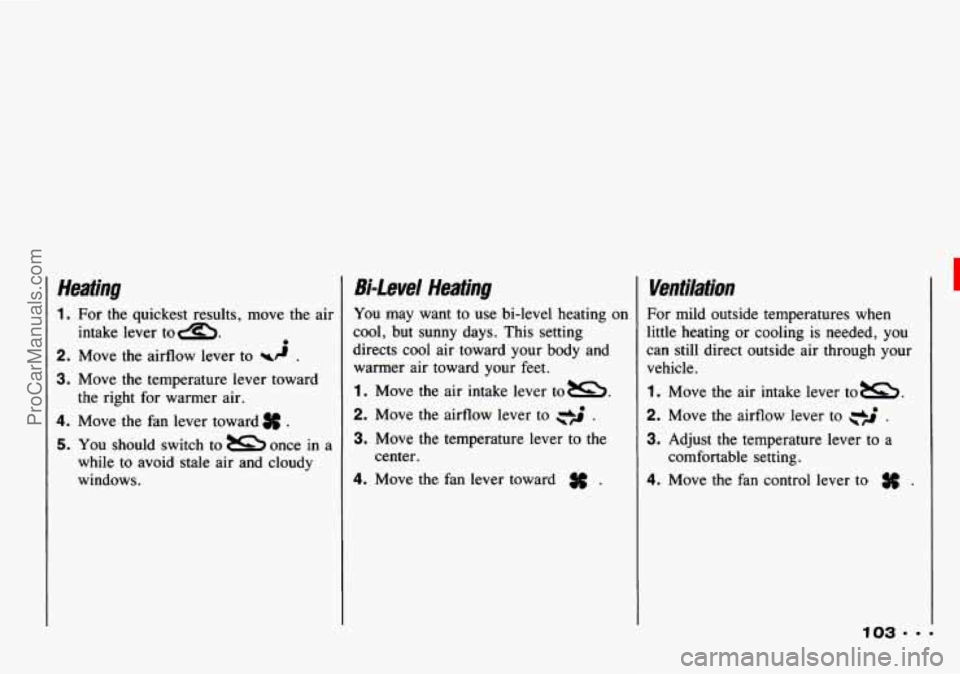
Heating
1. For the quickest results, move the air
2. Move the airflow lever to wd .
3. Move the temperature lever toward
4. Move the fan lever toward # .
5. You should switch to once in a
while to avoid stale air and cloudy
windows. intake
lever
tom. 0
the right for warmer air.
Bi-Level Heating
You may want to use bi-level heating on
cool, but sunny days. This setting
directs cool air toward your body and
warmer air toward your feet.
1. Move the air intake lever tom.
2. Move the airflow lever to .
3. Move the temperature lever to the
4. Move the fan lever toward # .
center.
Ventilation
For mild outside temperatures when
little heating or cooling is needed, you
can still direct outside air through your
vehicle.
1 . Move the air intake lever tom.
2. Move the airflow lever to .
3. Adjust the temperature lever to a
4. Move the fan control lever to .
comfortable setting.
ProCarManuals.com
Page 106 of 339

Comfort Controls & Audio Systems
I
1. Slide the air intake lever to =.
2. Slide the airflow lever to Q to
direct air to the windshield vents.
3. Slide the temperature lever toward
4. Slide the fan lever to # .
When the windshield is clear, turn down
the fan speed.
To defog the side windows, slide the
airflow lever to
ZJ. For increased
airflow to the side vents, close the
center vents. the
right.
Air Conditioner Controls
The air conditioning system uses the
same controls as the heating system. The
function of each lever is explained under
“Heater Controls” in this part. The
incoming air is cooled and dehumidified
instead of being heated.
A/C: Push this button to change your
comfort control system from heating
to
air conditioning. A light will come on
when the air conditioning is on. The
A/C button can also control the
humidity in your vehicle.
Cooling
The air conditioner works best if you
keep your windows closed. On very hot
days, open the windows just long
enough for the hot air to escape.
1. Push the A/C button.
2. Move the air intake lever to
for normal cooling. For
faster
cooling move the lever tom.
3. Move the airflow lever to -$ .
4. Move the temperature control lever
5. Move the fan control lever to # .
toward the left.
... 104
ProCarManuals.com
Page 107 of 339

Dehumidifying
On days when it is raining or the
humidity is high, follow these
dehumidifying steps instead of the
cooling directions. It will help clean
windows that are cloudy with moisture.
1. Push the A/C button.
2. Move the air intake lever tom.
3. Move the airflow lever to .
4. Move the fan control lever toward
5. Adjust the temperature control lever
s-
to a comfortable setting.
Rear Window Defogger (OPTIO~V) I
Don’t use a razor blade
The
rear window defogger uses a
warming grid to remove fog from the
rear window.
Press the switch to turn on the defogger.
An indicator light will come on below
the switch to remind you that the
defogger is on. Press the switch again to
turn the defogger off. The rear window
defogger will also turn off if you turn
the ignition switch to
ACC or LOCK.
Do not attach anything like a temporary
vehicle license or a decal across the
defogger grid on the rear window. something
else sharp on the
inside
of the
rear window. If you do, yc
could cut or damage
the warming
grid, and the repairs would1 be
covered by your warranty.
ProCarManuals.com
Page 108 of 339

Comfort Controls & Audio Systems
106
rmw-rirmuflh Ventilation System
Your Geo's flow-through ventilation
system supplies outside air into the
vehicle when it is moving. Outside air
will
also enter the car when the heater
or the air conditioning fan is running.
Ventilation Tips
Keep the hood and front air inlet free
of ice, snow, or any other obstruction
(such as leaves). The heater and
defroster will work far better,
reducing the chance of fogging the
inside of your windows.
When you enter a car in cold weather,
move the fan lever toward
# for a
few moments before driving off. This
helps clear the intake ducts of snow
and moisture, and reduces 'the chance
of fogging the inside of your
windows.
Keep the air path under the front seats
clear of objects. This helps air to
circulate throughout your car.
H Audio Systems
Your Delco@ audio system has been
designed to operate easily and give years
of listening pleasure. But you will get
the most enjoyment out of it if you
acquaint yourself with it first. Find out
what your Delco@ audio system can do
and how to operate all its controls, to be
sure you're getting the most out of the
advanced engineering that went into it.
ProCarManuals.com
Page 119 of 339
Here YOU’II find information
about driving on different kinds
of roads and in varying weather
conditions
. We’ve also included
many other useful tips on driving
.
Part 4
Your Driving and the Road
Roadsigns .......................................................... 118
DefensiveDriving
.................................................... 122
DrunkenDriving
..................................................... 123
Control of a Vehicle
.................................................. 126
Driving Guidelines
................................................... 140
Off-Road Driving with Your
Geo
Four-Wheel-Drive Vehicle ....................................... 140
Drivingat Night
..................................................... 157
Driving in the Rain
................................................... 160
Driving in Fog. Mist and Haze
......................................... 162
City Driving
........................................................ 164
Freeway Driving
..................................................... 165
Driving a Long Distance
.............................................. 167
Hilland MountainRoads
.............................................. 169
ParkingonHills
..................................................... 171
Winter Driving
...................................................... 173
TowingaTrailer
..................................................... 177
Recreational Towing
.................. ......................... 186
117 . =
ProCarManuals.com
Page 125 of 339
some drivers to ignore all these
markings and dash straight toward one
part of the lot.
Pedestrians can be careless. Watch for
them. In general, you must give way to
pedestrians even if you know you have
the right
of way.
Rear-end collisions are about
the most
preventable of accidents. Yet they are
common. Allow enough following
distance. It’s the best defensive driving
maneuver, in both city and rural
driving. You never know when the
vehicle in front
of you is going to brake
or turn suddenly. Here’s a final bit
of information
about
defensive driving. The most dangerous
time for driving in the
U.S. is very
early on Sunday morning. In fact,
GM
Research studies show that the most and
the least dangerous times for driving,
every week, fall on the same day. That
day is Sunday. The most dangerous time
is Sunday from
3 a.m. to 4 a.m. The
safest time is Sunday from
10 a.m. to
11 a.m. Driving the same distance on a
Sunday at
3 a.m. isn’t just a little more
dangerous than it is at
10 a.m. It’s about
134 times more dangerous!
That leads to the next section.
Drunken Driving
Death and injury associated with
drinking and driving is
a national
tragedy. It’s the number one contributor
to the highway death toll, claiming
thousands of victims every year.
Alcohol takes away three things that
anyone needs to drive a vehicle:
Judgment
Muscular Coordination
Vision
Police records show that half of all
motor vehicle-related deaths involve
alcohol
- a driver, a passenger or
someone else, such as a pedestrian, had
been drinking. In most cases, these
ProCarManuals.com
Page 168 of 339

Your Driving and the Road
make sure there isn’t another vehicle in
your
‘ ‘blind’ ’ spot.
If you are moving from an outside to a
center lane on a freeway having more
than two lanes, make sure another
vehicle isn’t about to move into the
same spot. Look at the vehicles two
lanes over and watch for telltale signs:
turn signals flashing, an increase
in
speed, or moving toward the edge of the
lane. Be prepared to delay your move.
Once you are moving on the freeway,
make certain you allow a reasonable
following distance. Expect to move
slightly slower at night.
... 166
Leaving the Freeway
When you want to leave the freeway,
move to the proper lane well in
advance. Dashing across lanes at the last
minute is dangerous. If you miss your
exit do not, under any circumstances,
stop and back up. Drive on to the next
exit.
At each exit point is a deceleration lane.
Ideally it should be long enough for you
to enter
it at freeway speed (after
signaling, of course) and
then do your
braking before moving onto
the exit
ramp. Unfortunately, not all deceleration
lanes are long enough
- some are too
short for all the braking. Decide when
to start braking. If
you must brake on the through
lane, and if there is traffic
close behind you, you can allow a little
extra time and flash your brake lights (in
addition
to your turn signal) as extra
warning that you are about
to slow
down and exit.
The exit ramp can be curved, sometimes
quite sharply. The exit speed is usually
posted. Reduce your speed according to
your speedometer, not to your sense of
motion. After driving for any distance at
higher speeds,
you may tend to think
you are going slower than you actually
are. For example,
40 mph (65 km/h)
might seem like only
20 mph (30 km/h).
Obviously, this could lead to serious
trouble
on a ramp designed for
20 mph (30 km/h)!
ProCarManuals.com