1993 CHEVROLET TRACKER tow
[x] Cancel search: towPage 252 of 339
Service & Appearance Care
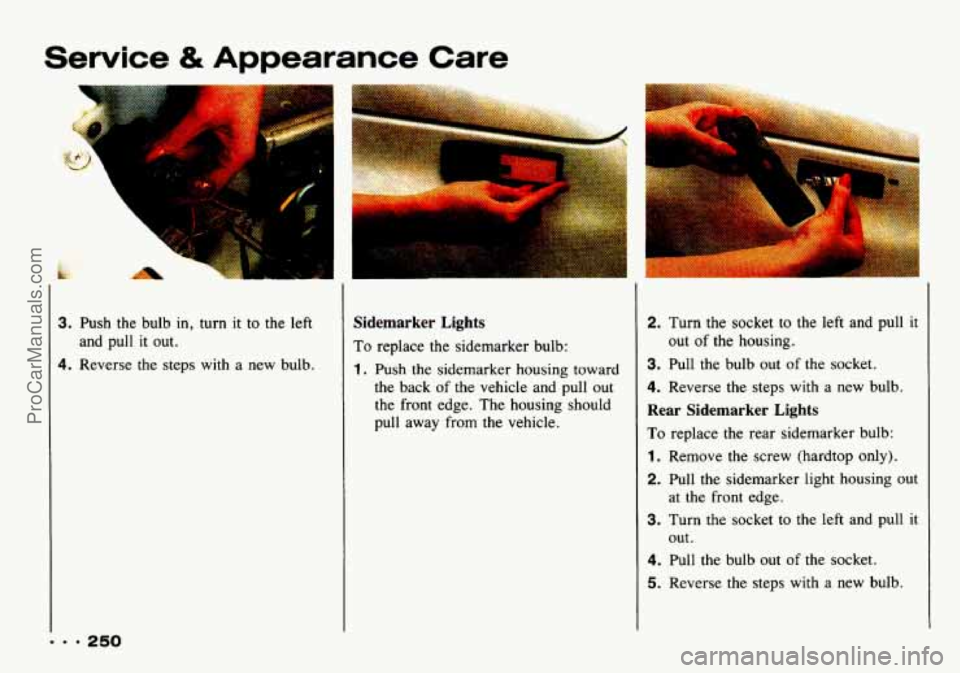
3. Push the bulb in, turn it to the left
4. Reverse the steps with a new bulb.
and
pull it out.
Sidemarker Lights
To replace
the sidemarker bulb:
1. Push the sidemarker housing toward
the back
of the vehicle and pull out
the front edge. The housing should
pull away from
the vehicle.
,
i
2. Turn the socket to the left and pull it
3. Pull the bulb out of the socket.
4. Reverse the steps with a new bulb.
Rear Sidemarker Lights
To replace the rear sidemarker bulb:
1. Remove the screw (hardtop only).
2. Pull the sidemarker light housing out
3. Turn the socket to the left and pull it
4. Pull the bulb out of the socket.
5. Reverse the steps with a new bulb.
out
of the
housing.
at the front edge.
out.
ProCarManuals.com
Page 258 of 339

Service & Appearance Care
I
- 256
If your spare wheel does not match your
other wheels, you may want to use this
pattern.
After the tires have been rotated, adjust
the front and rear inflation pressure as
shown
on the Tire-Loading Information
label. Make certain that all wheel nuts
are properly tightened. See “Wheel Nut
Torque’’ in the Index.
CA U TION
A
Rust or dirt on a wheel, or on
the parts
to which it is
fastened, can make the wheel nuts
become loose after a time. The
wheel could come off and cause an
accident. When you change a
wheel, remove any rust or dirt
from places where the wheel
attaches to the vehicle. In an
emergency, you can use
a cloth or
paper towel to
do this; but be sure
to use a scraper or wire brush
later,
if you need to, to get all the
rust or dirt
off. (See “Changing a
Flat Tire” in the Index.)
I
When It’s Time for New Tires
One way to tell when it’s time for new
tires is to check the treadwear
indicators, which will appear when your
tires have only
2/32 inch (1.6 mm) or
less of tread remaining.
You need a new tire if
You can see the indicators at three
You can see cord or fabric showing
The tread or sidewall is cracked, cut
places around
the tire.
through the tire’s rubber.
or snagged deep enough to show cord
or fabric.
ProCarManuals.com
Page 265 of 339
Using Foam-Type Cleaner on Fabric
Vacuum and brush the area to remove
Always clean a whole trim panel or
any
loose dirt.
section. Mask surrounding trim along
stitch or welt lines.
Mix Multi-Purpose Powdered Cleaner
following
the directions on the
container label.
Use suds only and apply with clean
Don’t saturate the material.
Don’t rub it roughly.
As soon as you’ve cleaned the
sponge.
section,
use a sponge to remove
the
suds.
Rinse the section with a clean, wet
sponge.
Wipe off what’s left with a slightly
damp paper towel or cloth.
Then dry it immediately with an air
hose, a hair dryer or a heat lamp.
Be careful with a nalr aryer or
heat lamp. You could scorch thl
Wipe with a clean cloth. Using
Solvent-Type Cleaner on
Fabric
First, see if you have to use solvent-type
cleaner at all. Some spots and stains will
clean off better with
just water and mild
soap.
If you need to use it, then:
Gently scrape excess soil from the
trim material with a clean, dull knife
or scraper. Use very little cleaner,
light pressure and clean cloths
263 - -
ProCarManuals.com
Page 266 of 339
Service & Appearance Care
I.. 264
(preferably cheesecloth). Cleaning should
start at the outside of the stain,
“feathering” toward the center. Keep
changing to a clean section of
the
cloth.
When you clean a stain from fabric,
immediately dry
the area with an air
hose, hair dryer, or heat lamp to help
prevent a cleaning ring. (See previous
NOTICE .)
Fabric Protection
Your Geo has upholstery that has been
treated
with Scotchgard’” Fabric
Protector, a
3M product. Scotchgard“
protects fabrics by repelling oil and
water, which are the carriers of most
stains. Even with this protection, you
still need to clean your upholstery often
to keep it looking new.
Further information on cleaning is
available on
1-800-433-3296 (in
Minnesota, 1-800-642-6 167).
Special Cleaning Problems
Greasy
or Oily Stains: Like grease, oil,
butter, margarine, shoe polish, coffee
with cream, chewing gum, cosmetic
creams, vegetable oils, wax crayon, tar
and asphalt.
Carefully scrape off excess stain.
Then follow the solvent-type
Shoe polish, wax crayons, tar and
instructions above.
asphalt will stain if left on a vehicle
seat fabric. They should be removed
as soon as possible. Be careful,
because the cleaner will dissolve them
and may cause them to bleed.
ProCarManuals.com
Page 269 of 339
Cleaning the Outside of the
Windshield and Wiper Blades
If your windshield is not clear after
using the windshield washer, or
if the
wiper blade chatters when running, wax
or other material may be on the blade or
windshield.
Clean the windshield with
GM
Windshield Cleaner Bon-Ami Powder@
(GM Part No. 1050011). The windshield
is clean
if beads do not form when you
rinse
it with water.
Clean the blade by wiping vigorously
with a cloth soaked in full strength
windshield washer solvent. Then rinse
the blade with water.
Wiper blades should be checked on a
regular basis and replaced when worn.
Cleaning the Outside of Your
Geo
The paint finish on your vehicle
provides beauty, depth of color, gloss
retention and durability.
Washing Your Vehicle
The best way to preserve your vehicle’s
finish
is to keep it clean by washing it
often with lukewarm or cold water.
Don’t wash your vehicle
in the direct
rays of the sun. Don’t use strong soaps
or chemical detergents. Use liquid hand,
dish or car washing (non-detergent)
soaps. Don’t use cleaning agents that
contain acid or abrasives. All cleaning
agents should be flushed promptly and
not allowed to dry on the surface, or they could
stain. Dry the finish with a
soft, clean chamois or a
100% cotton
towel to avoid surface scratches and
water spotting.
High pressure car washes may cause
water to enter your vehicle.
Finish Care
Occasional waxing or mild polishing of
your
Geo may be necessary to remove
residue from the paint finish.
You can
get GM approved cleaning products
from your dealer. (See “Appearance
Care and Materials”
in the Index.)
Your Geo has a “basecoat/clearcoat”
paint finish. The clearcoat gives more
depth and
gloss to the colored basecoat.
267 = -
ProCarManuals.com
Page 287 of 339

Maintenance Schedule
Section A: Scheduled Maintenance Services
Using Your Maintenance Schedules
This section tells you the maintenance services you should
have done and when you should schedule them. Your Geo
dealer knows your vehicle best and wants
you to be happy
with it. If you go to your dealer for your service needs,
you’ll know that GM-trained and supported service people
will perform the work using genuine GM parts.
These schedules are for vehicles that:
carry passengers and cargo within recommended limits.
You will find these limits on your vehicle’s Tire-Loading
Information Label. See “Loading Your Vehicle’’
in the
Index.
are driven on reasonable road surfaces within legal
use the recommended unleaded fuel. See “Fuel” in the
driving
limits.
Index.
Selecting the RiQht Schedule
First you’ll need to decide which of the two schedules is
right for your vehicle. Here’s
how to decide which schedule
to follow:
Schedule I
Is any one of these true for your vehicle?
Most trips are less than 4 miles (6 km).
Most trips are less than 10 miles (16 km) and outside
temperatures are below freezing.
The engine is at low speed most of the time (as in
door-to-door delivery, or
in stop-and-go traffic).
You operate your vehicle in dusty areas.
You tow a trailer.
If any one (or more) of these is true for your driving, follow
Schedule
I.
Schedule I1
Follow Schedule I1 only if none of the above conditions is
true.
285 =
ProCarManuals.com
Page 288 of 339

Maintenance Schedule
Section A: Scheduled Maintenance Services (Cont.)
I
... 286
Schedule I
Follow Schedule I if your vehicle is
MAINLY driven under one or more of
the following conditions:
When most trips are less than 4 miles
When most trips are less than 10 miles
(6 km).
(16 km) and outside temperatures
remain below freezing.
When most trips include extended
idling and/or frequent low-speed
operation, as
in stop-and-go traffic.
When towing a trailer.
When operating in dusty areas.
Schedule I should also be followed if
the vehicle is used for delivery service,
police, taxi
or other commercial
applications.
*An Emission Control Service.
* The U. S. Environmental Protection Agency
has determined that the failure to perform
this maintenance item will not nullify the
emission warranty or limit recall liability
prior to the completion
of vehicle useful life.
General Motors, however, urges that all
recommended maintenance services be
performed at the indicated intervals and the
maintenance be recorded in "Section E:
Maintenance Record.
' '
ITEM
NO.
2
4
~
14
16
18
WHAT TO SERVICE
See "Explanation of Scheduled Maintenance
Services "following Schedules
t and It.
WHEN TO PERFORM
Miles (kilometers) or Months
(whichever occurs first).
PCV Valve Replacement* I Every 50,000 Miles (83 OOO km).
ECM & Associated Sensors Insmtion* I Every 100,OOO Miles (166 OOO h).
Power Steering System Inspection I Every 7,500 Miles (12 500 km) or 7.5 Months.
ProCarManuals.com
Page 304 of 339

Maintenance Schedule
Section B: Owner Checks and Services (Cont.)
At Least Once a Year (CONT.)
CHECK
OR SERVICE I WHAT TO DO
Steering Column Lock While
parked, and with the parking brake set, try to turn the key to LOCK in each shift
position.
With an automatic transmission, the key should turn to LOCK only when the shift lever is in
With a manual transmission, the key will turn to LOCK only if you push the key in farther,
On all vehicles, the key should come out only
in LOCK.
P (Park).
while turning
it towards LOCK.
Parking Brake and
Automatic Transmission
P (Park) Mechanism
Check
Underbody Flushing When
you are doing this check, your vehicle could begin to move. You or others
could be injured and property could be damaged. Make sure there is room
in front
VI your vehicle in case it begins to roll. Be ready to apply the regular brake at once should the
Park
on a fairly steep hill, with the vehicle facing downhill. Keeping your foot on the regular
brake, set the parking brake.
To check the parking brake: With the engine running and transmission in Neutral, slowly
remove foot pressure from the regular brake pedal.
Do this until the vehicle is held by the
parking brake only.
To check the P (Park) mechanism’s holding ability: Shift to P (Park). Then release all brakes.
If your vehicle is four-wheel drive, be sure your transfer case is not in Neutral.
At least every spring, use plain water to flush any corrosive materials from the underbody. Take
care to clean thoroughly any areas where mud and other debris can collect.
ProCarManuals.com