1993 CHEVROLET S10 lock
[x] Cancel search: lockPage 173 of 356
Downloaded from www.Manualslib.com manuals search engine car suddenly pulls out from nowhere, or a child darts out from between
parked cars and stops right in front of you. You can avoid these problems by
braking-if you can stop in time. But sometimes you can’t; there isn’t room.
That’s the time for evasive action-steering around the proble\
m.
Your vehicle can perform very well in emergencies like these. First apply your
brakes, but not enough to lock your front wheels.
It is better to remove as much speed as you can from a possible collision.
Then steer around the problem, to the left or right depending on the space
available.
KO444
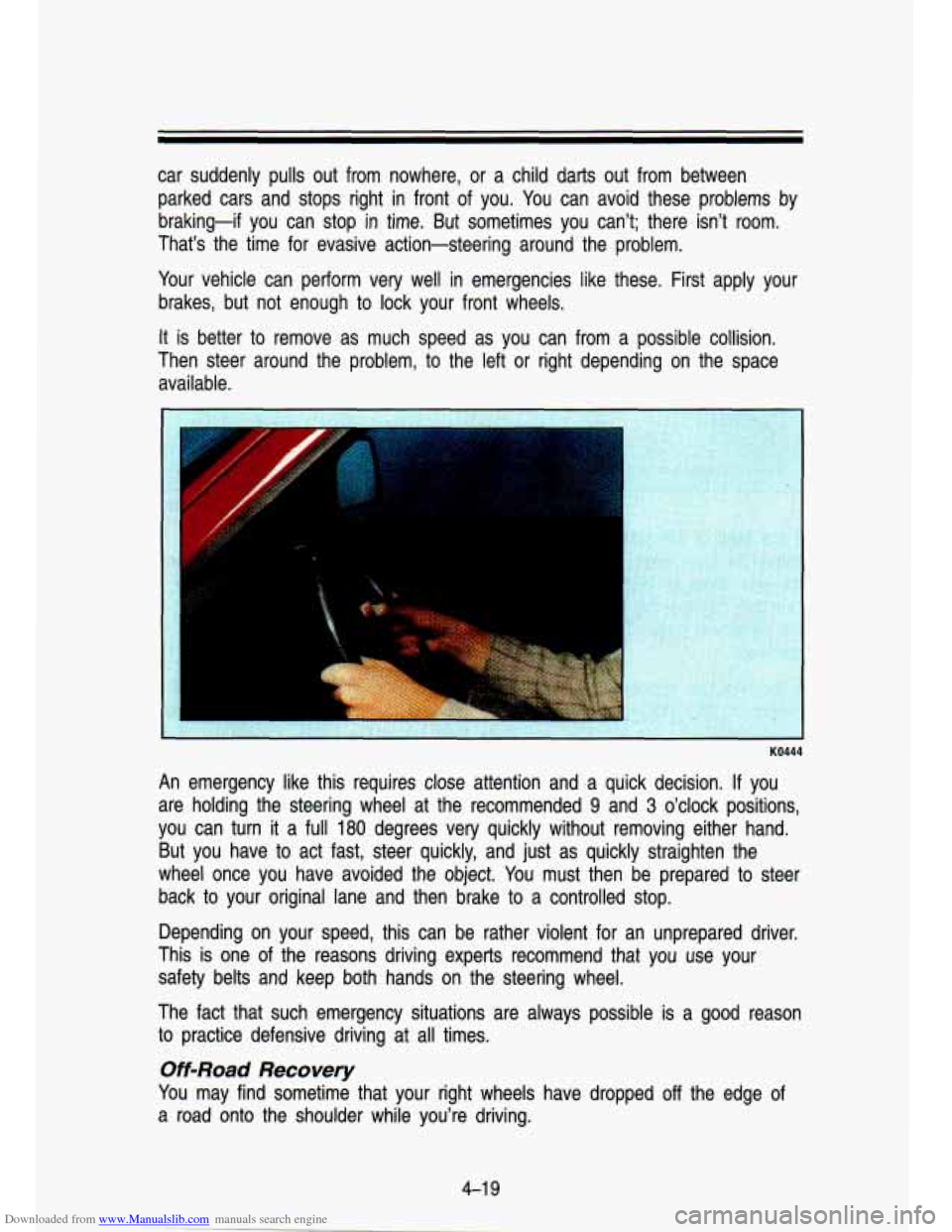
An emergency like this requires close attention and a quick de\
cision. If you
are holding the steering wheel at the recommended
9 and 3 o’clock positions,
you can turn
it a full 180 degrees very quickly without removing either hand.
But you have to act fast, steer quickly, and just as quickly straighten the
wheel once you have avoided the object. You must then be prepared to steer
back to your original lane and then brake
to a controlled stop.
Depending on your speed, this can be rather violent for an un\
prepared driver.
This is one
of the reasons driving experts recommend that you use your
safety belts and keep both hands on the steering wheel.
The fact that such emergency situations are always possible
is a good reason
to practice defensive driving at
all times.
Off-Road Recovery
You may find sometime that your right wheels have dropped off the edge of
a road onto the shoulder while you’re driving.
Page 177 of 356
 helps \
avoid only
a rear braking skid. In a braking skid (where th")
Downloaded from www.Manualslib.com manuals search engine Remember: The rear wheel antilock braking system (RWAL) helps \
avoid only
a rear braking skid. In a braking skid (where the front wheels \
are no longer
rolling), release enough pressure on the brakes to get the front wheels rolling
again. This restores steering control. Push the brake pedal dow\
n steadily
when you have to stop suddenly. As long as the front wheels \
are rolling, you
will have steering control. Steer the way you want to go.
Off-Road Driving with Your FoutNVheel
Drive Vehick
This off-road guide is for vehicles that have four-wheel drive.\
Also, see
“Antilock Brakes’’ in the Index.
If your vehicle doesn’t have four-wheel drive,
you shouldn’t drive off-road unless you’re on a level, so\
lid surface.
Off-road driving can be great fun. But it does have some definite hazards.
The greatest of these is the terrain itself.
“Off-roading” means you’ve left the great North American\
road system behind.
Traffic lanes aren’t marked. Curves aren’t banked. There a\
re no road signs.
Surfaces can be slippery, rough, uphill or downhill. In short, \
you’ve gone right
back to nature.
Off-road driving involves some new skills. And that’s why it’s very important
that you read this guide. You’ll find many driving tips and suggestio\
ns. These
will help make your off-road driving safer and more enjoyable. \
Before You Go Off-Roading
There are some things to do before you go outi For example, be sure to
have all necessary maintenance and service work done. Be sure \
you read all
the information about your four-wheel drive vehicle in this man\
ual.
Is there
enough fuel?
Is the spare tire fully inflated? Are the fluid levels up where
they should be? What are the local laws that apply to off-roading where you’ll
be driving?
If you don’t know, you should check with law enforcement people\
in the area. Will you be on someone’s private land?
If so, be sure to get the
necessary permission.
Loading Your Vehicle for Off-Road Driving
There are some important things to remember about how to load your
vehicle.
The heaviest things should be on the load floor and forward of your rear
Be sure the load is secured properly, so driving on the off-road terrain
axle. Put heavier items as far forward as you can.
doesn’t toss things around.
4-23
Page 178 of 356
Downloaded from www.Manualslib.com manuals search engine Your Driving and the Road
J I I
A Cargo on the load floor piled higher than the seatbacks can be
b thrown forward during a sudden stop. You or your passengers
..* could be injured. Keep cargo below the top of the seatbacks.
E==: ---I: Unsecured cargo on the load floor can be tossed about when :&&
@;!%:y:L - _. driving over rough terrain. You or your passengers can be struck
igFFSi e%x ..5=$i:< by flying objects. Secure the cargo properly.
i:...~~ r* ..&-
- .-<--x :2* .,.% ! .- a%%> &--. .
L?- .&1. .. ~ c. = ~-
9-2; .-.$y<- -- Heavy loads on the roof raise the vehicle’s center of gravity,
making it more likely to roll over. You can be seriously or fatally
injured
if the vehicle rolls over. Put heavy loads inside the cargo
area, not on the roof. Keep cargo in the cargo area as far
forward and low as possible.
You’ll find other important information in this manual. See “Vehicle Loading”
and “Tires” in the Index.
Traveling to Remote Areas
It makes sense to plan your trip, especially when going to a remote area.
Know the terrain and plan your route. You are much less likely to get bad
surprises. Get accurate maps of trails and terrain. Try to learn of any blocked
or closed roads.
It’s also a good idea to travel with at least one other v\
ehicle. If something
happens to one of them, the other can help quickly.
Does your vehicle have a winch? If
so, be sure to read the winch
instructions. In a remote area, a winch can be handy
if you get stuck. But
you’ll want to know how to use
it properly.
Getting Familiar with Off-Road Driving
It’s a good idea to practice in an area that’s safe and close to home before
you go into the wilderness. Off-road driving does require some \
new and
different driving skills. Here’s what we mean.
Tune your senses to different kinds of signals. Your eyes, for example, need
to constantly sweep the terrain for unexpected obstacles. Your ears need to
listen for unusual tire or engine sounds. With your arms, hand\
s, feet, and
body you’ll need to respond
to vibrations and vehicle bounce.
4-24
Page 181 of 356

Downloaded from www.Manualslib.com manuals search engine with only a small change in elevation where you can easily see all the wa\
y
to
the top. On a large hill, the incline may get steeper as you near the top,
but you may not see this because the crest of the hill is hidden by bushes,
grass, or shrubs.
Here are some other things to consider as you approach a hill.
0
0
0
e
0
0
Is there a constant incline, or does the hill get sharply steeper in
places?
Is there good traction on the hillside, or will the surface cause tire
slipping?
Is there a straight path up or down the hill so you won’t have to make
turning maneuvers?
Are there obstructions on the hill than can block your path (\
boulders,
trees, logs or ruts)?
What’s beyond the hill?
Is there a cliff, an embankment, a drop-off, a
fence? Get out and walk the hill if you don’t know. It’s the smart way to
find out.
Is the hill simply too rough? Steep hills often have ruts, gullies, troughs
and exposed rocks because they are more susceptible to the effects of
erosion.
Driving Uphill
Once you decide you can safely drive up the hill, you need t\
o take some
special steps.
Use a lower gear and get a firm grip on the steering wheel.
Get a smooth start up the hill and try to maintain your speed. Don’t use
more power than you need, because you don’t want your wheel\
s to
start
spinning or sliding.
Try to drive straight up the hill if at all possible. If the path twists and
turns, you might want to find another route.
3 CAUTION
Turning or driving across steep hills can lbe dangerous. You could
b lose traction, slide sideways, and possibly roll over. You could be
seriously injured or killed. When driving
up hills, always try to go
straight up. I
Ease up on your speed as you approach the top of the hill.
4-27
Page 182 of 356
Downloaded from www.Manualslib.com manuals search engine Your Driving and the Road
Attach a flag to the vehicle to make you more visible to approaching
traffic on trails or hills.
Sound the horn as you approach the top of hill to let opposing traffic
know you’re there.
Use your headlights even during the day. They make you more v\
isible to
oncoming traffic.
* Drivilng to the top (crest) of a hill at full speed can cause an
I accident. There could be a drop-off, embankment, cliff, or even
another vehicle. You could be seriously injured or killed.
As you near
the
top of a hill, slow down and stay alert. I
Q: What should I do if my vehicle stalls, or is about to stall, and I can’t
make
it up the hill?
A: If this happens, there are some things you should do, and there are some
things you must not
do. First, here’s what you should do:
Push the brake pedal to stop the vehicle and keep it from rolling
backwards. Also, apply the parking brake.
If your engine is still running, shift the transmission into rever\
se, release
the parking brake, and slowly back down the hill in reverse.
If your engine has stopped running, you’ll need to restart it. With the
brake pedal depressed and the parking brake still applied, shift the
transmission
to P (Park) (or, shift to N (Neutral) if your vehicle has a
manual transmission) and restart the engine. Then, shift
to R (Reverse),
release the parking brake, and slowly back down the hill in reverse.
As you are backing down the hill, put your left hand on the \
steering
wheel at the
12 o’clock position. This way, you’ll be able to tell if your
wheels are straight or turned
to the left or right as you back down.
Here are some things you must not
do if you stall, or are about to stall,
when going up a hill.
Never attempt to prevent a stall by shifting into N (Neutral) (or
depressing the clutch,
if you have a manual transmission) to “rev-up” the
engine and regain forward momentum. This won’t work. Your vehicle will
roll backwards very quickly and you could go out of control.
4-28
I
Page 184 of 356

Downloaded from www.Manualslib.com manuals search engine Your Driving and the Road
If you decide you can go down a hill safely, then try to keep \
your vehicle
headed straight down, and use a low gear. This way, engine drag can help
your brakes and they won’t have to do all the work. Descend slowly, keeping
your vehicle under control at all times.
A
Heavy braking when going down a hill can cause your brakes to
overheat and fade. This could cause
loss of control and a serious
accident. Apply the brakes lightly when descending a hill and use a
low gear to keep vehicle speed under
1 control.
Q: Are there some things I should not do when driving down a hill?
A: Yes! These are important because
if you ignore them you could lose
control and have a serious accident.
When driving downhill, avoid turns that take you across the in\
cline of the
hill. A hill that’s not too steep to drive down may be too steep to drive
across. You could roll over
if you don’t drive straight down.
Never go downhill with the transmission in N (Neutral), or with the clutch
pedal depressed in a manual shift. This is called “free-wheeling.” Your
brakes will have to do all the work and could overheat and fade.
Avoid braking so hard that you lock the wheels when going downhill. If
your front wheels are locked, you can’t steer your vehicle. \
If your wheels
lock up during downhill braking, you may feel the vehicle starting to slide
sideways.
To regain your direction, just ease off the brakes and steer to
keep the front of the vehicle pointing straight downhill.
Q: Am I likely to stall when going downhill?
A: It’s much more likely to happen going uphill. But if it happens going
downhill, here’s what to do.
* Stop your vehicle by applying the regular brakes. Apply the parking
brake.
Shift to P (Park) (or to N (Neutral) with the manual transmission) and,
while still braking, restart the engine.
Shift back to a low gear, release the parking brake, and drive straight
down.
4-30
If the engine won’t start, get out and get help.
Page 189 of 356
Downloaded from www.Manualslib.com manuals search engine Since you can’t see as well, you may need to slow down and keep
more space between you and other vehicles. It’s hard to tell how fast
the vehicle ahead is going just by looking at its taillights.
@ Slow down, especially on higher speed roads. Your headlights can light
up only
so much road ahead.
In remote areas, watch for animals.
If you’re tired, pull off the road in a safe place and rest.
Night Wsion
No one can see as well at night as in the daytime. But as we get older
these differences increase. A 50-year-old driver may require at \
least twice as
much light to see the same thing at night as a 20-year-old.
What you do in the daytime can also affect your night vision. For \
example,
if
you spend the day in bright sunshine you are wise to wear sunglasses. Your
eyes will have less trouble adjusting to night.
But
if you’re driving, don’t wear sunglasses at night. They may cut down on
glare from headlights, but they also make a lot of things inv\
isible that should remain visible-such as parked cars, obstacles, pedestrians, or even trains
blocking railway crossings. You may want
to put on your sunglasses after you
have pulled into a brightly-lighted service or refreshment area. Eyes shielded
from that glare may adjust more quickly to darkness back on the road. But
be sure
to remove your sunglasses before you leave the service area.
You can be temporarily blinded by approaching lights. It can take a second or
two, or even several seconds, for your eyes to readjust to the dark. When
you are faced with severe glare (as from a driver who doesn’t lower the high
beams, or a vehicle with misaimed headlights), slow down a li\
ttle. Avoid
staring directly into the approaching lights.
If there is a line of opposing
traffic, make occasional glances over the line of headlights to make certain
that one of the vehicles isn’t starting to move into your lane. Once you are
past the bright lights, give your eyes time to readjust before\
resuming speed.
High Beams
If the vehicle approaching you has its high beams on, signal by flicking yours
to high and then back to low beam. This is the usual signal to lower the
headlight beams.
If the other driver still doesn’t lower the beams, resist the
temptation to put your high beams on. This only makes
two half-blinded
drivers.
4-35
Page 204 of 356
Downloaded from www.Manualslib.com manuals search engine Your Driving and the Road
I ~~~~~~~~~~~~~~~~~~~~~~~~~~~~~~~~~~~~~
",.*,lcG~2*"*w" "* .**b;.. "~~" nl ~ -; *_ -~ ,,-,., ',.".~
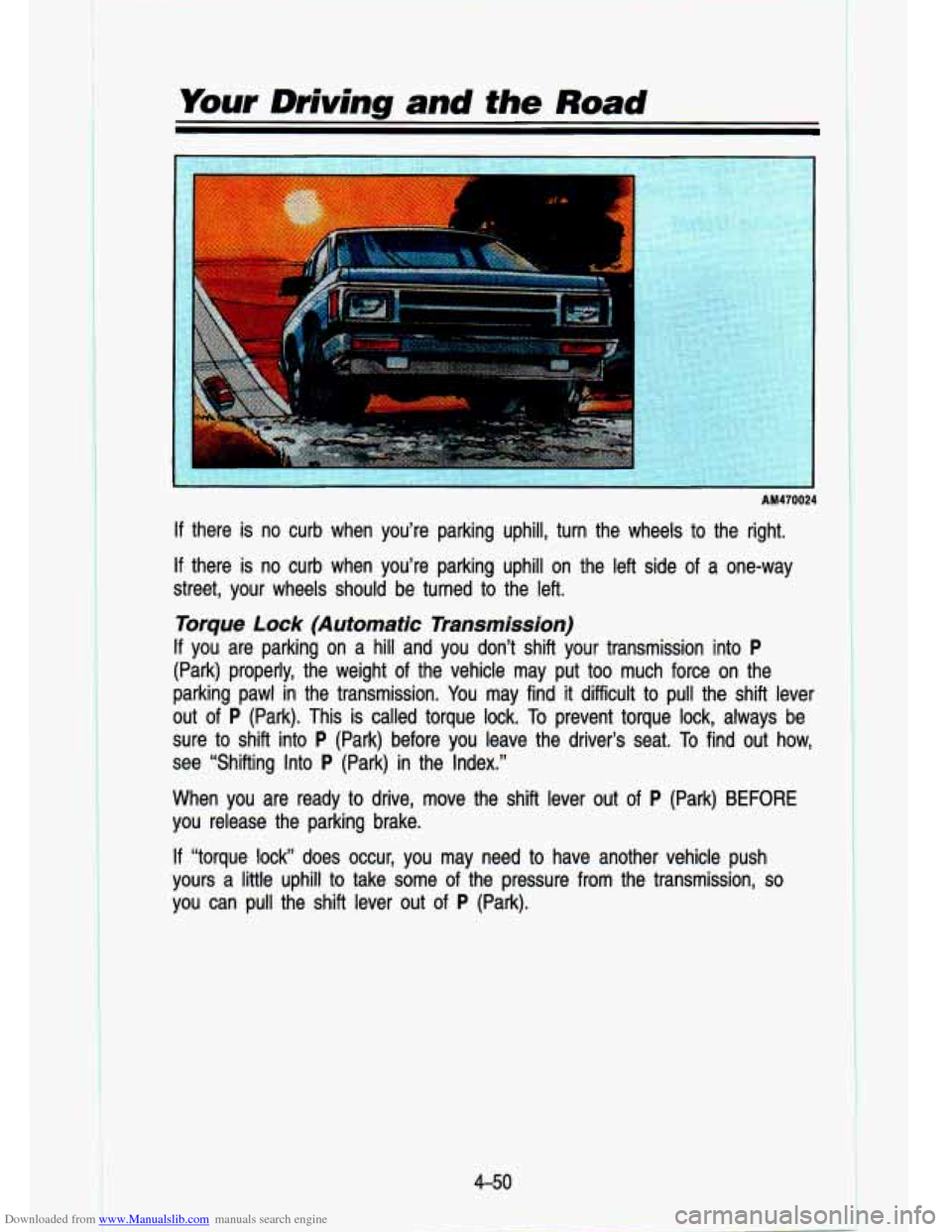
If there is no curb when you're parking uphill, turn the wheels to the right.
If there is no curb when you're parking uphill on the left side \
of a one-way
street, your wheels should be turned
to the left.
Torque Lock (Automatic Transmission)
If you are parking on a hill and you don't shift your transmissi\
on into P
(Park) properly, the weight of the vehicle may put too much \
force on the
parking pawl in the transmission.
You may find it difficult to pull the shift lever
out of
P (Park). This is called torque lock. To prevent torque lock, always be
sure to shift into
P (Park) before you leave the driver's seat. To find out how,
see "Shifting Into
P (Park) in the Index."
When you are ready
to drive, move the shift lever out of P (Park) BEFORE
you release the parking brake.
AM470024
If "torque lock" does occur, you may need to have another vehicle push
yours a little uphill
to take some of the pressure from the transmission, so
you can pull the shift lever out of P (Park).
4-50