Page 206 of 356

Downloaded from www.Manualslib.com manuals search engine Your Driving and the Road
r-
AM480016
What’s the worst time for this? “Wet ice.” Very cold \
snow or ice can be slick
and hard
to drive on. But wet ice can be even more trouble because it ma\
y
offer the least traction of all. You can get “wet ice” when it’s about freezing
(32°F; 0°C) and freezing rain begins to fall. Try to avoid driving on wet ice
until salt and sand crews can get there.
Whatever the condition-smooth ice, packed, blowing or loose snow\
-drive
with caution. Accelerate gently. Try not
to break the fragile traction. If you
accelerate
too fast, the drive wheels will spin and polish the surface under \
the tires even more.
Your antilock brakes improve your ability
to make a hard stop on a slippery
road. Even though you have the antilock braking system, you’\
ll want
to begin
stopping sooner than you would on dry pavement. See “Antiloc\
k” in the
Index.
Allow greater following distance on any slippery road.
Watch for slippery spots. The road might be fine until you hit a spot
that’s covered with ice. On an otherwise clear road, ice pa\
tches may appear in shaded areas where the sun can’t reach: around clumps of
trees, behind buildings, or under bridges. Sometimes the surface\
of
a
curve or an overpass may remain icy when the surrounding roads\
are
clear.
If you see a patch of ice ahead of you, brake before you are on
it. Try not to brake while you’re actually on the ice, and avoid sudden
steering maneuvers.
4-52
I i
Page 207 of 356

Downloaded from www.Manualslib.com manuals search engine - I- :_
A1480028
If you are stopped by heavy snow, you could be in a serious sit\
uation. You
should probably stay with your vehicle unless you know for sur\
e that you are
near help and you can hike through the snow. Here are some t\
hings to do to
summon help and keep yourself and your passengers safe: Turn o\
n your
hazard flashers. Tie a red cloth to your vehicle to alert police that you’ve
been stopped by the snow. Put on extra clothing or wrap a blanket around
you. If you have no blankets or extra clothing, make body ins\
ulators from newspapers, burlap bags, rags, floor mats-anything you can wrap \
around
yourself or tuck under your clothing to keep warm.
You can run the engine
to keep warm, but be careful.
I
I
Snow can trap exhaust gases under your vehicle. This can cause\
deadly CO (carbon monoxide) gas
to get inside. CO could overcome
you and kill you. You can’t see
it or smell it, so you might not know
it is in your vehicle. Clear away snow from around the base of your
vehicle, especially any that is blocking your exhaust pipe. And check
around again from time to time to be sure snow doesn’t collect there
Open
a window just a little on the side of the vehicle that’s away
from the wind. This will help keep
CO out. I
4-53
Page 209 of 356
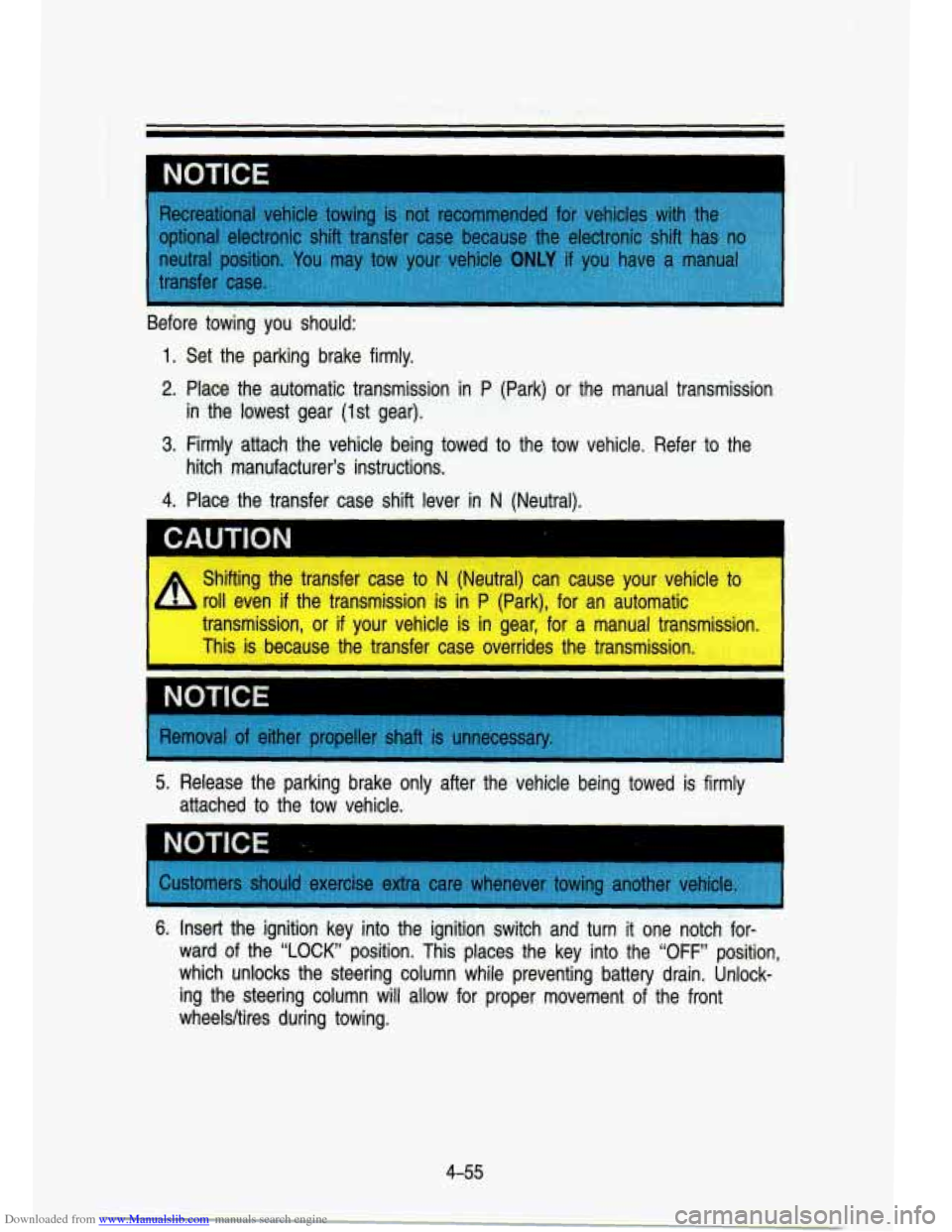
Downloaded from www.Manualslib.com manuals search engine Before towing you should:
1. Set the parking brake firmly.
2. Place the auto’matic transmission in P (Park) or the manual transmission
in th:e lowest gear
(1 st gear).
3. Firmly attach the vehicle being towed to the tow vehicle. Refer to the
hitch manufacturer’s instructions.
Shifting the transfer case to N (Neutral) can cause your veh\
icle
to
roll even if the transmission is in P (Park), for an automatic
transmission, or
if your vehicle is in gear, for a manual transmission.
This is because the transfer case overrides the transmission.
I
1 NOTICE
6. Insert the ignition key into the iginition switch and turn it one notch .for-
ward of the “LOCK’ position. This places the key into the “OFF” position,
which unlocks the steering column while preventing battery drain\
. Unlock-
ing the steering column will allow for proper movement of the front
wheelshires during towing.
4-55
Page 212 of 356
Downloaded from www.Manualslib.com manuals search engine Your Driving and the Road
the trailer tongue (A) should weigh 12% of the total loaded trailer weight (B).
After you’ve loaded your trailer, weigh the trailer and then\
the tongue,
separately,
to see if the weights are proper. If they aren’t, you may be able
to get them right simply by moving some items around in the trai\
ler.
Total Weight
on Your Vehicle’s Tires
Be sure your vehicle’s tires are inflated
to the limit for cold tires. You’ll find
these numbers on the Certification Label on the driver’s doo\
r lock pillar (or see “Tire-Loading” in the Index). Then be sure you don’\
t go over the GVW
limit for your vehicle.
Hitches
It’s important to have the correct hitch equipment. Crosswind\
s, large trucks
going by, and rough roads are a few reasons why you’ll need the right hitch.
Here are some rules to follow:
If you’ll be pulling a trailer that, when loaded, will weigh more than 2,000
pounds (900 kg) be sure to use a properly mounted weight-distributing
hitch and sway control
of the proper size. This equipment is very
important for proper vehicle loading and good handling when you\
’re
driving.
You can tow trailers up to
2,000 pounds (900 kg) with a step bumper hitch,
but
if your trailer tongue has a V-shaped foot, your bumper could be
damaged in sharp turns. Check the distance from the front edge of the fo\
ot
to the middle of the hitch ball socket. If the distance is less than 12 inches,
take the foot
off the trailer tongue.
Page 224 of 356
Downloaded from www.Manualslib.com manuals search engine , vr
KO51 9
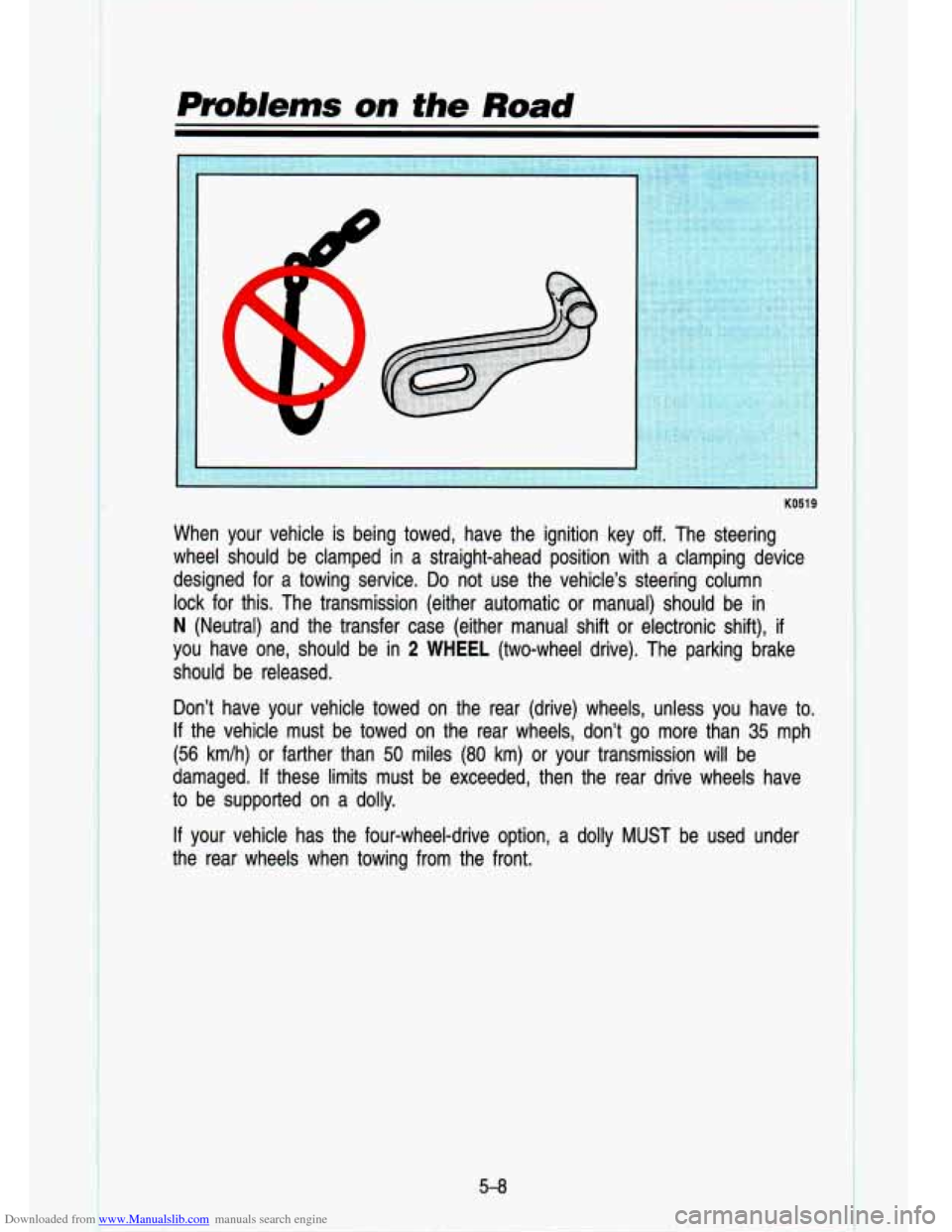
When your vehicle is being towed, have the ignition key off. The steering
wheel should be clamped in a straight-ahead position with a clamping device
designed for a towing service. Do not use the vehicle's steeri\
ng column
lock for this. The transmission (either automatic or manual) should\
be in
N (Neutral) and the transfer case (either manual shift or elec\
tronic shift), if
you have one, should be in 2 WHEEL (two-wheel drive). The parking brake
should be released.
Don't have your vehicle towed on the rear (drive) wheels, un\
less you have
to,
If the vehicle must be towed on the rear wheels, don't go more than 35 mph
(56 km/h) or farther than 50 miles (80 km) or your transmission will be
damaged.
If these limits must be exceeded, then the rear drive wheels have\
to be supported on a dolly.
If your vehicle has the four-wheel-drive option, a dolly
MUST be used under
the rear wheels when towing from the front.
5-8
Page 232 of 356
Downloaded from www.Manualslib.com manuals search engine Problems on the Road
A rear blowout, particularly on a curve, acts much like a skid and may,
require the same correction you'd use in a skid. In any rear blowout, remove
your foot from the accelerator pedal. Get the vehicle under co\
ntrol by steering
the way you want the vehicle
to go. It may be very bumpy and noisy, but
you can still steer. Gently brake
to a stop, well off the road if possible.
If your tire goes flat, the next part shows how to use your jac\
king equipment
to change a flat tire safely.
Changing a Flat Tire
If a tire goes flat, avoid further tire and wheel damage by driving slowly to a
level place. Turn on your hazard warning flashers.
I CAUTION I
A Changing a tire can cause an injury. The vehicle can slip off the jack
A and roll over you or other people. You and they coulld be badly
injured. Fin'd a level place to change your tire. To help prevent the
vehicle from moving:
I. Set the parking brake firmly.
2. Put the shift lever in P (Park).
3. Shift a manual transmission to 1 (First) or R (Reverse).
4. If you have a four-wheel-drive vehicle with a manu'al transfer
case
shift lever, be sure the transfer case is in a drive
gear-not
in ' N (Neutral).
5- Turn off the engine.
To be even more certain the. vehick won't move, you can put blocks
at
the front and rear of the tire farthest away from the one being
changed. That would be the tire
on the other side of the vehicle, at
the opposite end.
5-1 6
Page 233 of 356
Downloaded from www.Manualslib.com manuals search engine AM545003
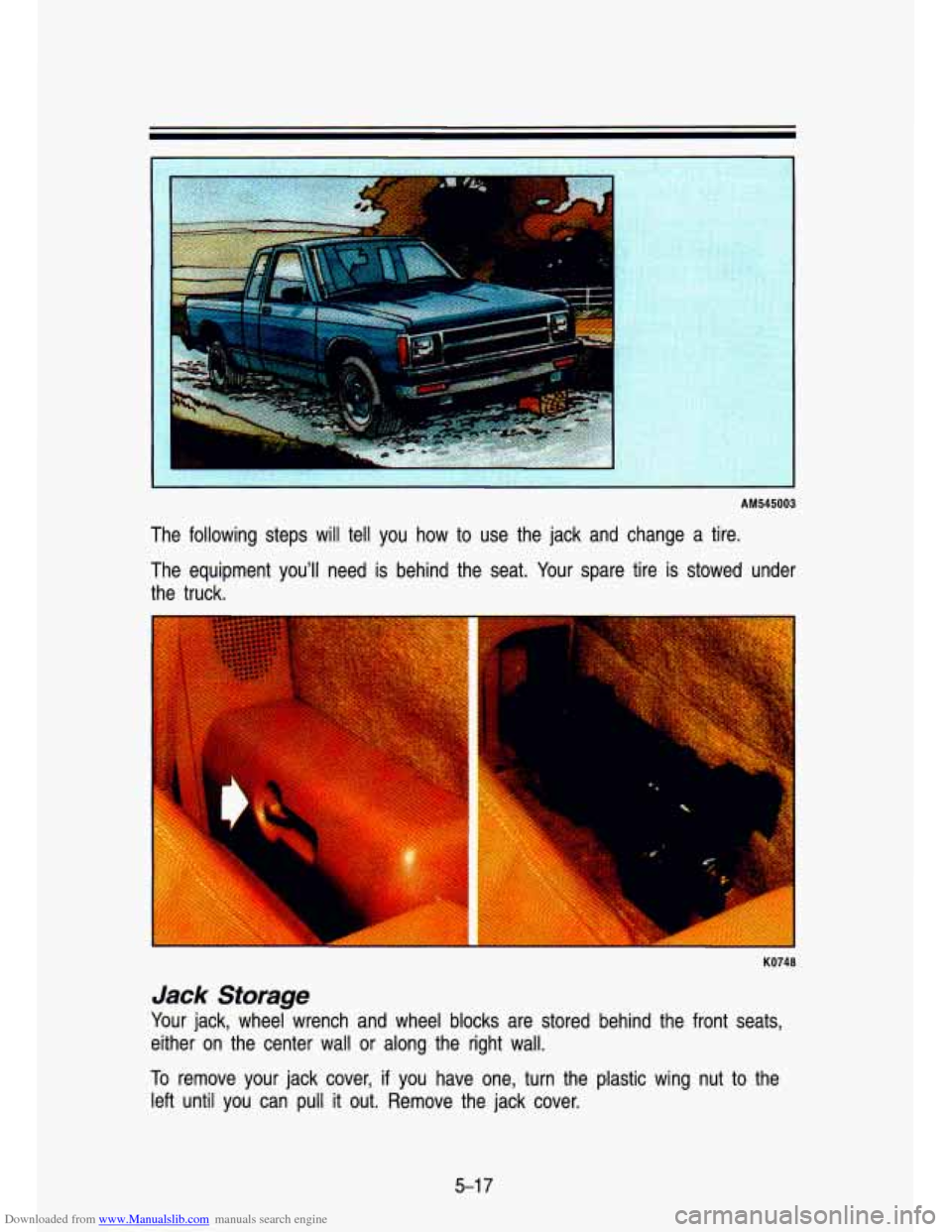
The following steps will tell you how to use the jack and change a tire.
The equipment you'll need is behind the seat. Your spare tire is stowed under
the truck.
KO748
Jack Storage
Your jack, wheel wrench and wheel blocks are stored behind the front seats,
either on the center wall or along the right wall.
To remove your jack cover,
if you have one, turn the plastic wing nut to the
left until you can pull it out. Remove the jack cover.
5-1 7
Page 234 of 356
Downloaded from www.Manualslib.com manuals search engine To remove the wheel blocks, iack and wheel wrench, turn the wina \
nut to the
left. Pull the wheel blocks, jack and wheel wrench
off.
"
- KO756