1993 CHEVROLET S10 lock
[x] Cancel search: lockPage 62 of 356

Downloaded from www.Manualslib.com manuals search engine .. ~ .
.. ..
Features & Contmls
LOCK: This position locks your ignition, steering wheel and tra\
nsmission. It’s
a theft deterrent feature. You will only be able to remove your key when the
ignition
is turned to LOCK.
Off: This position lets you turn off the engine but still turn the steering wheel
like LOCK. Use Off if you must have your vehicle in motion while the engine
is
off (for example, if your vehicle is being pushed).
Run: This is the position for driving.
Start: This starts your engine.
On manual transmission vehicles, turning the key to
“LOCK’ will lock
vehicle. This coiu18d cause am collision. If you need to turn the engiw
off Mhile the vehicle is moving, turn the key only to “OW. Don’t
mve the key release lever while the vehicle is moving.
- the steering column an’d result in a loss of ability to steer the
2-1 0
Page 63 of 356
Downloaded from www.Manualslib.com manuals search engine Key Release Lever
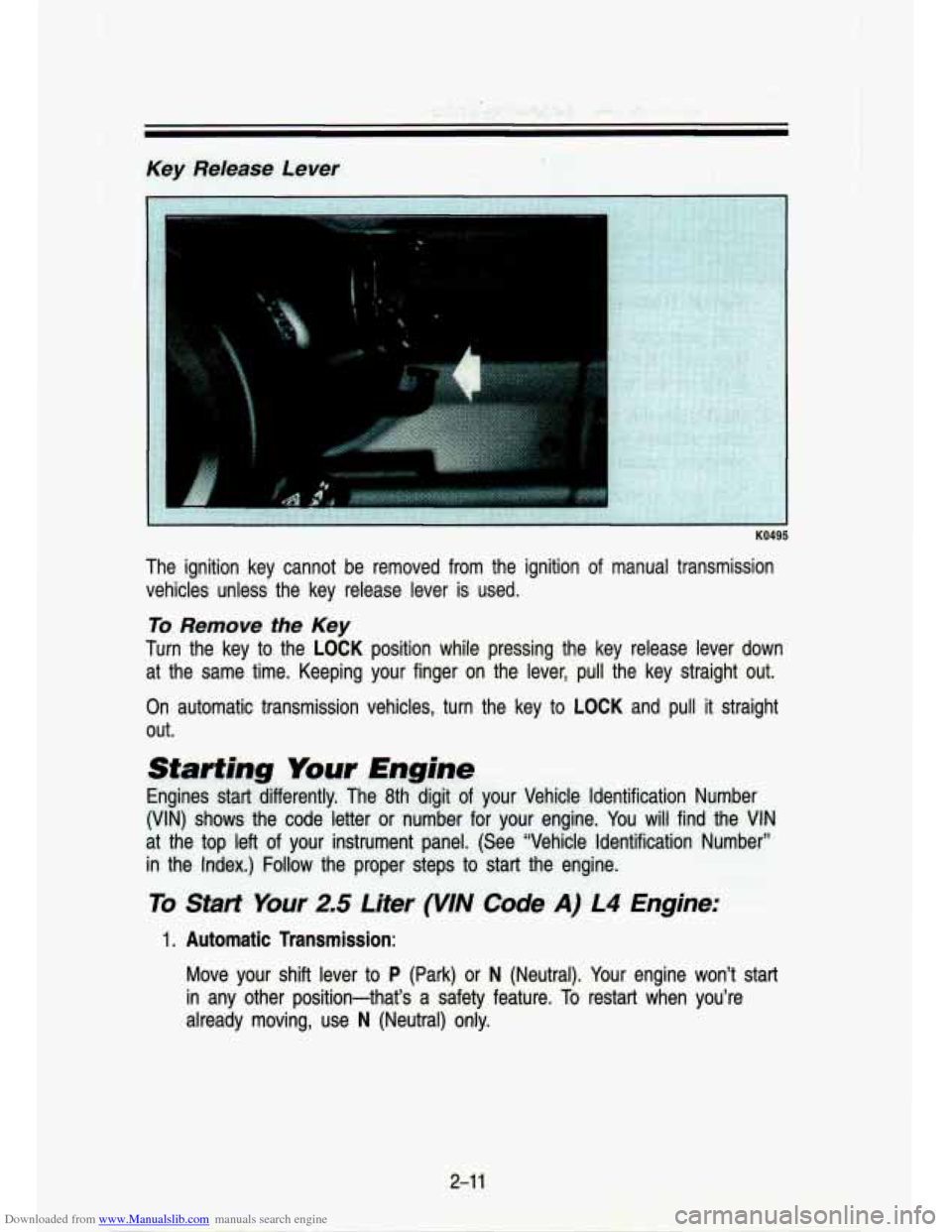
The ignition key cannot be removed from the ignition of manual transmission
vehicles unless the key release lever is used.
To Remove the Key
Turn the key to the LO,CK position while pressing the key release lever down
at the same time. Keeping your finger on the lever, pull the \
key straight out.
On automatic transmission vehicles, turn the key to LOCK and p\
ull it straight
out.
To Starz Your 2.5 -Liter (VIN Code A) L4 Engine:
1. Automatic Transmission:
Move your shift lever to
P (Park) or N (Neutral). Your engine won't start
in any other position-that's a safety feature.
To restart when you're
already moving, use
N (Neutral) only.
2-1 1
Page 67 of 356
Downloaded from www.Manualslib.com manuals search engine Engine Block Heater
KO41 4
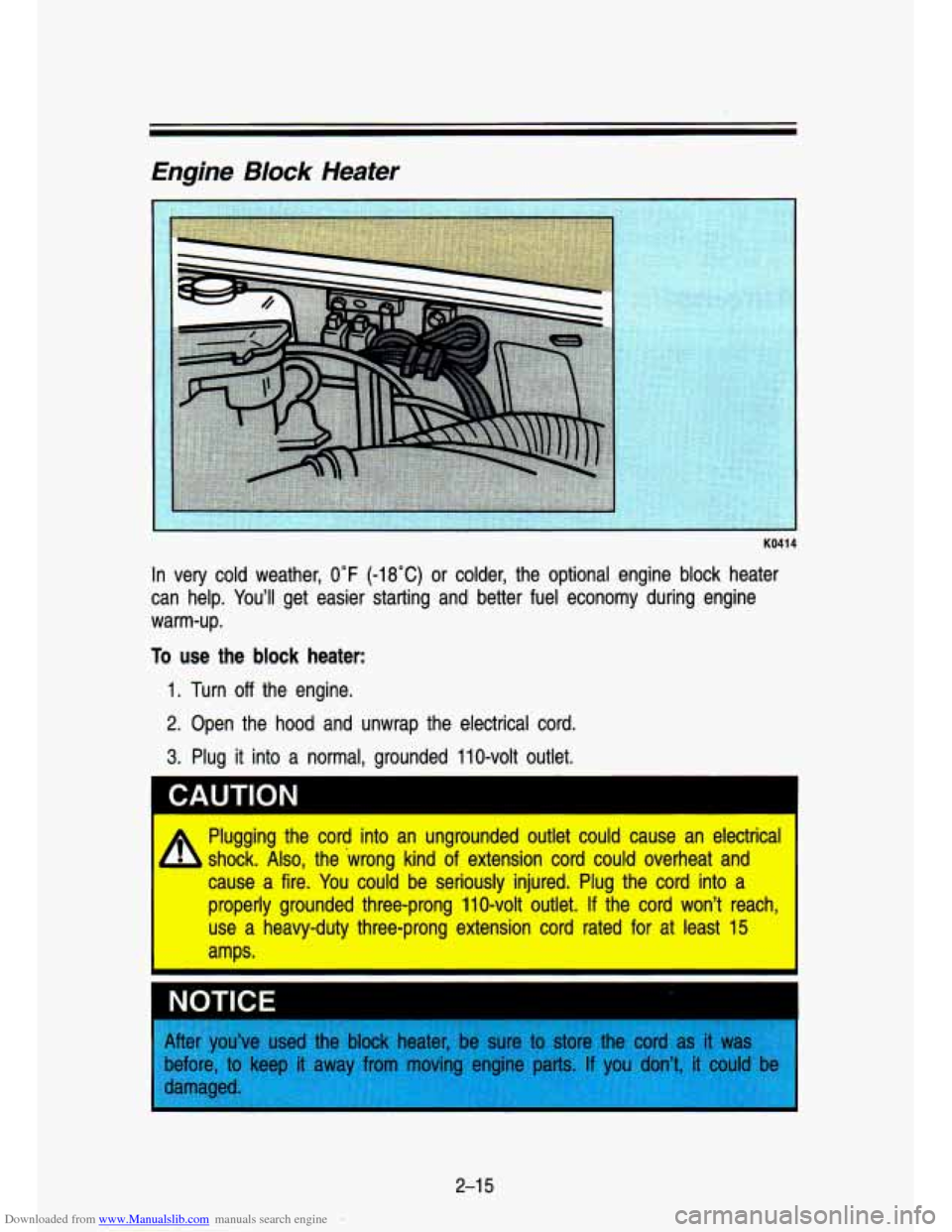
In very cold weather, 0°F (-18°C) or colder, the optional engine block heater
can help. You’ll get easier starting and better fuel economy\
during engine
warm-up.
To use the brock heater:
1. Turn
off the engine.
2. Open the hood and unwrap the electrical cord.
3. Plug it into a normal, grounded 1 IO-volt outlet.
A
Plugging the cord into an ungrounded outlet could cause an electrical
shock.
Also, the wrong kind of extension cord could overheat and
cause a fire. You could be seriously injured. Plug the cord into a
properly grounded three-prong 110-volt outlet.
If the cord won’t reach,
use a heavy-duty three-prong extension cord rated for at least \
15
amps.
2-1
5
Page 68 of 356

Downloaded from www.Manualslib.com manuals search engine Features & Controls
How long should you keep the block heater plugged in? The answer depends
on the weather, the kind of
oil you have, and some other things. Instead of
trying to list everything here, we ask that you contact a General Motors\
dealer
in the area where you’ll be parking your vehicle. The dealer c\
an give
you the best advice for that particular area.
Automatic Ilansmission
2-1 6
Page 73 of 356
Downloaded from www.Manualslib.com manuals search engine CAUTION I
If you skip more than one gear when you downshift, you could lose
control of your vehicle. And you could injure yourself or others.
NOTICE
Locking Rear Axle
If you have this feature, your rear axle can give you additio\
nal traction on
snow, mud, ice, sand or gravel. It works like a standard axle\
most of the
time, but one of the rear wheels has no traction and the other does, the
locking feature will allow the wheel with traction to move the vehicle.
Parking Brake
KO424
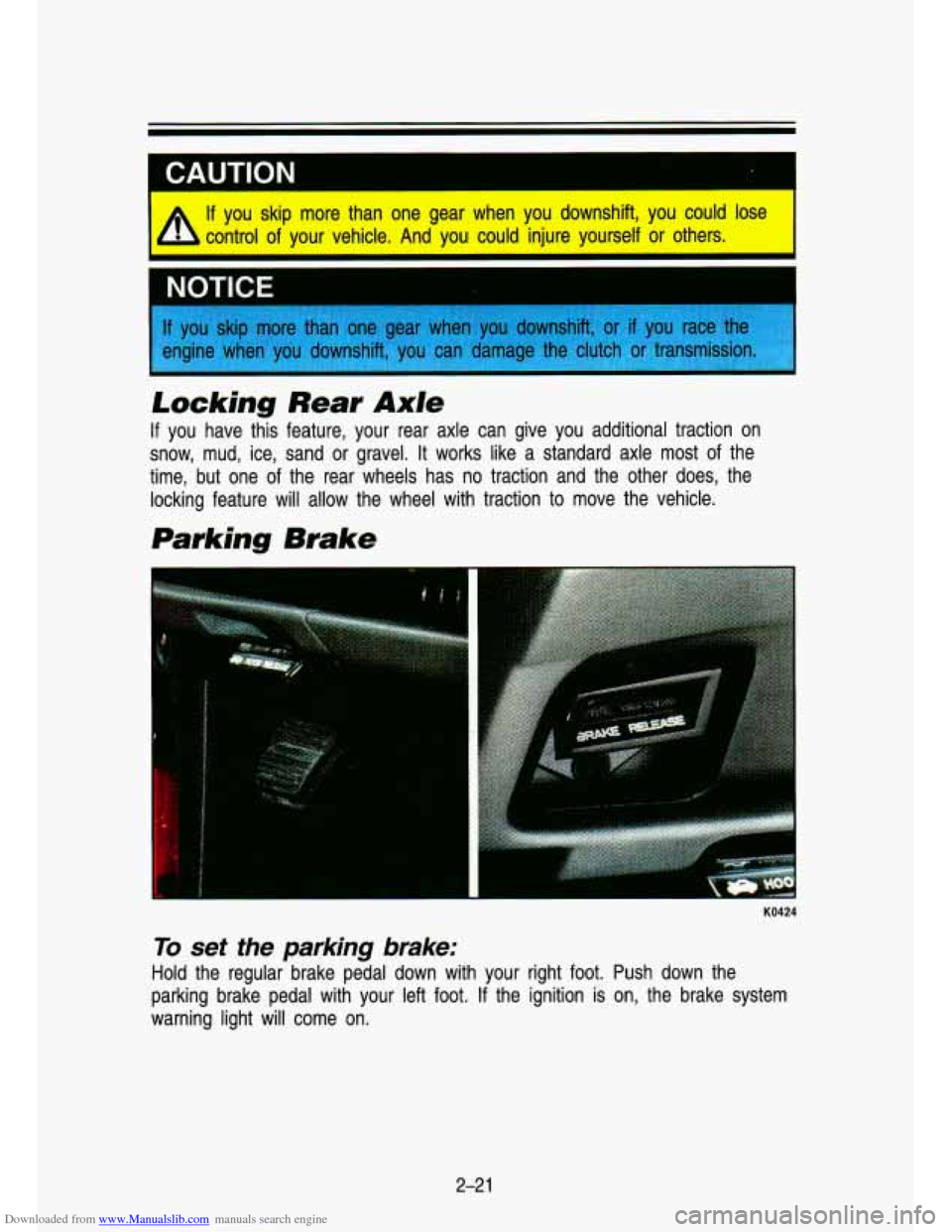
To set the parking brake:
Hold the regular brake pedal down with your right foot. Push \
down the
parking brake pedal with your left foot.
If the ignition is on, the brake system
warning light will come on.
2-21
Page 74 of 356
Downloaded from www.Manualslib.com manuals search engine Featums & Controls
To release the parking brake:
Hold the regular brake pedal down. Pull the brake release lever.
I NOTICE
If you are on a hill:
See “Parking on Hills” in the Index. That part shows how\
to turn your front
wheels.
If you are towing a trailer and are parking on any hill:
See “Towing a Trailer” in the Index. That part shows what to
do first to keep
the trailer from moving.
Torque Lock
The parking brake should be set first whenever leaving the driver’s seat. If
you are parked on a hill and the transmission is placed in P (Park) before
the parking brake is set, the weight of the vehicle may put too much force
on the parking pawl in the transmission.
It may be difficult to pull the selector
lever out of
P (Park). This is called “torque lock.” To prevent this, the parking
brake should be set BEFORE moving the selector lever
to P (Park).
When preparing to move the vehicle, the selector lever should \
be moved out of
P (Park) BEFORE releasing the parking brake. Set the parking br\
ake first,
Then release the transmission from
P (Park), even on level surfaces.
If “torque lock” does occur, you may need to have another vehicle nudge this
vehicle uphill to take some
of the pressure off the transmission while you pull
the selector lever out of
P (Park).
2-22
~
Page 76 of 356

Downloaded from www.Manualslib.com manuals search engine Features & Contmls
3. If you have four-wheel drive with a manual transfer case shift\
lever, be
4. Move the ignition key to
LOCK.
sure the transfer case is in a drive gear-not in N (Neutral).
5. Remove the key and take it with you. If you can walk away from your
vehicle with the ignition key in your hand, your vehicle is in
P (Park).
Leaving Your Vehicle With the Engine Running
(Automatic Transmission Models Only)
1 CAUTION
It can be dangerous to leave your vehicle with the engine running.
Your vehicle could move suddenly
if the shift lever is not fully in P
(Park) with the parking brake firmly set. If you have four-wheel drive
with a manual transfer case shift lever and your transfer case\
is in
N
(Neutral), your vehicle will be free to roll, even if your shift lever is in
P (Park). So be sure the transfer case is in a drive gear-not in N
(Neutral). And, if you leave the vehicle with the engine running, it
could overheat and even catch fire. You or others could be injured.
I Don’t leave your vehicle with the engine running unless you have to.
If you have to leave your vehicle with the engine running, be sure your
vehicle is in
P (Park) and your parking brake is firmly set before you leave it.
If you have four-wheel drive with a manual transfer case shift le\
ver, be sure
that the transfer case is in
a drive gear-not in N (Neutral). After you’ve
moved the shift lever into the
P (Park) position, hold the regular brake pedal
down. Then, see if you can move the shift lever away from P (Park) without
first pulling it toward you.
If you can, it means that the shift lever wasn’t fully
locked into
P (Park).
Parking Your b bide (Manual Transmission Models
Before you get out of your vehicle, put your manual transmissi\
on in R
(Reverse) and firmly apply the parking brake.
If you have four-wheel drive with a manual transfer case shift le\
ver, be sure
your transfer case is in a drive gear. Your vehicle could roll
if it isn’t.
Only)
If you are parking on a hill, or if your vehicle is equipped to tow a trailer,
see “Parking
on Hills” or “Towing a Trailer” in the Index.
2-24
I
Page 82 of 356

Downloaded from www.Manualslib.com manuals search engine t
Featums & Contmls
2. 4HI: This setting engages your front axle to help drive your \
vehicle. Use 4HI when you need extra traction, such as on snowy or ic\
y roads,
or in most off-road situations.
3. 4LO: This setting also engages your front axle to give you extra traction.
You may never need 4LO. It sends the maximum power to
all four
wheels. You might choose 4L0
if you were driving off-road in sand,
mud, or deep snow and climbing or descending steep hills.
Indicator lights on the switch show you which setting you are \
in. Both
indicator lights
will come on briefly when you turn on the ignition. If both
lights
do not come on, you should take your vehicle in for service. The 4HI
position has a green indicator light and the 4LO position has \
an amber
indicator light. When shifting from 4HI to 4LO or 4LO to 4HI,\
the indicator
light will flash until the shift is completed.
Two-Wheel Drive, “TWO WHEEL”, does not have a switch posi\
tion or an indicator light. Your vehicle will be in
two wheel drive if neither indicator light
is on.
To shift from two-wheel drive,
“TWO WHEEL”, to 4HI: Press and release
the 4HI switch. This can be done at any speed, and the front\
axle will lock
automatically.
To shift from 4HI to two-wheel drive, “TWO WHEEL”: Press and\
release
the 4HI switch. This can be done at any speed, and the front\
axle will unlock
automatically.
To shift from two-wheel drive, ‘‘TWO WHEEL”, or 4HI to 4LO: Stop your
vehicle. Shift your transmission into
N (Neutral) or depress your clutch pedal.
Press and release the 4LO switch. You must wait for the amber 4LO
indicator light to stop flashing and go solid amber before shi\
fting your
transmission into gear or releasing the clutch pedal.
If the 4L0 switch is pressed when your vehicle is in gear and/or moving, the
amber 4L0 indicator light will flash for
30 seconds and not complete the shift
unless your vehicle is below
3 mph and the transmission is in N (Neutral) or
the clutch pedal depressed.
On automatic transmission equipped vehicles:
If your transfer case does not
shift into 4L0, your transmission indicator switch may require adjustment. With
your transmission in
N (Neutral), press and release the 4LO switch. While the
amber 4LO indicator light is flashing, shift your transmission \
into
P (Park).
Wait until the 4LO indicator light goes solid amber before shifting your
transmission into gear. This will get you into 4L0, but you should take your
vehicle in for service
so normal operation can be restored.
2-30