1993 CHEVROLET S10 ECU
[x] Cancel search: ECUPage 153 of 356
Downloaded from www.Manualslib.com manuals search engine 4. Depress the BAND knob. The radio will display 000.
5. Enter the second three digits of the code. The display will show the
numbers as entered.
6. Depress the BAND knob. If the display shows "- - -", the disabling
sequence was successful. The numbers matched the user-selected c\
ode
or the factory back-up code and the unit is in the UNSECURED \
mode.
If
the display shows SEC, the disabling sequence was unsuccessful and
the numbers did not match either
of the codes and. the .unit will rema-in
in the SECURED mode.
Care of Your Compact Disc
KO557
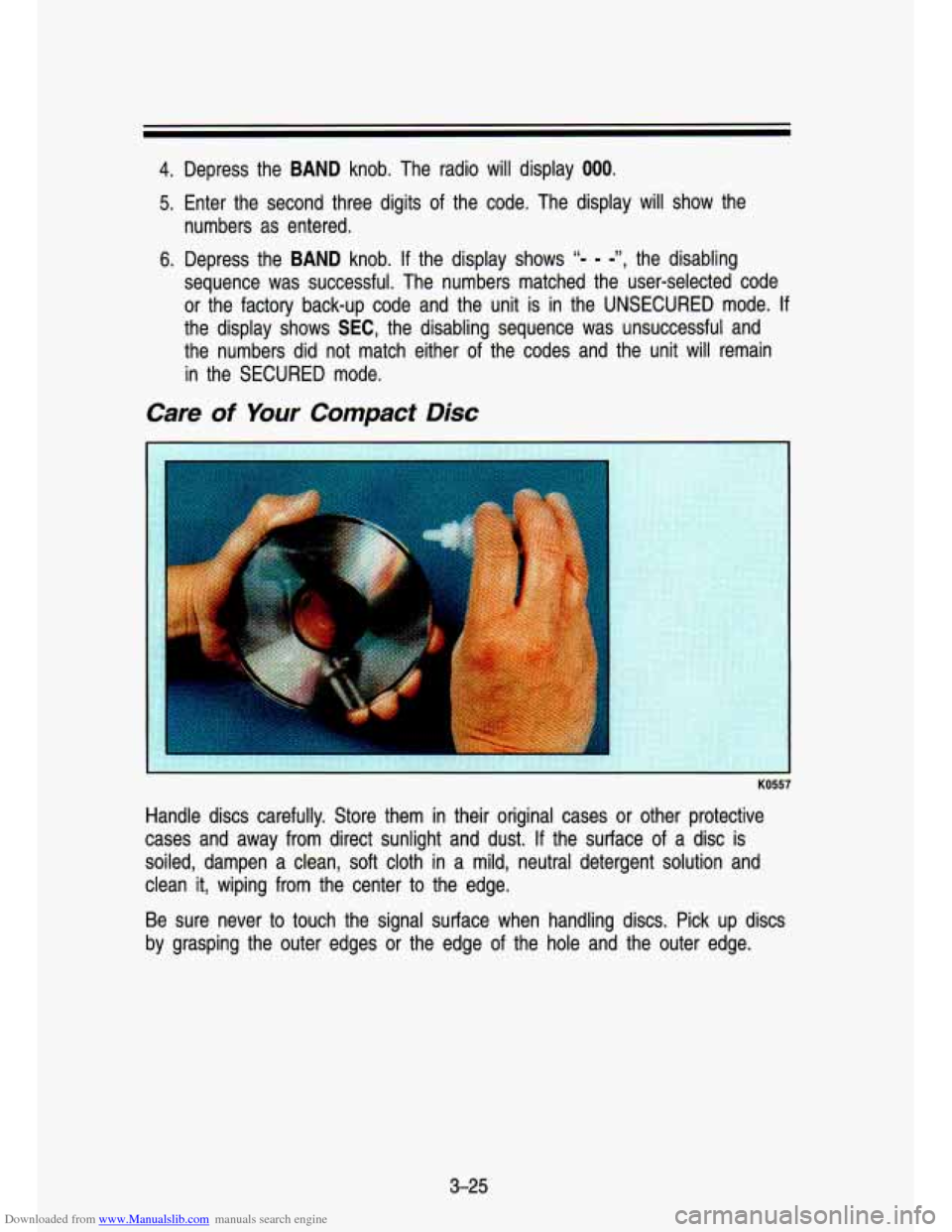
Handle discs carefully. Store them in their original cases or other protective
cases and away from direct sunlight and dust.
If the surface of a disc is
soiled, dampen a clean, soft cloth in a mild, neutral detergen\
t solution and
clean
it, wiping from the center to the edge.
Be sure never to touch the signal surface when handling discs.\
Pick up discs
by grasping the outer edges or the edge
of the hole and the outer edge.
3-25
Page 177 of 356
 helps \
avoid only
a rear braking skid. In a braking skid (where th")
Downloaded from www.Manualslib.com manuals search engine Remember: The rear wheel antilock braking system (RWAL) helps \
avoid only
a rear braking skid. In a braking skid (where the front wheels \
are no longer
rolling), release enough pressure on the brakes to get the front wheels rolling
again. This restores steering control. Push the brake pedal dow\
n steadily
when you have to stop suddenly. As long as the front wheels \
are rolling, you
will have steering control. Steer the way you want to go.
Off-Road Driving with Your FoutNVheel
Drive Vehick
This off-road guide is for vehicles that have four-wheel drive.\
Also, see
“Antilock Brakes’’ in the Index.
If your vehicle doesn’t have four-wheel drive,
you shouldn’t drive off-road unless you’re on a level, so\
lid surface.
Off-road driving can be great fun. But it does have some definite hazards.
The greatest of these is the terrain itself.
“Off-roading” means you’ve left the great North American\
road system behind.
Traffic lanes aren’t marked. Curves aren’t banked. There a\
re no road signs.
Surfaces can be slippery, rough, uphill or downhill. In short, \
you’ve gone right
back to nature.
Off-road driving involves some new skills. And that’s why it’s very important
that you read this guide. You’ll find many driving tips and suggestio\
ns. These
will help make your off-road driving safer and more enjoyable. \
Before You Go Off-Roading
There are some things to do before you go outi For example, be sure to
have all necessary maintenance and service work done. Be sure \
you read all
the information about your four-wheel drive vehicle in this man\
ual.
Is there
enough fuel?
Is the spare tire fully inflated? Are the fluid levels up where
they should be? What are the local laws that apply to off-roading where you’ll
be driving?
If you don’t know, you should check with law enforcement people\
in the area. Will you be on someone’s private land?
If so, be sure to get the
necessary permission.
Loading Your Vehicle for Off-Road Driving
There are some important things to remember about how to load your
vehicle.
The heaviest things should be on the load floor and forward of your rear
Be sure the load is secured properly, so driving on the off-road terrain
axle. Put heavier items as far forward as you can.
doesn’t toss things around.
4-23
Page 178 of 356
Downloaded from www.Manualslib.com manuals search engine Your Driving and the Road
J I I
A Cargo on the load floor piled higher than the seatbacks can be
b thrown forward during a sudden stop. You or your passengers
..* could be injured. Keep cargo below the top of the seatbacks.
E==: ---I: Unsecured cargo on the load floor can be tossed about when :&&
@;!%:y:L - _. driving over rough terrain. You or your passengers can be struck
igFFSi e%x ..5=$i:< by flying objects. Secure the cargo properly.
i:...~~ r* ..&-
- .-<--x :2* .,.% ! .- a%%> &--. .
L?- .&1. .. ~ c. = ~-
9-2; .-.$y<- -- Heavy loads on the roof raise the vehicle’s center of gravity,
making it more likely to roll over. You can be seriously or fatally
injured
if the vehicle rolls over. Put heavy loads inside the cargo
area, not on the roof. Keep cargo in the cargo area as far
forward and low as possible.
You’ll find other important information in this manual. See “Vehicle Loading”
and “Tires” in the Index.
Traveling to Remote Areas
It makes sense to plan your trip, especially when going to a remote area.
Know the terrain and plan your route. You are much less likely to get bad
surprises. Get accurate maps of trails and terrain. Try to learn of any blocked
or closed roads.
It’s also a good idea to travel with at least one other v\
ehicle. If something
happens to one of them, the other can help quickly.
Does your vehicle have a winch? If
so, be sure to read the winch
instructions. In a remote area, a winch can be handy
if you get stuck. But
you’ll want to know how to use
it properly.
Getting Familiar with Off-Road Driving
It’s a good idea to practice in an area that’s safe and close to home before
you go into the wilderness. Off-road driving does require some \
new and
different driving skills. Here’s what we mean.
Tune your senses to different kinds of signals. Your eyes, for example, need
to constantly sweep the terrain for unexpected obstacles. Your ears need to
listen for unusual tire or engine sounds. With your arms, hand\
s, feet, and
body you’ll need to respond
to vibrations and vehicle bounce.
4-24
Page 205 of 356
Downloaded from www.Manualslib.com manuals search engine Winter Driving
AN480001
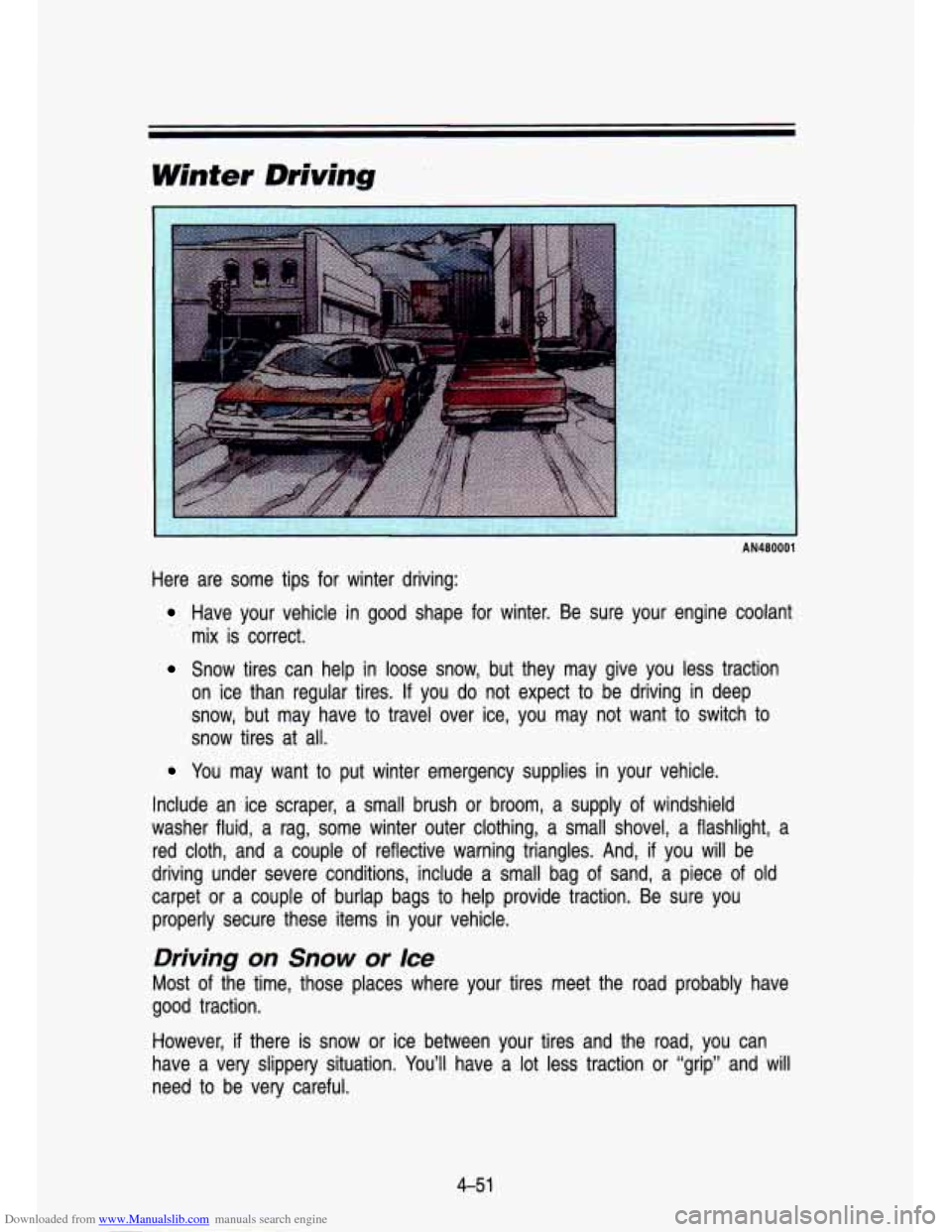
Here are some tips for winter driving:
Have your vehicle in good shape for winter. Be sure your engine coolant
mix is correct.
Snow tires can help in loose snow, but they may give you less traction
on ice than regular tires.
If you do not expect to be driving in deep
snow, but may have to travel over ice, you may not want to switch to
snow tires at all.
You may want to put winter emergency supplies in your vehicle.
Include an ice scraper, a small brush or broom, a supply of windshield
washer fluid, a rag, some winter outer clothing, a small shove\
l, a flashlight, a red cloth, and a couple of reflective warning triangles. And,
if you will be
driving under severe conditions, include a small bag of sand, a piece of old
carpet or a couple of burlap bags to help provide traction. Be sure you
properly secure these items in your vehicle.
Driving on Snow or Ice
Most of the time, those places where your tires meet the road probably\
have
good traction.
However,
if there is snow or ice between your tires and the road, you can
have a very slippery situation. You’ll have a lot less traction or “grip” and will
need to be very careful.
4-51
Page 213 of 356

Downloaded from www.Manualslib.com manuals search engine Safety Chains
You should always attach chains between your vehicle and your trail\
er. Cross
the safety chains under the tongue of the trailer
so that the tongue will not
drop to the road if
it becomes separated from the hitch. Instructions about
safety chains may be provided by the hitch manufacturer or by the trailer
manufacturer. Follow the manufacturer’s recommendation for atta\
ching safety
chains. Always leave just enough slack
so you can turn with your rig. And,
never allow safety chains to drag on the ground.
Trailer Brakes
If your trailer weighs more than 1,000 pounds (450 kg) loaded, then it needs
its own brakes-and they must be adequate. Be sure to read and follow the
instructions for the trailer brakes to install, adjust and maintain them properly.
And:
Don’t tap into your vehicle’s brake system if the trailer’s brake system
will use more than
0.02 cubic inch (0.3~~) of fluid from your vehicle’s
- master cylinder. If it does, both braking systems won’t work well. You
could even lose your brakes.
Will the trailer brake parts take 3,000 psi (20 650 kPa) of pressure? If
not, the trailer brake system must not be used with your vehi\
cle.
If everything checks out this far, then make the brake fluid tap \
at the
port on the master cylinder that sends fluid to the rear brak\
es. But don’t use copper tubing for this.
If you do, it will bend and finally break off.
Use steel brake tubing.
Driving with a Trailer
Towing a trailer requires a certain amount of experience. Before setti\
ng out
for the open road, you’ll want to get to know your rig. A\
cquaint yourself with
the feel of handling and braking with the added weight
of the trailer. And
always keep in mind that the vehicle you are driving is now a good deal
longer and not nearly
so responsive as your vehicle is by itself.
Before you start, check the trailer hitch and platform, safety \
chains, electrical
connector, lights, tires and mirror adjustment.
If the trailer has electric brakes,
start your vehicle and trailer moving and then apply the trail\
er brake controller
by hand to be sure the brakes are working. This lets you che\
ck your electrical
connection at the same time.
During your trip, check occasionally to be sure that the load \
is secure, and
that the lights and any trailer brakes are still working.
4-59
Page 223 of 356
Downloaded from www.Manualslib.com manuals search engine Towing Your Vehicle
Try to have a GM dealer or a professional towing service tow your vehicle.
They can provide the right equipment and know how to tow it without
damage.
If your vehicle has been changed since it was factory-new, by adding things
like fog lamps, aero skirting, or special tires and wheels, th\
ese things could
be damaged during towing.
Before you do anything, turn on the hazard warning flashers.
When you call, tell the towing service:
That your vehicle has rear-wheel drive, or that it has the fo\
ur-wheel drive
0 The make, model, and year of your vehicle.
Whether you can move the shift lever for the transmission and \
shift the
If there was an accident, what was damaged.
option.
transfer case,
if you have one.
I CAUTION
To help avoid injury to you or others:
A * Never let passengers ride ‘in a vehicle that is being towed.
Never tow faster than safe or posted speeds.
0 Never tow with damaged pads not fully secured.
Never get under your vehide after it has been lifted by the tow
. 0 Always use separate safety chains on each side when towing a
truck.
vehicle.
Never use “J” hooks. Use T-hooks instead.
5-7
Page 243 of 356

Downloaded from www.Manualslib.com manuals search engine 1
I
KO758
Tighten the wheel nuts firmly in a criss-cross sequence as shown. Remove
the wheel blocks.
A
Incorrect wheel nuts or improperly tightened wheel nuts can cause
the wheel to become loose and even come
off. This could lead to
an accident. Be sure to use the correct wheel nuts. If you have to
replace them, be sure
to get the right kind.
Stop somewhere as soon as you can and have the nuts tightened
with
a torque wrench to 95 ft. Ibs. (1 30 N.m ).
Storing The Tire in The Underbody Carrier
Put the tire on the ground at the rear of the vehicle, with the valve stem
pointed down and to the rear.
Pull the retaining bar through the wheel. Put the chisel end
of the wheel
wrench, on an angle, through the hole in the rear bumper and into the hoist
shaft. Turn the wheel wrench clockwise until the tire is raised against the
underside of the vehicle.
You will hear two “clicks” when the tire is secure,
but pull on the tire to
make sure.
5-27
Page 244 of 356

Downloaded from www.Manualslib.com manuals search engine Problenrs on the Road
KO546
Return the jack, wheel wrench and wheel blocks to the proper \
location behind
the seat. Secure the items and replace the jack cover.
Storing a jack, a tire, or other equipment in the passenger
compartment of the vehicle could cause injury. In a sudden stop or
collision, loose equipment could strike someone. Store all these\
in
I the proper place.
Compact Spare (If So Equipped)
Although your compact spare was fully inflated when the vehicle\
was new,
it can lose air over time. Check its inflation pressure regularly.\
It should be
60 psi (420 kPa). The compact spare is made to go up to 3,000 miles
(5000 km), so you can finish your trip and get a new tire where you want.
Of course, it's best to replace your spare with
a full-size tire as soon as you
can. Your spare will last longer and be in good shape in case you ever need
it again.
5-28