1993 CHEVROLET CAVALIER oil temperature
[x] Cancel search: oil temperaturePage 11 of 308
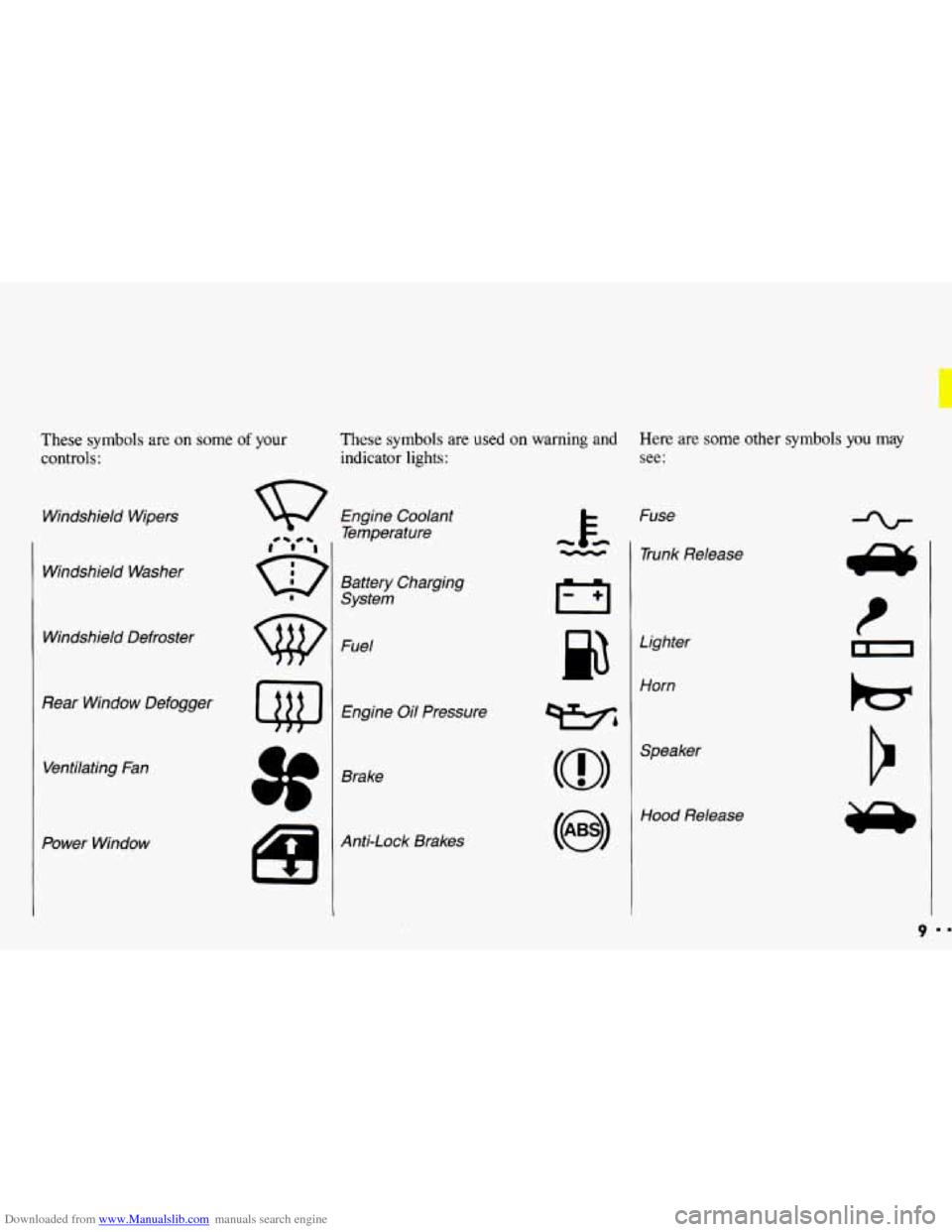
Downloaded from www.Manualslib.com manuals search engine These symbols are on some of your
controls:
Windshield Wipers
Windshield Washer
Windshield Defroster
Rear Window Defogger Ventilating Fan
Power Window
These symbols are used on warning and Here are some other symbols you may
indicator lights: see:
Engine Coolant
Temperature
Battery Charging
System
Fuel
Engine Oil Pressure
Brake
Anti-Lock Brakes Fuse
- 1 Trunk Release
cc
Lighter
Horn
wbl
(@I
Hood Release
9
Page 101 of 308
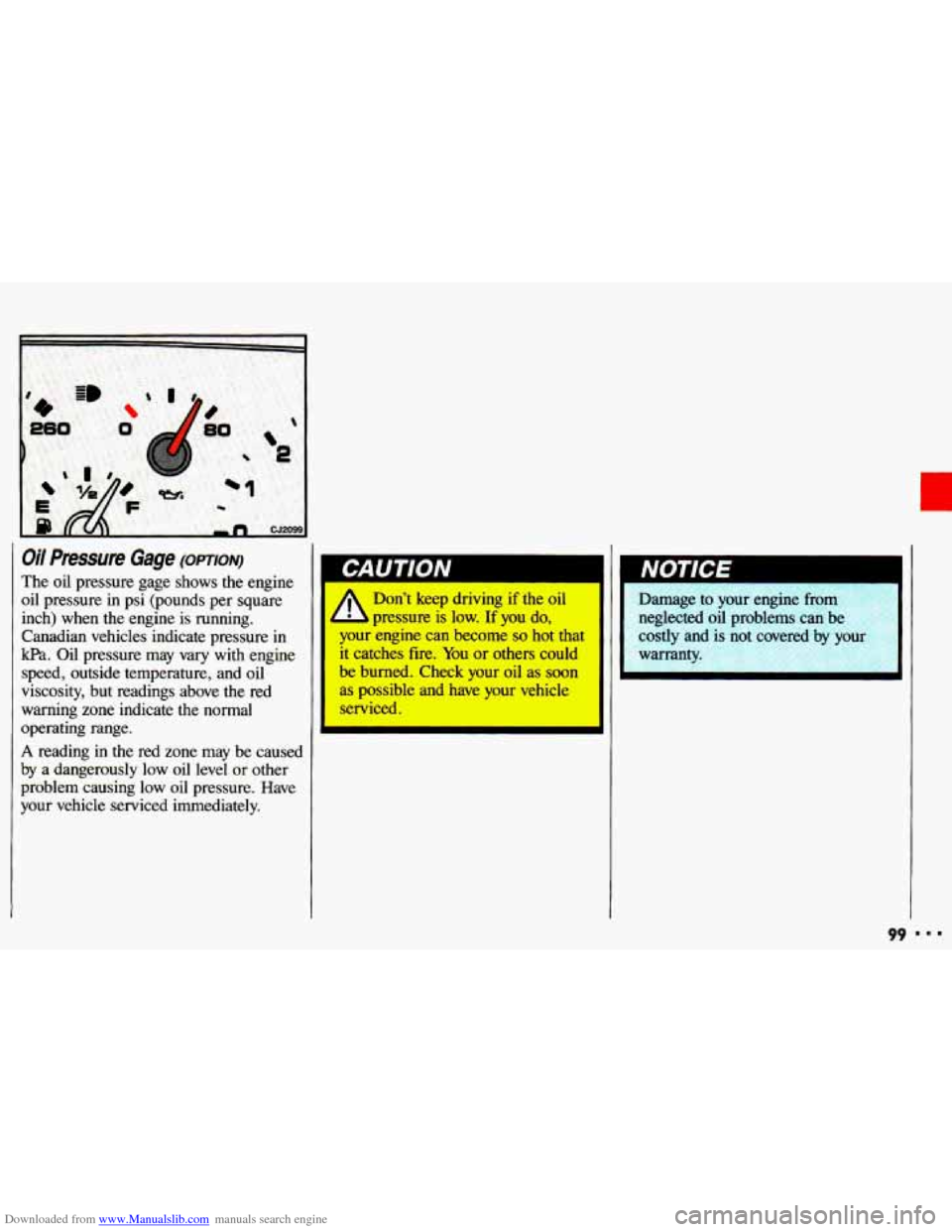
Downloaded from www.Manualslib.com manuals search engine Oil Pressure Gage (opTIoN)
The oil pressure gage shows the engine
oil pressure in psi (pounds per square
inch) when the engine is running.
Canadian vehicles indicate pressure
in
kpa. Oil pressure may vary with engine
speed, outside temperature, and oil
viscosity, but readings above the red
warning zone indicate the normal
operating range.
A reading in the red zone may be caused
by a dangerously low oil level
or other
problem causing low oil pressure. Have
your vehicle serviced immediately.
I
Don’t keep driving if the oil
3 pressure is low. If you do,
your engine can become so hot that
it catches fire. You or others could
be burned. Check your oil as soon
as possible and have your vehicle
serviced.
L
Nut IG-E I
Damage to your engine from
neglected oil problems can be
costly and
is not covered by your
warrant
99
Page 213 of 308
Downloaded from www.Manualslib.com manuals search engine Automaric Transaxle Fluid
When to Check and Change:
A good time to check your automatic
transaxle fluid level is when the engine
oil is changed. Refer to the Maintenance
Schedule to determine when to change
your fluid. See the
Index under
Scheduled Maintenance Services.
How to Check:
Because this operation can be a little
difficult, you may choose to have this
done at a Chevrolet dealership Service
Department.
If you do it yourself, be sure to follow
all the instructions here, or you could
get a false reading on the dipstick.
Too much or too little fluid can
damage
your transaxle. Too much
can mean that some of the fluid
could come out and fall
on hot
engine parts, starting a fire. Be
sure to get an accurate reading
if
you check your transaxle fluid. Wait
at least 30 minutes before checking
the transaxle fluid level if you have been
driving:
When outside temperatures are above
At high speed for quite a while.
In heavy traffic-especially in hot
To get the right reading, the fluid should
be at normal operating temperature,
which is 180°F to 200°F (82°C to
93" C).
Get the vehicle warmed up by driving
about 15 miles (24
km) when outside
temperatures are above
50°F (10OC). If
it's colder than 50" F (10" C), you may
have to drive longer.
90°F (32°C).
weather.
21 I
Page 218 of 308
Downloaded from www.Manualslib.com manuals search engine 888
Service rance Care
Hydraulic Clutch (CONTJ
How to Check:
The proper fluid should be added if the
level is at or below the
ADD mark on
the reservoir.
See the instructions on the
reservoir cap.
216
Engine Coolant
The following explains your cooling
system and how to add coolant when it
is low. If you have a problem with
engine overheating,
see the Index under
Engine Overheating.
The proper coolant for your Chevrolet
will:
Give freezing protection down to
Give boiling protection up to 262°F
Protect against rust and corrosion.
Help keep the proper engine
Let the warning lights work as they
-34" F (-37" C).
(128" C).
temperature.
should.
What to Use: Use a mixture of one-half
clean water (preferably distilled) and
one-half antifreeze that meets "GM
Specification 1825-M," which won't
damage aluminum parts.
You can also
use a recycled coolant conforming to
GM Specification 1825-M with a
complete coolant flush and refill.
If you
use this mixture, you don't need to add
anything else.
If you have a 2.2L LA engine, your
engine coolant system will have a
coolant recovery
tank. If you have a
3.1L V6 engine, your engine coolant
system will have a coolant surge
tank.
There are important differences between
these two cooling systems. Read this section carefully.
Page 266 of 308
Downloaded from www.Manualslib.com manuals search engine Maintenance Schedule
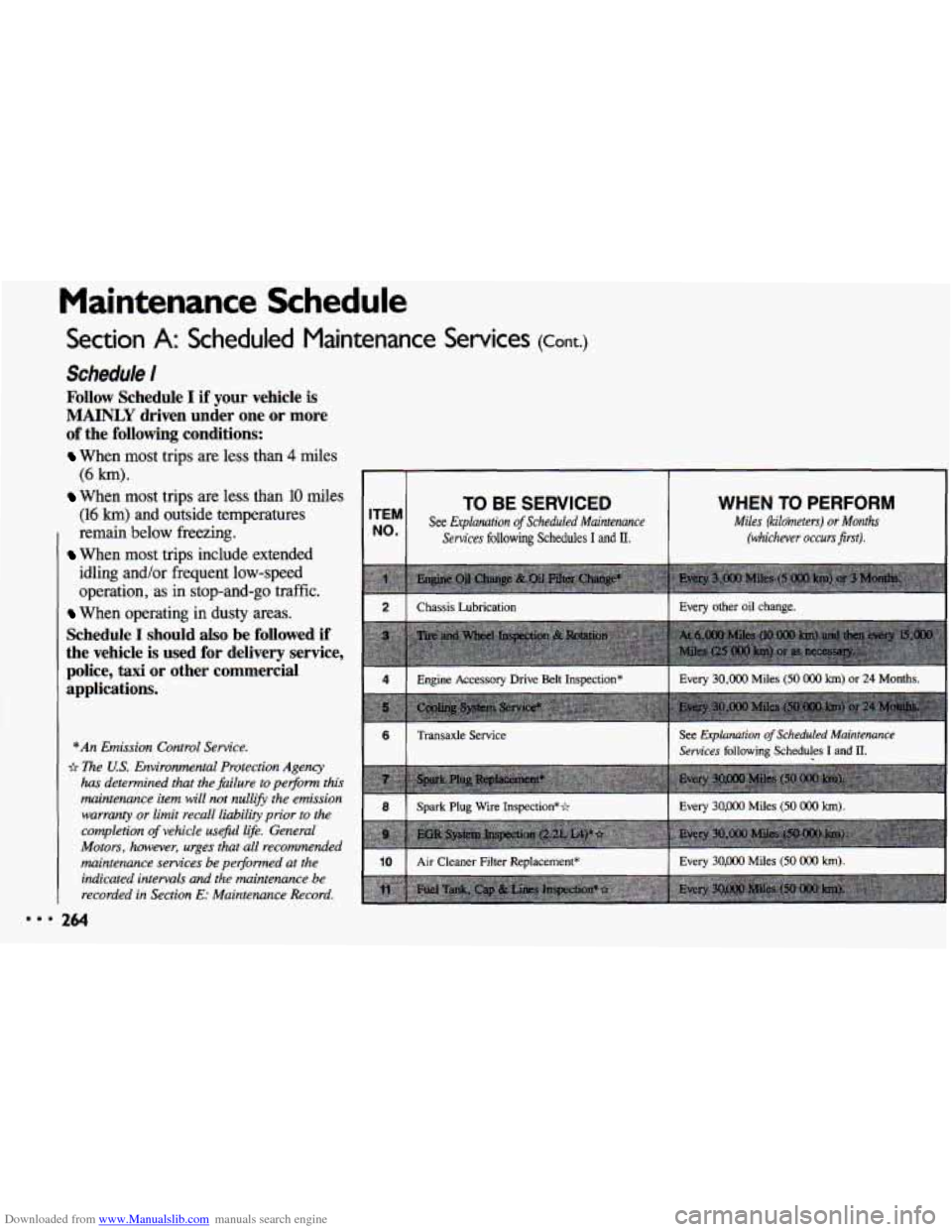
Section A: Scheduled Maintenance Services (Cont.)
Schedule I
Follow Schedule I if your vehicle is
MAINLY driven under one or more
of the following conditions:
When most trips are less than 4 miles
When most trips are less than 10 miles
(6 km).
(16 km) and outside temperatures
remain below freezing.
When most trips include extended
idling and/or frequent low-speed
operation, as in stop-and-go traffic.
When operating in dusty ,areas.
Schedule I should also be followed if
the vehicle is used for delivery service,
police, taxi
or other commercial
applications.
*An Emission Control Service.
b me US. Environmental Protection Agency
has determined that the failure to pelform this
maintenance item will not
nullifi the emission
warranty or limit recall liability prior to the
completion
of vehicle use&/ life. General
Motors, however, urges that all recommended maintenance services be performed at the indicated intervals and the maintenance be
recorded in Section
E: Maintenance Record.
I I
TO BE SERVICED ITEM
NO. See Explanation of Scheduled Maintenance
Sewices
following Schedules I and II.
WHEN TO PERFORM
Miles (kiloineters) or Months
(whichever
occurs first).
Chassis Lubrication 1 Every other oil change. I
I Engine Accessory Drive Belt Inspection* I Every 30,000 Miles (50 OOO km) or 24 Months. I
(ll
Transaxle Service See Explanation of Scheduled Maintenance
Services
following Schedules I and 11.
I 10 I Air Cleaner Filter Replacement* I Every 30,000 Miles (50 000 km). I
264
Page 271 of 308

Downloaded from www.Manualslib.com manuals search engine ITEM
NO. SERVICE ITEM NO. SERVICE
4
5
Engine
Accessory Drive Belt(s) Inspection*-
Inspect the belt(s) for cracks, fraying, wear and
proper tension. Replace as needed.
Cooling System Service*-Drain, flush and refill
the system with
new or approved recycled coolant
conforming to
GM Specification 1825M. Keep
coolant at the proper mixture as specified. See the
Index under Coolant. This provides proper freeze
protection, corrosion inhibitor level and engine
operating temperature.
Inspect hoses and replace if they are cracked,
swollen or deteriorated. Tighten screw-type hose
clamps. Clean the outside of the radiator and air
conditioning condenser. Wash
the pressure cap and
neck.
To help ensure proper operation, we recommend a
pressure test of both the cooling system and the
pressure cap.
6
7
8
9
Transaxle Service-For manual transaxles, fluid
doesn't require changing.
For automatic transaxles, change both the fluid and
filter every
15,000 miles (25 000 km) if the vehicle
is mainly driven under one or more of these
conditions:
In heavy city traffic where the outside temperature
In hilly or mountainous terrain.
Uses such as found in taxi, police car or delivery
regularly reaches
90" F (32" C) or higher.
service.
If you do not use your vehicle under any of
these conditions, change both the fluid and filter
every 100,000 miles (160
0oO km).
Spark Plug Replacement*-Replace spark plugs
with the proper type. See
the Index under
Replacement Parts.
Spark Plug Wire Inspection* *-Inspect for
burns, cracks or other damage. Check the boot
fit
at the coils and at the spark plugs. Replace wires as
needed.
Exhaust Gas Recirculation (EGR) System
Inspection
(2.2L L4 Code 4 engine)" *-Conduct
the
EGR system service as described in the service
manual. To purchase a service manual
, see the
Index under Service Publications.
Page 298 of 308
Downloaded from www.Manualslib.com manuals search engine Capacities & Specifications ...... 250
Carbon Monoxide in
Cassette Tape Player
Center Console Ashtray
........... 87
Center Passenger Position
......... 32
Chains. Tire
.............. .192. 236
Exhaust
.............. .70.
71. 159
(see
Audio Systems)
Changing a Flat Tire ............ 184
Charging System Warning Light
... -100
“Check Engine” Light
........... 102
“Check Gages” Light
............ 103
Checking Brake Fluid
.................. 221
Engine
Oil Level ............. 205
Hydraulic Clutch
.............. 215
Safety Belt Systems
............ 45
Transaxle Fluid
Automatic
................. 211
Manual
................... 213
Chemical Paint Spotting
......... 245
Child Restraints
................. 35
Children and Safety Belts
..... .33. 43
196
Engine Coolant ............... 217
Power Steering Fluid
........... 219
Checking Things Under the
Hood ... 201 Cigarette Lighter
................ 87
Circuit Breakers
8z Fuses ........ 247
Cleaner. Air
............. .209. 256
Cleaning Aluminum Wheels
............ 243
Antenna
.................... 122
Bumpers
.................... 242
Cassette Player
............... 121
Compact Discs
............... 122
Fabric
...................... 238
Glass
....................... 241
Inside of Your Chevrolet
....... 237
Instrument Panel
............. 240
Leather and Vinyl
............ 240
Outside
of Your Chevrolet ...... 241
Safety Belts
................. 240
ScotchgardTMFabric Protection
. . 239
Special Problems
............. 239
Textured-Surhce Bumper Coven
. . 242
Underbody Maintenance
....... 245
Warnings
.. .236. 237. 238. 240. 243
Waxing
..................... 243
Weatherstrips
................ 244
White Sidewall Tires
.......... 243
Windshield
.................. 241
City
Driving
.................. 149 Clock.
Setting the
............... 111
Clutch. Hydraulic
Adding Fluid
........... .215. 252
Checking Fluid
.............. -215
Air Conditioning System
....... 107
Climate Control System
........ 106
Ventilation
................... 110
Compact Disc Player
(see
Audio Systems)
Compact Spare Tire ............. 191
Control of a Vehicle
............. 131
Convenience Net
................ 54
Convex Outside Mirror ........... 85
Coolant ....................... 216
Checking
& Adding .. .217. 250. 252
Low Coolant Warning Light ..... 97
Proper Mixture to Use
......... 216
Safety Warnings About
... .174. 176. 177. 1781 179. 217. 218. 219
Temperature Gage
............. 97
Cruise Control .................. 74
Cup Holder
.................... 87
Curves. Driving on
............. 138
Customer Assistance Information
... 281
Comfort Controls
Page 299 of 308
Downloaded from www.Manualslib.com manuals search engine Daytime Running Lights ........ -80
Dead Battery: What to Do ........ 164
Defects. Safety (see
Safety Defects)
Defensive Driving .............. 128
Defogger. Rear Window .......... 109
Defrosting
.................... 108
Dome Light
.................... 82
Door Locks
.................... 49
Downshifting
.............. .65. W4
Driver Position
.................. 23
Driving
....................... 123
At Night
.................... 143
City
........................ 149
Controlling a Skid
............. 142
Defensively
................. -128
Drunken .................... 129
Freeway
.................... 150
Hill and Mountain ............ 154
In a Foreign Country
.......... 199
In Fog, Mist and Haze ......... 148
In the Rain .................. 145
Long Distance
................ 152
Loss
of Control ............... 142
On Curves
................... 138
Passing
..................... 140
Defogging
Your Windows
.... .106. 109 Through
Deep Standing Water
.... 58
Winter Driving ............... 157
Drunken Driving
............... 129
n
Easy-Entry Seat ................ 15
Electrical Equipment. Adding ..... 247
Emergencies. Braking
........... 137
Emergencies on the Road
......... 164
Emergencies. Steering in
......... 139
Emergency
Starting ............. 164
Emergency Towing
.............. 169
Engine Block Heater
........ .59, 208
Engine Coolant (see
Coolant)
Engine Coolant Temperature Warning
Engine Identification
........ .56. 246
Engine Oil
.................... 205
Additives
................... 207
Checking
&
Adding .......... .205. 250. 252
Crankcase Capacity
........... 250
Disposing of Used Oil ......... 209
Energy Conserving
............ 207
Filter
.................. .208. 256
Gage
(see Coolant)
Pressure Gage ................. 99
Warning Light ................ 98
When to
Change .............. 208
Engine Overheating
............. 174
Engine Specifications
............ 255
Engine, Starting
................. 56
Automatic Transaxle ........... 57
Manual Transaxle
.............. 57
Ethanol in Gasoline ............. 198
Exhaust Dangerous
Gas in ......... .70, 159
Parking with the Engine Running
................ .68, 71
Expectant Mothers, Use of
Safety Belts
................... 27
Expressway Driving
............. 150
Extender. Safety Belt ............ -44
Exterior Appearance
(see
Appearance Care)
Fabric Cleaning (see Appearance Care)
Fan Warnings .......... .166. 167. 175
Filling
the Fuel Tank ....... .200. 251
Filter. Oil
............ .208, 250. 256
Flashers, Hazard Warning
........ 164
297 r