1993 CHEVROLET CAVALIER fuel cap
[x] Cancel search: fuel capPage 98 of 308
Downloaded from www.Manualslib.com manuals search engine Features & Controls
Warning Lights,
Gages and Indicators
This section describes the warning lights
and gages that may be on your vehicle.
The pictures will help
you locate them.
Warning lights and gages can signal that something is wrong before it becomes
serious enough
to cause an expensive
repair or replacement. Paying attention
to your warning lights and gages could also save you or others from injury.
Warning lights
go on when there may be
or is a problem
with one of your
vehicle’s functions.
As you will see in
the details on the next few pages, some
warning lights come on briefly when
you turn the ignition key just to let you
know they’re working. If you are
familiar with this section, you should
not be alarmed when this happens. Gages can indicate when there
may be
or is a problem with one
of your
vehicle’s functions. Often gages
and
warning lights work together to let you
know when there’s a problem with your
vehicle.
When one of the warning lights comes
on and stays on when you are driving,
or when one
of the gages shows there
may be a problem, check the section
that tells you what to do about it. Please
follow the manual’s advice. Waiting to
do repairs can be costly-and even
dangerous.
So please get to know your
warning lights and gages. They’re a big
help.
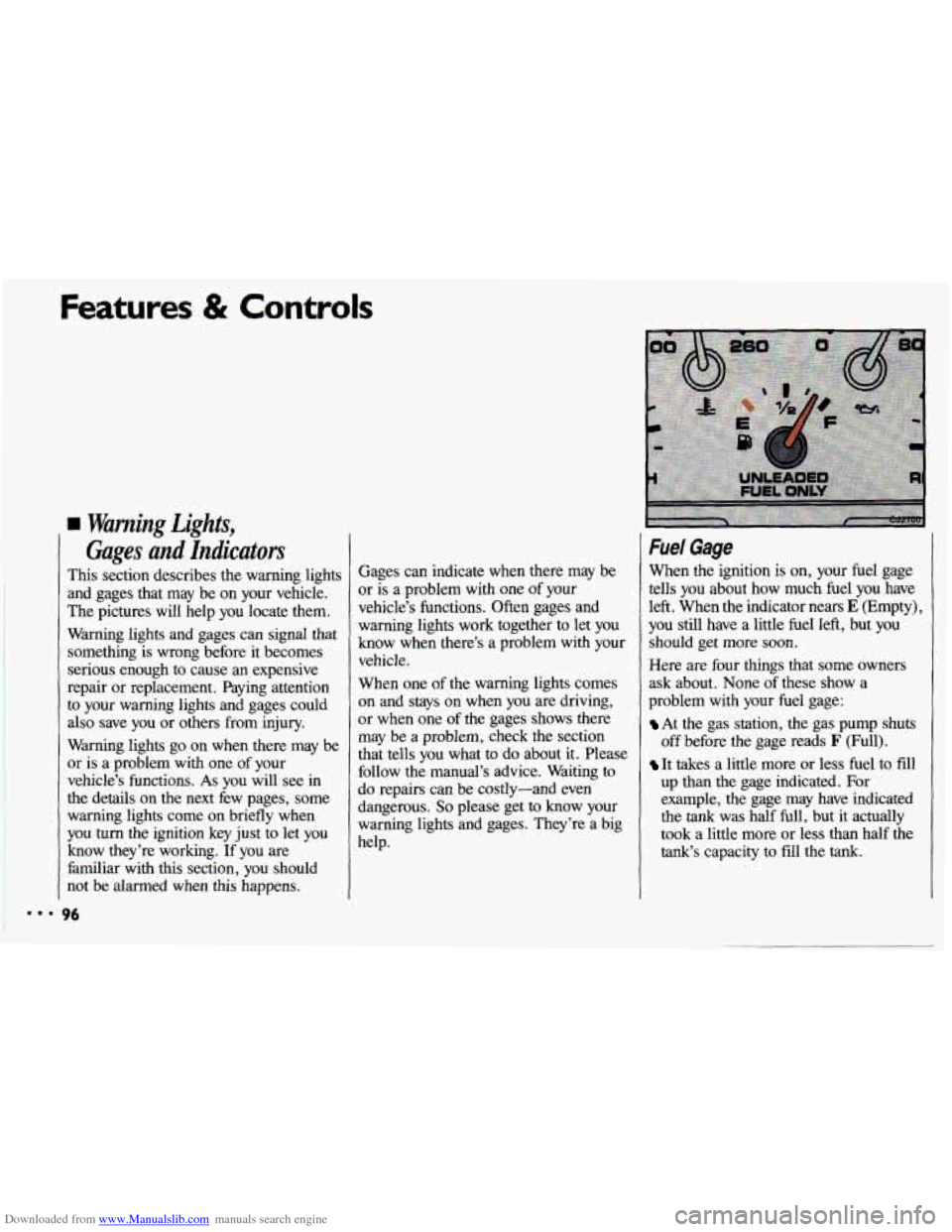
Fuel Gage
When the ignition is on, your fuel gage
tells
you about how much fuel you have
left. When the indicator nears
E (Empty),
you still have a little fuel left, but you
should get more soon.
Here are four things that some owners
ask about. None
of these show a
problem with your fuel gage:
At the gas station, the gas pump shuts
off before the gage reads
F (Full).
It takes a little more or less fuel to fdl
up than the gage indicated. For
example, the gage may have indicated
the
tank was half full, but it actually
took a little more or less than half the
tank‘s capacity to fill the tank.
Page 99 of 308
Downloaded from www.Manualslib.com manuals search engine The gage moves a little when you turn
The gage doesn’t go back to E when
For your fuel
tank capacity, see Service
Station Information
on the last page of
this manual. a
comer or speed up.
you
turn off the ignition.
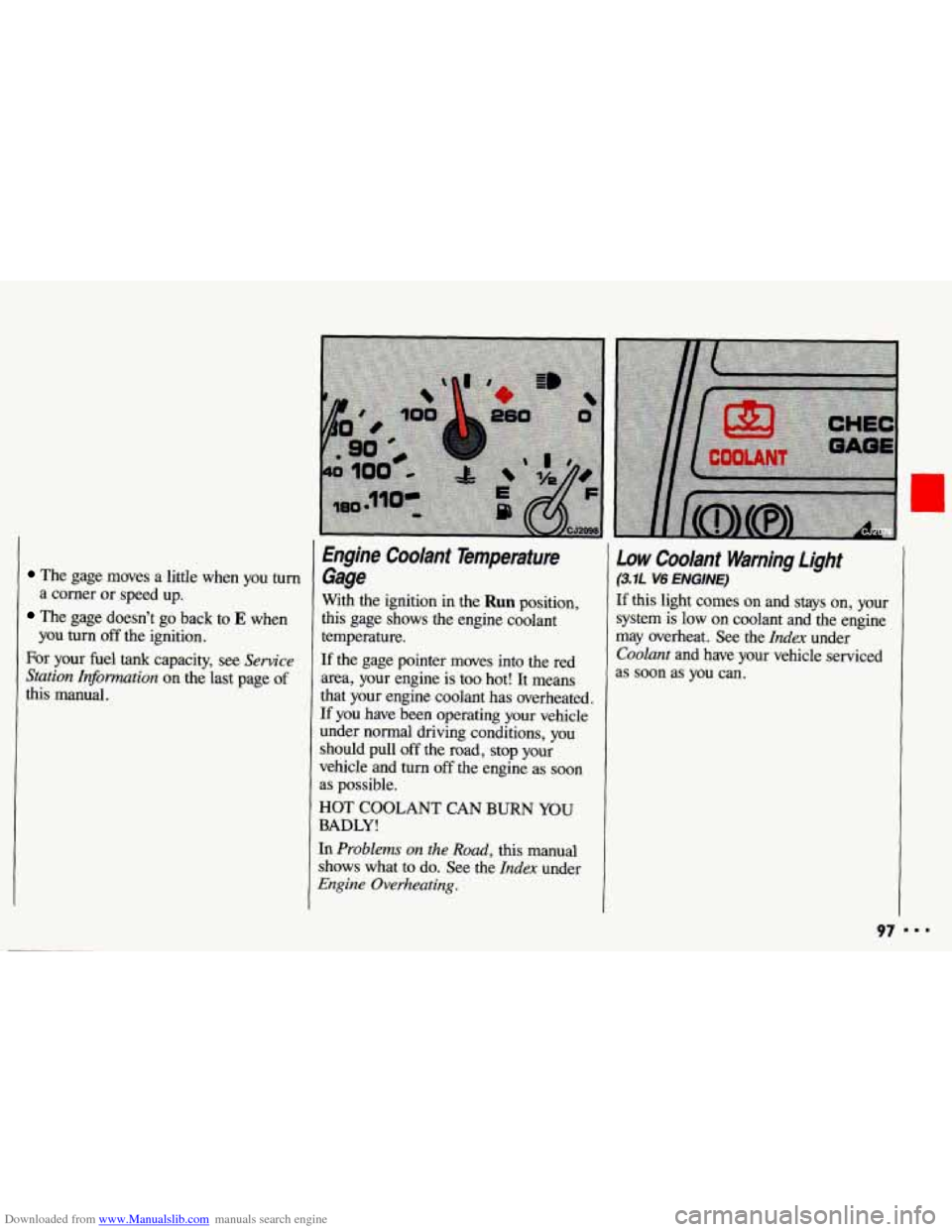
Engine Coolant Temperature
Gage
With the ignition in the Run position,
this gage shows
the engine coolant
temperature.
If the gage pointer moves into the red
area, your engine is
too hot! It means
that your engine coolant has overheated.
If you have been operating your vehicle
under normal driving conditions, you
should pull
off the road, stop your
vehicle and turn
off the engine as soon
as possible.
HOT COOLANT CAN BURN YOU
BADLY!
In Problems on the Road, this manual
shows what to do. See the
Index under
Engine Overheating.
Law Coolant Warning Light
(3.7L V6 ENGiNE)
If this light comes on and stays on, your
system is low on coolant and the engine
may overheat. See the
Index under
Coolant and have your vehicle serviced
as soon as
you can.
97
Page 109 of 308
Downloaded from www.Manualslib.com manuals search engine r
Air Conditioning System
(OPTION)
The air conditioner and heater work
best if you keep your windows closed
while using them. Your vehicle also has
the flow-through ventilation system
described later in this section.
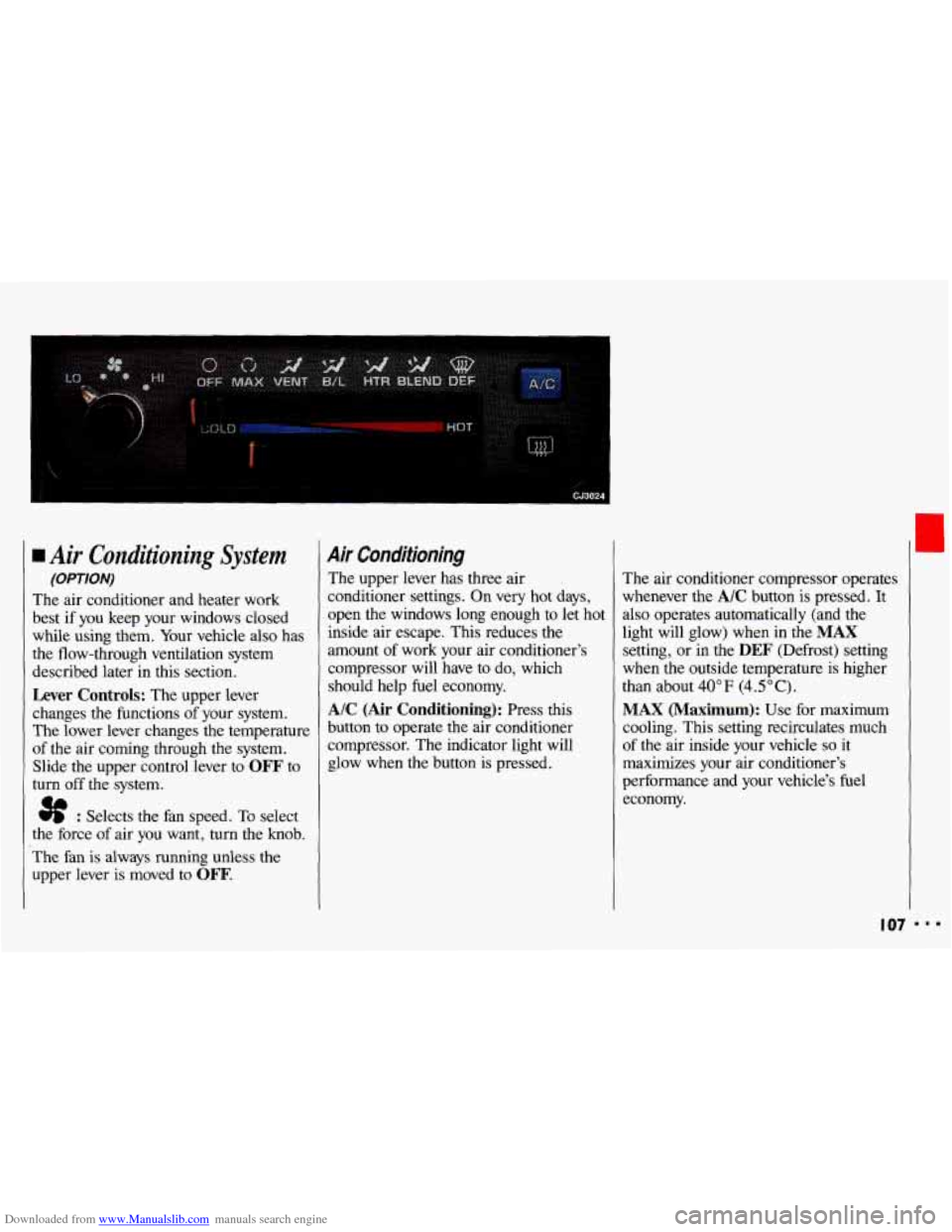
Lever Controls: The upper lever
changes the functions
of your system.
The lower lever changes the temperature
of the air coming through the system.
Slide the upper control lever to
OFF to
turn off the system.
I 3f : Selects the fan speed. To select
the force of air you want, turn the knob.
The fan is always running unless the
upper lever is moved to
OFF.
Air Conditioning
The upper lever has three air
conditioner settings.
On very hot days,
open the windows long enough to let hot
inside air escape. This reduces the
amount of work your air conditioner's
compressor will have to do, which
should help fuel economy.
A/C (Air Conditioning): Press this
button to operate the air conditioner
compressor. The indicator light will
glow when the button
is pressed. The air conditioner compressor
operates
whenever the
AIC button is pressed. It
also operates automatically (and the
light will glow) when in the
MAX
setting, or in the DEF (Defrost) setting
when the outside temperature is higher
than about
40°F (4.5"C).
MAX (Maximum): Use for maximum
cooling. This setting recirculates much
of the air inside your vehicle
so it
maximizes your air conditioner's
performance and your vehicle's fuel
economy.
I07
r
IIB
Page 197 of 308
Downloaded from www.Manualslib.com manuals search engine i
.....
.................................. ...................
........ ... . &5
..... ..... .... .. --
' . I .. ~
Here you wit1 find information
about the care
of your Chevrolet .
This part begins with service and
fuel information. and then
it shows
how to check important fluid and
lubricant levels
. There is also
technical information about your
vehicle. and
a section devoted to its
appearance care
.
Part 6
Service & Appearance Care
Service ......................................................... 196
Fuel ........................................................... 197
HoodRelease
.................................................... 201
EngineOil
...................................................... 205
Aircleaner
..................................................... 209
Transaxle Fluid
................................................... 211
Engine Coolant
................................................... 216
Power Steering Fluid
.............................................. 219
Windshield Washer Fluid
........................................... 220
Brakes
......................................................... 221
Battery
......................................................... 223
BulbReplacement
................................................ 224
Windshield Wiper Blade Replacement
................................. 227
Loading
Your Vehicle ............................................. 227
Vehicle Identification Number (VIN)
................................. 246
Add-on Electrical Equipment
....................................... 247
Fuses
& Circuit Breakers ........................................... 247
Capacities & Specifications ......................................... 250
Fluids & Lubricants ............................................... 252
Replacement Bulbs
............................................... 253
Engine Specifications
............................................. 255
Normal Maintenance Replacement
Parts ............................... 256
Tires .......................................................... 229
Appearancecare
................................................. 236
I95
Page 199 of 308
Downloaded from www.Manualslib.com manuals search engine If you try to do your own servic
work without knowing enough abot it, your vehicle could be damaged.
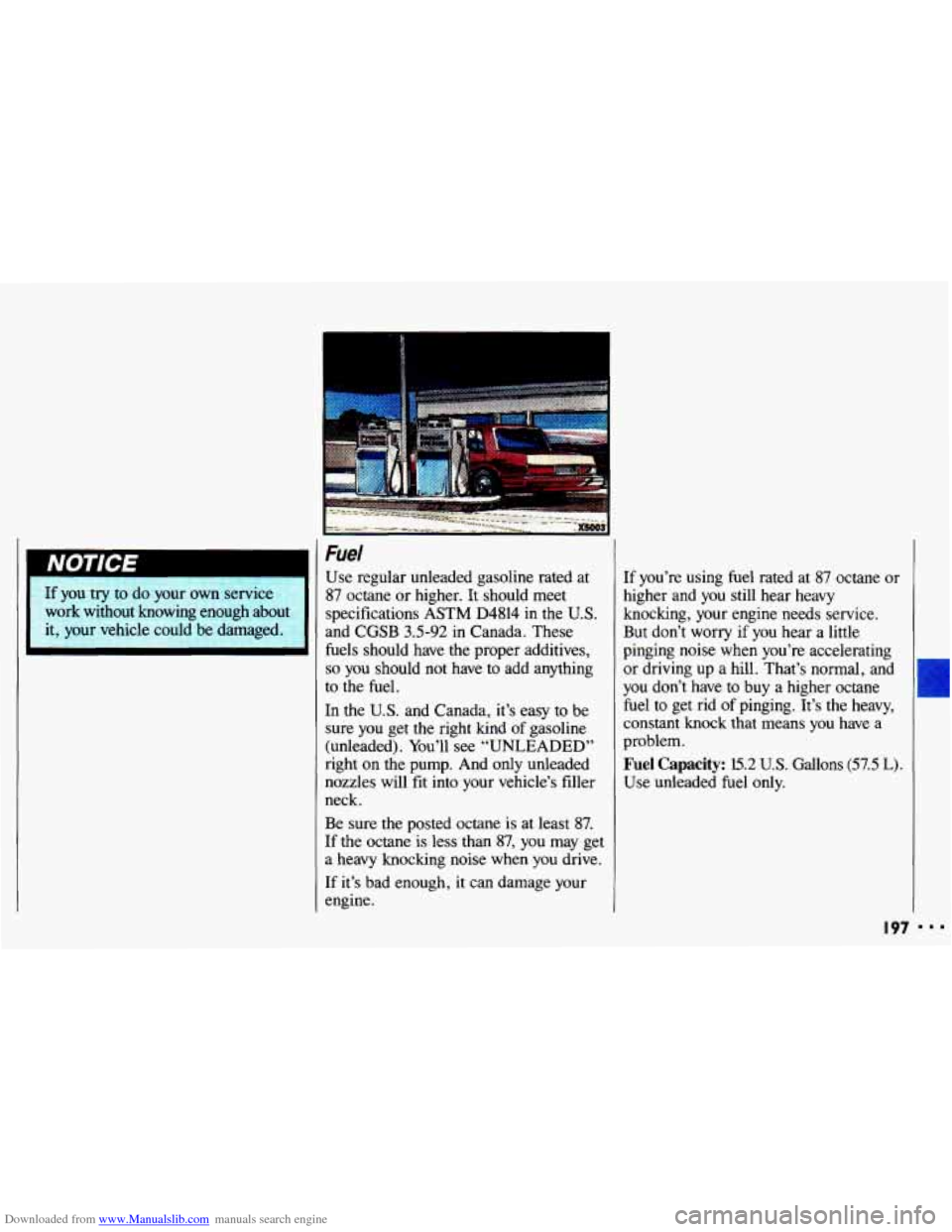
Fuel
Use regular unleaded gasoline rated at
87 octane or higher. It should meet
specifications ASTM D4814 in the U.S.
and CGSB
3.5-92 in Canada. These
fuels should have the proper additives,
so you should not have to add anything
to the fuel.
In the U.S. and Canada, it’s easy to be
sure you get the right kind
of gasoline
(unleaded). You’ll see “UNLEADED”
right on
the pump. And only unleaded
nozzles will
fit into your vehicle’s filler
neck.
Be sure the posted octane is at least
87.
If the octane is less than 87, you may get
a heavy knocking noise when you drive.
If it’s bad enough, it can damage your
engine.
If you’re using fuel rated at 87 octane or
higher and
you still hear heavy
knocking, your engine needs service.
But don’t worry
if you hear a little
pinging noise when you’re accelerating
or driving up
a hill. That’s normal, and
you don’t have to buy a higher octane
fuel to get rid of pinging. It’s the heavy,
constant knock that means
you have a
problem.
Fuel Capacity: 15.2 U.S. Gallons (57.5 L).
Use unleaded fuel only.
I97
Page 202 of 308
Downloaded from www.Manualslib.com manuals search engine Service & Appearance Care
..I
F
Filling Your lank
I 4Knu l”’”
I
Gasoline vapor is highly
- flammable. It bums violently,
and that can cause very bad
injuries. Don’t smoke if you’re
ar gasoline or refueling your
hicle. Keep sparks, flames, and
loking materials away from
,,soline.
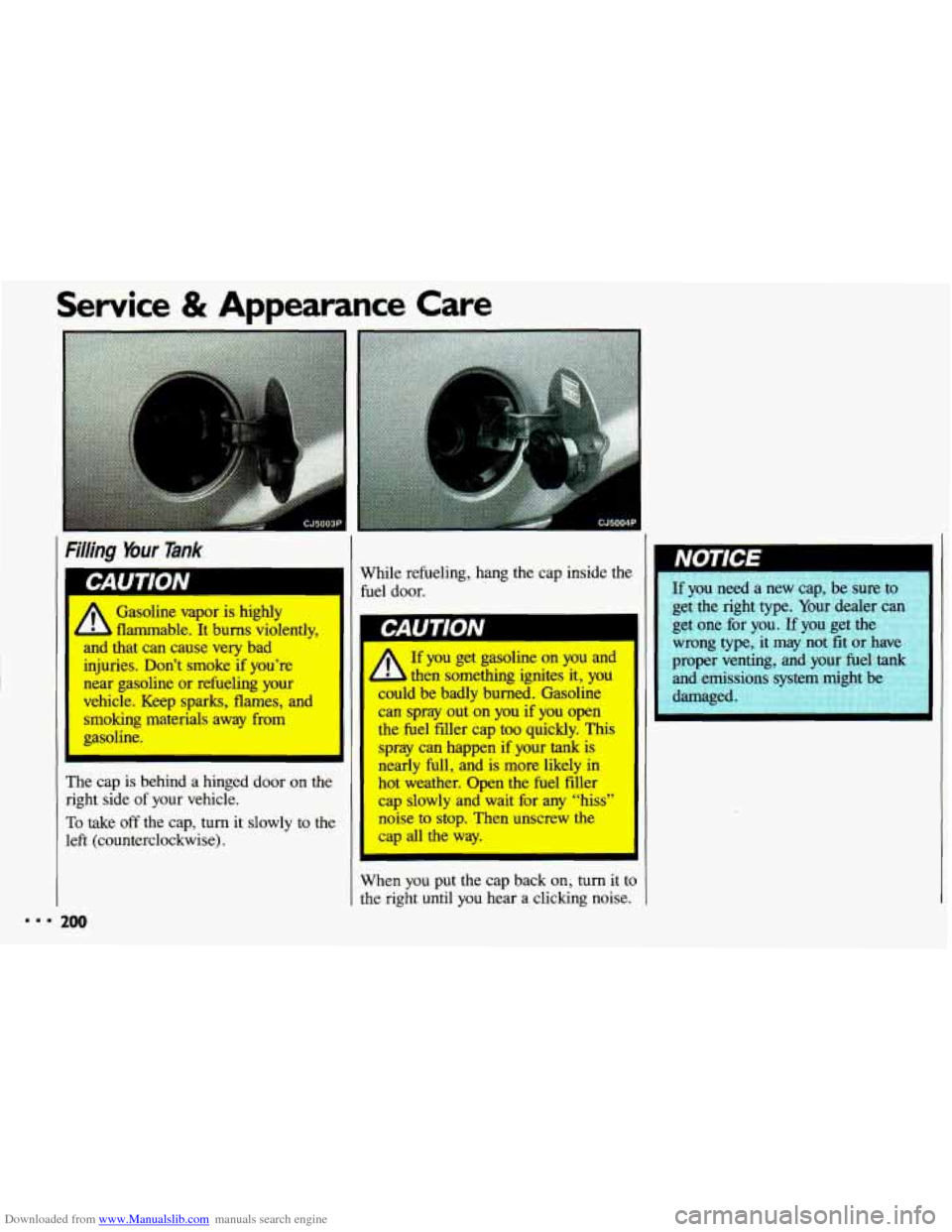
The cap
is behind a hinged door on the
right side of your vehicle.
To take off the cap, turn it slowly to the
left (counterclockwise).
200
rhile refueling, hang the cap inside the
le1 door.
If you get gasoline on you and
then something ignites it, you
could be badly burned. Gasoline
can spray out on you if you open
the fuel filler cap too quickly. This
spray can happen if your
tank is
nearly full, and is more likely in
hot weather. Open the fuel filler
cap slowly and wait for any “hiss”
noise
to stop. Then unscrew the
cap all the way.
{hen you put the cap back on,
turn it to
le right until you hear a clicking noise.
Page 232 of 308
Downloaded from www.Manualslib.com manuals search engine Service & Appearance Care
lnflation-lire Pressure
The Tire-Loading Information label
which is
on the rear edge of the driver’s
door shows the correct inflation
pressures for your tires, when they’re
cold. “Cold” means your vehicle has
been sitting for at least three hours or
driven no more than a mile. Don’t
let anyone tell you that
underinflation
or overinflation is
all right. It’s
not. If your tires don’t
have enough
you can get:
Too much flexing
Too much heat
Tire overloading
Bad weLA
Bad handling
Bad fuel economy. ition)
If your tires have too much air
(overinflation), you can get:
Unusual wear
Bad handling
Rough ride
Needless damage from road
hazards.
When to Check:
Check your tires once a month or more.
Don’t forget your compact spare tire. It
should be at
60 psi (420 kpa).
How to Check:
Use a good quality pocket-type gage to
check tire pressure. Simply looking at
the tires will not tell you the pressure,
especially if
you have radial tires-
which may look properly inflated even if
they’re underinflated.
If your tires have valve caps, be sure to
put them back on. They help prevent
leaks by keeping out dirt and moisture.
230
Page 253 of 308
Downloaded from www.Manualslib.com manuals search engine Refrigerant, Air Conditioning. .......................... See refrigerant charge label under hood.
Not all air conditioning refrigerants are the same. If the air
conditioning system in
your vehicle needs refrigerant, be sure
the proper refrigerant is used.
If you 're not sure, ask your
Chmrolet dealer.
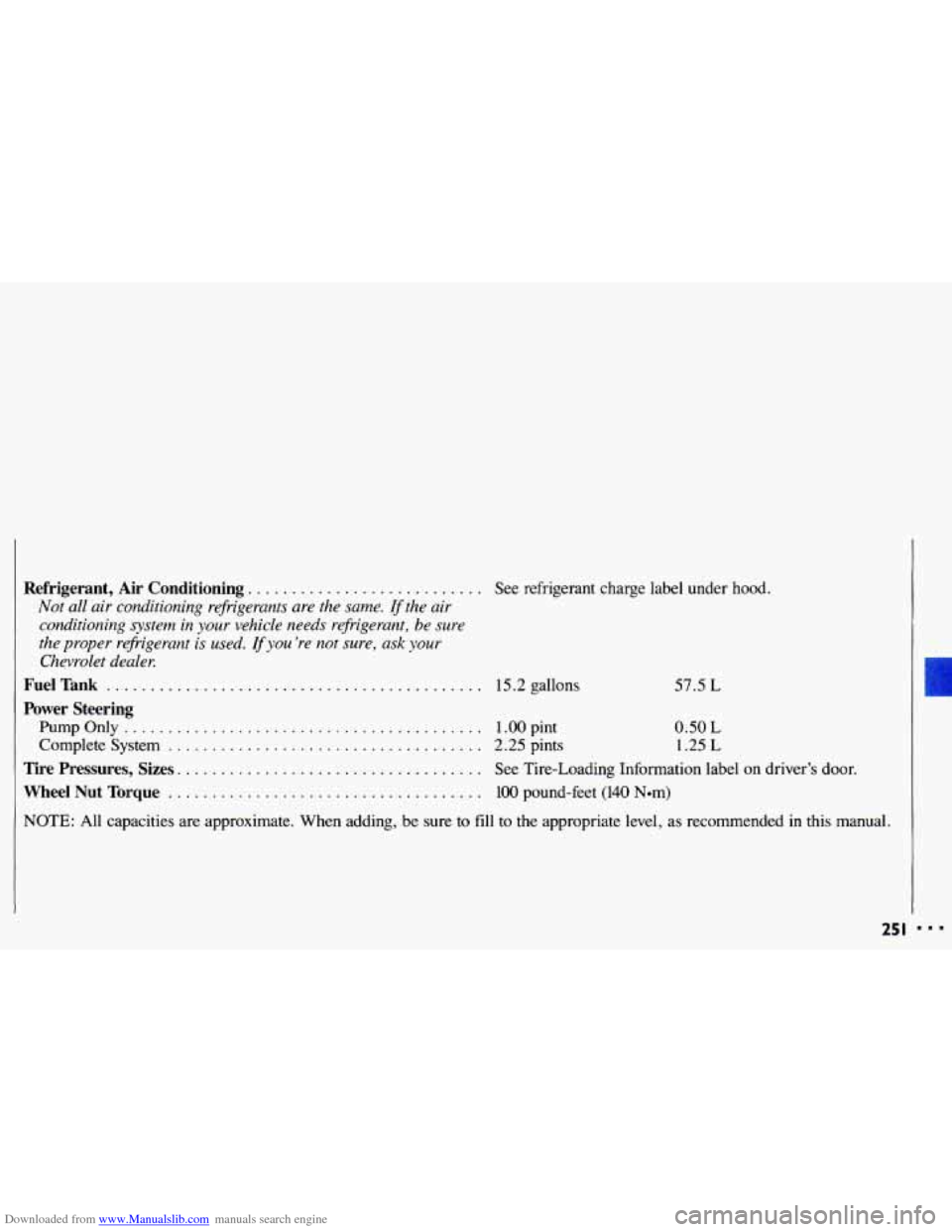
Fuel Tank ........................................... 15.2 gallons
Power Steering
Pump Only ......................................... 1 .OO pint
Complete System
.................................... 2.25 pints
57.5 L
0.50 L
1.25 L
Tire Pressures, Sizes. .................................. See Tire-Loading Information label on driver's door.
Wheel Nut Torque .................................... 100 pound-feet (140 Nem)
NOTE: All capacities are approximate. When adding, be sure
to fill to the appropriate level, as recommended in this manual.
25 I