Page 226 of 308
Downloaded from www.Manualslib.com manuals search engine Service & Appearance Care
1 Halogen Bulbs Headlight Bulb Replacement
~1 For the type of bulb, see the Index under
Replacement Bulbs.
Halogen bulbs have
bLl3t if you drop or scratch the
bulb.
You or others could be
injured. Take special care when
handling and disposing
of halogen
bulbs.
L: pressurized gas inside and can
3
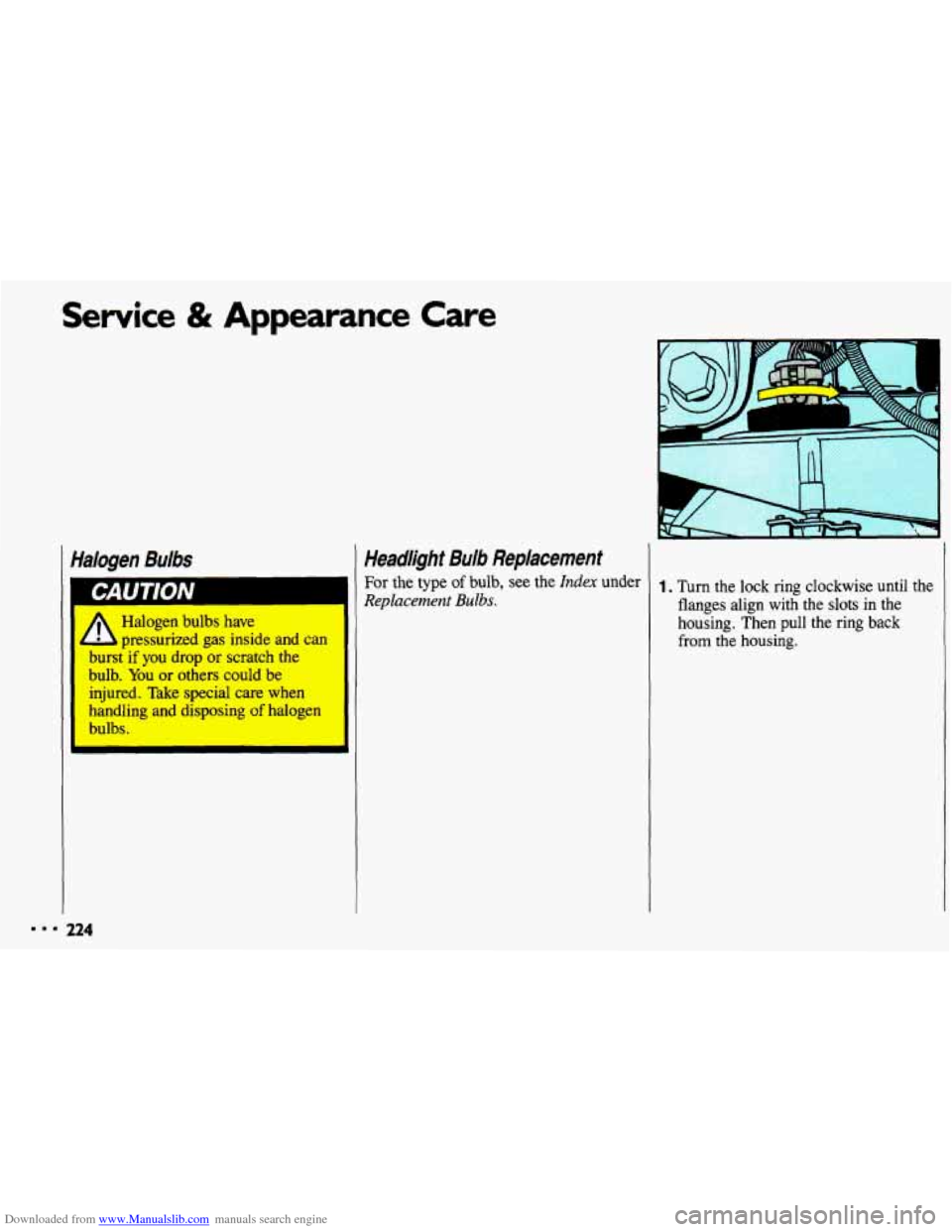
1. Turn the lock ring clockwise until the
flanges align with the slots in the
housing. Then pull the ring back
from the housing.
from the housing.
224
Page 227 of 308
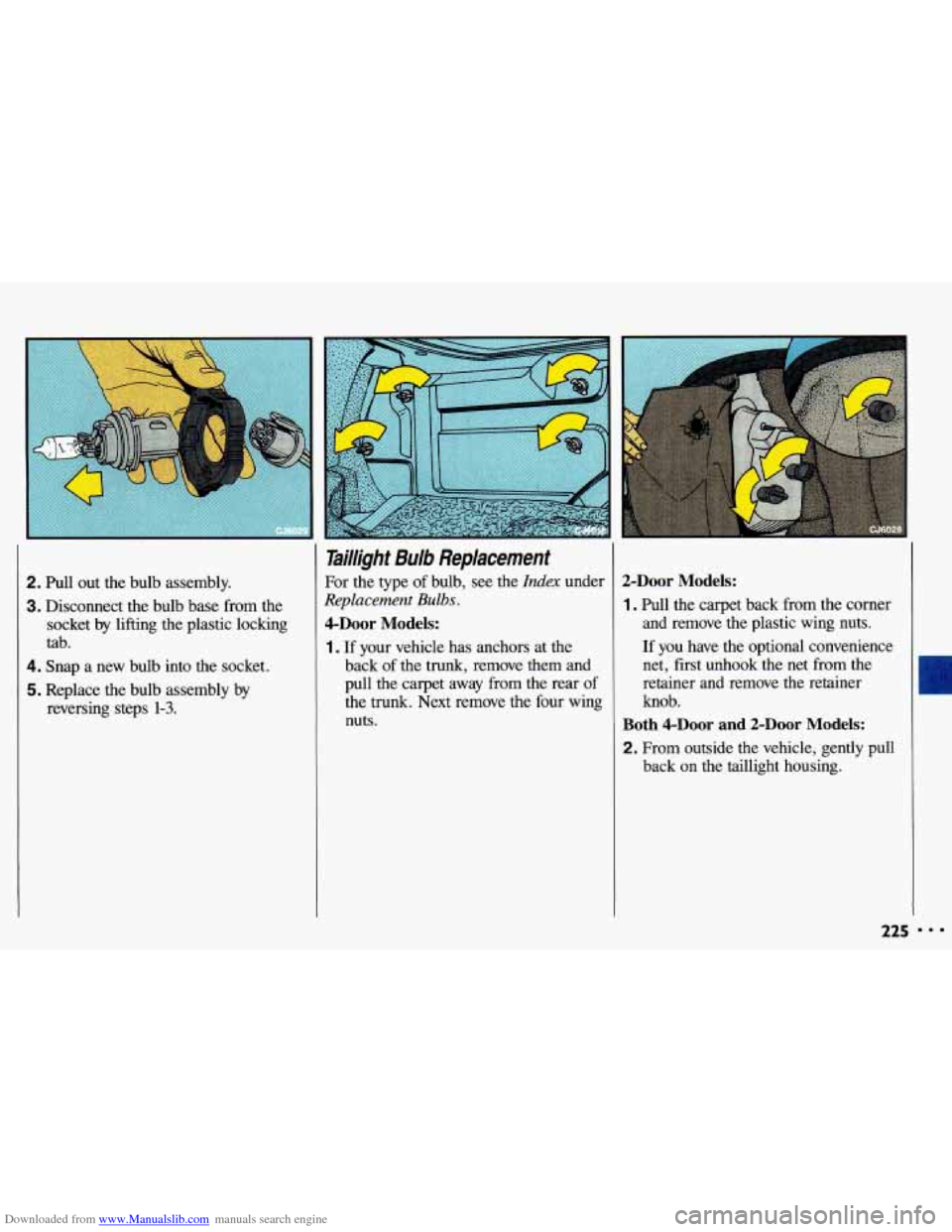
Downloaded from www.Manualslib.com manuals search engine 2. Pull out the bulb assembly.
3. Disconnect the bulb base from the
socket
by lifting the plastic locking
tab.
4. Snap a new bulb into the socket.
5. Replace the bulb assembly by
reversing steps
1-3.
Taillight Bulb Replacement
For the type of bulb, see the Idex under
Replacement Bulbs.
4-Door Models:
1 . If your vehicle has anchors at the
back
of the trunk, remove them and
pull the carpet away from the rear of
the trunk. Next remove the four wing
nuts.
2-Door Models:
1. Pull the carpet back from the comer
and remove the plastic wing nuts.
If you have the optional convenience
net, first unhook the net from the
retainer and remove the retainer
knob.
Both 4-Door and 2-Door Models:
2. From outside the vehicle, gently pull back
on the taillight housing.
Page 228 of 308
Downloaded from www.Manualslib.com manuals search engine DDD
Service & Appearance Care
Tai//ight Bulb Replacement
(CONr)
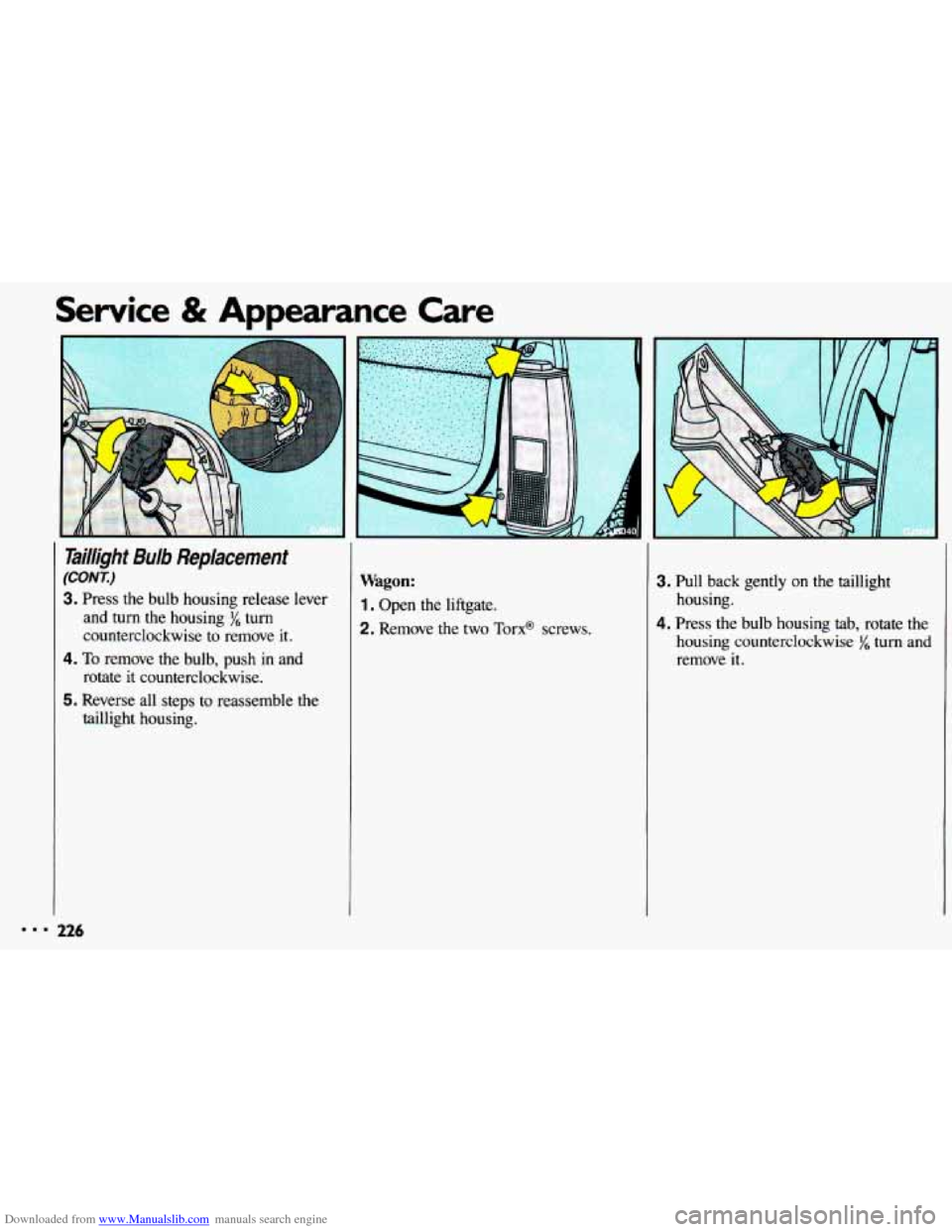
3. Press the bulb housing release lever
and turn the housing turn
counterclockwise to remove it.
4. To remove the bulb, push in and
rotate
it counterclockwise.
5. Reverse all steps to reassemble the
taillight housing.
226
Wagon:
1. Open the liftgate.
2. Remove the two Torx@ screws.
3. Pull back gently on the taillight
housing.
4. Press the bulb housing tab, rotate the housing counterclockwise
f/6 turn and
remove it.
Page 229 of 308
Downloaded from www.Manualslib.com manuals search engine 5. To remove the bulb, push the bulb in,
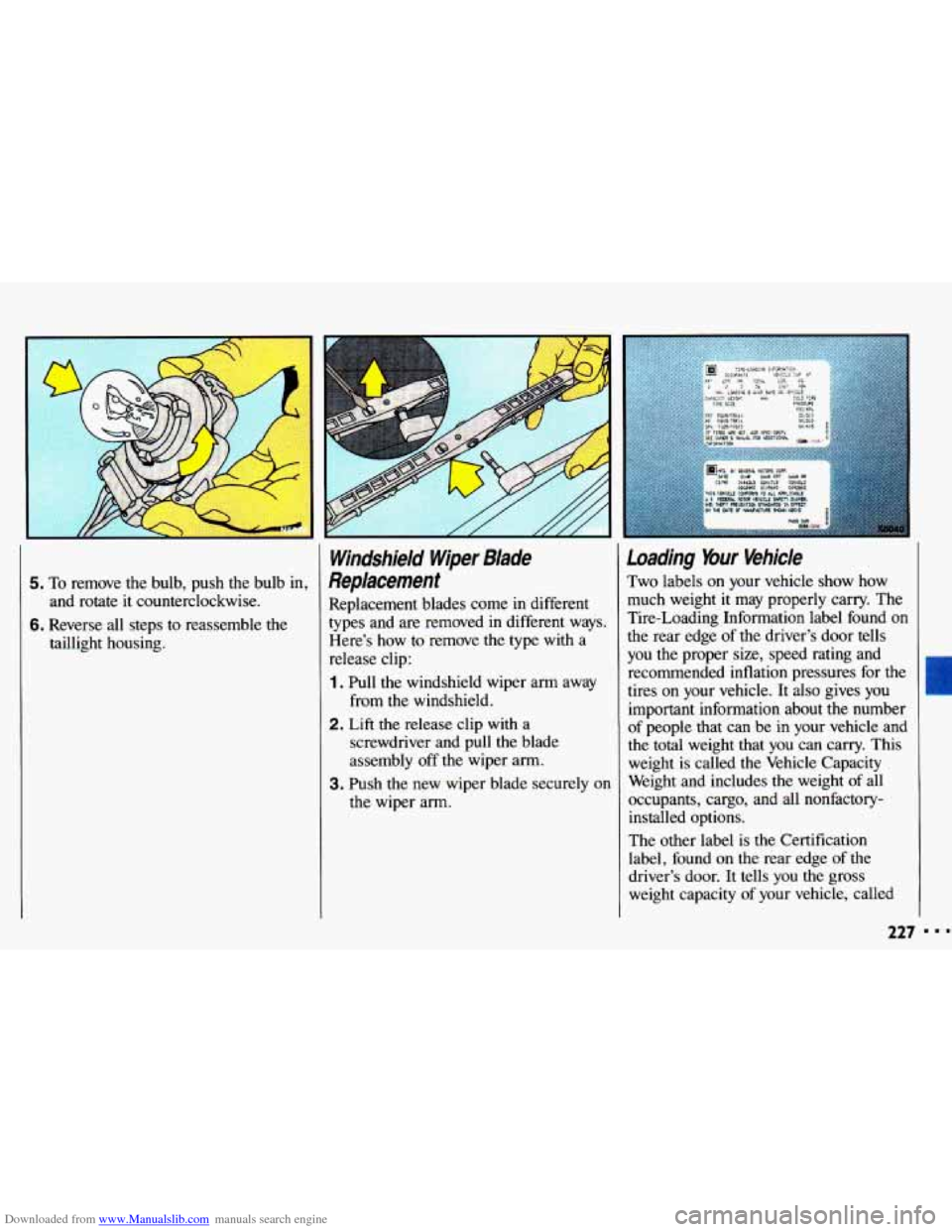
and rotate it counterclockwise.
6. Reverse all steps to reassemble the
taillight housing.
Windshield Wiper Blade
Replacement
Replacement blades come in different
types and are removed in different ways.
Here’s how
to remove the type with a
release clip:
1. Pull the windshield wiper arm away
2. Lift the release clip with a
from the windshield.
screwdriver and pull the blade
assembly
off the wiper arm.
the wiper arm.
3. Push the new wiper blade securely on
Loading %ur Vehicle
Two labels on your vehicle show how
much weight it may properly carry. The
Tire-Loading Information label found
on
the rear edge of the driver’s door tells
you the proper size, speed rating and
recommended inflation pressures for the
tires on your vehicle. It also gives
you
important information about the number
of people
that can be in your vehicle and
the total weight that you can carry. This
weight
is called the Vehicle Capacity
Weight and includes the weight
of all
occupants, cargo, and all nonfactory- installed options.
The other label
is the Certification
label, found on the rear edge of the
driver’s door. It tells you the gross
weight capacity
of your vehicle, called
I
227
Page 231 of 308
Downloaded from www.Manualslib.com manuals search engine 1--
-
Things you=
strike and injure
people in
a sudden stop or turn, or
in
a crash.
Put things in the trunk or rear
area
of your vehicle. In a trunk,
put them as hr forward as you
can.
Try to spread the weight
evenly.
If you have fold-down
rear seats, you’ll find four
anchors on the back wall
of your
trunk.
You can use these anchors
to tie down lighter loads. They’re
not strong enough for
heavy
things, however, so put them as
fbr forward
as you can in the
trunk or rear area.
Never stack heavier things, like
suitcases, inside the vehicle
so
that some of them are above the
tops
of the seats.
e When you carry something
inside the vehicle, secure it
whenever you can.
unless you need to.
0 Don’t leave a seat folded down
I
Tires
We don’t make tires. Your new vehicle comes with high quality tires made by a
leading tire manufacturer. These tires are warranted by the tire manufacturers and
their warranties are delivered with every
new Chevrolet. If your spare tire is a
different brand than your road tires,
you will have a tire warranty folder from each
of these manufacturers.
I I
CAUTION
Poorly maintained and improperly used tires are dangerous. 1
’ - Overloading your tires can cause overheating as a result of too much
friction. You could have
an air-out and a serious accident. See the Index
under hading Your Vehicle.
Underinflated tires pose the same danger as overloaded tires. The resulting
accident could cause serious injury. Check all tires frequently to maintain
the recommended pressure. Tire pressure should be checked
when your
tires
are cold.
sudden impact:
such as when you hit a pothole. Keep tires at the
recommended pressure.
I Overinflated tires are more likely to be cut, punctured, or broken by a
Worn, old tires can cause accidents. If your tread is badly worn, or if your
I tires have been damaged, replace them. I
229
I
I..
Page 237 of 308
Downloaded from www.Manualslib.com manuals search engine A
Using the wrong replacement
wheels, wheel
bolts, or wheel
nuts on your vehicle can be
dangerous. It could affect the braking
and handling of your
vehicle, make tires lose air and
make you lose control. You could
have a collision
in which you or
others .could be injured. Always
use the correct wheel, wheel bolts,
and wheel
nuts for replacement.
z -.
. ::?T?W wrong wheel can also cause
problems with bearing life, bra‘
cooling, speedometedodometer
calibration, headlight aim,
bumper
height, vehicle ground clearance,
.. and tire or tire chain clearance +*
the body adchassis.
Used Replacement Wheels
Putting a used wheel on your
4 vehicle is dangerous. You
can’t know how it’s been
used or
how many miles it’s been driven.
It could fail suddenly and cause an
accident. If you have to replace a
wheel use a new GM original
equipment wheel.
235
c
Page 240 of 308
Downloaded from www.Manualslib.com manuals search engine Service & Appearance Care
Using &am-Type Cleaner on
Fabric
Vacuum and brush the area to remove
any loose dirt.
Always clean a whole trim panel or
section. Mask surrounding trim along
stitch or welt lines.
Mix Multi-Purpose Powdered Cleaner
following the directions on the
container label.
Use suds only and apply with a clean
Don’t saturate the material.
Don’t rub it roughly.
As soon as you’ve cleaned the section,
sponge.
use a sponge to remove the suds.
Rinse the section with a clean, wet
sponge.
Wipe off what’s left with a slightly
damp paper towel or cloth.
Then dry it immediately with an air
hose,
a hair dryer or a heat lamp.
I
Be careful with a hair dryer or heat
lamp. You
could scorch the fabric. I
Wipe with a clean cloth.
Using Solvent-Type Cleaner on
Fabric
First, see if you have to use solvent-type
cleaner at all. Some spots and stains will
clean
off better with just water and mild
soap.
If you need to use it, then:
Gently scrape excess soil from the
trim material with a clean, dull knife
or scraper. Use very little cleaner,
light pressure and clean cloths (preferably cheesecloth). Cleaning
should start at the outside of the stain,
“feathering” toward the center. Keep
changing to a clean section
of the
cloth.
When you clean a stain from fabric,
immediately dry the area with an air
hose, hair dryer, or heat lamp to help
prevent a cleaning ring. (See the
previous
NOTICE.)
Page 241 of 308
Downloaded from www.Manualslib.com manuals search engine Fabric Protection
Your Chevrolet has upholstery that has
been treated with ScotchgardTM Fabric Protector, a 3M product. Scotchgard”
protects fabrics by repelling
oil and
water, which are the carriers of most
stains. Even with this protection,
you
still need to clean your upholstery often
to keep it looking new.
Further information
on cleaning is
available by calling 1-800-433-3296 (in
Minnesota,
1-800-642-6167).
Special Cleaning Problems
Greasy or Oily Stains: Like grease, oil,
butter, margarine, shoe polish, coffee
with cream, chewing gum, cosmetic
creams, vegetable oils, wax crayon, tar
and asphalt.
Carefully scrape off excess stain.
Then follow the solvent-type
Shoe polish, wax crayon, tar and
instructions earlier
in this section.
asphalt will stain if
left on a vehicle
seat fabric. They should be removed
as soon as possible. Be careful,
because the cleaner will dissolve them
and may cause them
to bleed.
Non-Greasy Stains: Like catsup, coffee
(black), egg, fruit, fruit juice, milk,
soft
drinks, wine, vomit, urine and blood.
Carefully scrape off excess stain, then
sponge the soiled area with cool water.
If a stain remains, follow the foam-
type instructions earlier in this
section.
If an odor lingers after cleaning vomit
or urine, treat the area with a water/
baking soda solution:
1 teaspoon
(5 ml) of baking soda to 1 cup
(250 ml) of lukewarm water.
solvent-type cleaner.
Finally, if needed, clean lightly with
Combination Stains: Like candy, ice
cream, mayonnaise, chili sauce and
unknown stains.
Carefully scrape off excess stain, then
clean with cool water and allow to
dry.
If a stain remains, clean it with
solvent-type cleaner.
239