1993 CHEVROLET CAVALIER warning
[x] Cancel search: warningPage 159 of 308

Downloaded from www.Manualslib.com manuals search engine Torque Lock
(AUTOMATIC TRANSAXLE)
If you are parking on a hill and you
don’t shift
your transaxle into P (Park)
properly, the weight of the vehicle may
put too much force on the parking pawl
in the transaxle. You may find it difficult
to pull the
shift lever out of P (Park).
This
is called “torque lock.” To prevent
torque lock, always be sure to shift into
P (Park) properly before you leave the
driver’s seat.
To find out how, see the
Index under Shiftirtg Into P (Park),
When you are ready to drive, move the
shift lever out
of P (Park) before you
release the parking brake.
If torque lock does occur, you may need
to have another vehicle push yours a
little uphill to take some
of the pressure
from the transaxle,
so you can pull the
shift lever out
of P (Park).
Winter Driving
Here are some tips for winter driving:
Have your Chevrolet in good shape for
winter. Be sure your engine coolant
mix is correct.
Snow tires can help in loose snow, but
they may give you less traction on ice
than regular tires.
If you do not expect
to be driving in deep snow, but may
have to travel over ice,
you may not
want to switch to snow tires at all.
You may want to put winter
emergency supplies in your trunk or
rear area.
Include an ice scraper, a small brush
or broom, a supply of windshield
washer fluid, a rag, some winter outer
clothing, a small shovel, a flashlight,
a
red cloth, and a couple of reflective
warning triangles. And, if you will be
driving under severe conditions,
include a small bag
of sand, a piece of
old carpet or a couple
of burlap bags
to help provide traction. Be sure you
properly secure these items
in your
vehicle.
I57
Page 165 of 308
Downloaded from www.Manualslib.com manuals search engine Part 5
Problems on the Road
Hazard Warning Flashers .......................................... .164
Towing Your Chevrolet ........................................... .169
Engine Overheating
.............................................. ,174
If a Tire Goes Flat ............................................... .184
ComDact Spare Tire
.............................................. .191
Jumpstarting
....................................................164
ChangingaFlatTire .............................................. 184
If You’re
Stuck: In Sand, Mud, Ice or Snow ................... ...... .192
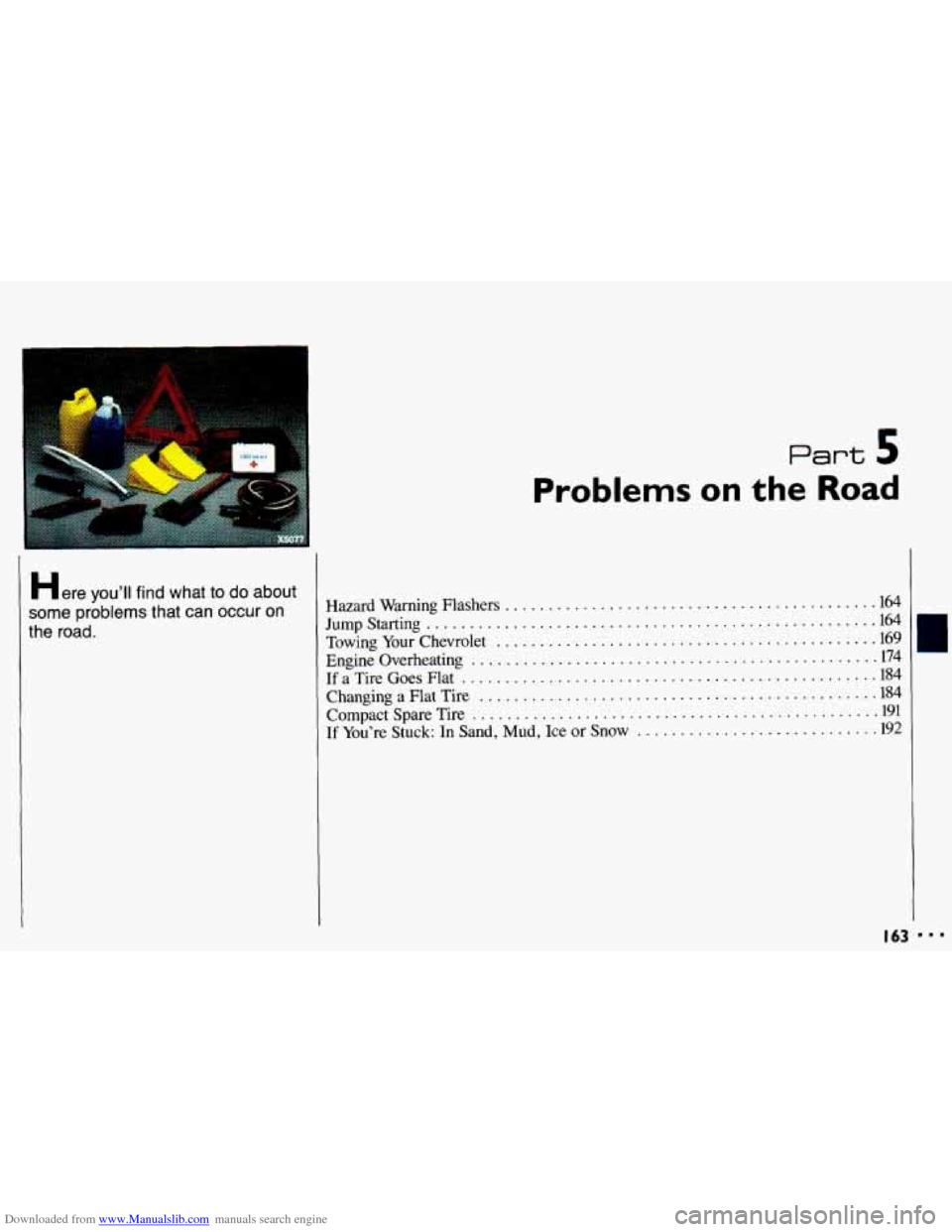
Here you’ll find what to do about
some problems that can occur on
the road.
I63
Page 166 of 308
Downloaded from www.Manualslib.com manuals search engine Problems on the Road
-<.'
I X600!
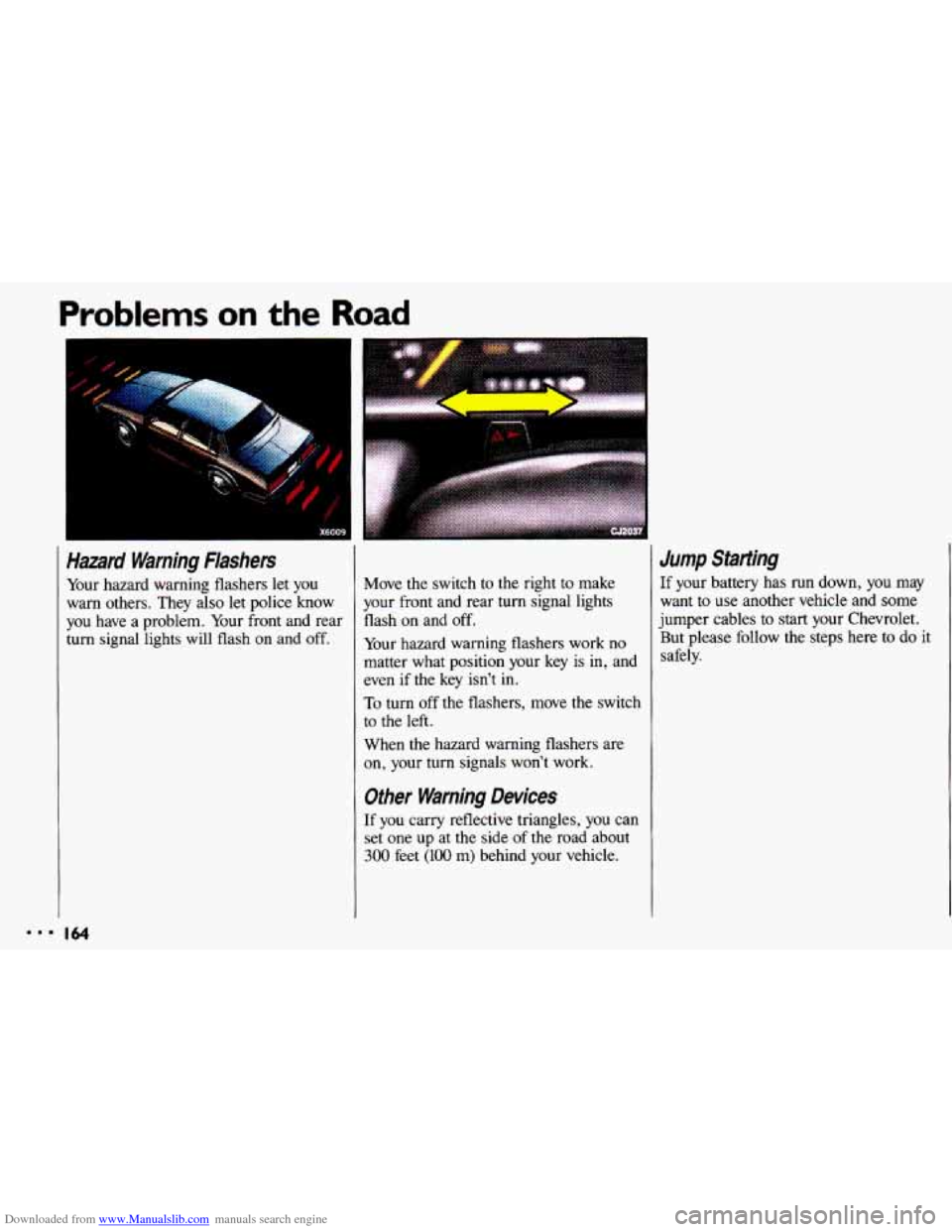
Hazard Warning Flashers
Your hazard warning flashers let you
warn others. They also let police know
you have a problem. Your front and rear
turn signal lights will flash on and off. Move
the switch to the right to make
your front and rear turn signal lights
flash on and off.
Your hazard warning flashers
work no
matter what position your key
is in, and
even if the key isn't in.
To turn off the flashers, move the switch
to the left.
When the hazard warning flashers are
on, your turn signals won't work.
Other Warning Devices
If you carry reflective triangles, you can
set one up at the side of the road about
300 feet (100 m) behind your vehicle.
Jump Starling
If your battery has run down, you may
want to use another vehicle and some
jumper cables
to start your Chevrolet.
But please follow the steps here to do it
safely.
Page 171 of 308
Downloaded from www.Manualslib.com manuals search engine 12. Remove the cables in reverse order
to prevent electrical shorting. Take
care that they don't touch each other
or any other metal.
I
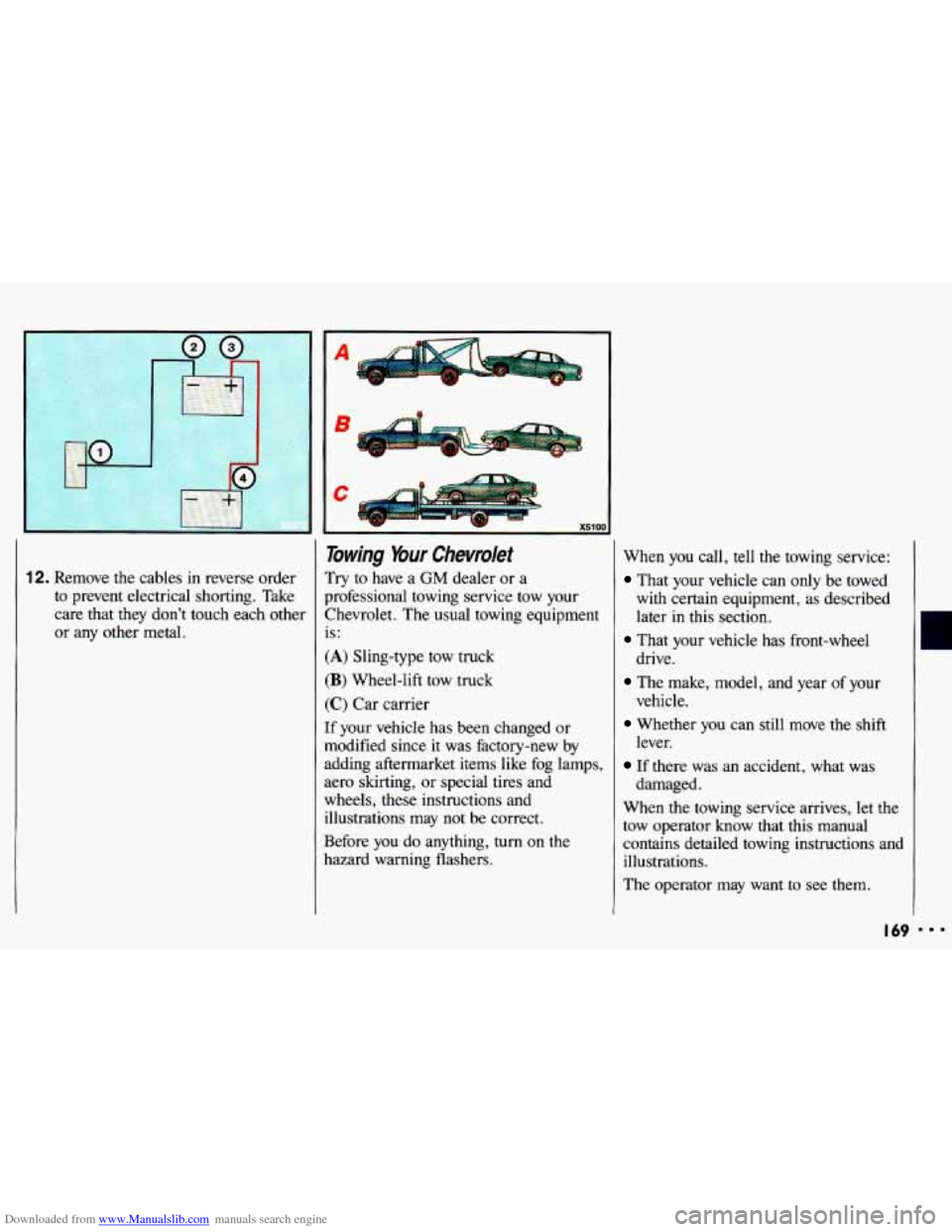
Towing Your Chevrolet
Try to have a GM dealer or a
professional towing service tow your
Chevrolet. The usual towing equipment
is:
(A) Sling-type tow truck
(B) Wheel-lift tow truck
(C) Car carrier
If your vehicle has been changed or
modified since it was factory-new by
adding aftermarket items like fog lamps,
aero skirting, or special tires and
wheels, these instructions and illustrations may not be correct.
Before you do anything, turn on the
hazard warning flashers. When
you call, tell the towing service:
That your vehicle can only be towed
with certain equipment,
as described
later
in this section.
drive.
vehicle. lever.
damaged.
That your vehicle has front-wheel
The make, model, and year of your
Whether you can still move the shift
If there was an accident, what was
When the towing service arrives, let the
tow operator know that this manual
contains detailed towing instructions and
illustrations.
The operator may want to see them.
I69
Page 176 of 308
Downloaded from www.Manualslib.com manuals search engine Problems on the Road
7
Engine Overheating
You will find a coolant temperature gage
on your Chevrclet's instrument panel.
If your engine catches fire because
you keep driving with
no coolant,
your vehicle can be badly
:z
damaged. The costly repairs wouf~,~
not be covered by your warranty.
<* .>* i
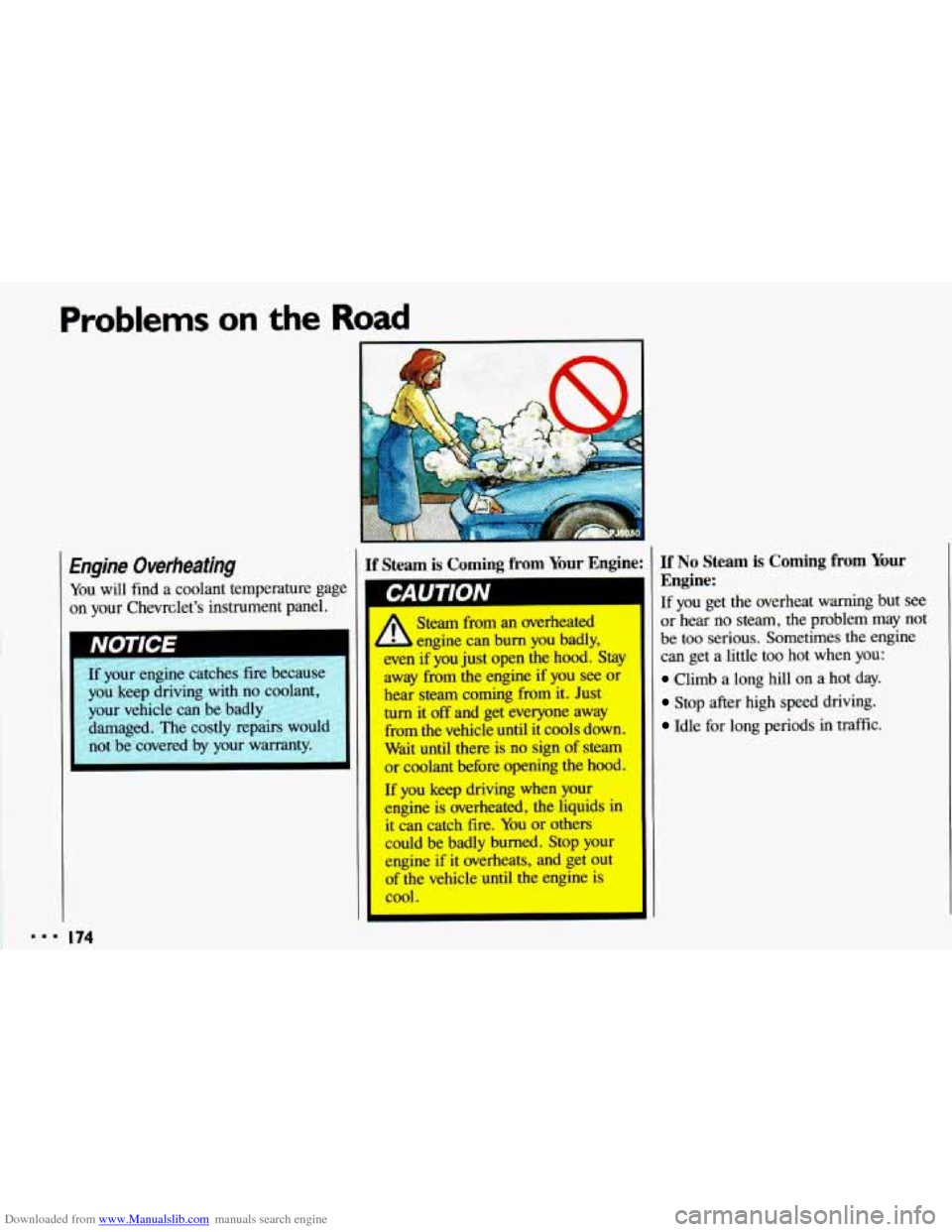
If Steam is Corning from Your Engine
A
Steam from an overheated
engine can burn
you badly,
even if you just open the hood. Stay
away from the engine
if you see or
hear steam coming from it. Just
turn it off and get everyone away
from the vehicle until it cools down.
Wait until there is no sign
of steam
or coolant before opening the hood.
If
you keep driving when your
engine is overheated, the liquids in
it can catch fire. You or others
could be badly burned. Stop your
engine if it overheats, and get out
of the vehicle until the engine is
cool.
If No Stem is Coming from Your
Engine:
If you get the overheat warning but see
or hear no steam, the problem may not
be too serious. Sometimes
the engine
can get a little too hot when you:
Climb a long hill on a hot day.
Stop after high speed driving.
Idle for long periods in traffic.
== 174
Page 177 of 308
Downloaded from www.Manualslib.com manuals search engine If you get the overheat warning with no
sign
of steam, try this for a minute or so:
1. If you have an air conditioner, turn it
2. Turn on your heater to full hot at the
off.
highest fan speed and open the window as necessary.
3. Try to keep your engine under load
(in a drive gear where the engine
runs slower).
If
you no longer have the overheat
warning, you can drive. Just to be safe,
drive slower for about ten minutes. If
the warning doesn’t come back on, you
can drive normally.
If the warning continues, pull over, stop, and park your vehicle right away. If there’s
still no sign of steam, you can
idle the engine for two or three minutes
while you’re parked, to see
if the
warning stops. But then, if you still have
the warning, TURN
OFF THE
ENGINE AND
GET EVERYONE
OUT OF THE VEHICLE until it cools
down.
You may decide not to
lift the hood but
to get service help right away.
If you have
a 2.2L L4 engine, your
engine coolant system
will have a
coolant recovery
tank. If you have a 3.1L
V6 engine, your engine coolant system
will have a coolant surge tank.
There are important differences between
these two cooling systems. Read this section carefully.
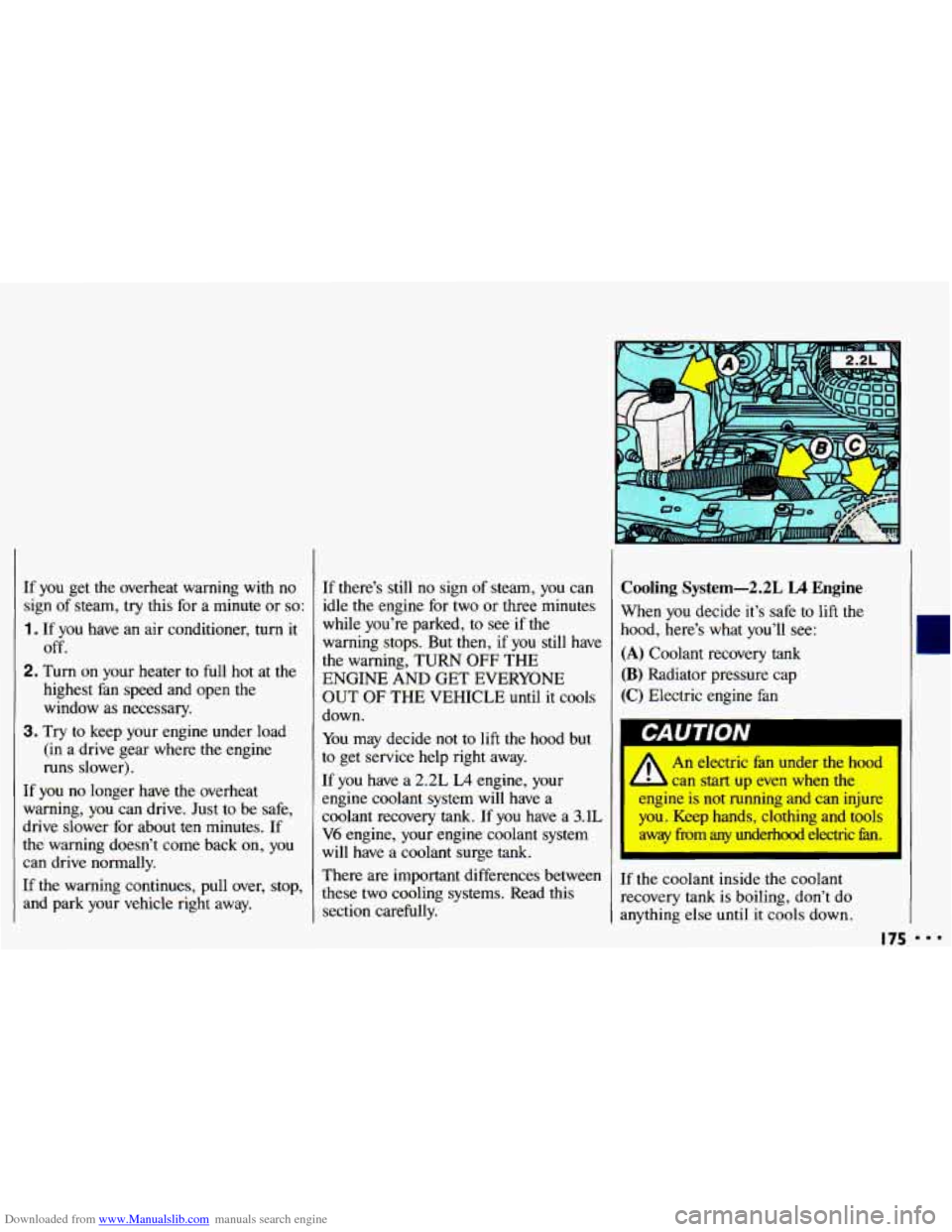
Cooling System-2.2L LA Engine
When you decide it’s safe to lift the
hood, here’s what you’ll see:
(A) Coolant recovery tank
(B) Radiator pressure cap
(C) Electric engine fan
a An electric fan under the hood
engine
is not running and can injure
you. Keep hands, clothing and tools
away
from any underhood electric h.
L can start up even when the
If the coolant inside the coolant
recovery tank
is boiling, don’t do
anything else until it cools down.
I75
Page 180 of 308
Downloaded from www.Manualslib.com manuals search engine Problems on the Road
Engine Overheating (CONT.)
How to Add Coolant to the Coolant
Recovery Tank
(or the Coolant Surge
Tank):
If you haven’t found a problem yet, but
the coolant level isn’t at or above FULL
COLD,
add a 50/50 mixture of clean
water
(preferably distilled) and a proper
antifreeze at the coolant recovery
tank
(or coolant surge tank). If you have the
coolant surge tank, be sure
the cooling
system, including the coolant surge
tank
pressure cap, is cool before you do it.
See How To Add Coolant to the 2.2L L4
Engirze at the Radiator or How to Add
Coolant
to the 3.1L V4 Engine ut the
Coolant
Surge Tank later in this section.
A
Adding only plain water to
your cooling system can be
dangerous. Plain water, or some
other liquid like alcohol, can boil
before the proper coolant mix will.
Your vehicle’s coolant warning
system
is set for the proper cool an^
mix. With plain water or the
wrong
mix, your engine could get
too hot but you wouldn’t get
the
overheat warning, Your engine
could catch fire and you or others
could be burned. Use a 50150 mix
of clean water and a proper
antifreeze. In cold weather, water can freezt
and crack the engine, radiator,
heater core and other parts Ise
the recommended coolant.
mmm I 78
Page 181 of 308
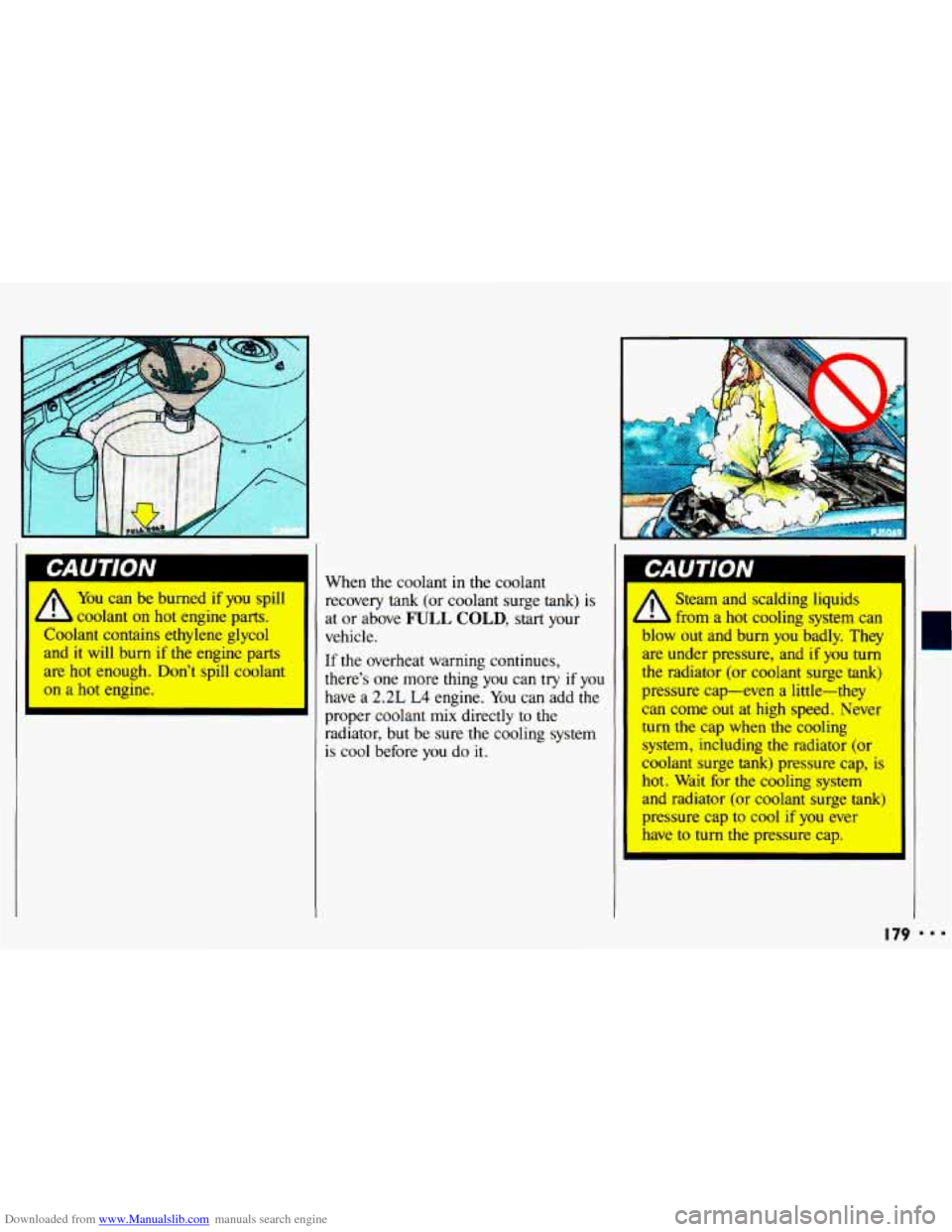
Downloaded from www.Manualslib.com manuals search engine A You can be burned if you spill
coolant on hot engine parts.
Coolant contains ethylene glycol
and
it will burn if the engine parts
are hot enough. Don't spill coolant
on a hot engine. When
the coolant
in the coolant
recovery
tank (or coolant surge tank) is
at or above
FULL COLD, start your
vehicle.
If the overheat warning continues,
there's one more thing you can
try if you
have a
2.2L L4 engine. You can add the
proper coolant mix directly to the
radiator, but be sure the cooling system
is cool before you do
it.
I
A
Steam and scalding liquids
from a hot cooling system can
blow out and burn you badly. They
are under pressure, and
if you turn
the radiator (or coolant surge
tank)
pressure cap-even a little-they
can come out at high speed. Never
turn the cap when the cooling
system, including the radiator (or
coolant surge tank) pressure cap, is
hot. Wait for the cooling system
and radiator (or coolant surge
tank)
pressure cap to cool if you ever
have to turn the pressure cap.
I I 79 I..