1993 CHEVROLET CAVALIER warning
[x] Cancel search: warningPage 186 of 308
Downloaded from www.Manualslib.com manuals search engine Problems on the Road
Zf a Tire Goes Flat
It’s unusual for a tire to “blow out”
while you’re driving, especially if you
maintain your tires properly.
If air goes
out of a tire, it’s much more likely
to
leak out slowly. But if you should ever
have a “blowout,” here are a few tips
about what to expect and what to do:
If a front tire fails, the flat tire will
create a drag that pulls the vehicle
toward that side. Take your foot off the accelerator pedal and grip the steering
wheel firmly. Steer to maintain lane
position, then gently brake
to a stop well
out of
the traffic lane.
I 84
A rear blowout, particularly on a curve,
acts much like a skid and may require
the same correction you’d use in a skid.
In any rear blowout, remove your foot
from the accelerator pedal. Get the
vehicle under control by steering the
way
you want the vehicle to go. It may
be very bumpy and noisy, but you can
still steer. Gently brake
to a stop, well
off the road
if possible.
If your tire goes flat, the next section
shows how
to use your jacking
equipment to change
a flat tire safely.
Changing a Flat Tire
If a tire goes flat, avoid further tire and
wheel damage by driving slowly to a
level place.
Turn on your hazard
warning flashers.
Page 193 of 308
Downloaded from www.Manualslib.com manuals search engine Don’t try to put a wheel cover on your
compact spare tire.
It won’t fit. Store the
wheel cover and plastic cap nuts in the
trunk or rear area until you have the flat
tire repaired or replaced.
16. Store the flat tire in the compact
spare tire compartment, and secure
with the wing bolt and extension.
Store the jack and wheel wrench in
their compartment, also.
MU I IVN 1
Storing a jack, a tire, or other
:quipment in the passenger
compartment
of the vehicle could
cause injury. In a sudden stop
or
collision, loose equipment could
strike someone. Store all these in
the proper place.
The compact spare is for temporary use
only. Replace the compact spare tire
with a full-size tire as soon as you can.
See
Compact Spare Tire next in this
section.
Compact Spare Tire
Although the compact spare was fully
inflated when your vehicle was new, it
can lose air after a time. Check the
inflation pressure regularly.
It should be
60 psi (420 Wa). The compact spare is
made to go up to
3,000 miles (5 000 km),
so you can finish your trip and have
your full-size tire repaired or replaced
where you want.
Of course, it’s best to
replace
your spare with a full-size tire as
soon as you can. Your spare will last
longer and be in good shape in case you
need it again.
Your anti-lock brake system warning
light may come on when you are driving
with a compact spare. See the
Index
under Anti-Lock Brake System Warning
Light.
191
Page 218 of 308
Downloaded from www.Manualslib.com manuals search engine 888
Service rance Care
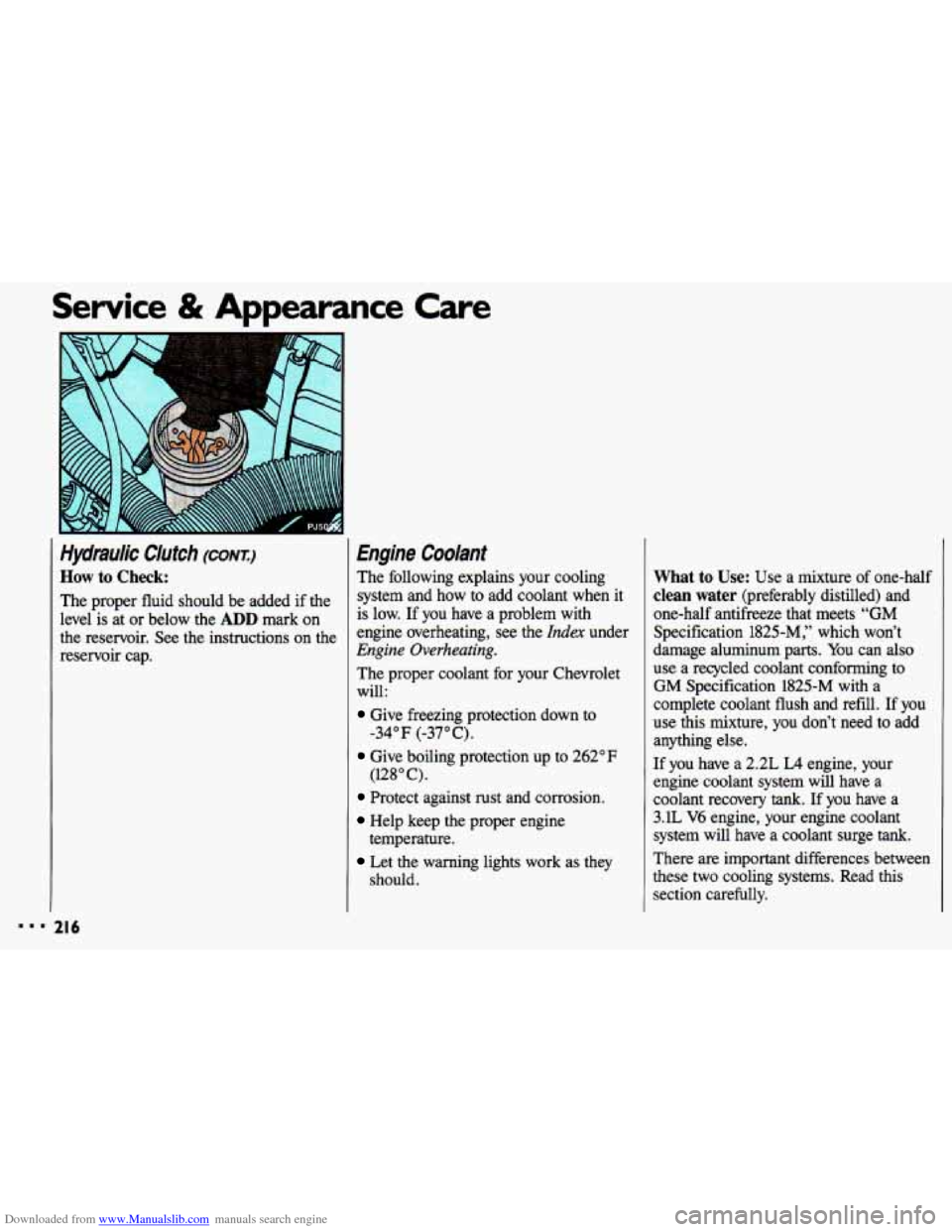
Hydraulic Clutch (CONTJ
How to Check:
The proper fluid should be added if the
level is at or below the
ADD mark on
the reservoir.
See the instructions on the
reservoir cap.
216
Engine Coolant
The following explains your cooling
system and how to add coolant when it
is low. If you have a problem with
engine overheating,
see the Index under
Engine Overheating.
The proper coolant for your Chevrolet
will:
Give freezing protection down to
Give boiling protection up to 262°F
Protect against rust and corrosion.
Help keep the proper engine
Let the warning lights work as they
-34" F (-37" C).
(128" C).
temperature.
should.
What to Use: Use a mixture of one-half
clean water (preferably distilled) and
one-half antifreeze that meets "GM
Specification 1825-M," which won't
damage aluminum parts.
You can also
use a recycled coolant conforming to
GM Specification 1825-M with a
complete coolant flush and refill.
If you
use this mixture, you don't need to add
anything else.
If you have a 2.2L LA engine, your
engine coolant system will have a
coolant recovery
tank. If you have a
3.1L V6 engine, your engine coolant
system will have a coolant surge
tank.
There are important differences between
these two cooling systems. Read this section carefully.
Page 219 of 308
Downloaded from www.Manualslib.com manuals search engine L Adding only plain water to - your cooling system can be
dangerous. Plain water,
or some
other liquid like alcohol, can boil
before the proper coolant
mix will.
Your vehicle's coolant warning
system
is set for the proper coolant
mix. With plain water or the
wrong mix, your engine could get
too hot but
you wouldn't get the
overheat warning. Your engine
could catch
fire and you or others
could be burned. Use a
50150 mix
of clean water and a proper
antifreeze.
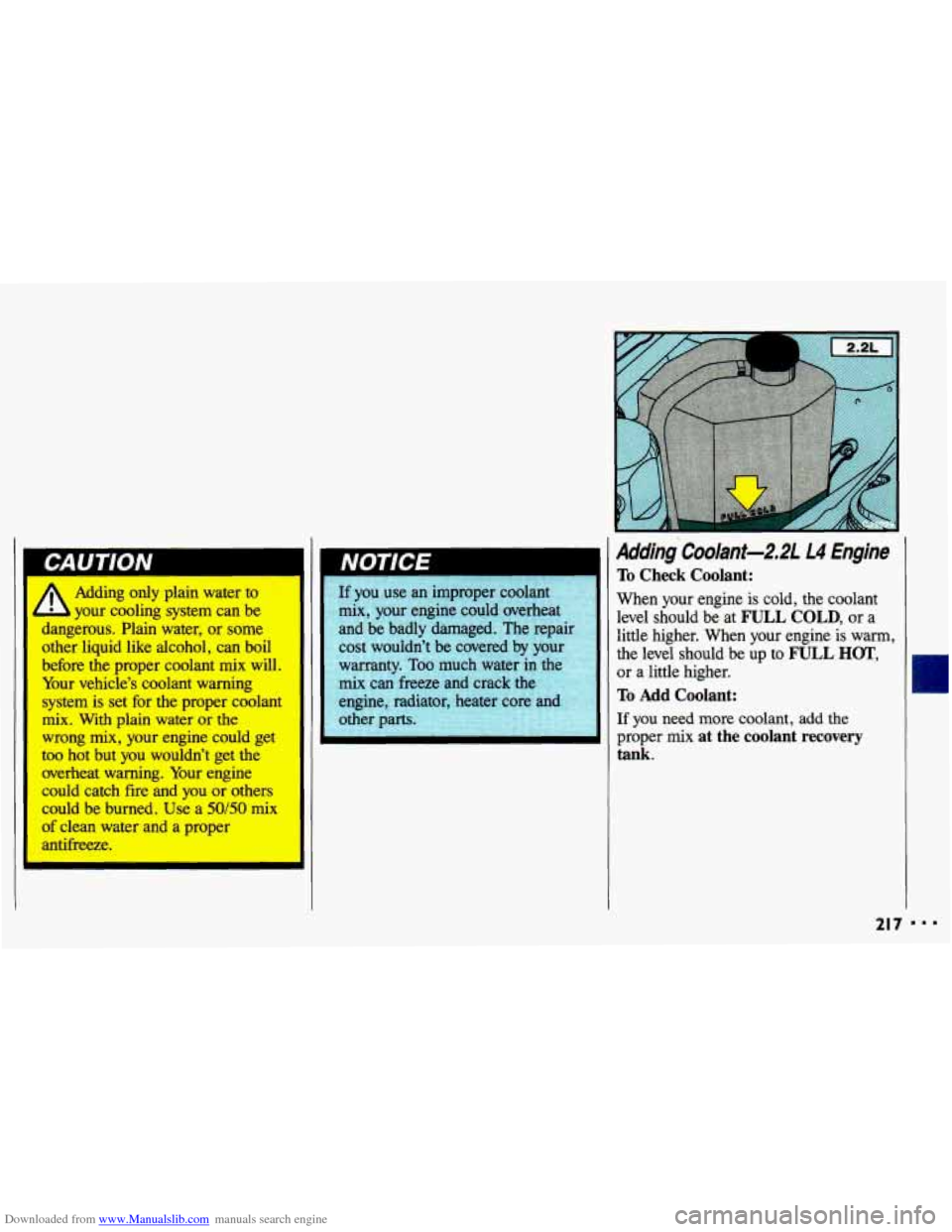
Adding Coolant-2,21 L4 Engine
To Check Coolant:
When your engine
is cold, the coolant
level should be at
FULL COLD, or a
little higher. When your engine
is warm,
the level should be up to
mJLL HOT,
or a little higher.
To Add Coolant:
If you need more coolant, add the
proper
mix at the coolant recovery
tank.
Page 224 of 308
Downloaded from www.Manualslib.com manuals search engine Service & Appearance Care
I’ A
Brake Master Cylinder (CONT.)
When your brake fluid falls to a low
level, your brake warning light will
come
on. See the Index under Brake
System Warning Light.
What to Add: When you do need brake
fluid, use only DOT-3 brake fluid-such
as Delco Supreme
ll@ (GM Part No.
1052535). Use new brake fluid from a
sealed container only.
122
DOT-5 silicone brake fluid can
damage your vehicle. Don’t use it.
Don’t let someone put in the
wrong kind
of fluid. For
example, just a few drops
of
mineral-based oil, such as engine
oil, in your brake system can
damage brake system parts
so
badly that they’ll have to be
replaced.
Brake fluid can damage ‘.nt, so
be careful not to spill brae fluid
on your vehicle.
Replacing Brake System parfs
The braking system on a modern vehicle
is complex.
Its many parts have to be of
top quality and work well together
if the
vehicle
is to have really good braking.
Vehicles we design and test have top-
quality
GM brake parts in them, as your
Chevrolet does when it
is new. When
you replace parts of your braking
system-for example, when your brake
linings wear down and
you have to have
new ones put in-be sure you get new
Page 235 of 308
Downloaded from www.Manualslib.com manuals search engine Treadwear
The treadwear grade is a comparative
rating based on the wear rate of the tire
when tested under controlled conditions
on a specified government test course.
For example, a tire graded 150 would
wear one and a half
(1%) times as well
on the government course as a tire
graded
100. The relative performance of
tires depends upon the actual conditions
of their use, however, and may depart
significantly from the norm due to
variations in driving habits, service
practices and differences in road
characteristics and climate.
Traction-A, B, C
The traction grades, from highest to
lowest are:
A, B, and C. They represent
the tire’s ability
to stop on wet pavement
as measured under controlled conditions
on specified government test surfaces of
asphalt and concrete.
A tire marked C
may have poor traction performance.
Warning: The traction grade assigned
to this tire
is based on braking (straight-
ahead) traction tests and does
not
include cornering (turning) traction.
Temperature-A, B, C
The temperature grades are A (the
highest),
B, and C, representing the
tire’s resistance to the generation of heat
and its ability to dissipate heat when
tested under controlled conditions on a
specified indoor laboratory test wheel.
Sustained high temperature can cause
the material of the tire to degenerate and
reduce tire life, and excessive
temperature can lead
to sudden tire
failure. The grade
C corresponds to a
level of performance which all
passenger car tires must meet under the
Federal Motor Vehicle Safety Standard
No. 109. Grades B and A represent
higher levels of performance
on the
laboratory test wheel than the minimum
required
by law.
233
Page 236 of 308
Downloaded from www.Manualslib.com manuals search engine Service & Appearance Care
Temperature-A, 8, C ~NTJ
Warning: The temperature grade for
this tire is established for a tire that is
properly inflated and not overloaded.
Excessive speed, underinflation,
or
excessive loading, either separately or in
combination, can cause heat buildup
and possible tire failure.
Those grades are molded on the
sidewalls of passenger car tires.
While
the tires available as standard or
optional equipment on General Motors
vehicles may vary
with respect to these
grades, all such tires meet General
Motors performance standards and have
been approved for use on General Motors vehicles.
All passenger type
(P Metric) tires must conform to Federal
safety requirements in addition to these
grades.
234
Wheel Alignment and
Tire Balance
The wheels on your vehicle were
aligned and balanced carefully at the
factory to give you the longest tire life
and best overall performance.
In most cases, you
will not need to have
your wheels aligned again. However,
if
you notice unusual tire wear or your
vehicle pulling one way or the other, the
alignment may need to be reset. If you
notice your vehicle vibrating when
driving on a smooth road, your wheels
may need to be rebalanced.
Wheel Replacement
Replace any wheel that is bent, cracked
or badly rusted. If wheel nuts keep
coming loose, the wheel, wheel bolts,
and wheel nuts should be replaced. If
the wheel leaks air out, replace
it
(except some aluminum wheels, which
can sometimes be repaired). See your
Chevrolet dealer if any of these
conditions exist.
Your dealer
will know the kind of wheel
you need. Each new wheel should have
the same load carrying capacity,
diameter, width, offset, and be mounted
the same way as the one
it replaces.
If you need to replace any of your
wheels, wheel bolts, or wheel nuts,
replace them only
with new GM
original equipment parts. This way, you
will be sure you have the right wheel,
wheel bolts, and wheel nuts for your
Chevrolet model.
Page 250 of 308
Downloaded from www.Manualslib.com manuals search engine Service & Appearance Care
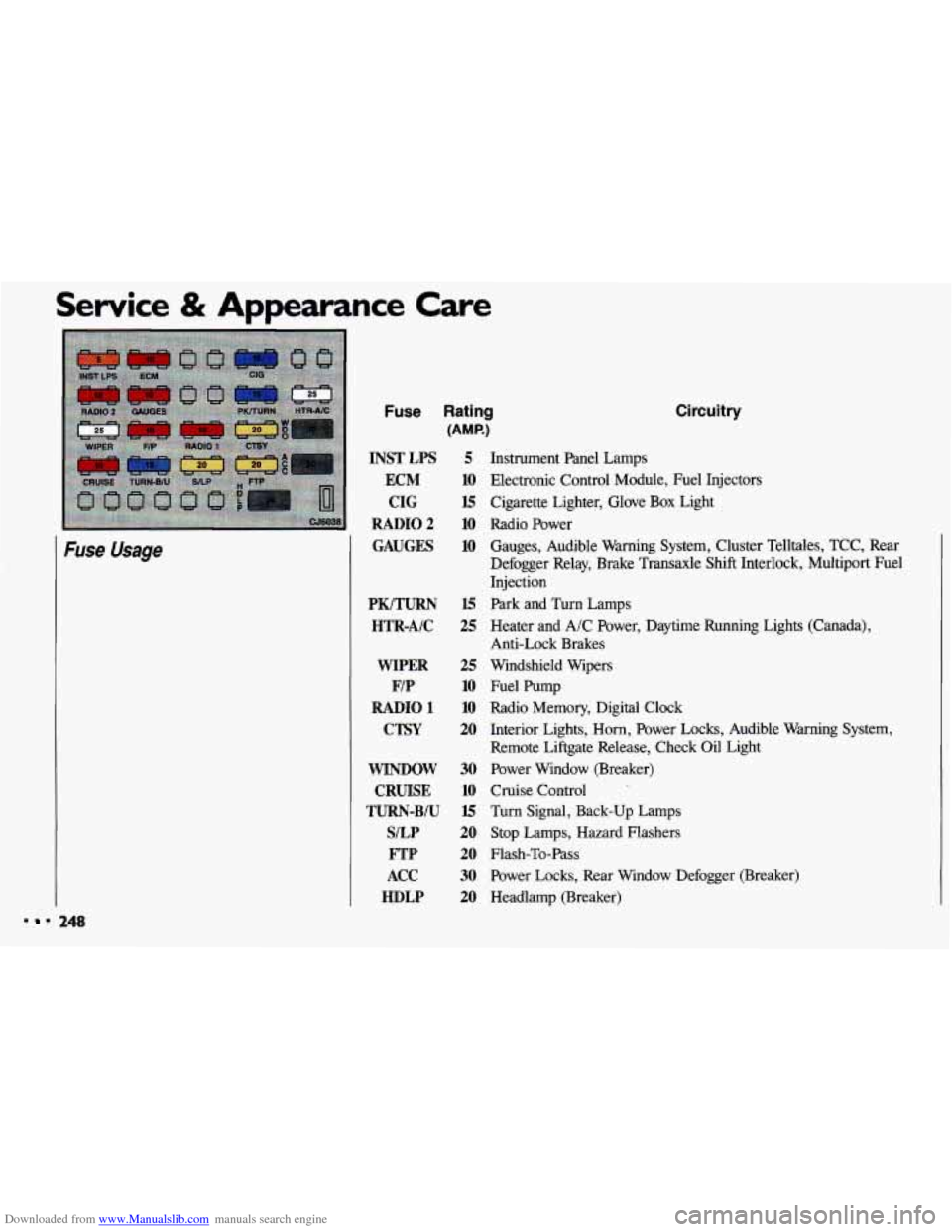
Fuse Usage
Fuse Rating
(AMP.)
INSTLPS 5
ECM 10
CIG 15
RADIO2 10
GAUGES 10
PK/TURN HTR-AIC
WIPER
F/P
RADIO 1
CTSY
WINDOW CRUISE
TURN-BIU
S/LP FTP
ACC
HDLP
15
25
25
10
10
20
30
10
15
20
20
30
20
Circuitry
Instrument Panel Lamps
Electronic Control Module, Fuel Injectors Cigarette Lighter, Glove
Box Light
Radio Power Gauges, Audible Warning System, Cluster Telltales, TCC, Rear
Defogger Relay, Brake Transaxle Shift Interlock, Multiport Fuel
Injection
Park and Turn Lamps
Heater and A/C Power, Daytime Running Lights (Canada),
Anti-Lock Brakes
Windshield Wipers
Fuel Pump
Radio Memory, Digital Clock
Interior Lights, Horn, Power Locks, Audible Warning System,
Remote Liftgate Release, Check Oil Light
Power Window (Breaker)
Cruise Control
Turn Signal, Back-up Lamps Stop Lamps, Hazard Flashers
Flash-To-Pass
Power Locks, Rear Window Defogger (Breaker)
Headlamp (Breaker)
248