1993 CHEVROLET CAVALIER stop start
[x] Cancel search: stop startPage 102 of 308
Downloaded from www.Manualslib.com manuals search engine Features & Controls
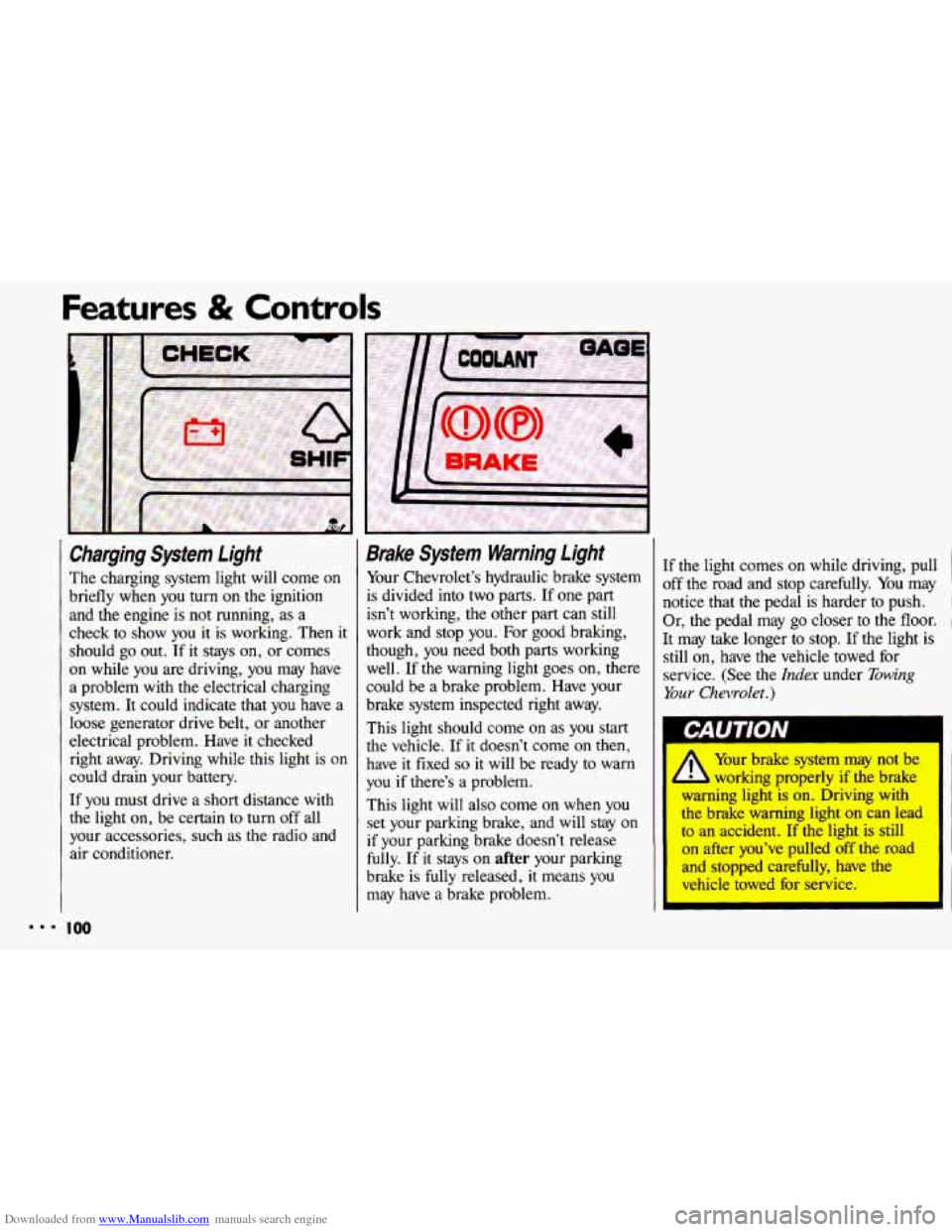
Charging System Light
The charging system light will come on
briefly when
you turn on the ignition
and the engine is not running, as a
check to show you it is working. Then it
should go out. If it stays on, or comes
on while you are driving, you may have
a problem with the electrical charging
system.
It could indicate that you have a
loose generator drive belt, or another
electrical problem. Have
it checked
right away. Driving while this light is on
could drain your battery.
If you must drive a short distance with
the light on, be certain to turn off all
your accessories, such as the radio and
air conditioner.
Brake Sysfem Warning Light
Your Chevrolet’s hydraulic brake system
is divided into two parts. If one part
isn’t working, the other part can still
work and stop you. For good braking,
though, you need both parts working
well. If the warning light goes on, there
could be a brake problem. Have your
brake system inspected right away.
This light should come on as you start
the vehicle. If it doesn’t come on then,
have
it fixed so it will be ready to warn
you if there’s
a problem.
This light will also come on when you
set your parking brake, and will stay
on
if your parking brake doesn’t release
fully. If it stays
on after your parking
brake is fully released,
it means you
may have
a brake problem. If
the light comes
on while driving, pull
off the road and stop carefully. You may
notice that the pedal is harder to push.
I
Or, the pedal may go closer to the floor. 1
It may take longer to stop. If the light is
still on, have the vehicle towed for
service. (See the
Index under Towing
Your Chevrolet.)
L-AU I IVN
I
/1 Your brake system may not be
L working properly if the brake
warning light is on. Driving with
the brake warning light
on can lead
to an accident. If the light is still
on after you’ve pulled off the road
and stopped carefully, have the
vehicle towed for service.
I
Page 103 of 308
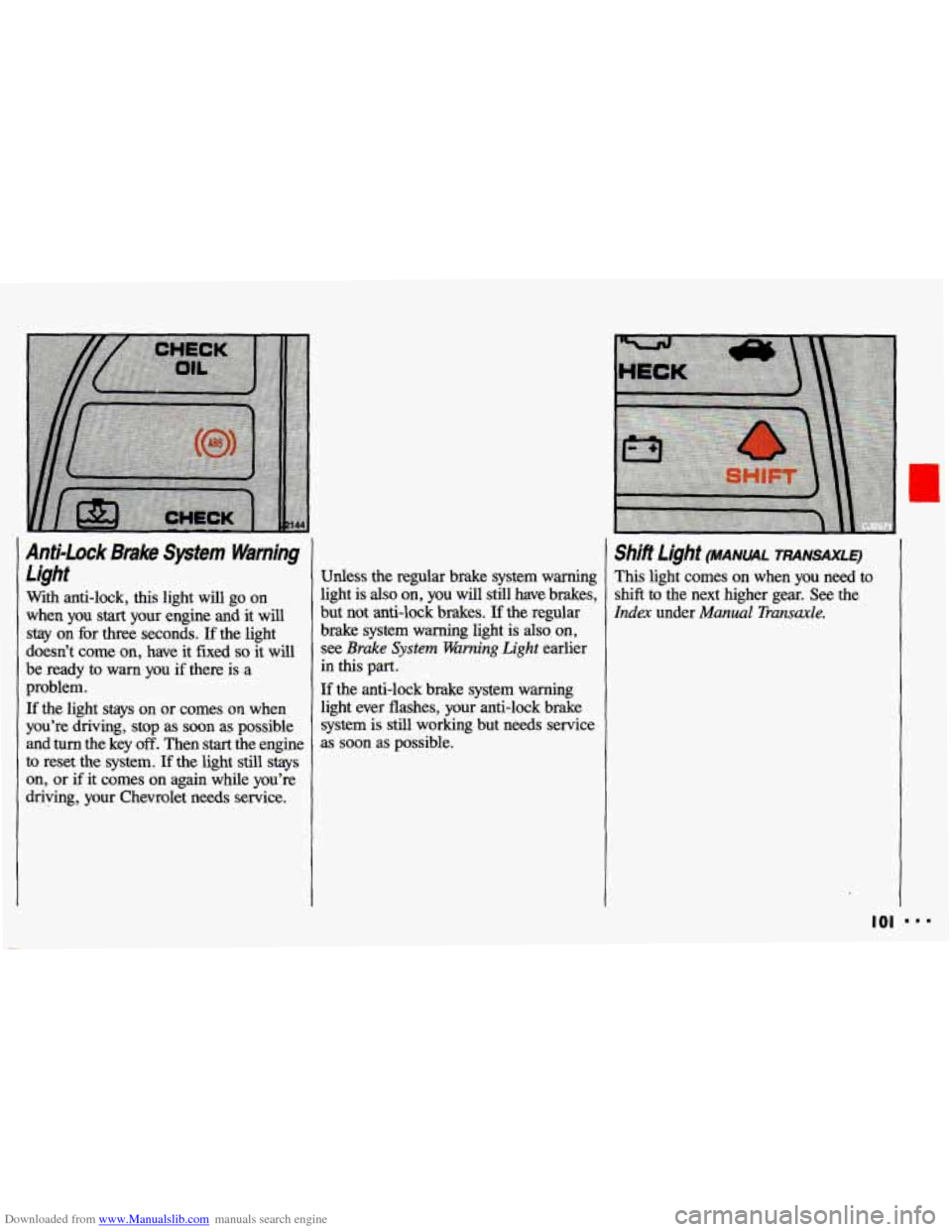
Downloaded from www.Manualslib.com manuals search engine Anti-Lock Brake System Warning
Light
With anti-lock, this light will go on
when you
start your engine and it will
stay on for three seconds.
If the light
doesn’t come on, have it fixed
so it will
be ready to warn you if there is a
problem.
If the light stays on or comes on when
you’re driving, stop as soon as possible
and turn the key
off. Then start the engine
to reset the system.
If the light still stays
on, or if it comes on again while you’re
driving, your Chevrolet
needs service.
Shift light (MANUAL TRANSAXLE)
Unless the regular brake system warning
brake system warning light is
also on,
Index under Manual Transale. but not anti-lock brakes. If the regular shift to the next higher gear. See
the
light is
also on, you will still have brakes, This
light comes on when you need to
in this part.
see Brake System Warning Light earlier
If the anti-lock brake system warning
light ever flashes, your anti-lock brake
system is still working but needs service
as soon as possible.
IO1
Page 120 of 308
Downloaded from www.Manualslib.com manuals search engine Comfort Controls & Audio Systems
I
AM.FM Stereo Radio with
Compact Disc Player (CONT.)
If the disc comes back out and/or Err
appears on the display:
The disc may be upside down.
The disc may be dirty, scratched or
wet.
There may be too much moisture in
the air (wait about one hour and try
again).
The player may be too hot, or the road
may be too rough for the disc to play.
As soon as things get back to normal,
the disc should play.
While a disc is playing, the
CD
indicator is displayed on the digital
screen, as is
the clock.
I I8
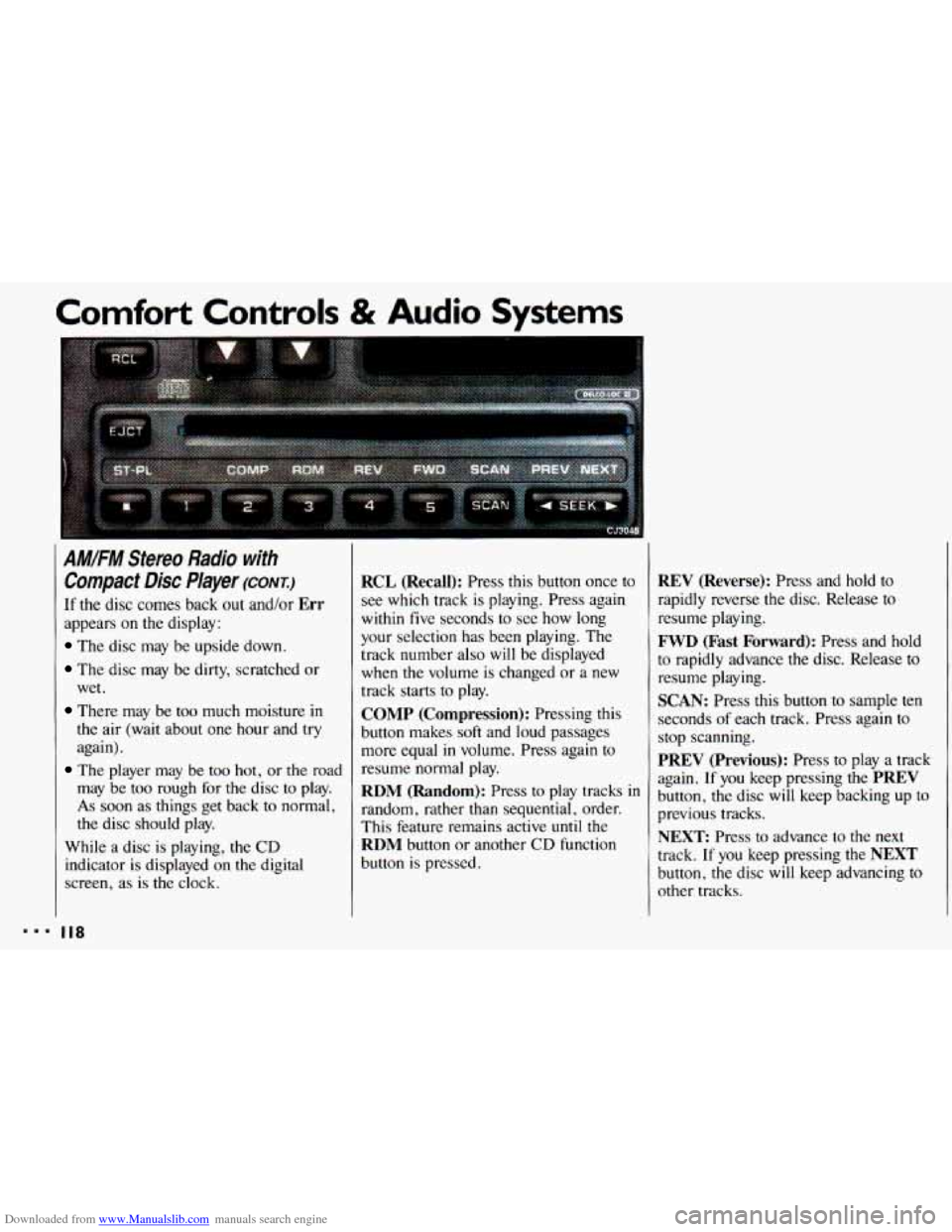
RCL (Recall): Press this button once to
see which track is playing. Press again
within five seconds to see how long
your selection has been playing. The
track number also
will be displayed
when
the volume is changed or a new
track starts to play.
COMP (Compression): Pressing this
button makes
soft and loud passages
more equal
in volume. Press again to
resume normal play.
RDM (Random): Press to play tracks in
random, rather than sequential, order.
This feature remains active
until the
RDM button or another CD function
button is pressed.
REV (Reverse): Press and hold to
rapidly reverse the disc. Release
to
resume playing.
FWD (Fast Forward): Press and hold
to rapidly advance
the disc. Release to
resume playing.
SCAN: Press this button to sample ten
seconds
of each track. Press again to
stop scanning.
PREV (Previous): Press to play a track
again.
If you keep pressing the PREV
button, the disc will keep backing up to
previous tracks.
NEXT: Press to advance to the next
track.
If you keep pressing the NEXT
button, the disc will keep advancing to
other tracks.
Page 121 of 308
Downloaded from www.Manualslib.com manuals search engine When Finished with the Compact Disc Player:
If you turn the radio off, or turn off the
ignition, the disc
will stay in the player
and
start again when you turn on the
ignition or the
PWR-VOL button. The
disc will begin playing at the point
where it had been stopped.
ST-PL (Stop-Play): Press to stop the
disc player; the radio will play. Press
again
to play the disc (the player will
start playing the disc where it had
stopped earlier).
EJCT(Eject): Press to eject the disc;
the radio
will play. The disc will start at
track
1 when you reinsert it. EJCT
works even when the radio or the
ignition is off.
CD Player Anti-Theit Feature
Delco LOC IP is a security feature that
can be used or ignored. If you ignore
it,
the radio will play normally. If you use
it, your radio cannot be turned
on if it is
stolen. These instructions will tell you
how
to enter a secret code into the radio.
If battery power is lost for any reason,
the secret code must be entered again
before your audio system can be turned
on.
To Set the Anti-Theft System:
1. Write down any six-digit number and
keep
it in a safe place. This is your
secret code.
2. Turn the ignition on.
3. Rotate the PWR knob to turn the
radio
off.
4. Press station preset buttons 1 and 4 at
the same time and hold
until "---"
shows on the display.
You now have only
15 seconds
between each
of the following steps.
5. Press SET, and 000 will appear on
the display.
6. Press SCAN until the first digit of
your code appears.
7. Press SEEK until the second and
third digits of your code appear.
8. Press the TUNE knob (000 will
appear on the display).
9. Press SCAN until the fourth digit of
your code appears.
10. Press SEEK until the fifth and sixth
digits of your code appear.
11. Press the TUNE knob (rEP will
appear for five seconds, then
000).
12. Repeat steps 6 through 10. Then
press the
TUNE knob again. SEC
will appear, indicating that Delco
LOC II@ is set, and your radio is
secure.
If "- - -" appears, the steps
were not successful and you must
repeat the entire procedure.
r
888 I I9
Page 130 of 308
Downloaded from www.Manualslib.com manuals search engine Your Driving and the Road
Defensive Driving
The best advice anyone can give about
driving is: Drive defensively.
Please
start with a very important safety
device in your Chevrolet: Buckle up. (See the
Index under Safety Belts.)
Defensive driving really means “be
ready for anything.” On city streets, rural roads, or freeways, it means
“always expect the unexpected.”
Assume that pedestrians or other drivers
are going to be careless and make
mistakes. Anticipate what they might do. Be ready for their mistakes.
Expect children to dash out from behind
parked cars, often followed by other
children. Expect occupants in parked
cars to open doors into traffic. Watch for movement in parked cars-someone
may be about to open a door.
213
Expect other drivers to run stop signs
when you are on a through street. Be
ready to brake if necessary as you go
through intersections. You may not have
to use the brake, but if you do, you will
be ready.
If you’re driving through a shopping
center parking lot where there are well-
marked lanes, directional arrows, and
designated parking areas, expect some
drivers to ignore
all these markings and
dash straight toward one part of the lot.
Pedestrians can be careless. Watch for
them.
In general, you must give way to
pedestrians even if you know you have
the right of way.
Rear-end collisions are about the most
preventable of accidents. Yet they are
common. Allow enough following distance. It’s the best defensive driving
maneuver, in both city and
rural
driving.
You never know when the
vehicle in front of you is going
to brake
or turn suddenly.
Here’s a final bit
of information about
defensive driving. The most dangerous
time for driving in the
U.S. is very early
on Sunday morning.
In fact, GM
Research studies show that the most and
the least dangerous times for driving,
every week, fall on the same day. That
day is Sunday. The most dangerous time
is Sunday from
3 a.m. to 4 a.m. The
safest time is Sunday from
10 a.m. to
11 a.m. Driving the same distance on a
Sunday at
3 a.m. isn’t just a little more
dangerous than it is at
10 a.m. It’s about
134 times more dangerous!
That leads to the next section.
Page 136 of 308
Downloaded from www.Manualslib.com manuals search engine Your Driving and the Road
Anti-Lock Brakes (ABS)
Your Chevrolet has an advanced
electronic braking system that will help
prevent skidding.
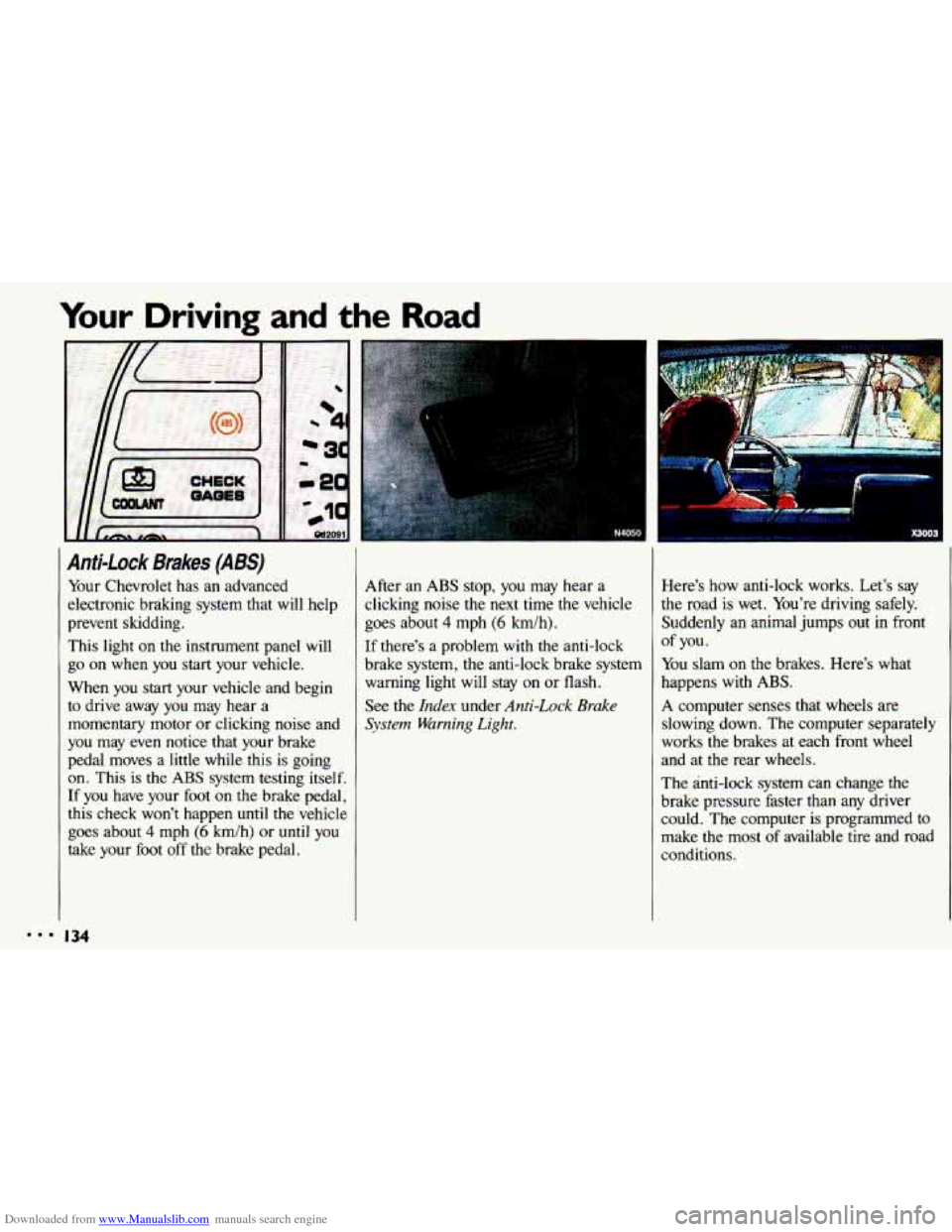
This light
on the instrument panel will
go
on when you start your vehicle.
When you start your vehicle and begin
to drive away you may hear a
momentary motor or clicking noise and
you may even notice that your brake
pedal moves a little while this is going
on. This is the ABS system testing itself.
If you have your foot on the brake pedal,
this check won’t happen
until the vehicle
goes about
4 mph (6 km/h) or until you
take your foot
off the brake pedal. After an
ABS stop,
you may hear a
clicking noise the next time the vehicle
goes about
4 mph (6 km/h).
If there’s a problem
with the anti-lock
brake system, the anti-lock brake system warning light will stay on or flash.
See
the Index under Anti-Lock Brake
System Warning Light.
Here’s how anti-lock works. Let’s say
the road is wet. You’re driving safely.
Suddenly an animal jumps out
in front
You slam
on the brakes. Here’s what
happens with ABS.
A computer senses that wheels are
slowing down. The computer separately
works the brakes at each front wheel
and at the rear wheels.
The anti-lock
system can change the
brake pressure faster than any driver
could. The computer is programmed to
make the most of available tire and road
conditions.
of you.
134
Page 143 of 308
Downloaded from www.Manualslib.com manuals search engine If you suspect that the driver of the
vehicle
you want to pass isn’t aware of
your presence, tap the horn a couple
of times before passing.
Do not get too close to the vehicle you
want
to pass while you’re awaiting an
opportunity. For one thing, following
too closely reduces your area
of
vision, especially if you’re following a
larger vehicle. Also, you won’t have
adequate space if the vehicle ahead suddenly slows or stops. Keep back a
reasonable distance.
When it looks like a chance to pass is
coming up, start to accelerate but stay
in the right lane and don’t get too
close. Time your move
so you will be
increasing
speed as the time comes to
move into the other lane.
If the way is
clear to pass, you will have a “running
start” that more than makes up for the
distance you would lose by dropping
back. And
if something happens to
cause you
to cance1,your pass, you
need only slow down and drop back
again and wait for another opportunity.
slow vehicle, wait your turn. But take
care that someone isn’t trying
to pass
you as you pull out to pass the slow
vehicle. Remember to glance over
your shoulder and check the blind
spot.
Check your mirrors, glance over your
shoulder, and
start your left lane
change signal before moving out of the
right lane to pass. When you are far
enough ahead of the passed vehicle to
see its front in your inside mirror,
activate your right lane change signal
If other cars are lined up to pass a and
move back into the right lane.
(Remember that your right outside
mirror is convex. The vehicle you just
passed may
seem to be further away
from you than it really
is.)
Try not to pass more than one vehicle
at a time on two-lane roads.
Reconsider before passing the next
vehicle.
vehicle too rapidly. Even though the
brake lights are not flashing, it may be
slowing down or starting to
turn.
If you’re being passed, make it easy
for the following driver to get ahead of
you. Perhaps you can ease a
little to
the right.
Don’t overtake a slowly moving
I41
Page 144 of 308
Downloaded from www.Manualslib.com manuals search engine Your Driving and the Road
Loss of Control
Let’s review what driving experts say
about what happens when the three
control systems (brakes,‘ steering and
acceleration) don’t have enough friction
where the tires meet
the road to do what
the driver has asked.
In any emergency, don’t give up. Keep
trying
to steer and constantly seek an
escape route or area of less danger.
I42
Skidding
In a skid, a driver can lose control of
the vehicle. Defensive drivers avoid
most skids
by taking reasonable care
suited
to existing conditions, and by not
“overdriving” those conditions.
But
skids are always possible.
The three types of skids correspond
to
your Chevrolet’s three control systems.
In the braking skid your wheels aren’t
rolling. In the steering
or cornering
skid, too much speed or steering
in a
curve causes tires to slip and lose
cornering force. And
in the acceleration
skid too much throttle causes the driving
wheels
to spin.
A cornering skid and an acceleration
skid are best handled by easing your
foot off the accelerator pedal. If your
vehicle starts
to slide (as when you turn
a corner on a wet, snow- or ice-covered
road), ease your foot off the accelerator
pedal as soon
as you feel the vehicle
start to slide. Quickly steer the way you
want the vehicle to
go. If you start
steering quickly enough, your vehicle
will straighten out. As
it does, straighten
the front wheels.
Of course, traction is reduced when
water, snow, ice, gravel, or other
material is
on the road. For safety, you’ll
want to
slow down and adjust your
driving to these conditions. It is
important to slow down on slippery
surfaces because stopping distance
will
be longer and vehicle control more
limited.