1993 CHEVROLET CAVALIER stop start
[x] Cancel search: stop startPage 147 of 308
Downloaded from www.Manualslib.com manuals search engine A Few More Night Driving
Suggestions
Keep your windshield and all the glass
on your vehicle clean-inside and out.
Glare at night is made much worse by
dirt
on the glass. Even the inside of the
glass can build up a film caused by dust.
Tobacco smoke also makes inside glass
surfaces
very filmy and can be a vision
hazard
if it's left there.
Dirty glass makes lights dazzle and
flash more than clean glass would,
making the pupils of your eyes contract
repeatedly. You might even want
to keep
a cloth and some glass cleaner in your
vehicle if you need
to clean your glass
frequently. Remember that your headlights light
up
far less of a roadway when you are in a
turn or curve.
Keep your eyes moving; that way, it's
easier to pick out dimly lighted objects.
Just as your headlights should be
checked regularly for proper aim,
so
should your eyes be examined regularly.
Some drivers suffer from night
blindness-the inability to see
in dim
light-and aren't even aware of
it.
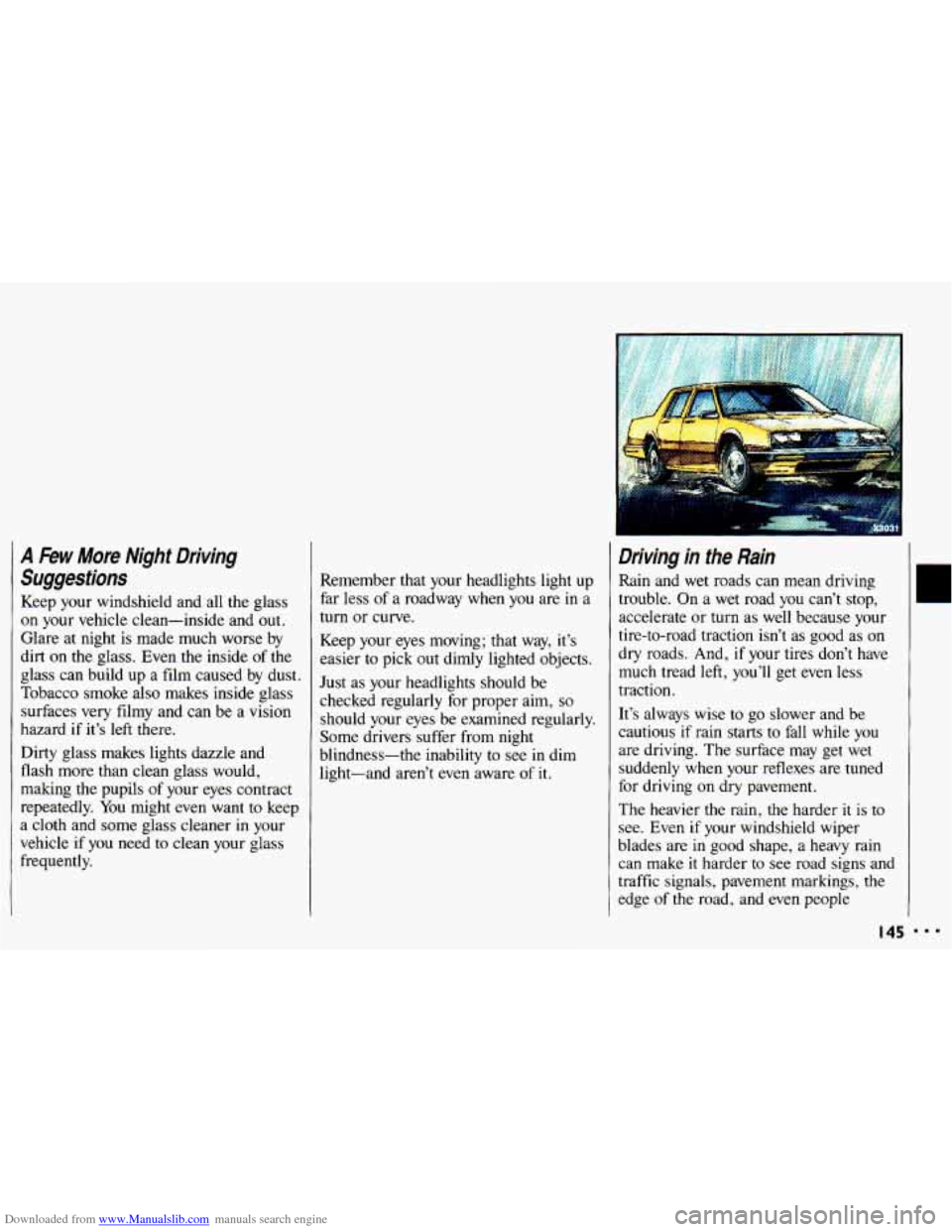
Driving in the Rain
Rain and wet roads can mean driving
trouble. On a wet road you can't stop,
accelerate or turn as well because your
tire-to-road traction isn't as good as on
dry roads. And,
if your tires don't have
much tread left, you'll get even less
traction.
It's always wise to go slower and
be
cautious if rain starts to fall while you
are driving. The surface may get wet
suddenly when your reflexes are tuned
for driving on dry pavement.
The heavier the rain, the harder
it is to
see. Even if your windshield wiper
blades are in good shape, a heavy rain
can make
it harder to see road signs and
traffic signals, pavement markings, the
edge
of the road, and even people
IC
I45 ...
Page 148 of 308
Downloaded from www.Manualslib.com manuals search engine Your Driving and the Road
Driving in the Rain (CONT:)
walking. Road spray can often be worse
for vision than rain, especially
if it
comes from a dirty road.
So it is wise to keep your wiping
2quipment in good shape and keep your
windshield washer tank filled. Replace
your windshield wiper inserts when they
show signs
of streaking or missing areas
on the windshield, or when strips of
rubber start to separate from the inserts.
I
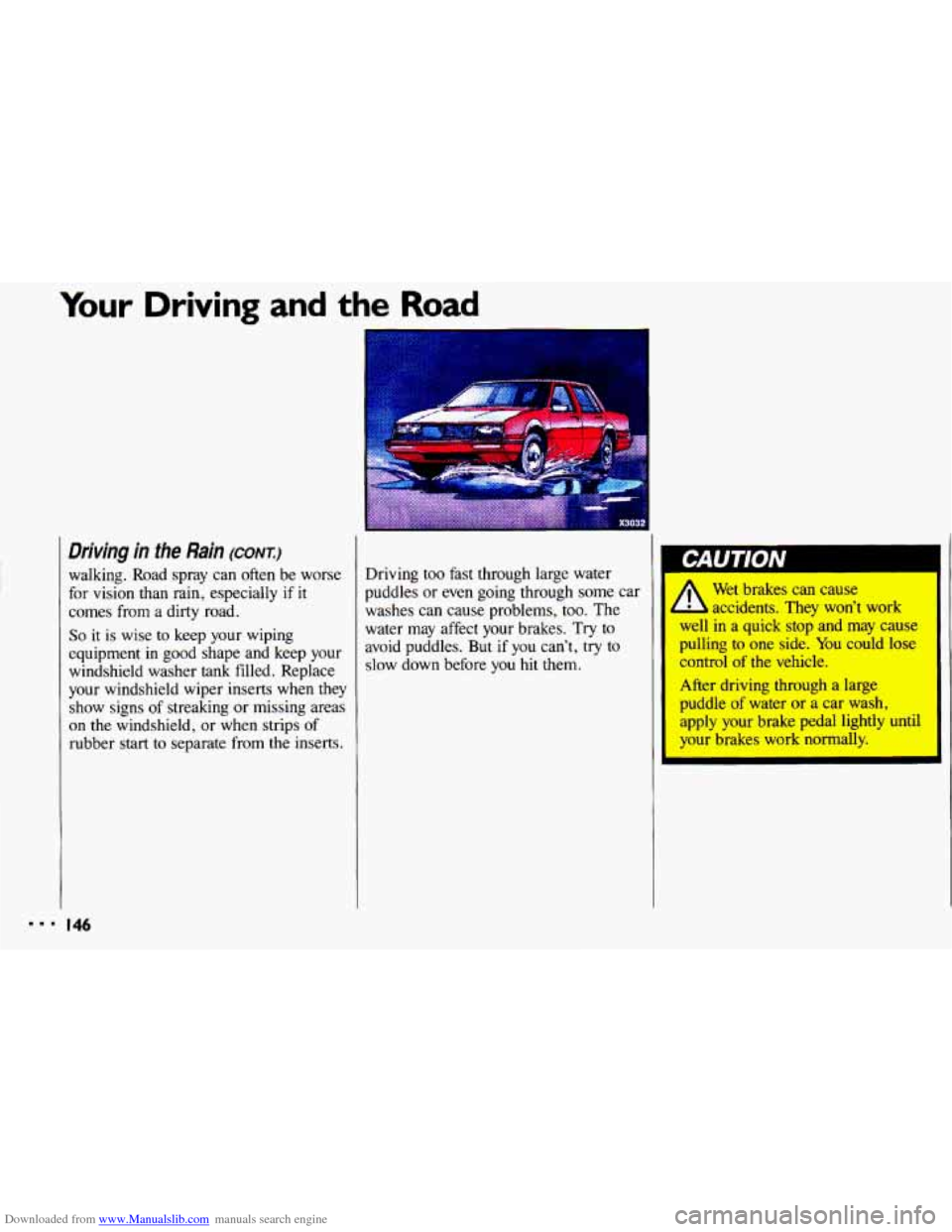
Driving too fast through large water
puddles or even going through some car
washes can cause problems, too. The
water may affect your brakes. Try
to
avoid puddles. But if you can’t, try to
slow down before you
hit them.
Wet brakes can cause
accidents. They
won’t work
werl in a quick stop and may cause
pulling to one side. You could. lose
control of the vehicle.
After driving though a large
puddle
of water or a car wash,
apply your brake pedal lightly until
your
brakes work normally.
mm. I46
Page 151 of 308
Downloaded from www.Manualslib.com manuals search engine something between you and moving
vehicles-space, trees, telephone poles,
a private driveway, anything that
removes you from other traffic.
zf visibility is near zero and you must
stop but are unsure whether you are
away from the road, turn your lights on,
start your hazard warning flashers, and
sound your horn at intervals or when
you hear approaching traffic.
Pass other vehicles in fog only if you
can see far enough ahead to pass safely.
Even then, be prepared to delay your
pass if you suspect the
fog is worse up
ahead. If other vehicles try to pass
you,
make it easy for them.
City Driving
One of the biggest problems with city
streets is the amount
of traffic on them.
You’ll want to watch out for what the
other drivers are doing and pay attention
to traffic signals.
Here are ways to increase your safety in
city driving:
Know the best way to get to where you
are going. Try not to drive around
trying to pick out a familiar street or
landmark. Get a city map and plan
your trip into an unknown part
of the
city just as
you would for a cross-
country trip.
Try to use the freeways that rim and
crisscross most large cities. You’ll save
time and energy. (See the next section,
Freeway Driving.)
Treat a green light as a warning
signal.
A traffic light is there because
the corner is busy enough to need it.
When
a light turns green, and just
before you
start to move, check both
ways for vehicles that have not cleared
the intersection or may be running the
red light.
remember that
they are for ideal road,
weather and visibility conditions. You
may need to drive below the posted
limit
in bad weather or when visibility
is especially poor.
clear
of intersections when you see or
hear emergency vehicles.
Obey all posted speed limits. But
Pull to the right (with care) and stop
I49 BIB
Page 153 of 308
Downloaded from www.Manualslib.com manuals search engine If you are moving from an outside to a
center lane on a freeway having more
than two lanes, make sure another vehicle isn’t about to move into the same
spot. Look at the vehicles two lanes
over and watch for telltale signs: turn
signals flashing, an increase in speed, or
moving toward the edge of the lane. Be
prepared
to delay your move.
Once you are moving on the freeway,
make certain you allow a reasonable
following distance. Expect to move
slightly slower at night.
Leaving the Freeway
When you want to leave the freeway,
move to the proper lane well in advance.
Dashing across lanes at the last minute
is dangerous. If you
miss your exit do
not, under any circumstances, stop and
back up. Drive on to the next exit.
At each exit point is
a deceleration lane.
Ideally it should be long enough for you
to enter it at freeway speed (after
signaling, of course) and then do your
braking before moving onto the exit
ramp. Unfortunately, not all deceleration
lanes
are long enough-some are too
short for all the braking. Decide when
to start braking. If you must brake on
the through lane, and if there is traffic
close behind you, you can allow a little extra
time and flash your brake lights (in
addition to your turn signal) as extra
warning that you are about to slow
down and exit.
The exit ramp can be curved, sometimes
quite sharply. The exit speed is usually
posted. Reduce your speed according to
your speedometer, not to your sense
of
motion. After driving for any distance at
higher speeds, you may tend to think
you are going slower than you actually
are. For example,
40 mph (65 km/h)
might seem like only
20 mph (30 km/h).
Obviously, this could lead to serious
trouble on a ramp designed for
20 mph
(30 km/h)!
I51
Page 177 of 308
Downloaded from www.Manualslib.com manuals search engine If you get the overheat warning with no
sign
of steam, try this for a minute or so:
1. If you have an air conditioner, turn it
2. Turn on your heater to full hot at the
off.
highest fan speed and open the window as necessary.
3. Try to keep your engine under load
(in a drive gear where the engine
runs slower).
If
you no longer have the overheat
warning, you can drive. Just to be safe,
drive slower for about ten minutes. If
the warning doesn’t come back on, you
can drive normally.
If the warning continues, pull over, stop, and park your vehicle right away. If there’s
still no sign of steam, you can
idle the engine for two or three minutes
while you’re parked, to see
if the
warning stops. But then, if you still have
the warning, TURN
OFF THE
ENGINE AND
GET EVERYONE
OUT OF THE VEHICLE until it cools
down.
You may decide not to
lift the hood but
to get service help right away.
If you have
a 2.2L L4 engine, your
engine coolant system
will have a
coolant recovery
tank. If you have a 3.1L
V6 engine, your engine coolant system
will have a coolant surge tank.
There are important differences between
these two cooling systems. Read this section carefully.
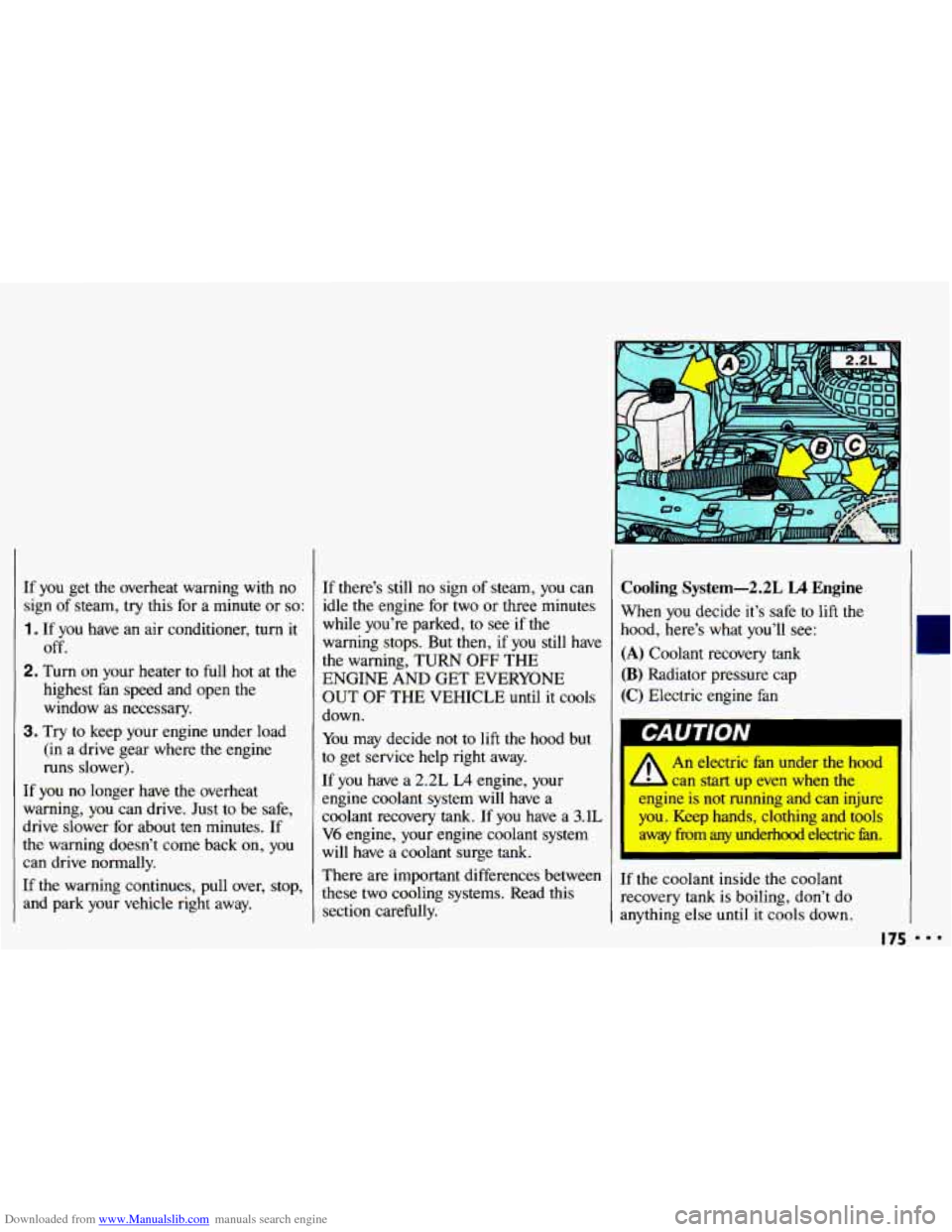
Cooling System-2.2L LA Engine
When you decide it’s safe to lift the
hood, here’s what you’ll see:
(A) Coolant recovery tank
(B) Radiator pressure cap
(C) Electric engine fan
a An electric fan under the hood
engine
is not running and can injure
you. Keep hands, clothing and tools
away
from any underhood electric h.
L can start up even when the
If the coolant inside the coolant
recovery tank
is boiling, don’t do
anything else until it cools down.
I75