1993 CHEVROLET CAVALIER radiator cap
[x] Cancel search: radiator capPage 205 of 308
Downloaded from www.Manualslib.com manuals search engine d
56053
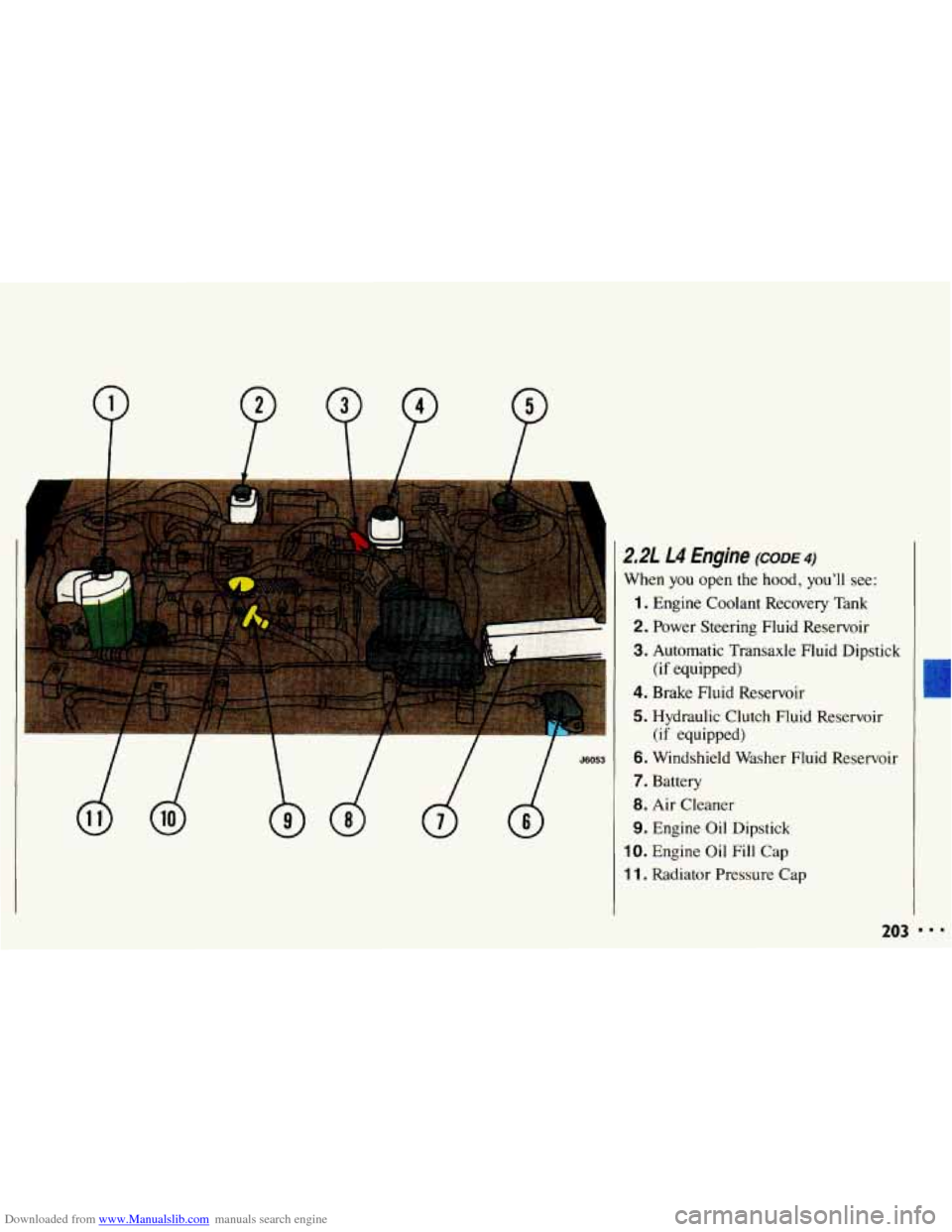
2.21 L4 Engine (CODE 4)
When you open the hood, you’ll see:
1. Engine Coolant Recovery Tank
2. Power Steering Fluid Reservoir
3. Automatic Transaxle Fluid Dipstick
4. Brake Fluid Reservoir
5. Hydraulic Clutch Fluid Reservoir
6. Windshield Washer Fluid Reservoir
7. Battery
8. Air Cleaner
9. Engine Oil Dipstick
IO. Engine Oil Fill Cap
1 1. Radiator Pressure Cap
(if equipped)
(if equipped)
203
Page 220 of 308
Downloaded from www.Manualslib.com manuals search engine Service & Appearance Care
I
Adding Co01ant-2~2L L4 Engine
(CONT.)
A
Turning the radiator pressure
cap
when the engine and
radiator are hot can allow steam
and scalding liquids
to blow out
and
burn you badly. With the
coolant
recovery tank, you will
almost never have to add coolant at
the radiator. Never turn the
radiator
pressure cap-even a
little-when the engine and radiator are hot.
II
1 I Adding C00lant-3~IL V6 Engine
You can be burned if you spill
coolant on hot engine parts. Coolant
contains ethylene glycol,
and it will burh if the engine parts
are hot enough. Don’t spill coolant
II
on a hot eniine.
I 31
II
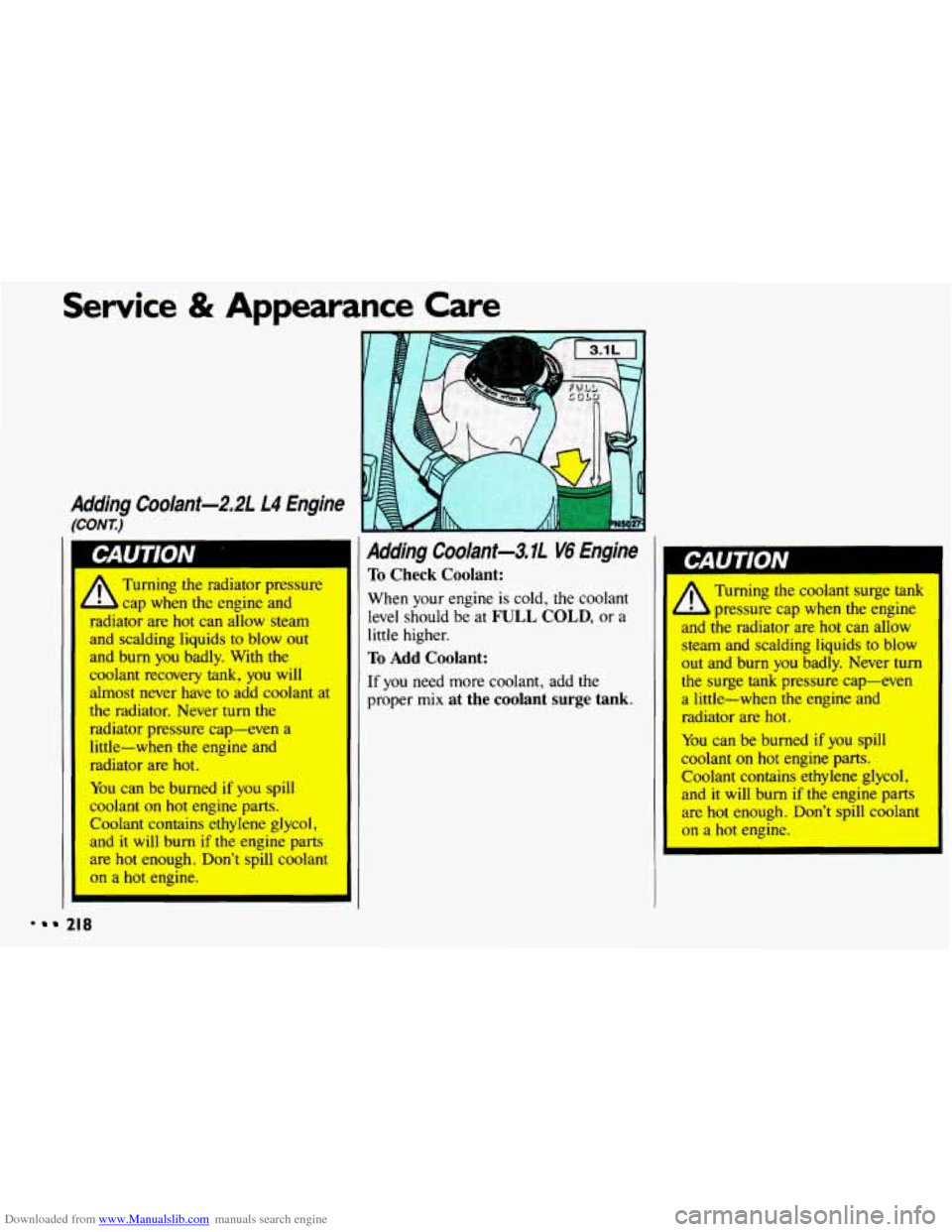
To Check Coolant:
When your engine is cold, the coolant
level should be at
FULL COLD, or a
little higher.
To Add Coolant:
If you need more coolant, add the
proper
mix at the coolant surge tank
1 I
Turning the coolant surge tank
d L pressure cap when the engine
and the radiator are hot c~ln allow
steam and scalding liquids to blow
out and
bum you badly. Never turn
the surge tank pressure cap-even
a little-when the engine and
radiator are hot.
You can be burned if you spill
coolant on
hot engine parts.
Coolant contains ethylene glycol, and
it will bum if the engine parts
are hot enough. Don’t spill coalant
on a hot engine.
- 218
Page 221 of 308
Downloaded from www.Manualslib.com manuals search engine Radiator Pressure Cap
, .. g.., ',!: Your radiator cap is a 15 psi
I.,, ''.' (105 kPa) pressure-type cap and
,;:, must be tightly installed to prevent
'.. coolant loss and possible engine
.':: damage from overheating. Be sure
.; the arrows on the cap line up with
the overflow
tube on the radiator
Y; _/,.__ filler neck.
When you replace your radiator pressurl
cap, an
AC@ cap is recommended.
.. . ..
~. .
..
F+
Thermostat
Engine coolant temperature is controlled
by a thermostat in the engine coolant
system. The thermostat stops the
flow of
coolant through the radiator until the
coolant reaches a preset temperature.
When you replace your thermostat, an
AC@ thermostat is recommended.
Power Steering Fluid
How to Check Power Steering Fluid:
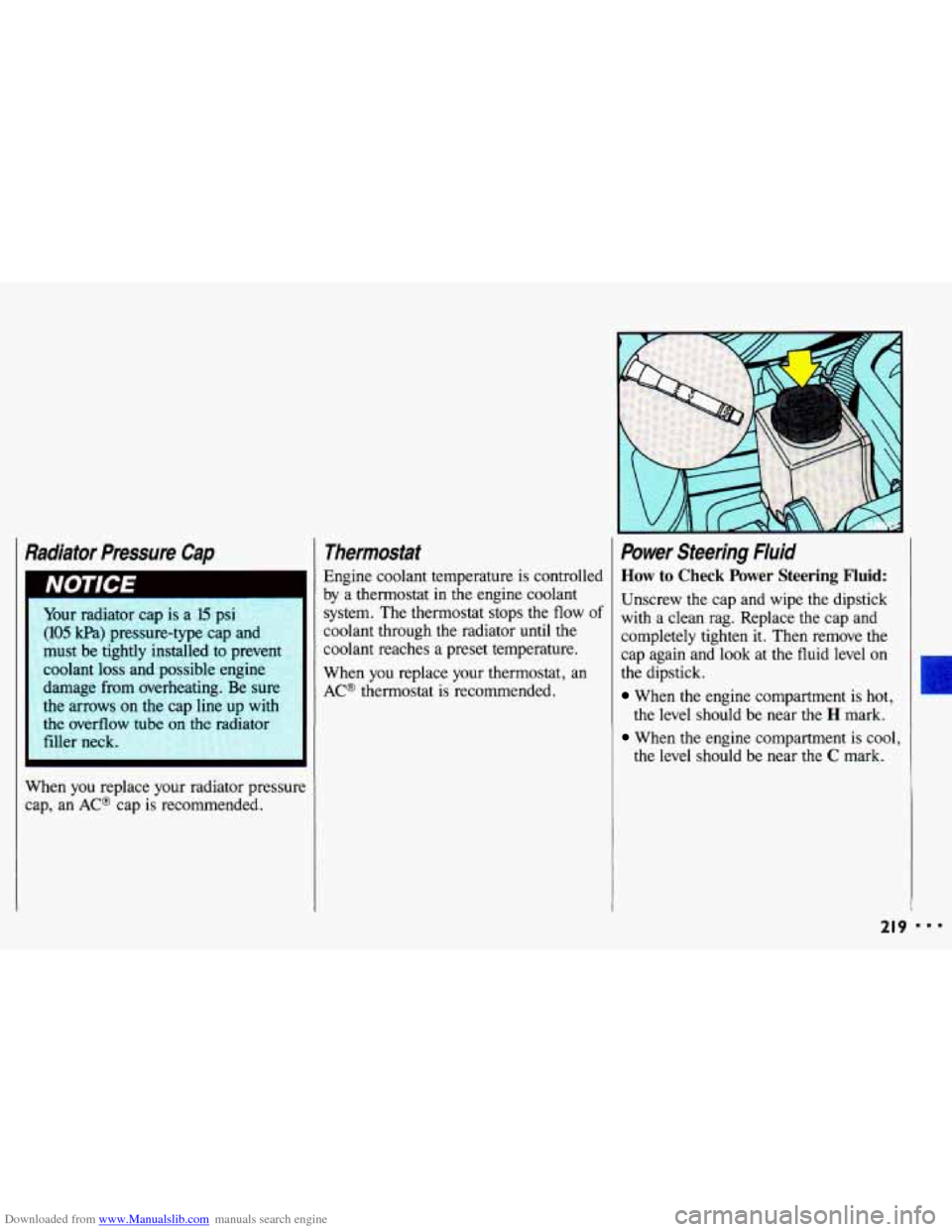
Unscrew the cap and wipe the dipstick
with a clean rag. Replace the cap and
completely tighten it. Then remove the
cap again and
look at the fluid level on
the dipstick.
When the engine compartment is hot,
the level should be near the H mark.
When the engine compartment is cool,
the level should be near the
C mark.
21 9 I..
Page 222 of 308
Downloaded from www.Manualslib.com manuals search engine ..I
Service & Appearance Care
Power Steering Fluid (CONT.)
What to Add:
Refer to the Maintenance Schedule to determine what kind of fluid to use. See
the
Index under Fluids & Lubricants.
When adding power steering fluid
or making a complete fluid change,
always use the proper fluid. Failure
to use the proper fluid can cause
leaks and damage hoses and seals.
120
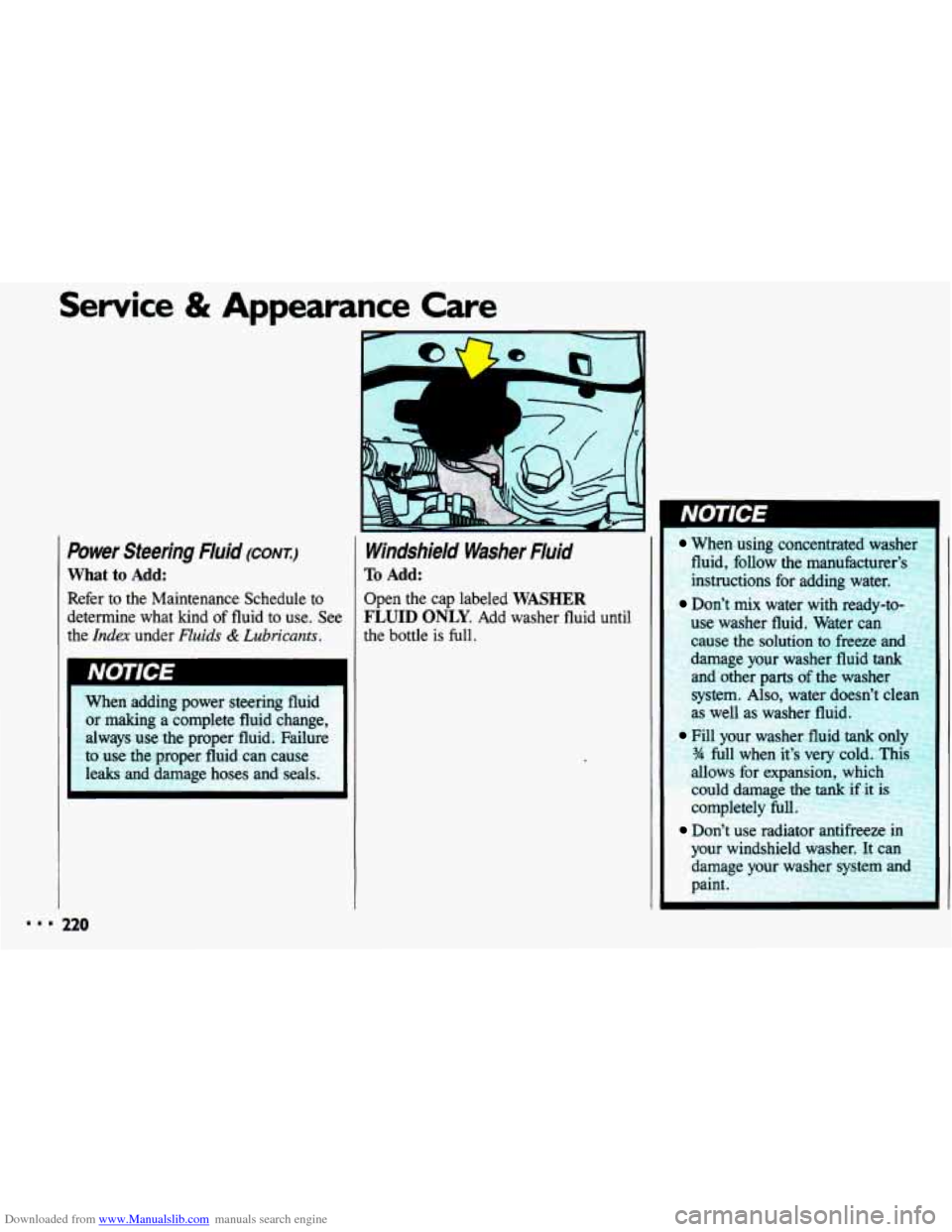
Windshield Washer Fluid
To Add:
Open the cap labeled WASHER
FLUID ONLY. Add washer fluid until
the bottle is full.
When using concentrated washer
fluid, follow the manufacturer’s
instructions for adding water.
Don’t mix water with ready-to-
l15e washer fluid. Water can
use the solution
to freeze and
. .tmage your washer fluid tank
and other parts of the washer
system.
Also, water doesn’t clean
s well as washer fluid.
Fill your washer fluid tank on14
?4 full when it’s very cold. Thir
allows for expansion, which
could damage the
tank if it is
completely
full
Don’t use radiator antifreeze
your windshield washer.
It can
damage your washer system an(
paint.
Page 271 of 308

Downloaded from www.Manualslib.com manuals search engine ITEM
NO. SERVICE ITEM NO. SERVICE
4
5
Engine
Accessory Drive Belt(s) Inspection*-
Inspect the belt(s) for cracks, fraying, wear and
proper tension. Replace as needed.
Cooling System Service*-Drain, flush and refill
the system with
new or approved recycled coolant
conforming to
GM Specification 1825M. Keep
coolant at the proper mixture as specified. See the
Index under Coolant. This provides proper freeze
protection, corrosion inhibitor level and engine
operating temperature.
Inspect hoses and replace if they are cracked,
swollen or deteriorated. Tighten screw-type hose
clamps. Clean the outside of the radiator and air
conditioning condenser. Wash
the pressure cap and
neck.
To help ensure proper operation, we recommend a
pressure test of both the cooling system and the
pressure cap.
6
7
8
9
Transaxle Service-For manual transaxles, fluid
doesn't require changing.
For automatic transaxles, change both the fluid and
filter every
15,000 miles (25 000 km) if the vehicle
is mainly driven under one or more of these
conditions:
In heavy city traffic where the outside temperature
In hilly or mountainous terrain.
Uses such as found in taxi, police car or delivery
regularly reaches
90" F (32" C) or higher.
service.
If you do not use your vehicle under any of
these conditions, change both the fluid and filter
every 100,000 miles (160
0oO km).
Spark Plug Replacement*-Replace spark plugs
with the proper type. See
the Index under
Replacement Parts.
Spark Plug Wire Inspection* *-Inspect for
burns, cracks or other damage. Check the boot
fit
at the coils and at the spark plugs. Replace wires as
needed.
Exhaust Gas Recirculation (EGR) System
Inspection
(2.2L L4 Code 4 engine)" *-Conduct
the
EGR system service as described in the service
manual. To purchase a service manual
, see the
Index under Service Publications.
Page 302 of 308
Downloaded from www.Manualslib.com manuals search engine Index
Manual Adjust ................ 85
Manual Remote Control ......... 86
Mountain Driving ............... 154
New Vehicle Break-In
Requirements
................. 54
Night Driving .................. 143
Octane Requirements
Odometer
& Speedometer ......... 94
Oil. Engine ................... 205
Pressure Gage ................. 99
Thickness ................... 207
Used Oil ................... -209
When to Add ................ 206
When to Change .............. 208
Oil Warning Light ............... 98
Outside Rearview Mirrors ......... 85
Overheated Engine .............. 174
Overheated Engine Coolant
Warning Gage
............... 97
(see Fuel Requirements)
Quality ..................... 206
Operation of Lights .............. 79
Owner Checks & Services ........ 271
Owner’s Manual. How to Use ....... 6
Eint Spotting. Chemical ......... 245
Park. Shifting Into ........... .60. 67
Parking
On Hills
................ .60. 155
Over Things That Burn ......... 70
Torque Lock ............ .157. 251
With the Engine
Running
............. .60. 68. 71
Parking Brake .................. 66
Passenger Belts (see Safety Belts)
Passing ................... .77. 140
Polishing and Waxing
Power Door Locks
............... 50
Power Windows ................. 72
Power Window Lock-out
Switch
..................... 72
Pregnancy. Use of Safety Belts
During
...................... 27
Problems on the Road ........... 163
Publications (see Service Publications)
(see Appearance Care)
Power Steering Fluid .... .219. 251. 252
Radiator Overheating
(see
Overheated Engine)
Radiator Pressure Cap ........... 219
Radio (see Audio Systems)
Reading Light .................. 82
Rear Safety Belt Comfort Guides .... 30
Rear Seat. Split Fold-Down ........ 15
Rearview Mirrors ............... 85
Rear Window Defogger .......... 109
Reclining Seatbacks .............. 12
Replacement Bulbs ............. 253
Replacement Fuses ............ -248
Replacement Parts .............. 256
Replacing Safety Belts ............ 45
Replacing Tires ................ 232
Replacing Wheels .............. 234
Reporting Safety Defects ......... 286
Restraints. Child ............... -35
Road Signs .................... 124
Color ...................... 124
Shape ...................... 125
Symbols .................... 126
Traffic Lights ................ 126
Your Own Signals ............. 127
Roads. Hill and Mountain ........ 154
Replacement. Windshield Wiper ... 227