Page 199 of 308
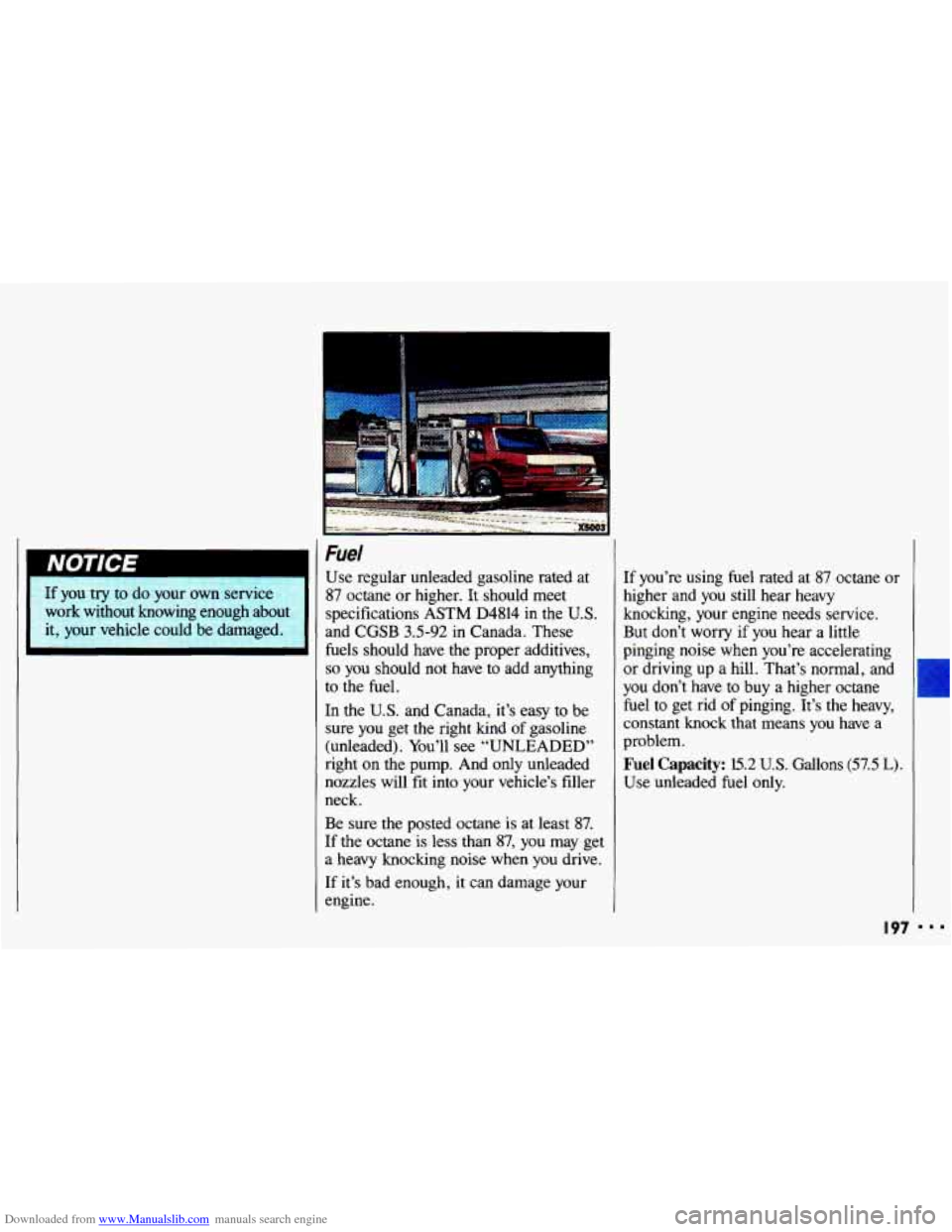
Downloaded from www.Manualslib.com manuals search engine If you try to do your own servic
work without knowing enough abot it, your vehicle could be damaged.
Fuel
Use regular unleaded gasoline rated at
87 octane or higher. It should meet
specifications ASTM D4814 in the U.S.
and CGSB
3.5-92 in Canada. These
fuels should have the proper additives,
so you should not have to add anything
to the fuel.
In the U.S. and Canada, it’s easy to be
sure you get the right kind
of gasoline
(unleaded). You’ll see “UNLEADED”
right on
the pump. And only unleaded
nozzles will
fit into your vehicle’s filler
neck.
Be sure the posted octane is at least
87.
If the octane is less than 87, you may get
a heavy knocking noise when you drive.
If it’s bad enough, it can damage your
engine.
If you’re using fuel rated at 87 octane or
higher and
you still hear heavy
knocking, your engine needs service.
But don’t worry
if you hear a little
pinging noise when you’re accelerating
or driving up
a hill. That’s normal, and
you don’t have to buy a higher octane
fuel to get rid of pinging. It’s the heavy,
constant knock that means
you have a
problem.
Fuel Capacity: 15.2 U.S. Gallons (57.5 L).
Use unleaded fuel only.
I97
Page 200 of 308
Downloaded from www.Manualslib.com manuals search engine Service & Appearance Care
Fuel (CONTI
What about gasoline with blending
materials that contain oxygen, such
as
MTBE or alcohol?
MTBE is “methyl tertiary-butyl
ether?
Fuel that is no more than 15 %
MTBE is fine for your vehicle.
Ethanol is ethyl or grain alcohol.
Properly-blended fuel that is
no more
than
10% ethanol is fine for your
vehicle.
Methanol is methyl or wood alcohol.
I98
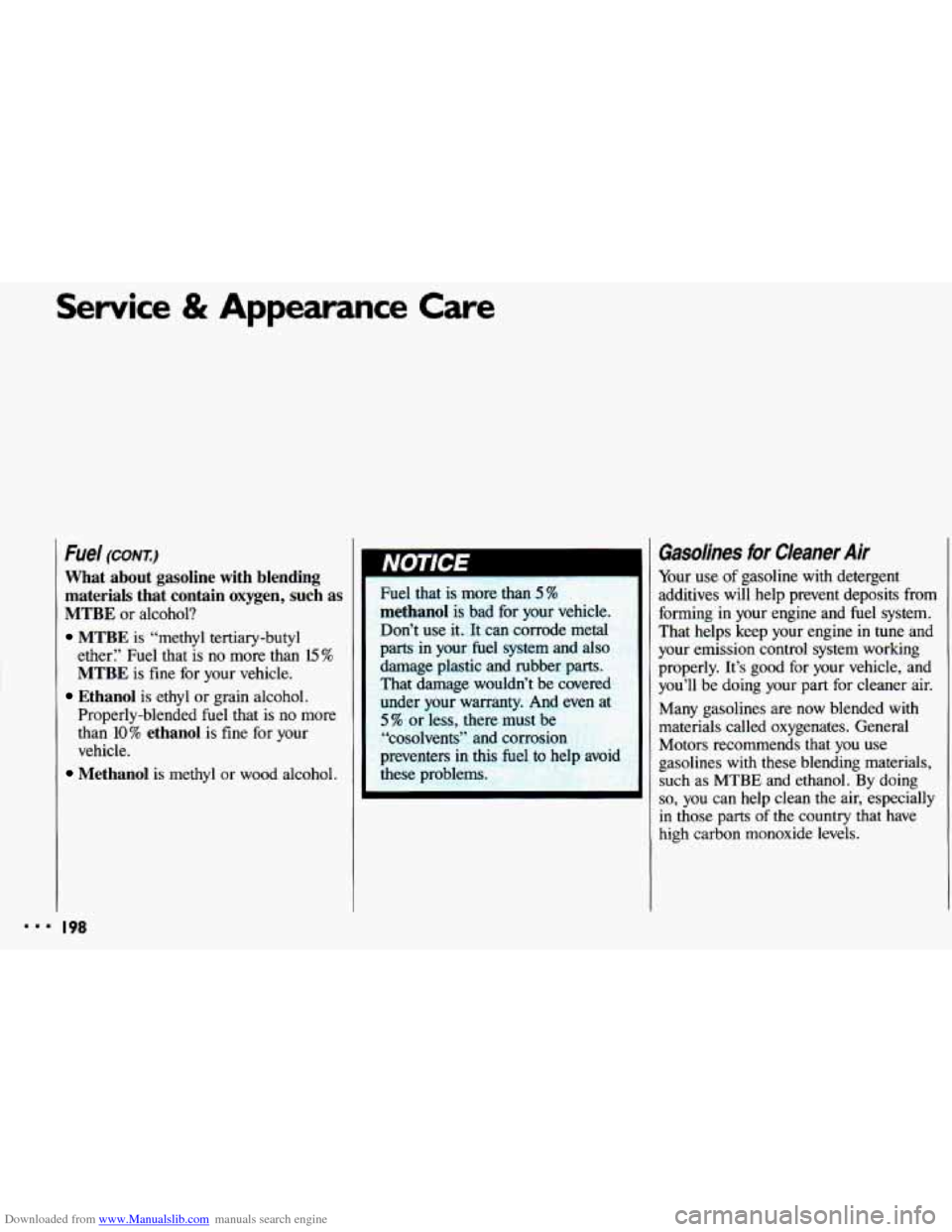
Fuel that is more than 5 %
methanol is bad for your vehicle.
Don’t use it.
It can corrode metal
parts in your fuel system and also
damage plastic and rubber
parts.
That damage wouldn’t be covered
under
your warranty. And even at
5 % or less, there must be
“cosolvents” and corrosion
preventers in th he1 to :lp avoid
these problems.
- -
Gasolines for Cleaner Air
Your use of gasoline with detergent
additives will help prevent deposits from
forming
in your engine and fuel system.
That helps keep your engine
in tune and
your emission control system working
properly. It’s good for your vehicle, and
you’ll be doing your part for cleaner air.
Many gasolines are now blended
with
materials called oxygenates. General
Motors recommends that you use
gasolines with these blending materials,
such as MTBE and ethanol. By doing
so, you can help clean the air, especially
in those parts of the country that have
high carbon monoxide levels.
Page 209 of 308
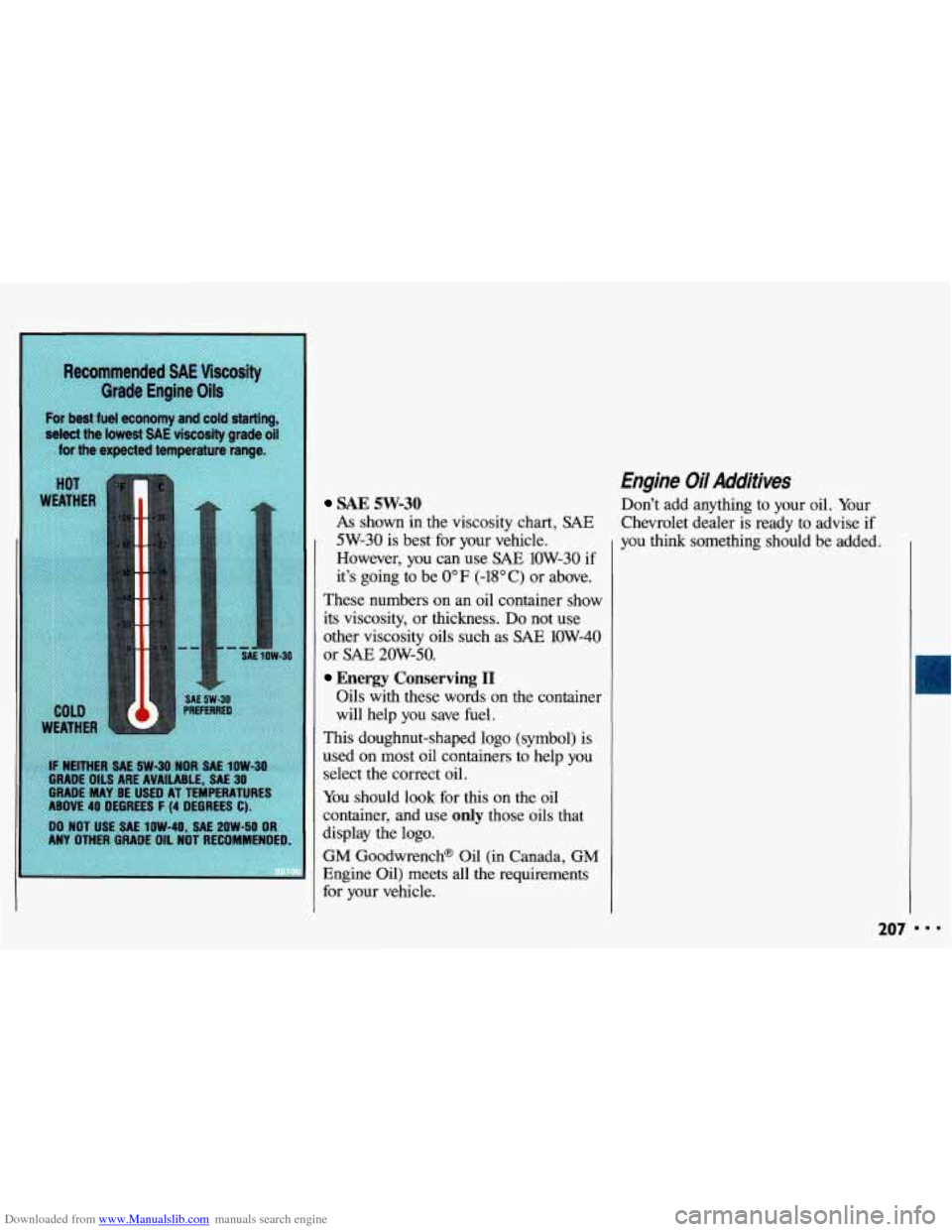
Downloaded from www.Manualslib.com manuals search engine SAE 5W-30
As shown in the viscosity chart, SAE
5W-30 is best for your vehicle.
However, you can use
SAE 1OW-30 if
it's going to be 0" F (-18" C) or above.
These numbers on
an oil container show
its viscosity, or thickness. Do not use
other viscosity oils such as
SAE 1OW-40
or SAE 20W-50.
Energy Conserving II
Oils with these words on the container
will help you save fuel.
This doughnut-shaped logo (symbol) is
used on most
oil containers to help you
select the correct oil.
You should look for this on the oil
container, and use
only those oils that
display the logo.
GM Goodwrench@ Oil (in Canada, GM
Engine Oil) meets all the requirements
for your vehicle.
Engine Oil Additives
Don't add anything to your oil. Your
Chevrolet dealer is ready to advise if
you think something should be added.
207
.
Page 299 of 308
Downloaded from www.Manualslib.com manuals search engine Daytime Running Lights ........ -80
Dead Battery: What to Do ........ 164
Defects. Safety (see
Safety Defects)
Defensive Driving .............. 128
Defogger. Rear Window .......... 109
Defrosting
.................... 108
Dome Light
.................... 82
Door Locks
.................... 49
Downshifting
.............. .65. W4
Driver Position
.................. 23
Driving
....................... 123
At Night
.................... 143
City
........................ 149
Controlling a Skid
............. 142
Defensively
................. -128
Drunken .................... 129
Freeway
.................... 150
Hill and Mountain ............ 154
In a Foreign Country
.......... 199
In Fog, Mist and Haze ......... 148
In the Rain .................. 145
Long Distance
................ 152
Loss
of Control ............... 142
On Curves
................... 138
Passing
..................... 140
Defogging
Your Windows
.... .106. 109 Through
Deep Standing Water
.... 58
Winter Driving ............... 157
Drunken Driving
............... 129
n
Easy-Entry Seat ................ 15
Electrical Equipment. Adding ..... 247
Emergencies. Braking
........... 137
Emergencies on the Road
......... 164
Emergencies. Steering in
......... 139
Emergency
Starting ............. 164
Emergency Towing
.............. 169
Engine Block Heater
........ .59, 208
Engine Coolant (see
Coolant)
Engine Coolant Temperature Warning
Engine Identification
........ .56. 246
Engine Oil
.................... 205
Additives
................... 207
Checking
&
Adding .......... .205. 250. 252
Crankcase Capacity
........... 250
Disposing of Used Oil ......... 209
Energy Conserving
............ 207
Filter
.................. .208. 256
Gage
(see Coolant)
Pressure Gage ................. 99
Warning Light ................ 98
When to
Change .............. 208
Engine Overheating
............. 174
Engine Specifications
............ 255
Engine, Starting
................. 56
Automatic Transaxle ........... 57
Manual Transaxle
.............. 57
Ethanol in Gasoline ............. 198
Exhaust Dangerous
Gas in ......... .70, 159
Parking with the Engine Running
................ .68, 71
Expectant Mothers, Use of
Safety Belts
................... 27
Expressway Driving
............. 150
Extender. Safety Belt ............ -44
Exterior Appearance
(see
Appearance Care)
Fabric Cleaning (see Appearance Care)
Fan Warnings .......... .166. 167. 175
Filling
the Fuel Tank ....... .200. 251
Filter. Oil
............ .208, 250. 256
Flashers, Hazard Warning
........ 164
297 r