Page 121 of 358
AMIFM Stereo with Cassette
Tape Player
To Play the Radio
Turn the upper knob to turn the system on
or off.
Volume
Turn the upper knob to adjust the volume.
AM-FM
Press the lower knob to get AM or FM.
The lighted display shows your selection.
Tune
Turn the lower knob to choose radio
stations.
Recall
Press the upper knob to recall the station
being played or the clock display.
Seek
Press SEEK v or A and the radio will
tune to the next lower or higher station
and stay there.
Scan
The scan function uses the same two
buttons
as the seek function.
To go to the next higher station and stay
there for
a few seconds, press and hold
SEEK A and then press SEEK v for an
instant.
To go to the next lower station and stay
there for
a few seconds, press and hold
SEEK v and then press SEEK A for an
instant.
To stop the scan function, press either
SEEK A or v.
ProCarManuals.com
Page 132 of 358
Comfort Controls & Audio Systems
AM Stereo
This means the Delco@ system can
receive C-QUAM@ stereo broadcasts.
Many AM stations around the country use
C-QUAM@
to produce stereo, though
some
do not. (C-QUAM@ is a registered
trademark
of Motorola, Inc.) If your
Delco@ system can get C-QUAM@, your
“STEREO” light will come on when
you’re receiving
it.
I
Care of Your Cassette Tape
Player
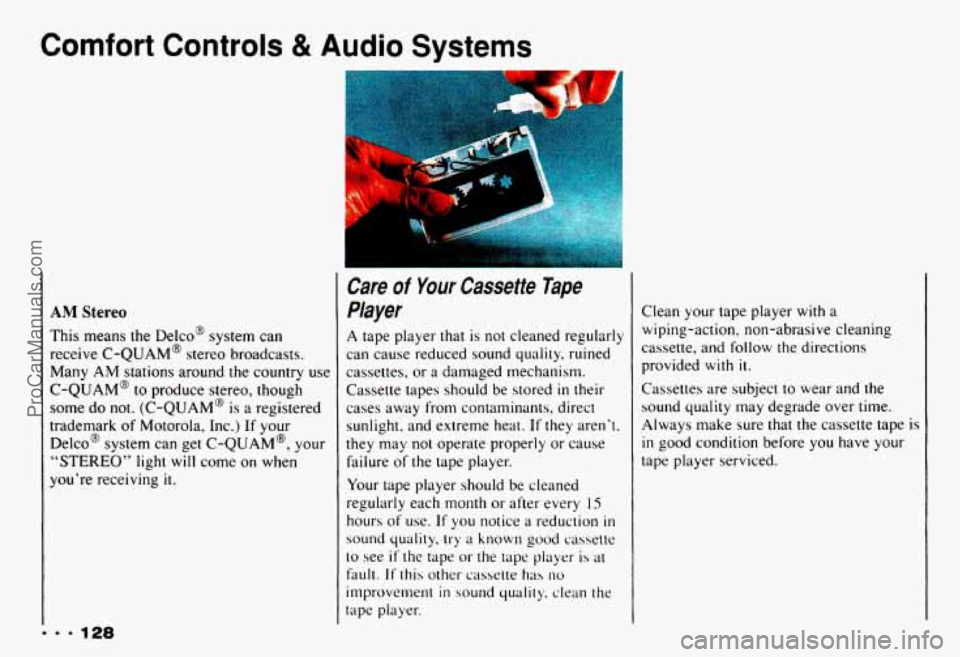
A tape player that is not cleaned regularly
can cause reduced sound quality, ruined
cassettes, or a damaged mechanism.
Cassette tapes should be stored
in their
cases away from contaminants, direct
sunlight, and extreme heat. If they aren’t.
they may not operate properly or cause
failure
of the tape player.
Your tape player should be cleaned
regularly each month or after every
IS
hours of use. If you notice a reduction in
sound quality. try a known good cassette
to see
if the tape or the tape player is a1
fault. If this other cassette has no
improvenlent in sound qualily. clean the
tape player. Clean
your tape player
with a
wiping-action, non-abrasive cleaning
cassette, and follow the directions
provided with it.
Cassettes are subject to wear and the
sound quality may degrade over time.
Always make sure that the cassette tape is
in good condition before you have your
tape player serviced.
ProCarManuals.com
Page 133 of 358
I Care of Your Compact Discs
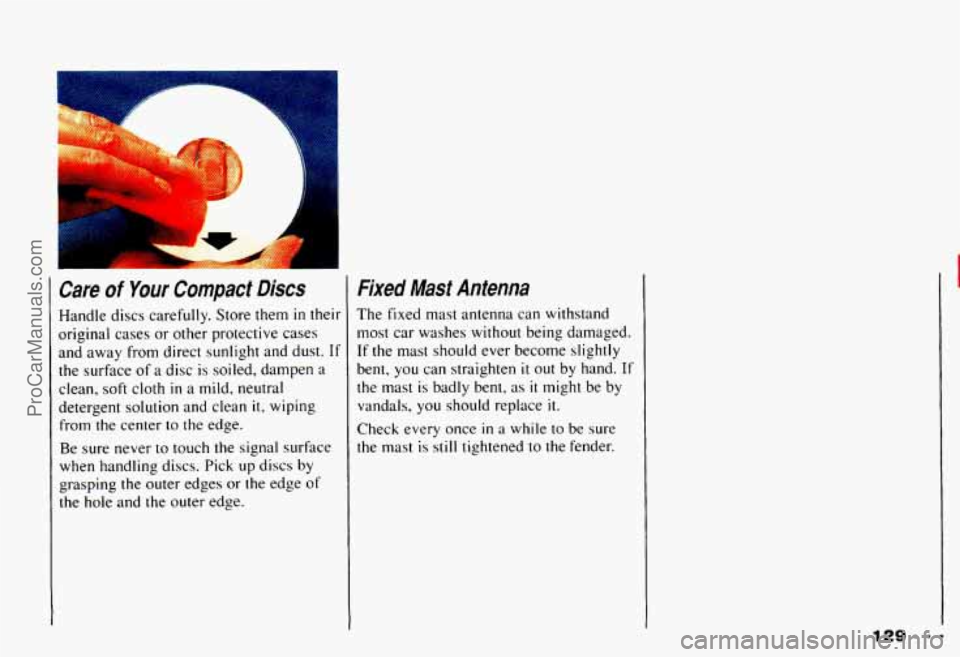
Handle discs carefully. Store them in their
original cases or other protective cases
and away from direct sunlight and dust. If
the surface of a disc is soiled, dampen
a
clean, soft cloth in a mild, neutral
detergent solution and clean
it, wiping
from the center to the edge.
Be sure never to touch the signal surface
when handling discs. Pick up discs by
grasping the outer edges
or the edge of
the hole and the outer edge.
Fixed Mast Antenna
The fixed mast antenna can withstand
most car washes without being damaged.
If the mast should ever become slightly
bent, you can straighten
it out by hand. If
the mast is badly bent, as it might be by
vandals, you should replace
it.
Check every once in a while to be sure
the mast
is still tightened to the fender.
ProCarManuals.com
Page 138 of 358
Your Driving and the Road
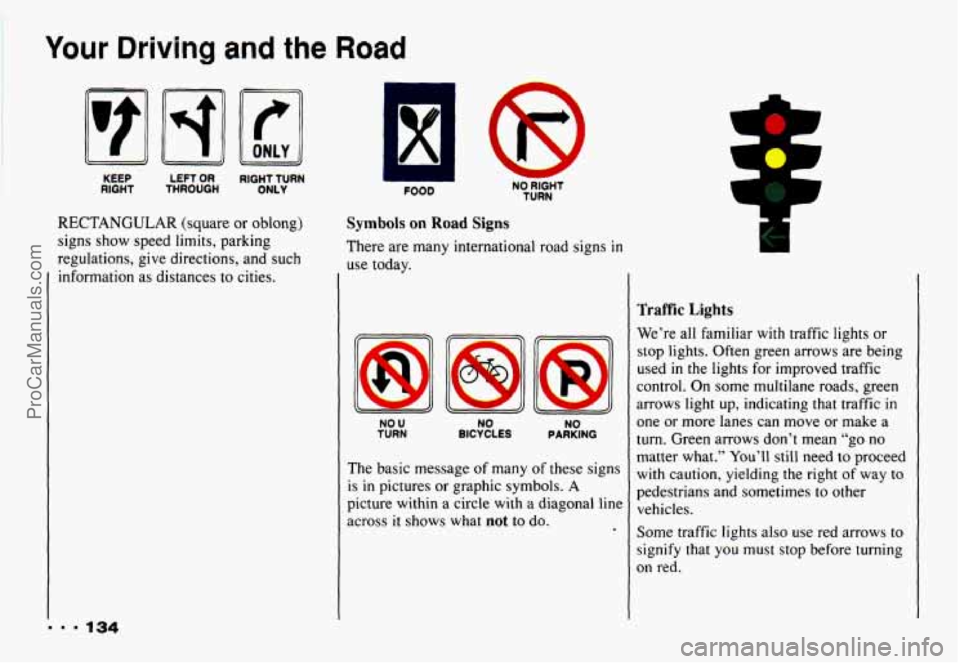
KEEP LEFT OR RIGHT TURN
RIGHT THROUGH ONLY
RECTANGULAR (square or oblong)
signs show speed limits, parking
regulations, give directions, and such
information as distances
to cities.
Symbols on Road Signs
There are many international road signs in
use today.
NO U TURN BICYCLES NO PARKING NO
The basic message
of many of these signs
is in pictures or graphic symbols.
A
picture within a circle with a diagonal line
across
it shows what not to do.
Traffic Lights
We’re all familiar with traffic lights or
stop lights. Often green arrows are being
used
in the lights for improved traffic
control. On some multilane roads, green
arrows light up, indicating that traffic
in
one or more lanes can move or make a
turn. Green arrows don’t mean “go no
matter what.’’
You’ll still need to proceed
with caution, yielding the right of way to
pedestrians and sometimes to other
vehicles.
Some traffic lights also use red arrows
to
signify that you must stop before turning
on red.
ProCarManuals.com
Page 139 of 358
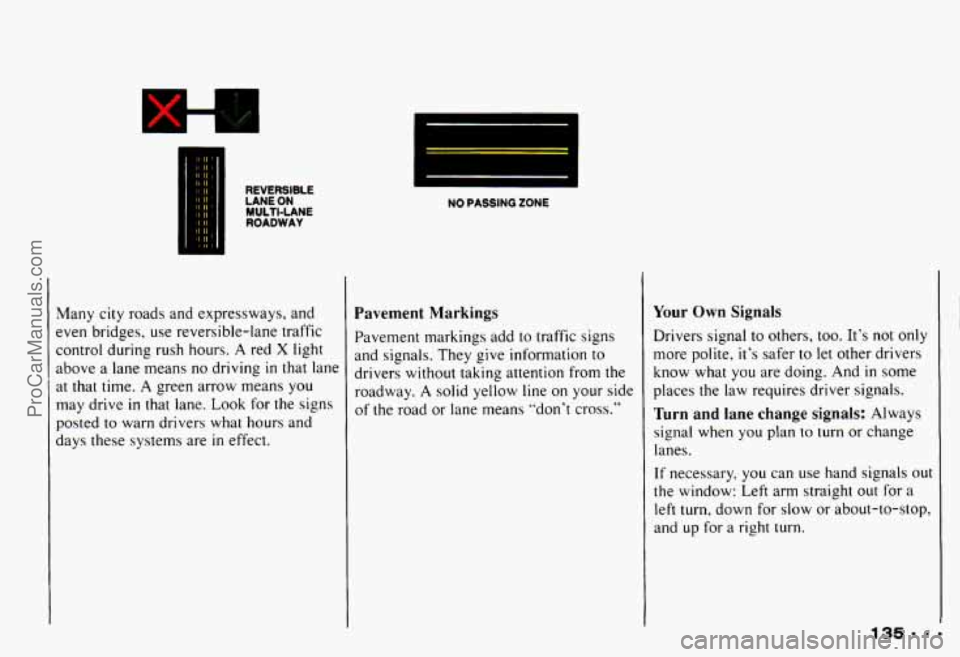
REVERSIBLE
LANE ON
ROADWAY MULTI-LANE
Many city roads and expressways, and
2ven bridges, use reversible-lane traffic
control during rush hours. A red
X light
above a lane means no driving
in that lane
at that time. A green arrow means you
may drive
in that lane. Look for the signs
posted to warn drivers what hours and
days these systems are
in effect.
NO PASSING ZONE
Pavement Markings
Pavement markings add to traffic signs
and signals. They give information to
drivers without taking attention from the
roadway. A solid yellow line on your side
of the road or lane means “don’t cross.”
Your Own Signals
Drivers signal to others, too. It’s not only
more polite, it’s safer
to let other drivers
know what you are doing. And
in some
places the law requires driver signals.
Turn and lane change signals: Always
signal when
you plan to turn or change
lanes.
If necessary, you can use hand signals out
the window: Left arm straight out for a
left
turn, down for slow or about-to-stop,
and up for a right turn.
ProCarManuals.com
Page 140 of 358
Your Driving and the Road
136
Slowing down: If time allows, tap the
brake pedal once or twice
in advance of
slowing or stopping. This warns the driver
behind you.
Disabled: Your four-way flashers signal
that your vehicle
is disabled or is a
hazard. See “Hazard Warning Flashers”
in
the Index.
Traffic Officer
The traffic police officer is also a source
of important information. The officer’s
signals govern, no matter what the traffic
lights or other signs say.
The next section discusses some of the
road conditions you may encounter.
Defensive Driving
The best advice anyone can give about
driving
is: Drive defensively.
Please start
with a very important safety
device
in your Chevrolet: Buckle up. (See
“Safety Belts”
in the Index.)
Defensive driving really means “be ready for anything.“ On city streets,
rural roads,
or freeways, it means “always expect the
unexpected.”
Assume that pedestrians or other drivers
are going
to be careless and make
mistakes. Anticipate what they
might do.
Be ready for their mistakes.
Expect children
to dash out from behind
parked cars, often followed
by other
children. Expect occupants
in parked cars
to open doors into traffic. Watch for movement
in parked cars - someone
may be about
to open a door.
Expect other drivers
to run stop signs
when you are
on a through street. Be
ready
to brake if necessary as you go
:hrough intersections.
You may not have
:o use the brake, but if you do, you will be
-eady.
If you’re driving through a shopping
center parking
lot where there are
well-marked lanes, directional arrows,
and designated parking areas, expect
some drivers to ignore all these markings
and dash straight toward one part of the
lot.
ProCarManuals.com
Page 142 of 358
Your Driving and the Road
... 138
In most cases, these deaths are the result
of someone who was drinking and
driving. Over
25,000 motor
vehicle-related deaths occur each year
because
of alcohol, and thousands of
people are injured.
Just how much alcohol is too much if a
person plans to drive? Ideally, no one
should drink alcohol and then drive.
But
if one does, then what’s “too much”? It
can be a lot less than many might think.
Although it depends on each person and
situation, here is some general
information on the problem. The
Blood Alcohol Content (BAC) of
someone who
is drinking depends upon
four things:
How much alcohol is
in the drink.
The drinker’s body weight.
The amount
of food that is consumed
before and during drinking.
The length of time
it has taken the
drinker to consume the alcohol. According to the American Medical
Association,
a 180-pound
(82 kg) person
who drinks three 12-ounce
(355 ml)
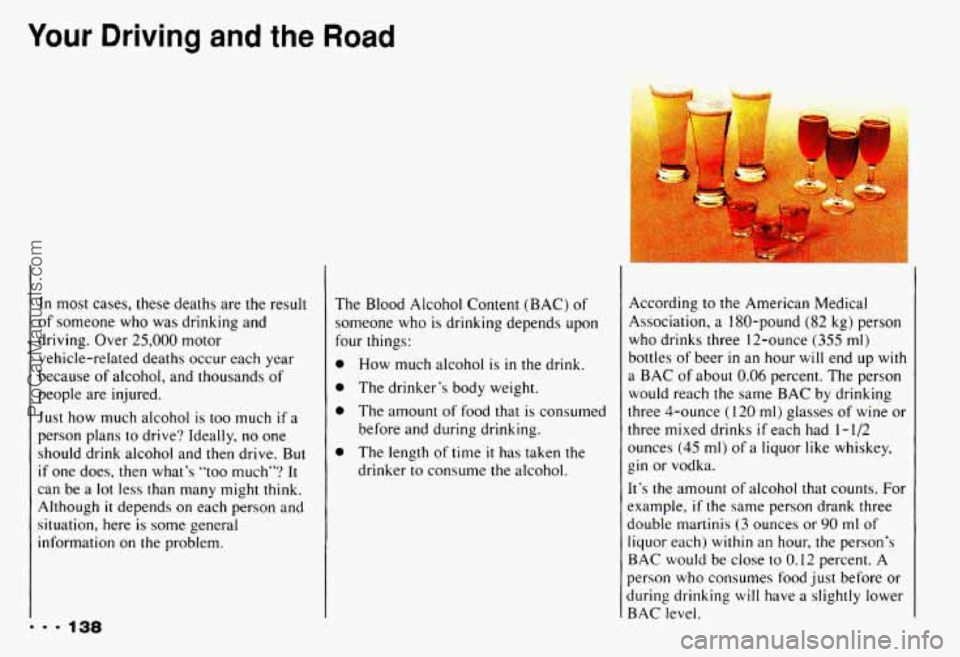
bottles of beer in an hour will end up with
a BAC of about 0.06 percent. The person
would reach the same BAC by drinking
three 4-ounce
(120 ml) glasses of wine or
three mixed drinks
if each had 1-1/2
ounces (45 ml) of a liquor like whiskey,
gin or vodka.
It’s the amount of alcohol that counts. For
example,
if the same person drank three
double martinis
(3 ounces or 90 ml of
liquor each) within an hour, the person’s
BAC would
be close to 0.12 percent, A
person who consumes food just before or
during
drinking will have a slightly lower
BAC level.
ProCarManuals.com
Page 145 of 358
Braking
Braking action involves perception time
and reaction time.
First, you have to decide to push on the
brake pedal. That’s
perception time.
Then you have to bring up your foot and
do
it. That’s reaction time.
Average reaction time is about 3/4 of a
second. But that’s only an average.
It
might be less with one driver and as long
as two or three seconds or more with
another. Age, physical condition,
alertness, coordination, and eyesight all
play a part.
So do alcohol, drugs and
frustration.
But even in 3/4 of a second, a
vehicle moving at
60 mph ( 100 km/h)
travels
66 feet (20 m). That could be a lot
of distance in an emergency, so keeping :nough
space between your vehicle and
Dthers is important.
And, of course, actual stopping distances
vary greatly
with the surface of the road
:whether it’s pavement or gravel); the
;ondition of the road (wet, dry, icy); tire
tread; and the condition
of your brakes.
Most drivers treat their brakes with care,
Some, however, overwork the braking system
with poor driving habits.
B Avoid needless heavy braking. Some
people drive
in spurts - heavy
acceleration followed by heavy
braking
- rather than keeping pace
with traffic. This is a mistake. Your
brakes may not have time
to cool
between hard stops. Your brakes will
wear out much faster
if you do a lot of
heavy braking.
Don’t “ride” the brakes by letting your
left foot rest lightly on the brake pedal
while driving.
ProCarManuals.com