Page 190 of 358
Problems an the Road
To Jump Start Your Chevrolet:
1. Check the other vehicle. It must have
a 12-volt battery
with a negative
ground system.
11 NOTICE:
... 186
2.
lr tne otner system Isn’t a lz-vo~t
--/stem
with a negative ground, botn
Yzhicles can be damaged.
r
Get the vehicles close enough so the
jumper cables can reach,
but be sure
the vehicles aren’t touching each
other.
If they are, it could cause a
ground connection you don’t want.
You wouldn’t be able to start your
Chevrolet, and the bad grounding
could damage the electrical systems.
I
’WTION: II ~____
rou cows De rnJurea if the
4 vehicles roll. Set the parking
,,ake firmly on each vehicle. Put
an automatic transmission
in
P (Park) or a manual transmission
in Neutral.
‘I
3. Turn off the ignition on both vehicles,
Turn
off all lights that aren’t needed,
and radios. This
will avoid sparks and
help save both batteries.
And it could
save your radio!
be badly damaged. The repairs
wouldn’t be covered
1 your
NOTICE:
warrar
I
ProCarManuals.com
Page 191 of 358

, Open the hoods and locate the
batteries.
CAUTION:
A
An electric fan can start up
even when the engine
is not
running and can injure you. Keep
hands, clothing and tools away from
any underhood electric fan.
Find the positive
(+) and negative (-)
terminals on each battery.
A
Using a match near a battery
can cause battery gas to
explode. People have been hurt
doing
this, and some have been
blinded.
Use a flashlight if you need
more light.
Be sure the battery has enough
water,
You don’t need to add water
to the Delco Freedom@ battery
installed
in every new GM vehicle.
But if a battery has filler caps, be
sure the right amount of fluid is
there. If it is low, add water to take
care
of that first. If you don’t,
explosive
gas could be present.
Battery fluid contains acid that can
burn you. Don’t get it on you. If
you accidentally get it in your eyes
or
on your skin, flush the place
with water and get medical help
immediately. Check that the
jumper cables don’t
have
loose or missing insulation. If
they do, you could get a shock. The
vehicles could
be damaged, too.
Before you connect the cables, here
are some basic things you should
know. Positive
(+) will go to positive
(+) and negative (-) will go to
negative
(-) or a metal engine part.
Don’t connect
(+) to (-) or you’ll get a
short that would damage the battery
and maybe other parts, too.
18799.
ProCarManuals.com
Page 196 of 358
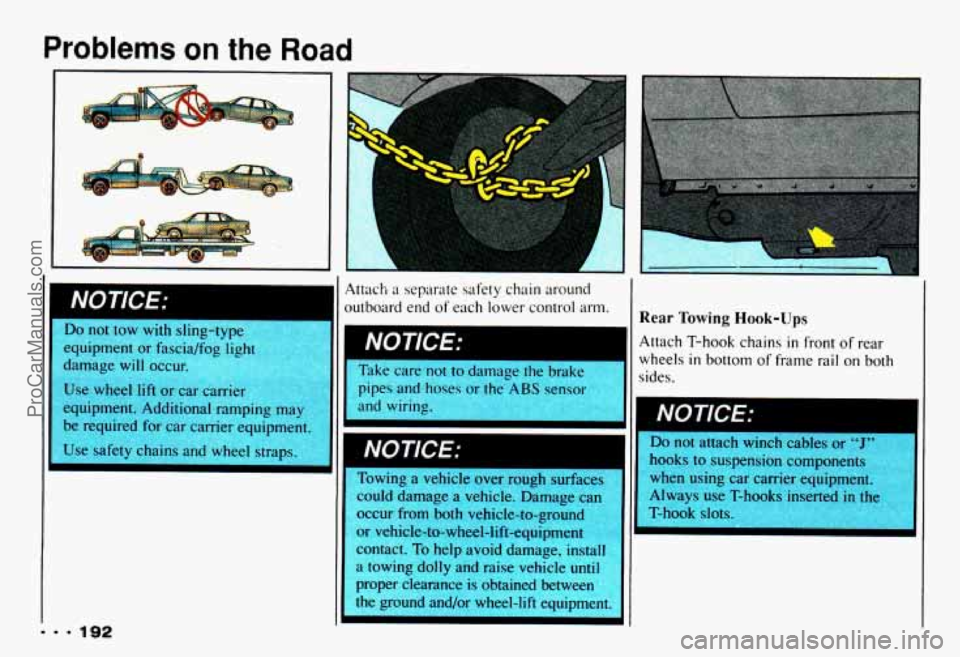
Problems on the Road
I.. 192
not tow with sling-typc
equipment or fascia/fog light
damage will occu
Use wheel lift or car carrier
equipment. Additional ramping may
be required for car carrier equipment.
Use safety chains and wheel straps. Attach
a separate safety chain around
outboard end
of each lower control arm.
I
contact. To help avoid damage, install
a towing
dolly and raise vehicle until
proper clearance
is obtained between *
the ground and/or wheel-lift equipment.
Rear Towing Hook-Ups
Attach T-hook chains in front of rear
wheels in bottom of frame rail on both
sides.
/I
I ~ to suspension compontllLa
using car carrier equipment.
ProCarManuals.com
Page 197 of 358
I
c
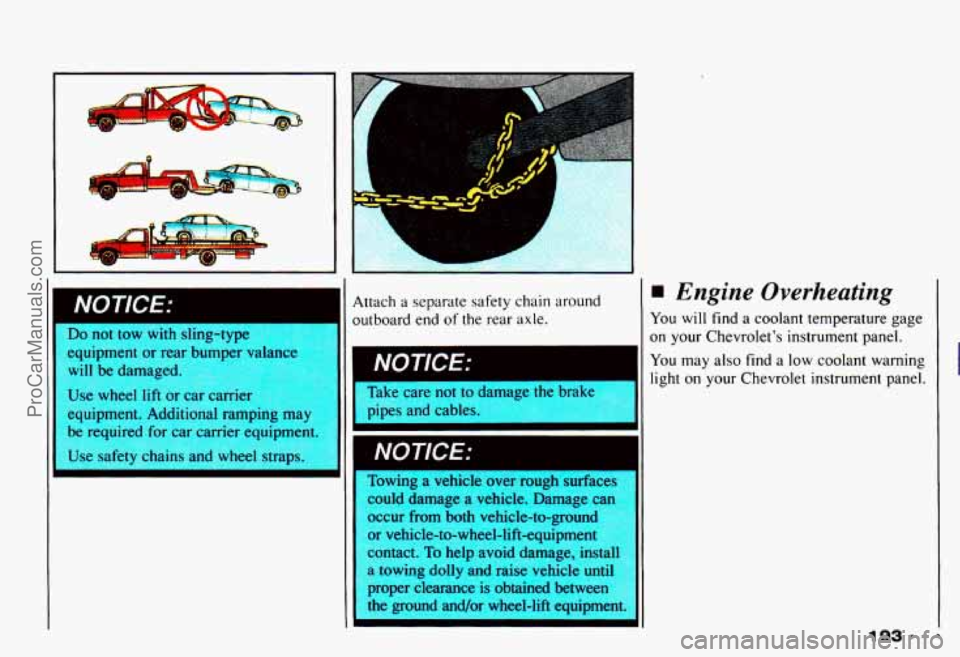
Do not tow with sling-type
eauipment or rear bumDer valance
equipment. Additional ramping may
be required for car carrier equipment.
Use safety chains and wheel straps. Attach
a separate
safety chain around
outboard end
of the rear axle.
NOTICE: I
could damage a vehicle. Damage can
occur from both vehicle-to-ground
or vehicle-to-wheel-lift-equipment
To help avoid damage, install
g dolly and raise vehicle until
er clearance is obtained between
the ground and/or wheel-lift equipment.
Engine Overheating
You will find a coolant temperature gage
on your Chevrolet's instrument panel.
You may also find a low coolant warning
light on your Chevrolet instrument panel.
193 9
ProCarManuals.com
Page 220 of 358
Problems on the Road
If you let your tires spin at high
speed, they can explode and
you or others could be injured. And,
the transmission or other partsof the
vehicle can overheat. That could
II I
I
cause an engine compartment fire or
other damage. When you’re stuck,
spin the wheels as little as possible.
Don’t spin the wheels above
35 mph
(55 km/h) as shown on the
speedometer.
I
Spinning your wheels can destroy
parts of your vehicle as well as the
.ires. If you spin the wheels too fast
Nhile shifting your transmission
aack and
forth, you can destro!,
your transmission.
Rocking your vehicle to get it out:
First, turn your steering wheel left and
right. That will clear the area around your
front wheels. Then shift back and forth
between
R (Reverse) and a forward gear
(or with a manual transmission, between
First or Second gear and Reverse),
spinning the wheels as little as possible.
Release the accelerator pedal while you
shift, and press lightly on
the accelerator
pedal when the transmission is
in gear. If
that doesn’t get you out after a few tries,
you may need to be towed out. If you do
need to be towed out, see “Towing Your
Vehicle”
in the Index.
... 21 6
ProCarManuals.com
Page 231 of 358
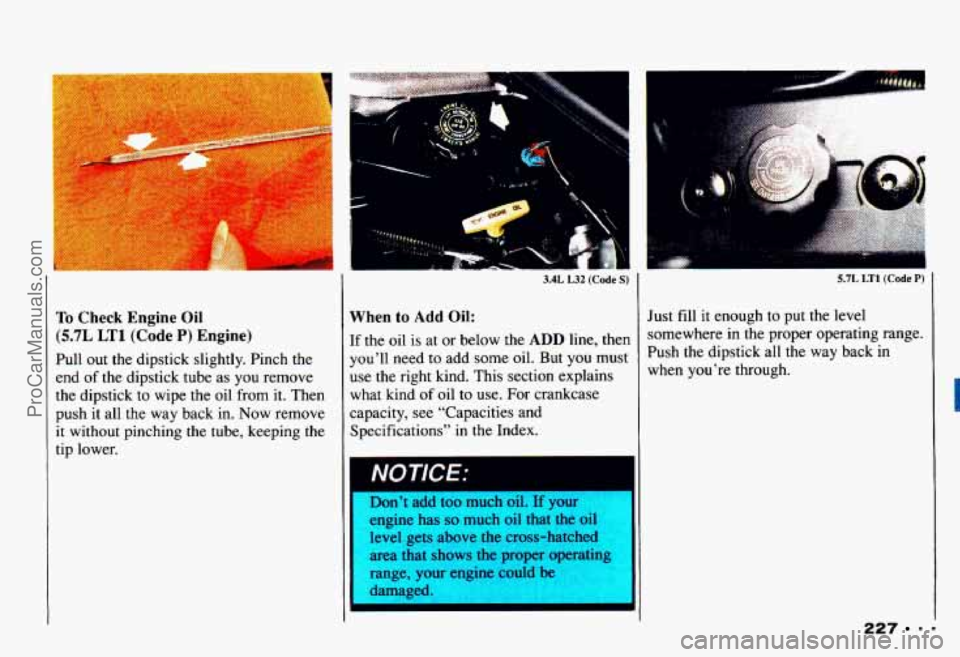
To Check Engine Oil
(5.7L LT1 (Code P) Engine)
Pull out the dipstick slightly. Pinch the
end of the dipstick tube as you remove
the dipstick to wipe the oil from it.
Then
push it all the way back in. Now remove
it without pinching the tube, keeping the
tip lower.
3.4L L32 (Code S:
When to Add Oil:
If the oil is at or below the ADD line, then
you’ll need
to add some oil. But you must
use the right kind. This section explains
what kind
of oil to use. For crankcase
capacity, see “Capacities and
Specifications” in the Index.
11 NOTICE:
UUll 1 auu LUU IIIULII u11. 11 ywul
engine has so much oil that the oil
I level gets above the cross-hatched
area that shows the proper operating
I
range, you
damaged.
I I
5.7L LT1 (Code P)
Just fill it enough to put the level
somewhere in the proper operating range.
Push the dipstick all
the way back in
when you’re through.
227 9
ProCarManuals.com
Page 242 of 358
Service & Appearance Care
What to Use:
Standard and Limited-Slip Differential
Use Axle Lubricant (GM Part No.
1052271) or SAE 8OW-90 GL-5 gear
lubricant.
Engine Coolant
The following explains your cooling
system and how
to add coolant when it
is low. If
you have a problem with
engine overheating or if you need to add
coolant to your radiator, see “Engine
Overheating”
in the Index.
I
The proper coolant for your Chevrolet
will:
0
0
0
0
0
Give freezing protection down to
-34°F (-37°C).
Give boiling protection up to 262°F
(128°C).
Protect against rust and corrosion.
Help keep the proper engine
temperature.
Let
the warning lights work as they
should.
ProCarManuals.com
Page 244 of 358
Service & Appearance Care
1
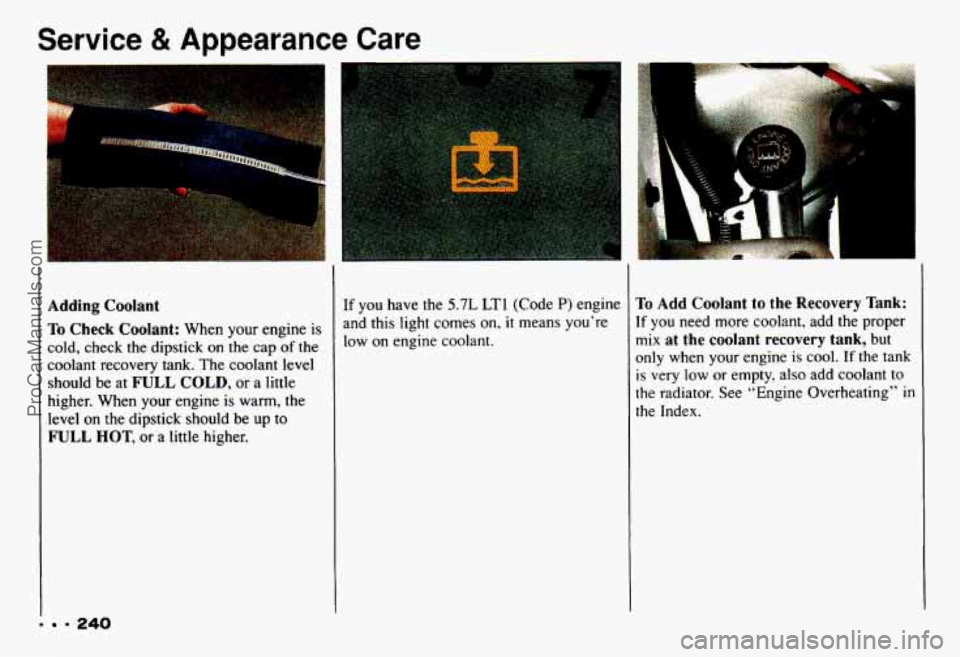
Adding Coolant
To Check Coolant: When your engine is
cold, check the dipstick on the cap of the
coolant recovery tank. The coolant level
should be at
FULL COLD, or a little
higher. When your engine is warm, the
level on the dipstick should be up to
FULL HOT, or a little higher.
If you have the 5.7L LTl (Code P) engine
and this light comes on,
it means you’re
low on engine coolant.
To Add Coolant to the Recovery Tank:
If you need more coolant, add the proper
mix
at the coolant recovery tank, but
only when your engine
is cool. If the tank
is very low or empty, also add coolant to
the radiator. See “Engine Overheating” in
the Index.
9 240
ProCarManuals.com