1993 CHEVROLET CAMARO headlights
[x] Cancel search: headlightsPage 82 of 358
Features & Controls
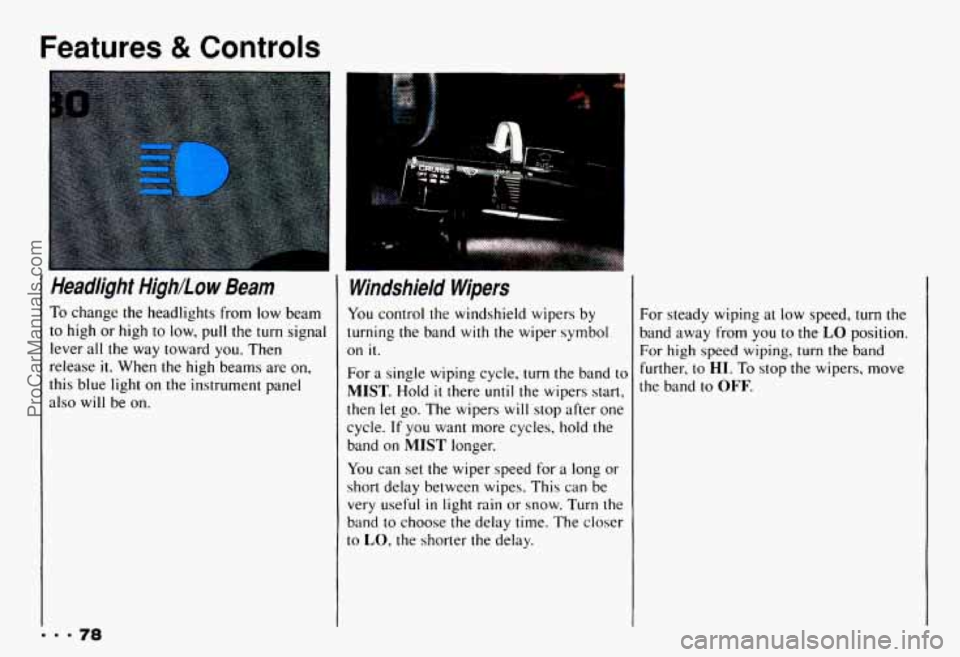
Headlight HighLow Beam
To change the headlights from low beam
to high or high
to low, pull the turn signal
lever all
the way toward you. Then
release
it. When the high beams are on,
this blue light on the instrument panel
also will
be on.
. e*. 5 r
Windsmpers
You control the windshield wipers by
turning the band with the wiper symbol
on it.
For a single wiping cycle, turn the band
to
MIST. Hold it there until the wipers start,
then let go. The wipers
will stop after one
cycle.
If you want more cycles, hold the
band on
MIST longer.
You can set the wiper speed for a long or
short delay between wipes. This can be
very useful
in light rain or snow. Turn the
band to choose the delay time. The closer
to LO, the shorter the delay. For
steady wiping at
low speed, turn the
band away from you
to the LO position.
For high speed wiping, turn the band
further,
to HI. To stop the wipers, move
the band
to OFF.
99978
ProCarManuals.com
Page 88 of 358

Features & Controls
I
I
I'o Get Out of Cruise Control
There are several ways to turn off the
Cruise Control:.
1. Step lightly on the brake pedal or push
the clutch pedal,
if you have a manual
transmission:
OR
2. Move the Cruise switch to OFF.
To Erase Speed Memory
When you turn off the Cruise Control or
the ignition, your Cruise Control set speed
memory
is erased.
Operation of Lights
Although your vehicle's lighting system
(headlights, parking lights,
fog lamps,
side marker lights and taillights) meet all
applicable federal lighting requirements,
certain states and provinces may apply
their own lighting regulations that may
require special attention before you
operate these lights. For example, some
jurisdictions may require that
you operate
your lower beam lights with fog lamps at
all times, or that headlights be turned on
whenever you must use your windshield
wipers.
In addition, most jurisdictions
prohibit driving solely with parking
lights, especially at dawn or dusk. It is
recommended that you check with your
own state or provincial highway authority
for applicable lighting regulations.
ProCarManuals.com
Page 89 of 358

Main Light Control
The main light control is a knob that
works these lights:
0 Headlights
0 Taillights
Parking lights
0 License lights
0 Sidemarker lights
Instrument panel lights
Turn the knob
to SF- to turn on your
headlights and other operating lights.
Turn
the knob to pf to turn on your
parking lights without your headlights,
Turn the knob to
OFF to turn off the
lights.
. .....
Brightness Control
This switch controls the brightness of
your instrument panel lights. Turn the switch to brighten or dim the lights.
If you
turn the switch all the way up to
dv ,
your courtesy lights will come on.
Lights On Reminder
If you turn the ignition Off and leave the
lights on, you
will hear a tone when you
open the driver’s door.
Daytime Running Lights (Canada)
The Canadian Federal Government has
decided that “Daytime Running Lights”
(DRL) are a useful feature,
in that DRL
can make your vehicle more visible to
pedestrians and other drivers during
daylight hours.
DRL are required on new
vehicles sold
in Canada.
Your DRL work
with a light sensor on top
of the instrument panel. Don’t cover
it up.
The front
turn signal lights will come on
in daylight when:
0 The ignition is on
The headlight switch is off, and
The parking brake is released.
ProCarManuals.com
Page 90 of 358
Features & Controls
At dusk, the exterior lights will come on
automatically and the front turn signal
lights will go out.
At dawn, the exterior
lights will
go out and the front turn signal
lights will come on (if the headlight
switch is
off).
Of course, you may still turn on the
headlights any time you need to.
To idle your vehicle with the
DRL off, set
the parking brake while the ignition is
in
the Off or LOCK position. Then start the
vehicle. The
DRL will stay off until you
release the parking brake.
I
Fog Lights (Option)
Use your fog lights for better vision in
foggy or misty conditions. Your parking
lights must be on or your fog lights won't
work.
To turn the fog lights on, push the switch
abovego. Push the bottom of the
switch to
turn the fog lights off. A light
on the switch will come on when the fog
lights are on.
Fog lights will go off whenever your high
beams come on. When the high beams
go
off, the fog lights will come on again.
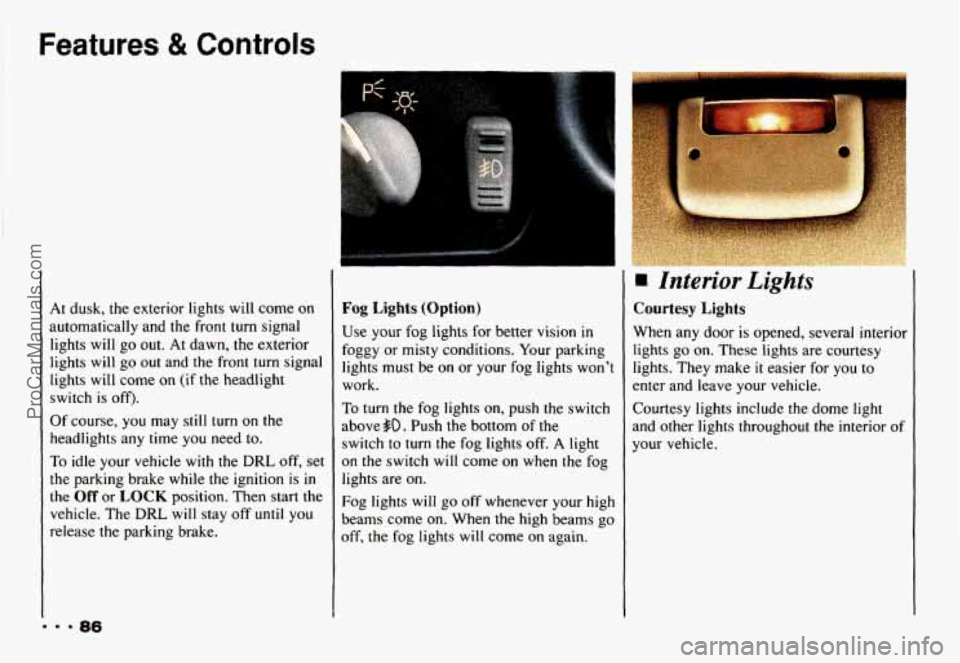
Interior Lights
Courtesy Lights
When any door is opened, several interior
lights
go on. These lights are courtesy
lights. They make
it easier for you to
mter and leave your vehicle.
Courtesy lights include the dome light
md other lights throughout the interior of
your vehicle.
ProCarManuals.com
Page 157 of 358
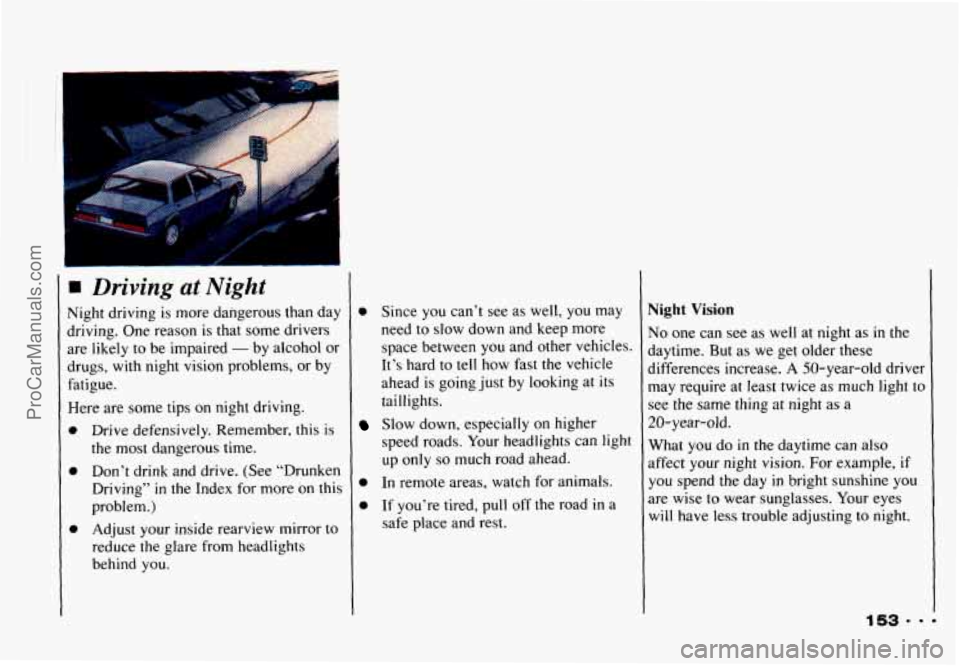
Driving at Night
Night driving is more dangerous than day
driving. One reason is that some drivers
are likely to be impaired
- by alcohol or
drugs, with night vision problems, or by
fatigue.
Here are some tips on night driving.
0
e
e
Drive defensively. Remember, this is
the most dangerous time.
Don’t drink and drive. (See “Drunken
Driving’’
in the Index for more on this
problem.)
Adjust your inside rearview mirror to
reduce
the glare from headlights
behind you.
0
0
0
Since you can’t see as well, you may
need to slow down and keep more
space between you and other vehicles.
It’s hard to tell how fast the vehicle
ahead is going just by looking at its
taillights.
Slow down, especially
on higher
speed roads. Your headlights can light
up only
so much road ahead.
In remote areas, watch for animals.
If you’re tired, pull off the road
in a
safe place and rest.
Night Vision
No one can see as well at night as in the
daytime. But as we get older these
differences increase. A 50-year-old driver
may require at least twice as much light to
see
the same thing at night as a
20-year-old.
What you do
in the daytime can also
affect your night vision. For example,
if
you spend the day in bright sunshine you
are wise to wear sunglasses. Your eyes
will have less trouble adjusting to night.
ProCarManuals.com
Page 158 of 358
Your Driving and the Road
But if you’re driving, don’t wear
sunglasses at night. They may cut down
on glare from headlights, but they also
make a lot
of things invisible that should
remain visible
- such as parked cars,
obstacles, pedestrians,
or even trains
blocking railway crossings. You may
want to put
on your sunglasses after you
have pulled into a brightly-lighted service
or refreshment area. Eyes shielded from
that glare may adjust more quickly to
darkness back on the road. But be sure to
remove your sunglasses before you leave
the service
area.-^-
You can be temporarily blinded by
approaching lights.
It can take a second or
two, or even several seconds, for your
eyes to readjust to the dark. When you are
faced with severe glare (as from a driver
who doesn’t lower the high beams, or a
vehicle
with misaimed headlights), slow
down a
little. Avoid staring directly into
the approaching lights. If there is a line of
opposing traffic, make occasional glances
over the line
of headlights to make certain
that one
of the vehicles isn’t starting to
move into
your lane. Once you are past
the bright lights, give your eyes time to
readjust before resuming speed.
High Beams
[f the vehicle approaching you has its
high beams on, signal
by flicking yours to
high and then back to low beam. This is
:he usual signal to lower the headlight
beams. If the other driver
still doesn’t
lower the beams, resist the temptation
to
put your high beams on. This only makes
two half-blinded drivers.
On a freeway, use your high beams only
in remote areas where you won’t impair
approaching drivers. In some places, like
Zities, using high beams is illegal.
ProCarManuals.com
Page 159 of 358
When you follow another vehicle on a
freeway or highway, use low beams. True,
most vehicles now have day/night mirrors
that enable the driver to reduce glare. But
outside mirrors are not of this type and
high beams from behind can bother the
driver ahead.
A Few More Night Driving Suggestions
Keep your windshield and all the glass on
your vehicle clean
- inside and out.
Glare at night is made much worse by dirt
on the glass. Even the inside of the glass
can build
up a film caused by dust.
Tobacco smoke also makes inside glass
surfaces very filmy and can be a vision
hazard
if it’s left there. Dirty
glass makes lights dazzle and flash
more than clean glass would, making the
pupils of your eyes contract repeatedly.
You might even want to keep a cloth and
some glass cleaner
in your vehicle if you
need to clean your glass frequently.
Remember that your headlights light
up
far less of a roadway when you are in a
turn or curve.
Keep your eyes moving; that
way, it’s
easier to pick
out dimly lighted objects.
Just as your headlights should be checked
regularly for proper aim,
so should your
eyes be examined regularly. Some drivers
suffer from
night blindness - the
inability to see
in dim light - and aren’t
even aware of
it.
Driving in the Rain
Rain and wet roads can mean driving
trouble. On a wet road you can’t stop,
accelerate or
turn as well because your
tire-to-road traction isn’t as good as on
dry roads. And,
if your tires don’t have
much tread left,
you’ll get even less
traction.
It’s always wise to go slower and be
cautious
if rain starts to fall while you are
driving. The surface may get wet
suddenly when your reflexes are tuned for
driving on
dry pavement.
ProCarManuals.com
Page 161 of 358
Hydroplaning
Hydroplaning is dangerous. So much
water can build up under your tires that
they can actually ride on the water. This
can happen
if the road is wet enough and
you’re going fast enough. When your
vehicle
is hydroplaning, it has little or no
contact
with the road.
You might not be aware of hydroplaning.
You could drive along for some time
without realizing your tires aren’t
in
constant contact with the road. You could
find
out the hard way: when you have to
slow, turn, move out to pass - or if you
get hit by a gust of wind. You could
suddenly find yourself out of control. Hydroplaning doesn’t happen
often.
But it
can if your tires haven’t much tread or if
the pressure in one or more is low. It can
happen
if a lot of water is standing on the
road.
If you can see reflections from trees,
telephone poles, or other vehicles, and
raindrops “dimple” the water’s surface,
there could be hydroplaning.
Hydroplaning usually happens at higher
speeds. There
just isn’t a hard and fast
rule about hydroplaning. The best advice
is to
slow down when it is raining, and be
careful.
Some Other Rainy Weather Tips
0
Turn on your headlights - not just
your parking lights
- to help make
you more visible to others.
Look for hard-to-see vehicles coming
from behind.
You may want to use
your headlights even
in daytime if it’s
raining hard.
ProCarManuals.com