Your Driving and the Road
I
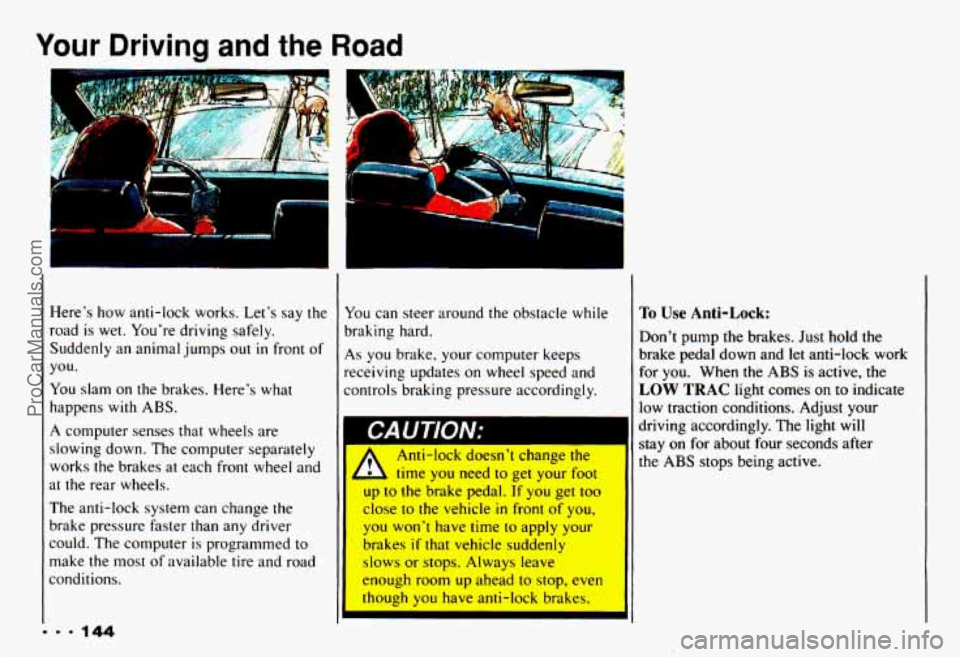
Here's how anti-lock works. Let's say the
road is wet. You're driving safely.
Suddenly an animal jumps out
in front of
you.
You slam on
the brakes. Here's what
happens with ABS.
A computer senses that wheels are
slowing down. The computer separately
works the brakes at each front wheel and
at the rear wheels.
The anti-lock system can change
the
brake pressure faster than any driver
could. The computer is programmed
to
make the most of available tire and road
conditions.
1
You can steer around the obstacle while
braking hard.
As you brake, your conlputer keeps
receiving updates
on wheel speed and
controls braking pressure accordingly.
I CAUTION;
A
Anti-lock doesn't change the
time
you need to get your foot
up
to the brake pedal. If you get too
close
to the vehicle in front of you,
1 you won't have time to apply your
brakes
if that vehicle suddenly
slows or stops. Always leave
enough room up ahead
to stop, even
though
you have anti-lock brakes.
I'o Use Anti-Lock:
Don't pump the brakes. Just hold the
brake pedal down and
let anti-lock work
for you. When the
ABS is active, the
LOW TRAC light comes on to indicate
low traction conditions. Adjust your
driving accordingly. The light will
stay on for about four seconds after
the
ABS stops being active.
ProCarManuals.com
I Off-Road Recovery
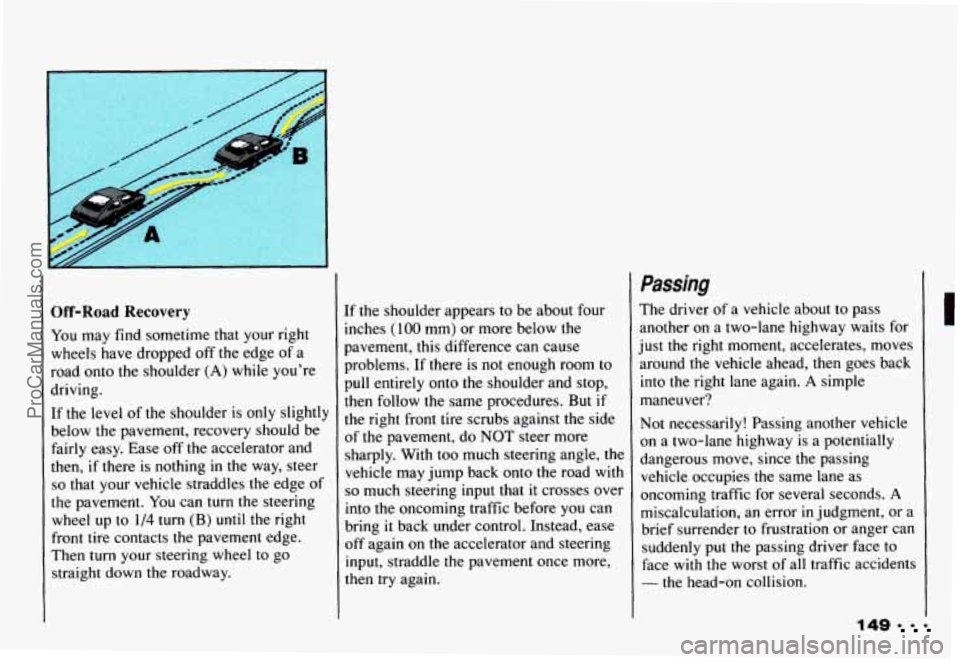
You may find sometime that your right
wheels have dropped off the edge of a
road onto the shoulder
(A) while you’re
driving.
If the level of
the shoulder is only slightly
below the pavement, recovery should be
fairly easy. Ease off the accelerator and
then,
if there is nothing in the way, steer
so that your vehicle straddles the edge of
the pavement. You can turn
the steering
wheel up to 1/4 turn (B) until the right
front tire contacts the pavement edge.
Then turn your steering wheel to go
straight down the roadway. If
the shoulder appears to be about four
inches
(100 mm) or more below the
pavement, this difference can cause
problems. If there is not enough room to
pull entirely onto the shoulder and stop,
then follow the same procedures. But
if
the right front tire scrubs against the side
of the pavement, do NOT steer more
sharply. With too much steering angle, the
vehicle may jump back onto the road with
so much steering input that it crosses over
into the oncoming traffic before you can
bring
it back under control. Instead, ease
off again on the accelerator and steering
input, straddle the pavement once more,
then try again.
Passing
The driver of a vehicle about to pass
another on a two-lane highway waits for
just the right moment, accelerates, moves
around the vehicle ahead,
then goes back
into the right lane again.
A simple
maneuver?
Not necessarily! Passing another vehicle
on a two-lane highway is a potentially
dangerous move, since
the passing
vehicle occupies the same lane as
oncoming traffic for several seconds.
A
miscalculation, an error in judgment, or a
brief surrender to frustration or anger can
suddenly put the passing driver face to
face
with the worst of all traffic accidents
- the head-on collision.
149
ProCarManuals.com