1993 CHEVROLET CAMARO headlights
[x] Cancel search: headlightsPage 162 of 358
Your Driving and the Road
Besides slowing down, allow some
extra following distance. And be
especially careful when you pass
another vehicle. Allow yourself more
clear room ahead, and be prepared to
have your view restricted by road
spray. If the road spray is
so heavy
you are actually blinded, drop back.
Don’t pass
until conditions improve.
Going more slowly
is better than
having an accident.
Use your defogger
if it helps.
Have good tires
with proper tread
depth. (See “Tires”
in the Index.)
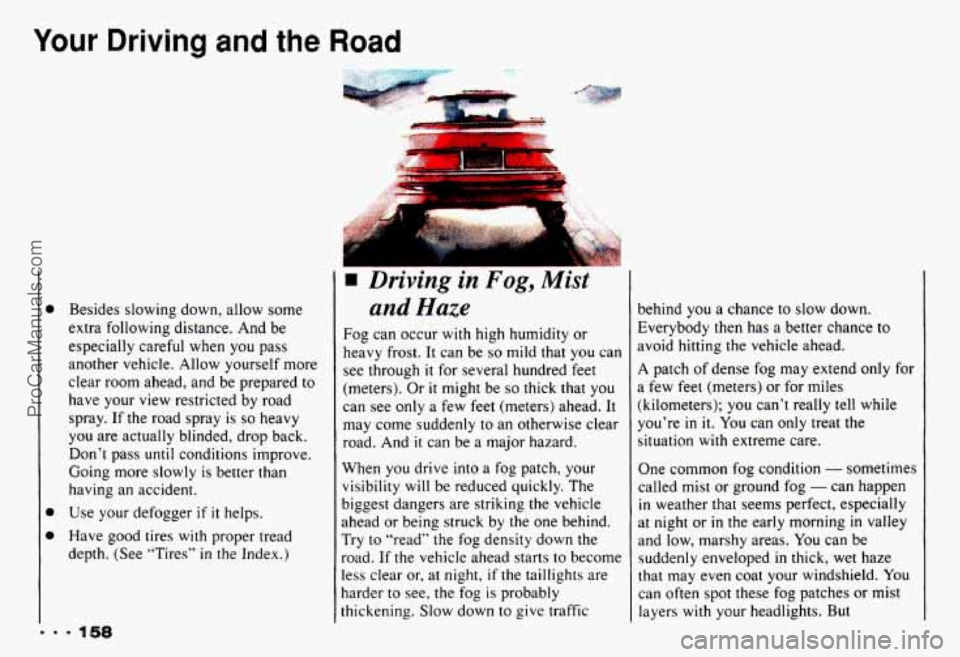
Driving in Fog, Mist
and Haze
Fog can occur with high humidity or
heavy frost. It can be
so mild that you can
see through
it for several hundred feet
(meters). Or
it might be so thick that you
can see only a few feet (meters) ahead.
It
may come suddenly to an otherwise clear
road.
And it can be a major hazard.
When you drive into
a fog patch, your
visibility will be reduced quickly. The
biggest dangers are striking the vehicle
ahead or being struck
by the one behind.
Try to “read” the fog density down the
road. If the vehicle ahead starts to become
less clear or, at night,
if the taillights are
harder to see, the fog is probably
thickening. Slow down to give traffic behind you
a chance to slow down.
Everybody then has a better chance
to
avoid hitting the vehicle ahead.
A patch of dense fog may extend only for
a few feet (meters) or for miles
(kilometers);
you can’t really tell while
you’re
in it. You can only treat the
situation with extreme care.
One common fog condition
- sometimes
called mist or ground fog
- can happen
in weather that seems perfect, especially
at
night or in the early morning in valley
and low, marshy areas.
You can be
suddenly enveloped
in thick, wet haze
that may even coat your windshield. You
can often spot these fog patches or mist
layers
with your headlights. But
.. 158
ProCarManuals.com
Page 163 of 358
sometimes they can be waiting for you as
you come over a hill or dip into a shallow
valley. Start your windshield wipers and
washer, to help clear accumulated road
dirt. Slow down carefully.
Tips on Driving in Fog
If you get caught in fog, turn your
headlights on low beam, even
in daytime.
You’ll see
- and be seen - better. Use
your fog lights
if your vehicle has them.
Don’t use your high beams. The light will
bounce off the water droplets that make
up fog and reflect back at you. Use
your defogger. In high humidity, even
a light buildup of moisture on the inside
of the glass will cut down on your already
limited visibility. Run your windshield
wipers and washer occasionally. Moisture
can build up on the outside glass, and
what seems to be fog may actually be
moisture on the outside of your
windshield.
Treat dense fog as an emergency. Try to
find a place to pull off the road. Of course
you want to respect another’s property,
but you might need to put something
between you and moving vehicles
-
space, trees, telephone poles, a private
driveway, anything that removes you
from other traffic.
[f visibility is near zero and you must stop
but are unsure whether you are away from
the road,
turn your lights on, start your
hazard warning flashers, and sound your
horn at intervals or when you hear
approaching traffic.
Pass other vehicles in fog only if you can
see far enough ahead to pass safely. Even
then, be prepared to delay your pass if
you suspect the fog is worse up ahead. If
other vehicles try to pass you, make
it
easy for them.
ProCarManuals.com
Page 177 of 358
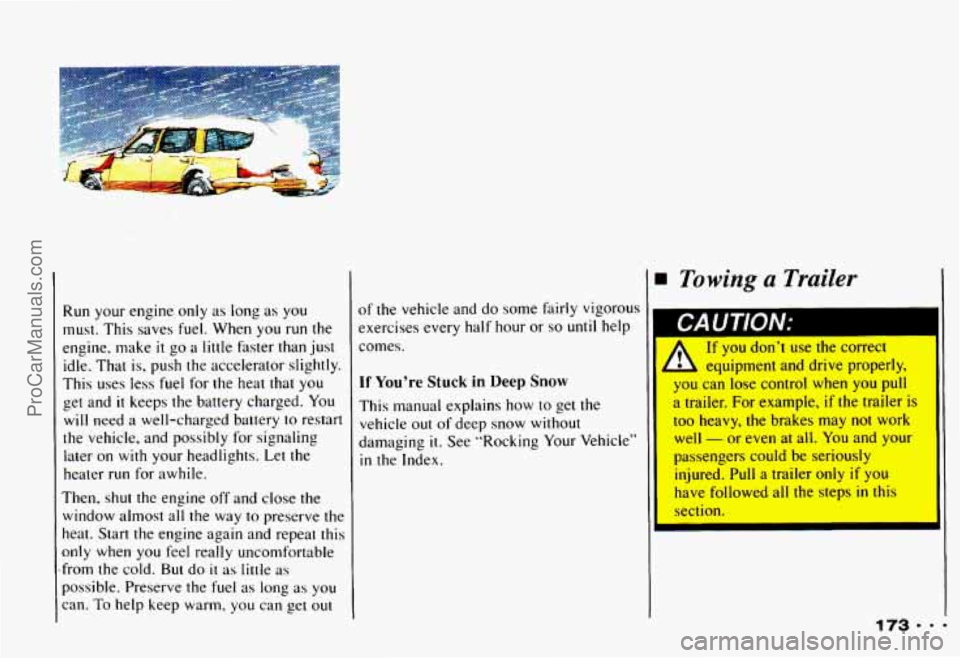
Run your engine only as long as you
must. This saves fuel. When you
run the
engine, make
it go a little faster than just
idle. That is, push the accelerator slightly.
This uses less fuel for the heat that you
get and
it keeps the battery charged. You
will need a well-charged battery to restart
the vehicle, and possibly for signaling
later on
with your headlights. Let the
heater
run for awhile.
Then. shut the engine off and close the
window almost all the way to preserve the
heat. Start the engine again and repeat this
only when you feel really uncomfortable
from the cold.
But do it as little as
possible. Preserve the fuel as long as you
can.
To help keep warm. you can get out
3f the vehicle and do some fairly vigorous
zxercises every half hour or
so until help
Zomes.
If You're Stuck in Deep Snow
This manual explains how to get the
vehicle
out of deep snow without
damaging it. See "Rocking Your Vehicle"
in the Index.
Towing a Trailer
you can lose control when you pull
a trailer. For example, if the trailer is
too heavy, the brakes may not work
well - or even at all. You and your
passengers could be seriously
injured. Pull a trailer only if you
have followed all the steps in this
section.
ProCarManuals.com
Page 252 of 358

Service & Appearance Care
Headlights
Headlight Aiming
Your vehicle has a mini-quad headlight
system. These headlights have vertical
and horizontal indicators. When the
headlights are properly installed and
adjusted, and the vehicle is on level
ground, both indicators will read in the
center of the gage. If they do not, you can
adjust the aim.
A
To adjust the aim of your headlights:
1. Move your vehicle to a level surface.
Use a spirit level to be sure. Be sure
to remove any items that are not part
of your original equipment from the
trunk and passenger areas.
No one
should be seated in the vehicle and
your fuel tank should be about half
full. Check to be sure your tires are
at the correct pressure. There
are four headlights. Each one
has its own vertical and horizontal
aim position indicator. Each indicator
has its own aiming screw.
A. Vertical Indicator
B. Horizontal Indicator
C. Vertical Aiming Screw
D. Horizontal Aiming Screw
ProCarManuals.com
Page 255 of 358
I
r 1
3.
4.
5.
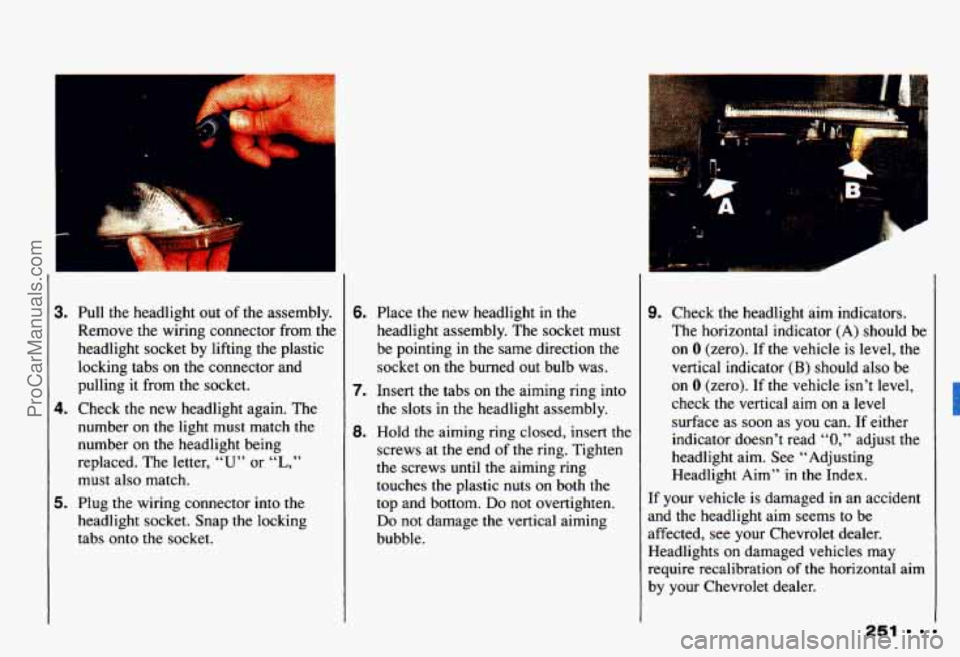
Pull the headlight out of the assembly.
Remove
the wiring connector from the
headlight socket by lifting the plastic
locking tabs on the connector and
pulling it from the socket.
Check
the new headlight again. The
number on
the light must match the
number on
the headlight being
replaced. The letter,
“U” or “L,”
must also match.
Plug the wiring connector into the
headlight socket. Snap the locking
tabs onto the socket.
6.
7.
8.
Place the new headlight in the
headlight assembly. The socket must
be pointing
in the same direction the
socket on the burned out bulb was.
Insert the tabs on the aiming ring into
the slots in the headlight assembly.
Hold the aiming ring closed, insert the
screws at the end of the ring. Tighten
the screws
until the aiming ring
touches the plastic nuts on both the
top and bottom.
Do not overtighten.
Do not damage the vertical aiming
bubble.
. ..
9. Check the headlight aim indicators.
The horizontal indicator (A) should be
on
0 (zero). If the vehicle is level, the
vertical indicator
(B) should also be
on 0 (zero). If the vehicle isn’t level,
check the vertical aim on a level
surface as soon as you can. If either
indicator doesn’t read
“0,” adjust the
headlight aim. See “Adjusting
Headlight Aim”
in the Index.
If your vehicle
is damaged in an accident
and the headlight aim seems to be
affected, see your Chevrolet dealer.
Headlights on damaged vehicles may
require recalibration
of the horizontal aim
by your Chevrolet dealer.
251
ProCarManuals.com
Page 280 of 358
Service & Appearance Care
9 276
Fuses and Circuit
Breakers
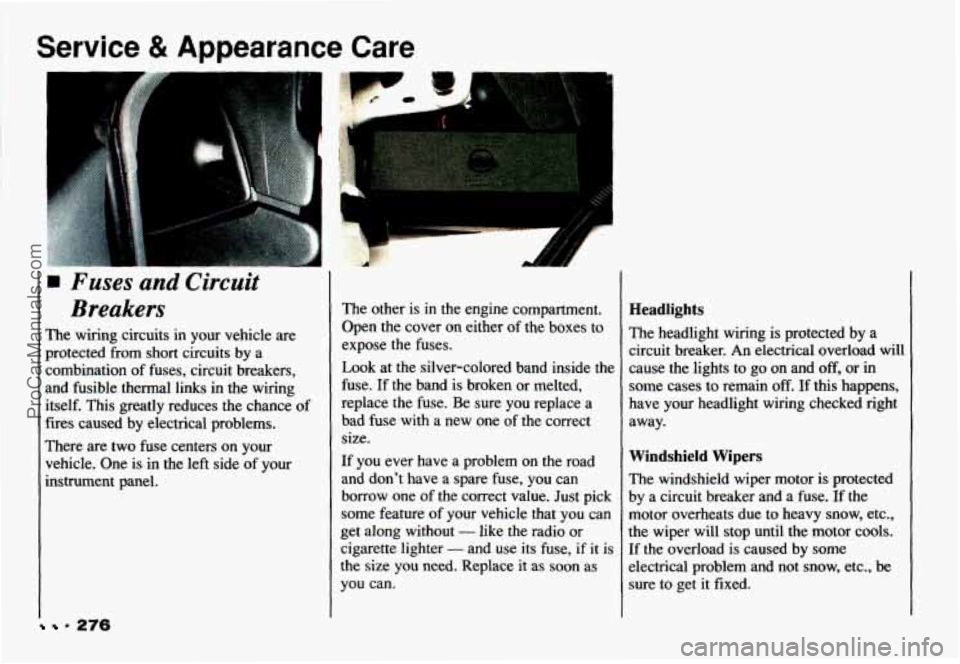
The wiring circuits in your vehicle are
protected from short circuits by a
combination of fuses, circuit breakers,
and fusible thermal links in the wiring itself. This greatly reduces the chance of
fires caused by electrical problems.
There are
two fuse centers on your
vehicle. One is
in the left side of your
instrument panel.
The other is in the engine compartment.
Open the cover on either of the boxes to
expose the fuses.
Look at the silver-colored band inside the
fuse. If the band
is broken or melted,
replace the fuse. Be sure you replace a
bad fuse with a new one
of the correct
size.
If you ever have a problem on the road
and don’t have a spare fuse, you can
borrow one
of the correct value. Just pick
some feature of your vehicle that you can
get along without
- like the radio or
cigarette lighter
- and use its fuse, if it is
the size you need. Replace
it as soon as
you can.
Headlights
The headlight wiring is protected by a
circuit breaker.
An electrical overload will
cause the lights to go on and off, or in
some cases to remain
off. If this happens,
have your headlight wiring checked right
away.
Windshield Wipers
The windshield wiper motor is protected
by a circuit breaker and a fuse.
If the
motor overheats due to heavy snow, etc.,
the wiper will stop until the motor cools.
If the overload is caused by some
electrical problem and not snow, etc., be
sure to get it fixed.
ProCarManuals.com
Page 334 of 358

9 330
Brakes Adjustment
................. 146
Anti-lock (ABS)
............. 143
Fluid
...................... 245
Master Cylinder
............. 244
Parking
..................... 70
Pedal Travel
................ 146
Rear Drum
................. 145
System Parts. Replacing
....... 246
System Warning Light
........ 100
Trailer
..................... 177
Wear Indicators. Disc
......... 145
Braking (Control
of a Vehicle) .... 141
Braking
in Emergencies ......... 146
“Break.1n.
.. New Vehicle ........ 55
Brightness Control .............. 85
Bulb Replacement ............. 247
Headlight Aiming
............ 248
Headlights
................. 248
Center High-Mounted
Stoplight
................. 252
Front Turn Signal
............ 252
Rear Lights
................. 253
Rear Sidemarker
............. 254
Bulbs. Replacement
............ 279
Bulbs. Halogen
................ 247
Capacities and Specifications
... 280
Carbon Monoxide
.............. 75
Care of Safety Belts
............ 269
Cassette and Compact Disc
Storage
..................... 93
Cassette Tape Player.
AM/FM Stereo with ........... 11 7 Cassette Tape Player. Care
Cassette Tape.
To Play a
of Your .................... 128
AM/FM Stereo with Cassette
Tape Player
................ 119
Chains. Safety
................ 177
Chains. Tire
.................. 264
Changing
a Flat Tire ............ 205
Check Gages Light
............. 105
Checking Things under the
Hood ...................... 223
Checking Your Restraint System
... 45
Chemical Paint Spotting
......... 273
Chevrolet Roadside Assistance
... 319
Chevrolet Service Publications (Ordering Information)
....... 323
ProCarManuals.com