1993 CHEVROLET CAMARO engine
[x] Cancel search: enginePage 117 of 358
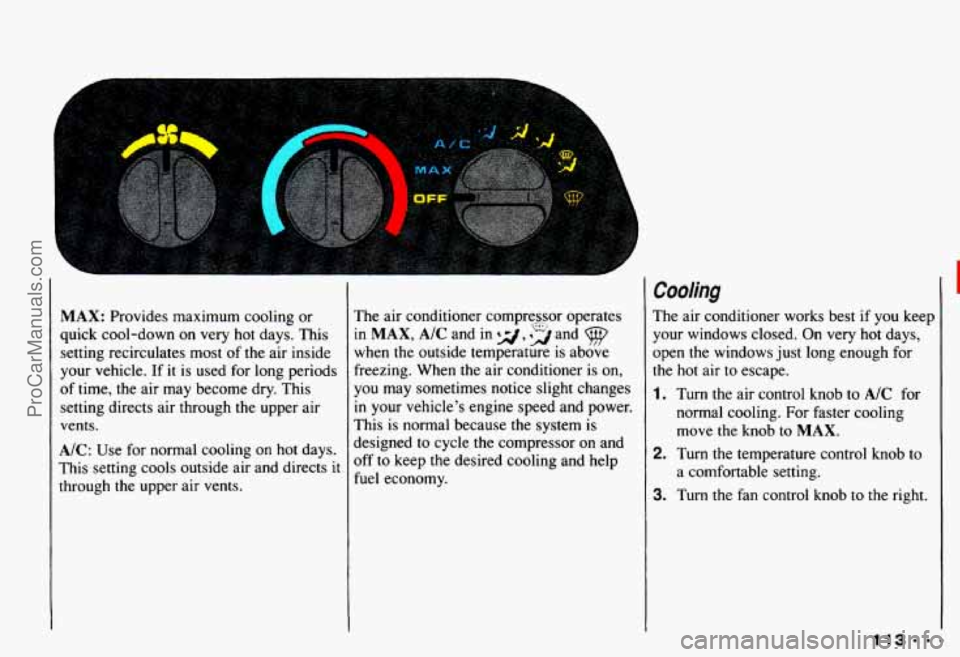
MAX: Provides maximum cooling or
quick cool-down
on very hot days. This
setting recirculates most of
the air inside
your vehicle. If it is used for long periods
of time, the air may become dry. This
setting directs air through the upper air
vents.
A/C: Use for normal cooling on hot days.
This setting cools outside air and directs
it
through the upper air vents.
The air conditioner compressor operates
in MAX, A/C and in 9, t2 and 9
when the outside temperature is above
freezing. When the air conditioner is on,
you may sometimes notice slight changes
in your vehicle’s engine speed and power.
rhis is normal because the system is
designed to cycle the compressor on and
Dff to keep the desired cooling and help
fuel economy.
Cooling
The air conditioner works best if you keep
your windows closed. On very hot days,
open
the windows just long enough for
the hot air to escape.
1. Turn the air control knob to A/C for
normal cooling. For faster cooling
move
the knob to MAX.
2. Turn the temperature control knob to
3. Turn the fan control knob to the right.
a comfortable setting.
ProCarManuals.com
Page 119 of 358
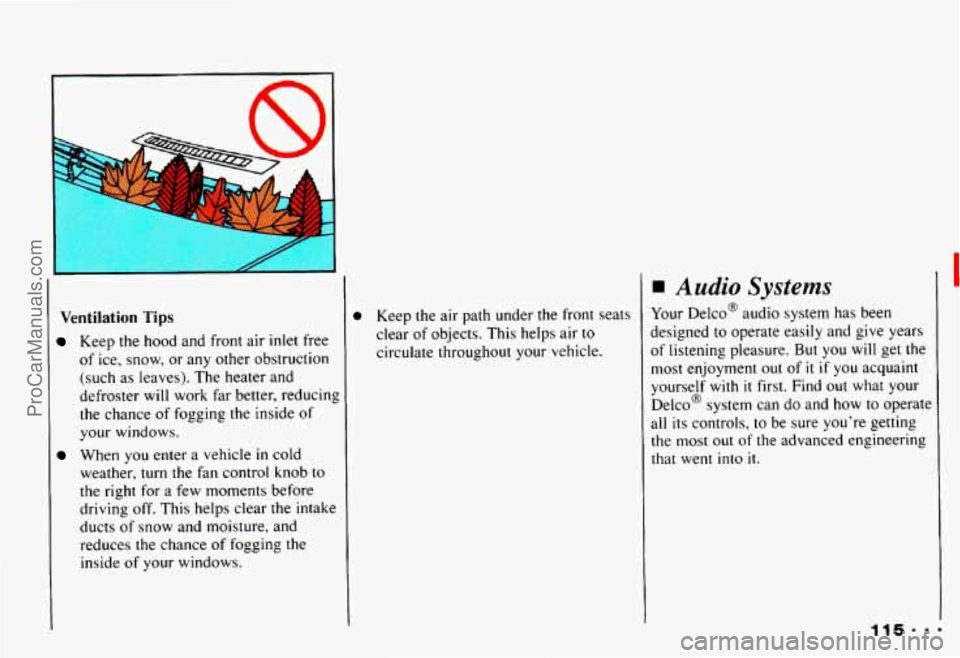
Ventilation Tips
Keep the hood and front air inlet free
of ice, snow, or any other obstruction
(such as leaves). The heater and
defroster will work far better, reducing
the chance of fogging the inside of
your windows.
When you enter a vehicle
in cold
weather, turn the fan control knob to
the right for
a few moments before
driving off. This helps clear the intake
ducts of snow and moisture, and
reduces the chance of fogging the
inside
of your windows.
D Keep the air path under the front seats
clear of objects. This helps air to
circulate throughout your vehicle.
Audio Systems
Your Delco@ audio system has been
designed to operate easily and give years
of listening pleasure. But you will get the
most enjoyment out of
it if you acquaint
yourself
with it first. Find out what your
Delco@ system can do and how to operate
all its controls, to be sure you’re getting
the most out of the advanced engineering
that went into
it.
ProCarManuals.com
Page 120 of 358
Comfort Controls & Audio Systems
I Setting the Clock noise is almost undetectable AM/FM Stereo with Cassette Tape
until it is too late. Your hearing can
adapt
to higher volumes of sound. sure you can add what you want. If
Player
you can, it’s very important to do it 1. Press SET. Sound that Seems normal can be
Ioud and harmful to your hearing.
Take precautions by adjusting the
volume
control on your radio to a
safe sound level before your hearing
adapts
to it.
To help avoid hearing loss or 31
damage:
a Adjust the volume control to
the lowest setting. properly.
Added
sound equipment
may interfere
with the operation of
your vehicle’s engine, Delco@ radio
or other systems, and even damage
them. And, your vehicle’s systems may interfere
with the operation of
sound equipment that has been
added improperly.
So, before adding sound
equipment, check with your d er
2. Within five
seconds, press and hold
SEEK until the correct hour
appears.
correct minute appears.
3. Press and hold SEEK A until the
Delco/Bose AM/FM Stereo with
Compact Disc Player
1. Press SET.
2. Within five seconds, press and hold
SEEK 4 until the correct hour I, Increase volume slowly until
you
hear comfortably and appears.
clearly. 3. Press and hold SEEK until the
1116 correct minute appears.
ProCarManuals.com
Page 146 of 358
Your Driving and the Road
I
CAUTION: - A 66. nlulllg YVUl UlaKGS Cdn Cause
them to overheat to the point
that they won’t work well. You
might
not be able to stop your
vehicle
in time to avoid an accident.
If you “ride” your brakes, they
will
get so hot they will require a lot of
pedal force to slow you down.
Avoid “riding” the brakes. Klamg-.
me DraaKes wears
tnern 01
lnuch faster. You would need costly
brake replacement much sooner
than normal, and
it also reduces fuel
economy.
If you keep pace
with the traffic and
allow realistic following distances, you
will eliminate a lot of unnecessary
braking. That means better braking and
longer brake life.
I
If your engine ever stops while you’re
driving, brake normally
but don’t
pump your brakes. If you do,
the
pedal may get harder to push down. If
your engine stops, you
will still have
some power brake assist.
But you will
use it when you brake. Once the
power assist is used up, it may take
longer to stop and the brake pedal
will
be harder to push.
ProCarManuals.com
Page 150 of 358
Your Driving and the Road
Brake Pedal Travel
See your dealer if the brake pedal does
not return to normal height, or if there is a
rapid increase
in pedal travel. This could
be a sign of brake trouble.
Brake Adjustment
Every time you make a moderate brake
stop, your disc brakes adjust for wear. If
you rarely make a moderate or heavier
stop, then your brakes might not adjust
correctly. If you drive in that way, then
-
very carefully - make a few moderate
brake stops about every
1000 miles
(1 600 km), so your brakes will adjust
properly. If
your brake pedal goes down farther
than normal, your rear drum brakes may
need adjustment. Adjust them by backing up and firmly applying the brakes a few
times.
Braking in Emergencies
Use your anti-lock braking system when
you need to. With anti-lock, you can steer
and brake at the same time. In many emergencies, steering can help you more
than even the very best braking.
Steering
Power Steering
If you lose power steering assist because
the engine stops or the system fails to
function, you can steer but
it will take
much more effort.
Steering Tips
Driving on Curves
It’s important to take curves at a
reasonable speed.
A lot of the “driver lost control” accidents
mentioned on the news happen on curves.
Here’s why:
Experienced driver or beginner, each of
us is subject to the same laws of physics
when driving on curves. The traction of
ProCarManuals.com
Page 156 of 358

Your Driving and the Road
The three types of skids correspond to
your Chevrolet’s three control systems. In
the braking skid your wheels aren’t
rolling. In the steering or cornering skid,
too much speed or steering in a curve
causes tires to slip and lose cornering
force. And
in the acceleration skid too
much throttle causes the driving wheels to
spin.
A cornering skid and an acceleration skid
are best handled by easing your foot off
the accelerator pedal. If your vehicle
starts to slide (as when you turn a corner
on a wet, snow- or ice-covered road),
ease your
foot off the accelerator pedal as
soon as you feel the vehicle start to slide.
Quickly steer the way
you want the vehicle to
go. If you
start steering quickly
enough, your vehicle will straighten out.
As it does, straighten the front wheels.
Of course, traction
is reduced when water,
snow, ice, gravel, or other material is on
the road. For safety, you’ll want to
slow
down and adjust your driving to these
conditions. It is important to slow down
on slippery surfaces because stopping
distance will be longer and vehicle control more limited. While
driving on a surface
with reduced
traction,
try your best to avoid sudden
steering, acceleration, or braking
(including engine braking by shifting to a
lower gear). Any sudden changes could
cause the tires to slide.
You may not
realize the surface is slippery until your
vehicle is skidding. Learn to recognize
warning clues
- such as enough
water, ice or packed snow on the road to
make
a “mirrored surface” - and slow
down when you have any doubt.
Remember:
Any anti-lock braking system
(ABS) helps avoid only the braking skid.
Steer the way you want to go.
ProCarManuals.com
Page 167 of 358

Driving a Long
Distance
Although most long trips today are made
on freeways, there are
still many made on
regular highways.
Long-distance driving on freeways and
regular highways
is the same in some
ways. The
trip has to be planned and the
vehicle prepared, you drive at
higher-than-city speeds, and there are
longer turns behind the wheel. You’ll
enjoy your trip more
if you and your
vehicle are
in good shape. Here are some
:ips for a successful long trip.
Before Leaving on a Long Trip
Make sure you’re ready. Try to be well
rested. If you must start when you’re not
fresh
- such as after a day’s work -
don’t plan to make too many miles that
first part of the journey. Wear comfortable
clothing and shoes you can easily drive
in.
Is your vehicle ready for a long trip? If
you keep
it serviced and maintained, it’s
ready to go. If
it needs service, have it
done before starting out. Of course, you’ll
find experienced and able service experts
in Chevrolet dealerships all across North
America. They’ll be ready and willing to
help
if you need it. Here
are some things you can check
before a trip:
0
0
0
0
0
Windshield Washer Fluid: Is the
reservoir
full? Are all windows clean
inside and outside?
Wiper Blades: Are they in good
shape?
Fuel, Engine Oil, Other Fluids:
Have you checked all levels?
Lights: Are they all working? Are the
lenses clean?
Tires: They are vitally important to a
safe, trouble-free trip.
Is the tread
good enough for long-distance
driving? Are the tires all inflated to
the recommended pressure?
163 -
ProCarManuals.com
Page 168 of 358
Your Driving and the Road
m.. 164
0 Weather Forecasts: What’s the
weather outlook along
your route?
Should you delay your trip a short
time to avoid a major storm system?
0 Maps: Do you have up-to-date
maps?
On the Road
Unless you are the only driver, it is good
to share the driving task
with others.
Limit turns behind the wheel to about
100 miles (160 km) or two hours at a
sitting. Then, either change drivers or stop
for some refreshment like coffee, tea or
soft drinks and some limbering up.
But do
stop and move around. Eat lightly along
the way. Heavier meals tend to make
some people sleepy. On two-lane highways
or undivided
multilane highways that do not have
controlled access, you’ll want to watch
for some situations not usually found on
freeways. Examples are: stop signs and
signals, shopping centers
with direct
access to the highway, no passing zones
and school zones, vehicles turning left
and right off the road, pedestrians, cyclists, parked vehicles, and even
animals.
Highway Hypnosis
Is there actually such a condition as
“highway hypnosis”? Or
is it just plain
falling asleep at the wheel? Call
it
highway hypnosis, lack of awareness, or
whatever.
There is something about an easy stretch
of road
with the same scenery, along with
the hum of the tires on the road, the drone
of the engine, and the rush
of the wind
against the vehicle that can make you
sleepy. Don’t let
it happen to you! If it
does, your vehicle can leave the road in
less than a second, and you could crash
and be injured.
ProCarManuals.com