Page 170 of 358
Your Driving and the Road
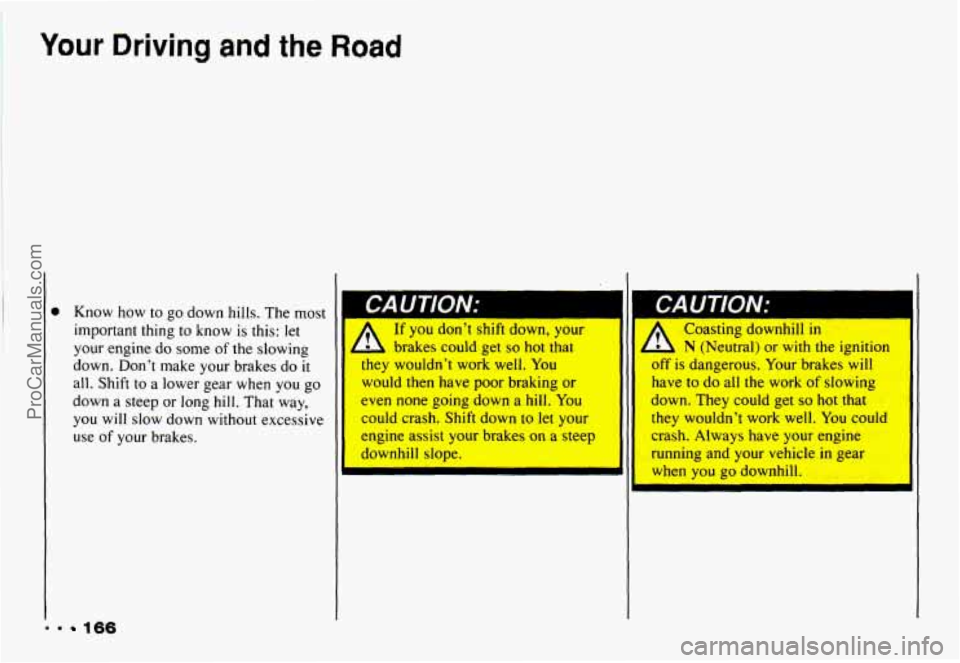
Know how to go down hills. The most
important
thing to know is this: let
your engine
do some of the slowing
down.
Don’t make your brakes do it
all. Shift to a lower gear when you go
down a steep or long hill. That way,
you
will slow down without excessive
use of your brakes.
If you don’t shift down, your
brakes could get
so hot that
they wouldn’t work well. You
would then have poor braking or
even none
going down a hill. You
could crash. Shift down to let your
engine assist your brakes on
a steep
downhill slope.
2 Coasting downhill in
, N (Neutral) or with the ignition
off is dangerous, Your brakes will
have to do all the work of slowing
down, They could get so hot that
they wouldn’t work weiL You could
crash. Always have your engine
running and your vehicle in gear
when you go downhill.
.. 166
ProCarManuals.com
Page 171 of 358
Know how to go uphill. You may
want
to shift down to a lower gear.
The lower gears help cool your engine
and transmission, and
you can climb
the
hill better.
Stay
in your own lane when driving
on two-lane roads in hills or
mountains. Don’t swing wide or cut
across the center of the road. Drive at
speeds that let you stay
in your own
lane. That way, you won’t be surprised
by a vehicle coming toward you
in the
same lane.
It takes longer to pass another vehicle
when you’re going uphill. You’ll want
to leave extra room to pass. If a
vehicle is passing you and doesn’t
have enough room, slow down
to
make it easier for the other vehicle to
get
by.
As you go over the top of a hill, be
alert. There could be something
in
your lane, like a stalled car or an
accident.
0
You may see highway signs on
mountains that warn
of special
problems. Examples are long grades,
passing or no-passing
zones, a falling
rocks area, or winding roads. Be alert
to these and take appropriate action.
Winter driving can present special problems. See
“Winter Driving” in the
Index.
ProCarManuals.com
Page 174 of 358
Your Driving and the Road
Winter Driving
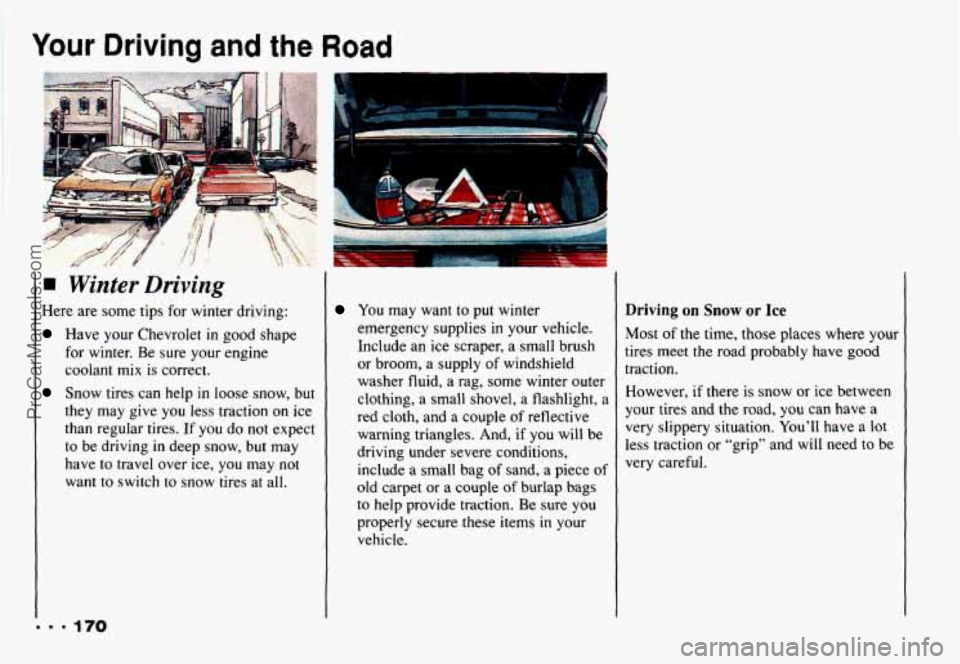
Here are some tips for winter driving:
Have your Chevrolet in good shape
for winter. Be sure your engine
coolant mix is correct.
Snow tires can help in loose snow, but
they may give
you less traction on ice
than regular tires.
If you do not expect
to be driving in deep snow, but may
have to travel over ice, you may not
want to switch
to snow tires at all.
You may want to put winter
emergency supplies in your vehicle.
Include an ice scraper, a small brush
or broom, a supply
of windshield
washer fluid, a rag, some winter outer
clothing, a small shovel, a flashlight, a
red cloth, and a couple
of reflective
warning triangles. And, if you will be
driving under severe conditions,
include a small bag of sand, a piece of
old carpet or
a couple of burlap bags
to help provide traction. Be sure you
properly secure these items in your
vehicle.
Driving on Snow or Ice
Most of the time, those places where your
tires meet
the road probably have good
traction.
However, if
there is snow or ice between
your tires and the road, you can have a
very slippery situation. You’ll have a lot
less traction or “grip” and will need to
be
very careful.
ProCarManuals.com
Page 176 of 358
Your Driving and the Road
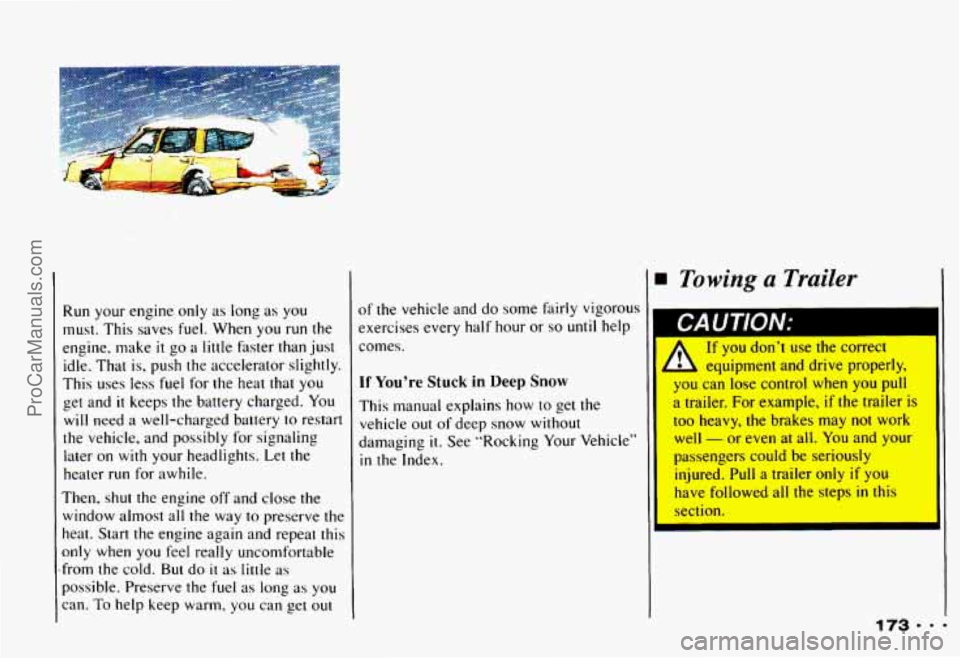
If You’re Caught in a Blizzard
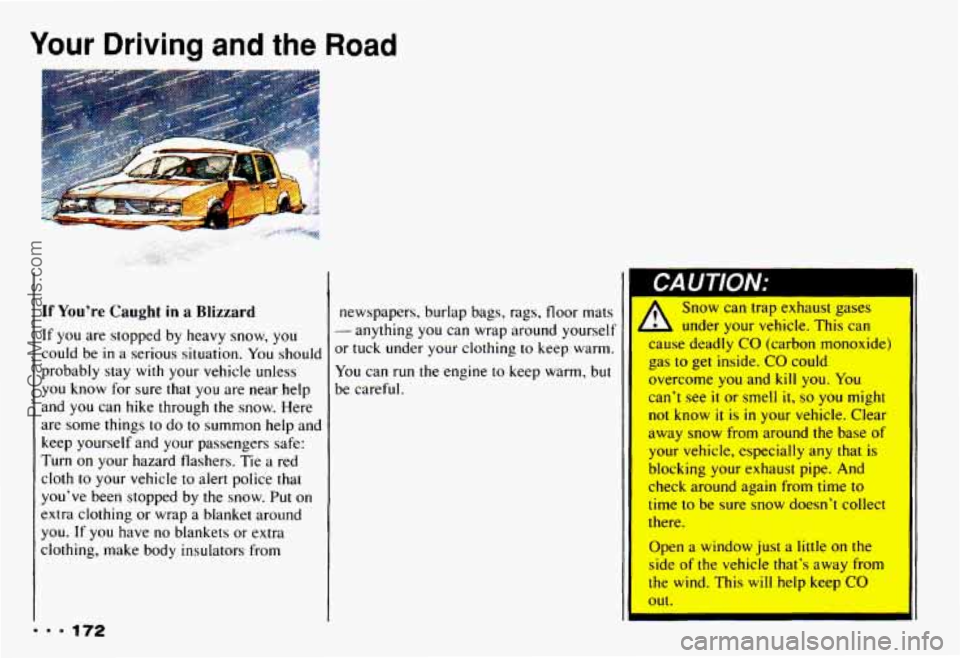
If you are stopped by heavy snow, you
could be
in a serious situation. You should
probably stay
with your vehicle unless
you know for sure that you are near
help
and you can hike through the snow. Here
are some things to
do to summon help and
keep yourself and your passengers safe:
Turn on your hazard flashers. Tie a red
cloth to your vehicle
to alert police that
you’ve been stopped
by the snow. Put on
extra clothing or wrap a blanket around
you.
If you have no blankets or extra
clothing, make body insulators from newspapers, burlap bags, rags, floor mats
- anything
you can wrap around yourself
or tuck under your clothing to keep warm.
You can run the engine to keep warm, but
be careful. Snow can trap exhaust gases
L under your vehicle.
This can
cause deadly
CO (carbon monoxide)
gas to get inside. CO could
overcome you and
kill you. You
can’t see it or smell it, so you might
not know
it is in your vehicle. Clear
away snow from around the base of
your vehicle, especially any that is
blocking your exhaust pipe.
And
check around again from time to
time
to be sure snow doesn’t collect
there.
Open a window just a little on the
side
of the vehicle that’s away from
the wind. This
will help keep CO
out. I
m.. 172
ProCarManuals.com
Page 177 of 358
Run your engine only as long as you
must. This saves fuel. When you
run the
engine, make
it go a little faster than just
idle. That is, push the accelerator slightly.
This uses less fuel for the heat that you
get and
it keeps the battery charged. You
will need a well-charged battery to restart
the vehicle, and possibly for signaling
later on
with your headlights. Let the
heater
run for awhile.
Then. shut the engine off and close the
window almost all the way to preserve the
heat. Start the engine again and repeat this
only when you feel really uncomfortable
from the cold.
But do it as little as
possible. Preserve the fuel as long as you
can.
To help keep warm. you can get out
3f the vehicle and do some fairly vigorous
zxercises every half hour or
so until help
Zomes.
If You're Stuck in Deep Snow
This manual explains how to get the
vehicle
out of deep snow without
damaging it. See "Rocking Your Vehicle"
in the Index.
Towing a Trailer
you can lose control when you pull
a trailer. For example, if the trailer is
too heavy, the brakes may not work
well - or even at all. You and your
passengers could be seriously
injured. Pull a trailer only if you
have followed all the steps in this
section.
ProCarManuals.com
Page 178 of 358
Your Driving and the Road
I NOTICE:
AAtnage your vehicle and result i~
jtly repairs not covered by you.
warranty.
To pull a trailer correctly,
follow the advice
in this section.
I
Your vehicle can tow a trailer if it is
equipped
with the proper trailer towing
equipment.
To identify what the vehicle
trailering capacity
is for your vehicle, you
should read the information in “Weight
of the Trailer” that appears later
in this
section. But trailering is different than just
driving your vehicle by itself. Trailering
means changes
in handling, durability, and fuel economy.
Successful, safe
trailering takes correct equipment, and
it has to be used properly.
That’s the reason for this section, In it are
many time-tested, important trailering
tips and safety rules. Many of these are
important for your safety and that of your
passengers.
So please read this section
carefully before you pull a trailer.
Load-pulling components such as the
engine, transmission, wheel assemblies,
and tires are forced to work harder against
the drag of the added weight. The engine
is required to operate at relatively higher
speeds and under greater loads, generating extra
heat. What’s more,
the
trailer adds considerably to wind
resistance, increasing the pulling
requirements.
If You Do Decide to Pull a Trailer
If you do, here are some important points.
There are many different laws having
to do
with trailering. Make sure your
rig
will be legal, not only where you
live but also where you’ll be driving.
A good source for this information
can be state or provincial police.
ProCarManuals.com
Page 179 of 358
Consider using a sway control. You
can ask a hitch dealer about sway
controls,
Don’t tow a trailer at all during the
first
500 miles (800 km) your new
vehicle is driven. Your engine, axle or
other parts could
be damaged.
Then, during the first
500 miles (800
km) that you tow a trailer, don’t drive
over
50 mph (80 km/h) and don’t
make starts at full throttle. This helps
your engine and other parts of your
vehicle wear
in at the heavier loads. Three
important considerations have to do
with weight:
Weight of the Trailer
How heavy can a trailer safely be?
It should never weigh more than
1,500 pounds (680 kg) under normal
driving conditions. It should never
weigh more than
1,000 pounds
(450 kg) when driven on long grades
at high ambient temperatures. But
even that can be too heavy.
It depends on how you plan to use
your rig. For example, speed, altitude,
road grades, outside temperature and
how much your vehicle is used to pull a
trailer are all important. And,
it can
also depend on any special equipment
that you have on your vehicle.
You can ask your dealer for our
trailering information or advice, or
you can write
us at:
Chevrolet Motor Division
Customer Assistance Department
P.O. Box 7047
Troy, MI 48007-7047
In Canada, write to:
General Motors
of Canada Limited
Customer Assistance Center
1908 Colonel Sam Drive
Oshawa, Ontario
LlH 8P7
ProCarManuals.com
Page 183 of 358

Turn Signals When Towing a Trailer
When you tow a trailer, your vehicle has to
have a different turn signal flasher and
extra wiring. The green arrows on your
instrument panel will flash whenever you
signal a turn or lane change. Properly
hooked up, the trailer lights will also flash,
telling other drivers you’re about to
turn,
change lanes or stop.
When towing a trailer, the green arrows on
your instrument panel will flash for turns
even if the bulbs on the trailer are burned
out. Thus,
you may think drivers behind
you are seeing your signal when they are
not. It’s important to check occasionally to
be sure the trailer bulbs are still working.
Driving on Grades
Reduce speed and shift to a lower gear
before you start down a long or steep
downgrade. If
you don’t shift down, you
might have to use your brakes
so much
that they would get hot and no longer work well.
On a long uphill grade, shift down and
reduce your speed to around
45 mph
(70 km/h) to reduce the possibility of
engine and transmission overheating. If you
are towing a trailer and you
have an automatic transmission with
Overdrive, you may prefer to drive
in D
instead of Overdrive (or, as you need to,
a lower gear). Or, if you have a manual
transmission
with fifth (or sixth) gear
and you are towing a trailer, it’s better
not to use
fifth (or sixth) gear. Just drive
in fourth gear (fifth gear
if you have
a six-speed manual transmission)
(or, as you need to, a lower gear.
ProCarManuals.com